Author Archives: Shmuel Browns

Unknown's avatar

About Shmuel Browns

I am a tour guide, licensed by the Israel Ministry of Tourism. I do tours throughout Israel, personalized to your interests, time and budget.

Dome of the Chain on Haram el-Sharif

The enigmatic building known as the Dome of the Chain was inaccessible and hidden for eight months by metal sheeting as the Waqf did some renovations on the structure. Just a few weeks ago the building was made accessible once again so I went and took these photographs.

Dome of ChainThe Dome of the Chain is not a mosque or a shrine and is one of the most ancient buildings on the Haram. It was probably built in 691 during the Umayyad period by Abd al-Malik who also built the Dome of the Rock. Some think the structure, because of its position in the precise center of the Haram, existed prior to Islamic rule in Jerusalem and refers back to the days of the Jewish temple or at least to the traditions that surrounded it. There is a tradition that the Dome of the Chain is the site where King David hung a chain that could not be grasped or touched by anyone deceitful, unjust or wicked and where his son King Solomon administered justice.

With the Crusader conquest it became a Christian chapel to St. James, restored as an Islamic prayer house by the Ayyubids and has been renovated by the Mamluks, Ottomans and the Palestinian-based waqf. It seems that the Mamluk sultan Baibars renovated it, refacing the mihrab with marble and reducing the number of outer columns. The ceramic tiles were added in the time of the Ottoman sultan, Suleiman the Magnificent.

Dome of Chain interiorOne of the most unusual things about the structure is that it combines an interior hexagon defined by marble columns with open arches supporting the dome surrounded by an eleven-sided polygon of columns with eleven open arches. Note that each of the column capitals is different. In the southern wall one arch has been closed as a mihrab. It is the third largest building on the Haram after the mosque of al-Aqsa and the Dome of the Rock with a diameter of 14 meters.

Dome interior

Closeup of Hanging lantern

Lantern hanging from the dome of Dome of the Chain
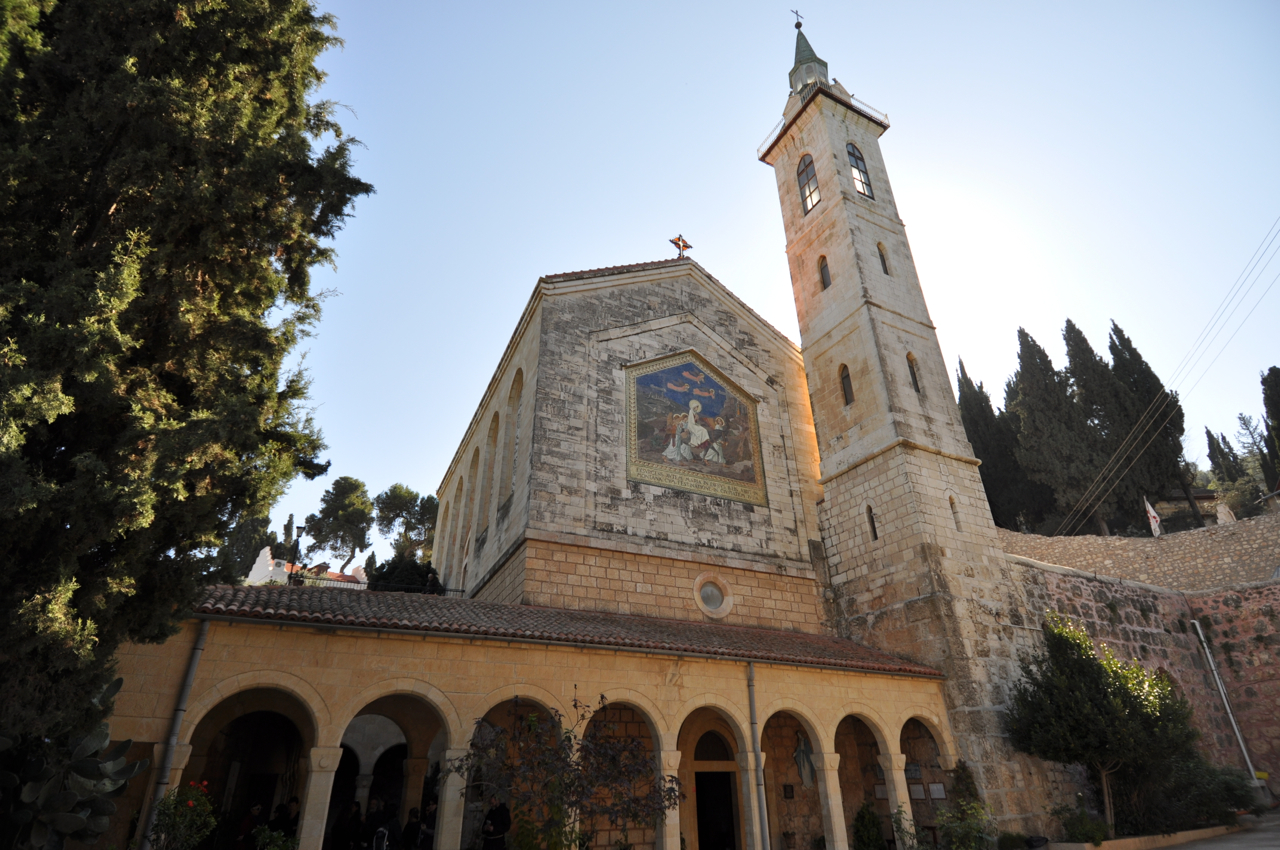
 

Ein Karem and Barluzzi’s Church of the Visitation

When you’re in Jerusalem take some time to enjoy walking around and exploring the village of Ein Karem (Hebrew of Spring of the Vineyard), today a neighborhood of Jerusalem and when you get hungry check out one of the restaurants (see below). The spring made it possible for settlement there dating from the Middle Bronze Age. According to Christian tradition,  Mary, pregnant with Jesus, met Elizabeth, pregnant with John at the spring.

There are two churches named St. John the Baptist, one a Franciscan church built in the second half of the 19th century on the remnants of earlier Byzantine and Crusader churches and an Eastern Orthodox church built in 1894 (restored in 1975), also on the remnants of an ancient church. Inside the Franciscan church are the remains of a Byzantine mosaic floor and a cave where, according to Christian tradition, John the Baptist was born. Below the building a mikve or Jewish ritual bath was found dated to the Second Temple period.

The Franciscan Church of the Visitation is located across the village from St. John. The ancient sanctuary there was built against a rock slope, the site where Zechariah and Elizabeth lived and where Mary visited them. An ancient cistern from which, according to tradition, Zechariah and Elizabeth drank, can also be found in the church; the stone next to it is said to have hidden the two from Herod’s soldiers. Tradition attributes its construction to Helena, Emperor Constantine’s mother.

Barluzzi Church of VisitationOn the wall of the courtyard are ceramic tiles bearing verses from the Magnificat (the Canticle of Mary from Luke 1:46-55) in forty-two different languages. On the church’s façade is a striking mosaic commemorating the Visitation.

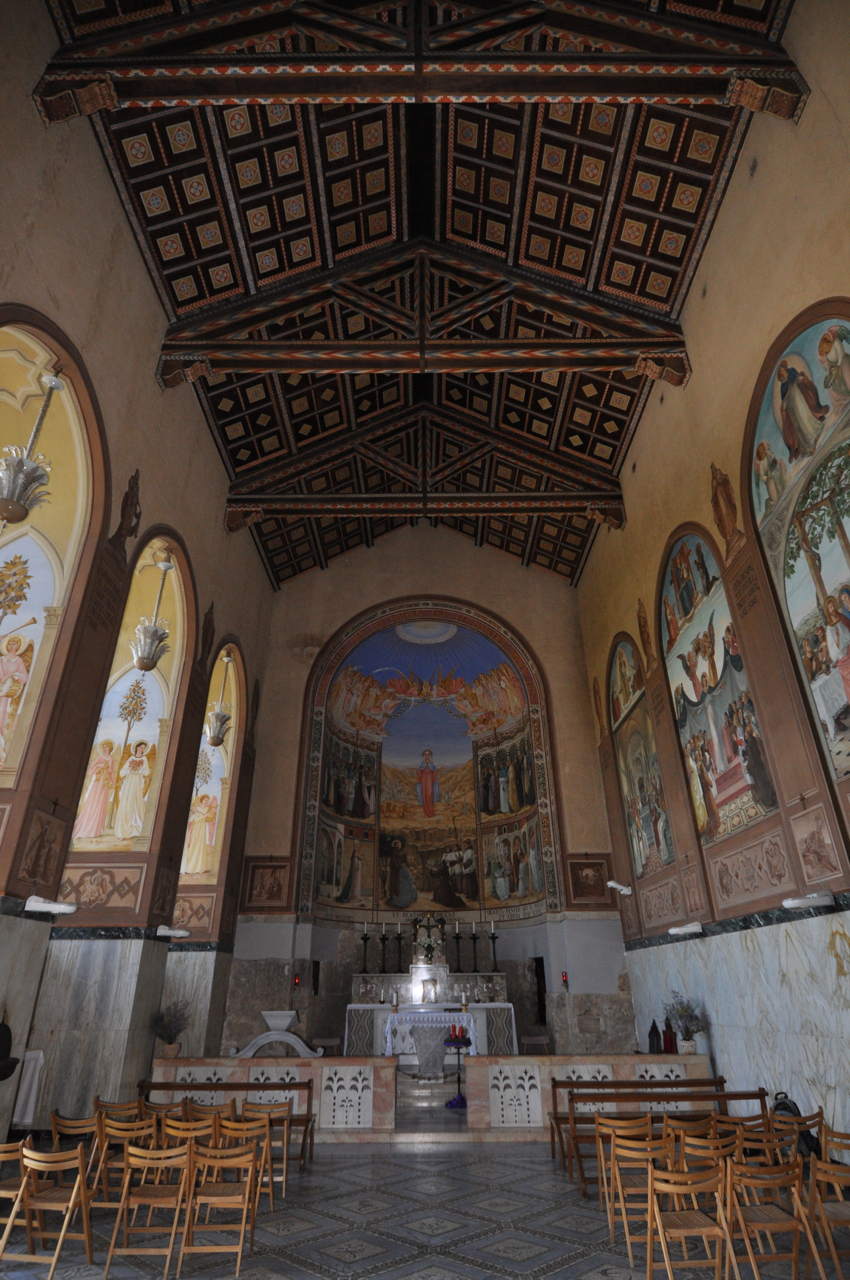
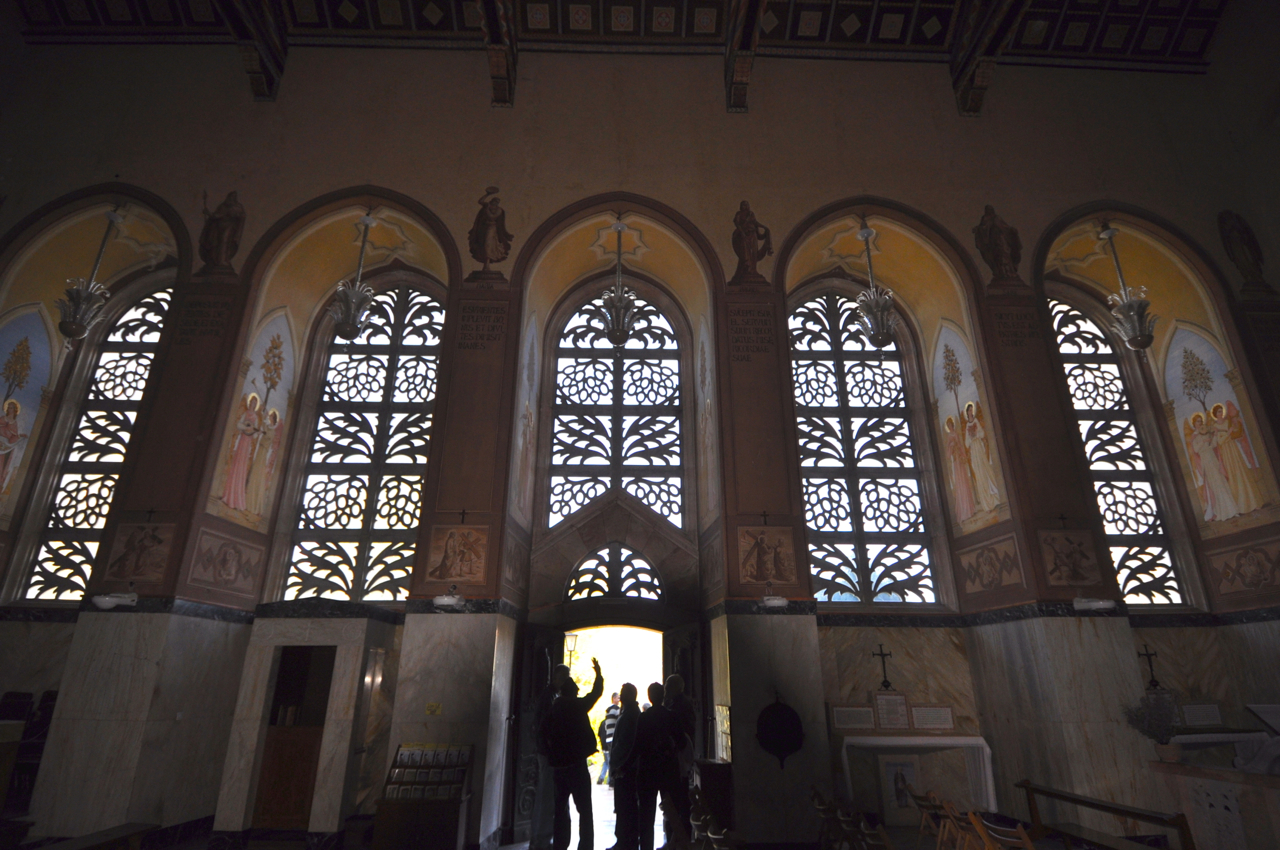
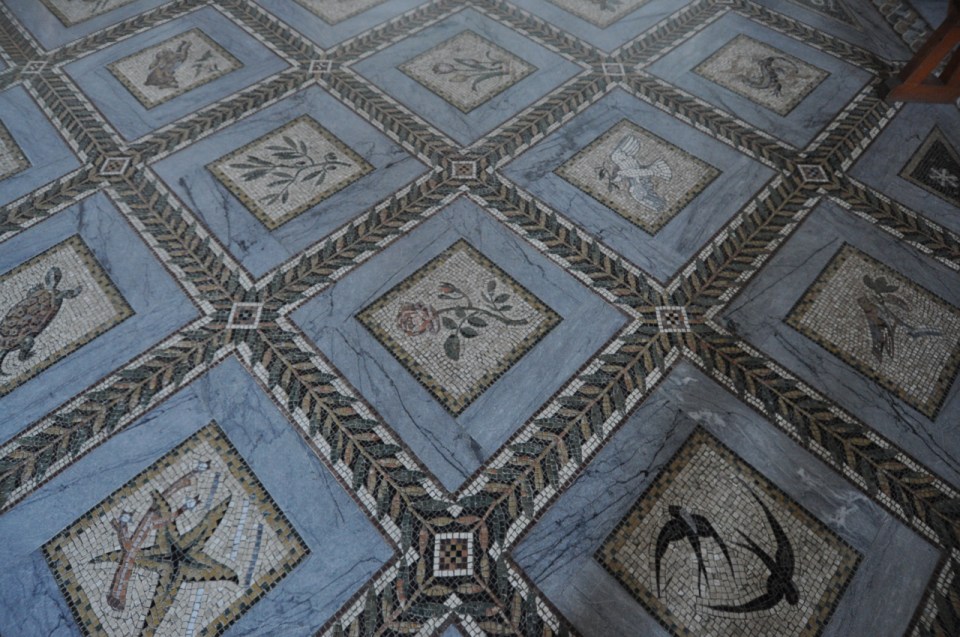
Visitation church InteriorThe lower level of the church was built in 1862, the upper level was begun in 1938 and completed by Italian architect Antonio Barluzzi in 1955. The upper hall is dedicated to Mary, and its walls are decorated with many paintings in her honor. The interior has Italianate frescoes depicting the Visitation, Elizabeth hiding her son John the Baptist, and Zechariah next to the altar in the Temple and beautiful mosaic floors. In one of the frescoes, there is an image of none other than Barluzzi himself.

Interior 2

Visitation church mosaic floor

Located up the hill is the Russian Orthodox Church, part of the Gorny monastery, nicknamed Moscovia by the locals, begun in 1905 and only completed in 2005, with its classic gold onions.

Take the opportunity to walk or meditate in the tranquil garden of Notre Dame De Sion monastery.

Restaurants

Pundak Ein Karem “with a garden blooming in and around its stone courtyard specializes in pan-European fusion cuisine of the decidedly unkosher variety; free WiFi.”

Karma “will have you eating like a Buddhist monk fallen off the wagon, a genre-defying culinary quality, with a traditional Middle Eastern taboon stone oven at its spiritual center.”

Café Inbal “small bake shop has a nice selection of classic light Israeli fare, kosher.”

Charlotte for those with a passion for a variety of grilled meats and delicious side dishes, kosher.

Esti and Perla “run by and in the home of two ladies by the names of Esti and Perla, who have resided in Ein Karem for over 50 years serves high-quality dairy food, specializing in Moroccan fare, kosher.”

Photo of the Week – Meron Synagogue Ruins

According to Shamai, the first century Jewish sage, Rosh Hodesh Shvat (the new month) is the New Year of Trees – of course, we go by Hillel’s opinion that says the 15th of the month. This photo shows the ruins of the 3rd century synagogue on Mount Meron with a tree in the foreground. Both Hillel and Shamai are buried at Meron. I chose this photo as an example of a new photographic exhibit I’m working on that is called “Wild and Sacred Places”. Many ruins and tombs, revered as holy sites, have a large, old tree growing nearby.

Today I received an email from a German expat, Florian Seidel, living in Osaka, Japan who is into “urban exploration”, a term that I heard for the first time. With many abandoned or yet to be developed archaeological sites Israel would be a great place for urbex. For example, the synagogue in Meron was destroyed by the earthquake of 409CE. Coins were found at Meron from the Decapolis city at Sussita/Hippos that was destroyed in the Golan earthquake of 749CE and never rebuilt. Both are haikyo (廃墟 abandoned places) and fascinating to explore.

Meron synagogueYou can click on the image for a larger view (which may take some time to load depending on your Internet connection). Please share this post with your friends by clicking on the icons at the end of this message.

The technical details – the photo was taken with a Nikon D70 digital SLR and 18-70mm lend in September (ISO 200, 31mm, F4 at 1/1600 sec).

Photographs on this website are © Shmuel Browns (unless marked otherwise) – if you are interested in purchasing one of my photos or using one of my photos for your own project please contact me.

Jerusalem the White City

I woke up this morning to Jerusalem covered in a blanket of snow. It’s not that I haven’t seen snow before, I grew up in Ottawa, Canada but it’s still pretty amazing to have snow in Israel. The meteorological service had been promising snow for Jerusalem since Tuesday. We bundled up and walked to the Old City and I shot photos until my camera lens fogged up.

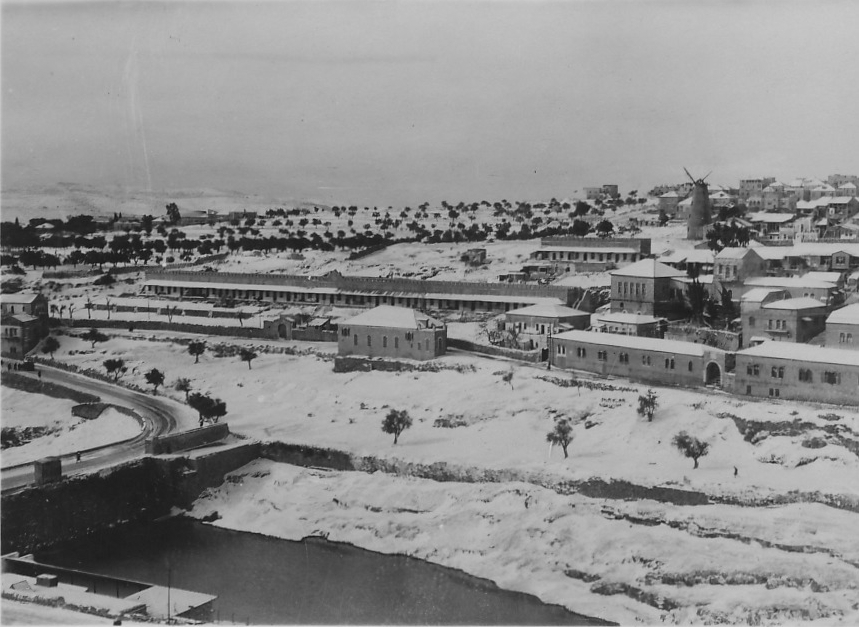
We walked from the German Colony past Cinemateque and Ben Hinnom valley up Mount Zion. I shot a photo of Yemin Moshe from there. While writing this post and organizing the photographs I came across this black and white photo, photographer unknown from 1920. Similar photo, the cypress and pine trees are bigger, Montefiore’s windmill was recently renovated.

Yemin Moshe Yemin Moshe in snow 1920

We walked through the Jewish quarter past the Byzantine Cardo and the Hurva synagogue. It was snowing and I caught the snow falling in the photo. The photo of the Hurva synagogue with minaret and palm tree has quite a painterly feel.

Byzantine cardo in snow

Hurva synagogue w minaret in snow

I had planned to go up onto the Haram el-Sharif but there was no access for non-Muslims and even the rooftop lookout at the Austrain Hospice was closed. There is a place with a good view above the Kotel plaza. This photo was shot with a 11-16mm wide-angle lens, giving quite a panorama.

Overlooking Kotel Plaza in snow

On our way home I got a nice photo of the “Tower of David” at Jaffa gate.

Tower of David

Archaeology in Israel Tour

I’m delighted to announce that Dan McLerran at Popular Archaeology and I are creating a phenomenal tour of archaeological sites in Israel that I will be guiding October 2013.
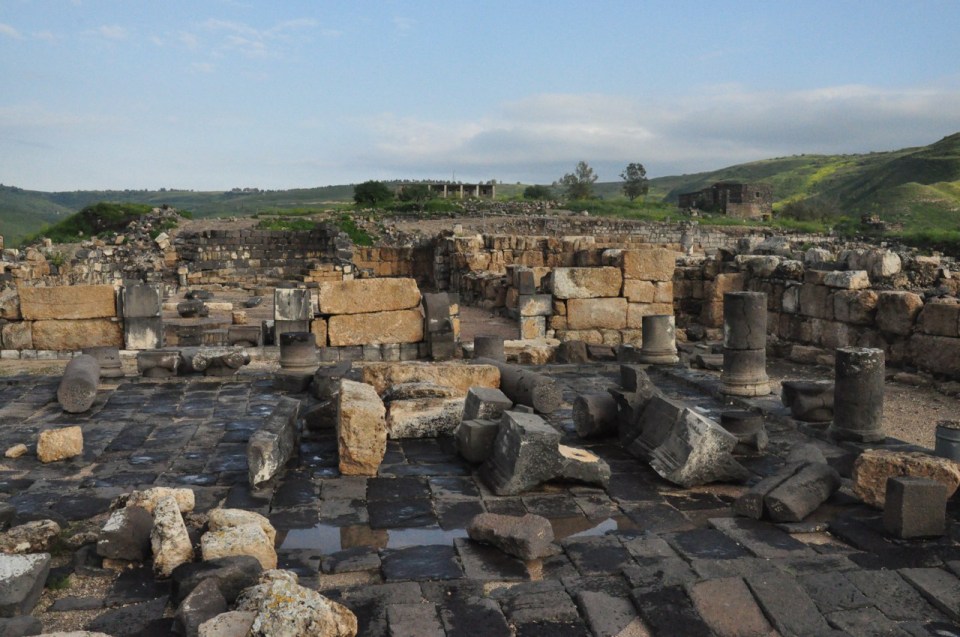
I invite you to join us on this adventure, 12 days of touring in Israel, where we’ll cover the famous sites like Megiddo and Hazor and uncover some of the less well-known gems like Sussita-Hippos, one of the Decapolis cities overlooking the Sea of Galilee that was destroyed in the earthquake of 749CE and never rebuilt.

Sussita excavation

We’ll start by going back 6500 years to the Chalcolithic period and tour up on the Golan Heights to learn about burial at that time. We’ll see dolmens, the megalithic tombs consisting of a flat rock resting on two vertical rocks that mark a grave. We’ll hike to the cultic site of Rujm el Hiri – is it a site that is connected to the calendar or to burial? At Ein Gedi we’ll see the ruins of a Chalcolithic temple. We’ll see artifacts at the Israel museum, examples of clay ossuaries and fine bronze castings of ritual objects.

We’ll follow in the path of the Kings from 1000BCE to 586BCE by traveling from Dan where a piece of a basalt victory stella in Aramaic was found mentioning the kings of Israel and the house of David. We will explore the City of David, the walled Jebusite city on the ridge between the Kidron and Tyropean valleys. We’ll walk through Hezekiah’s tunnel that brought the water of the Gihon spring to the Siloam pool inside the walls. From there we will follow in the steps of pilgrims to the Temple mount. Part of the 650m distance will be in Jerusalem’s drainage channel until we come out right under Robinson’s Arch. We’ll see the Broad wall, the remains of an 8 meter high wall that protected Jerusalem from the north in the time of the Kings.

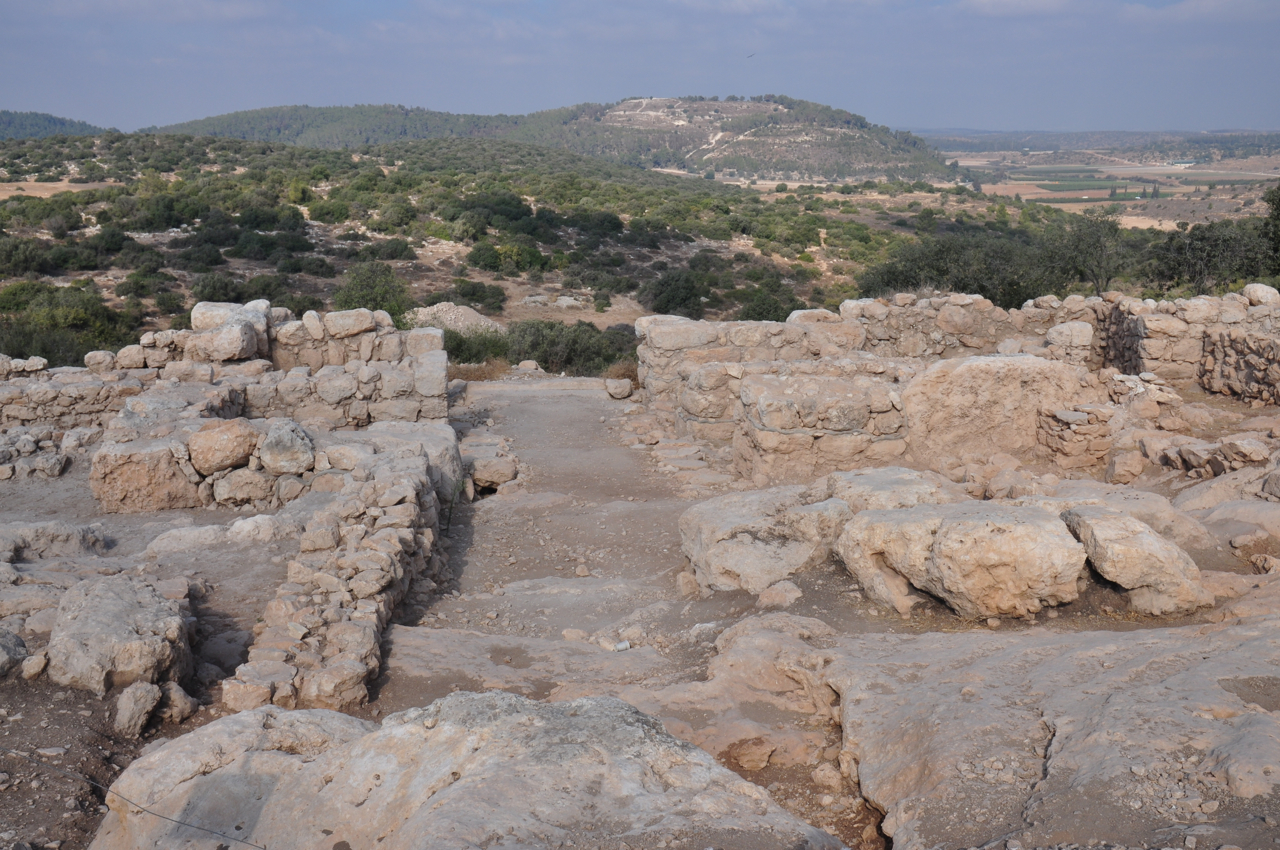
Khirbet Qeiyafa

We’ll explore the walled Judean city of Khirbet Qeiyafa, with two gates and hence identified as Shaarayim, situated on the border of Judea facing the Phillistines.

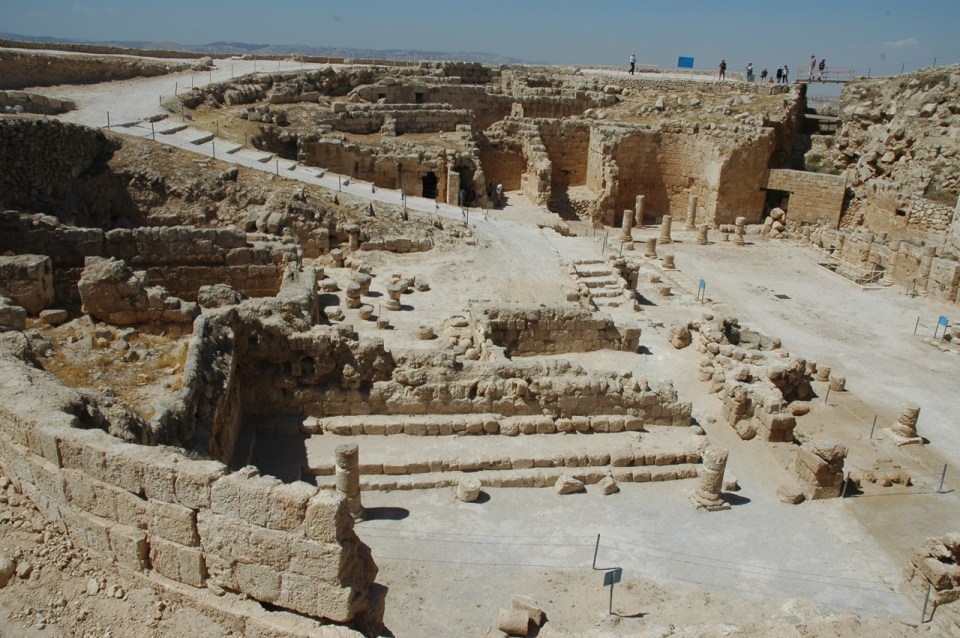
We’ll learn about the Second Temple Period, specifically the time of the Hasmoneans and King Herod who ruled under the auspices of the Romans. We’ll check out Herod’s impressive building projects. At Caesarea, we have the temple to Augustus, the protected harbor, the palace as well as a theater and a hippodrome later used as an amphitheater. At Sebaste there is another temple to Augustus. Josephus writes that Herod built a third temple at Banias. It’s unclear whether the temple was at Banias or nearby, perhaps at Omrit. We’ll visit Herod’s palaces at Masada, the Western palace and the 3 tier hanging palace on the northern end of the site. We’ll explore the palace and administrative complex at Lower Herodium and the palace/fortress on the top of a manmade mountain where the base of a mausoleum was discovered by Prof. Ehud Netzer in 2007.

Herodium Palace:fortress

We’ll visit the newly opened exhibit at the Israel museum Herod the Great: The King’s Final Journey, artifacts from Herodium on display for the first time. We’ll also visit the Second Temple period model that displays Jerusalem at its peak just before its destruction at the hand of the Romans. We’ll visit the Shrine of the Book that houses the Dead Sea scrolls and other artifacts and combine that with the archaeological site of Qumran by the Dead Sea where the scrolls were found.

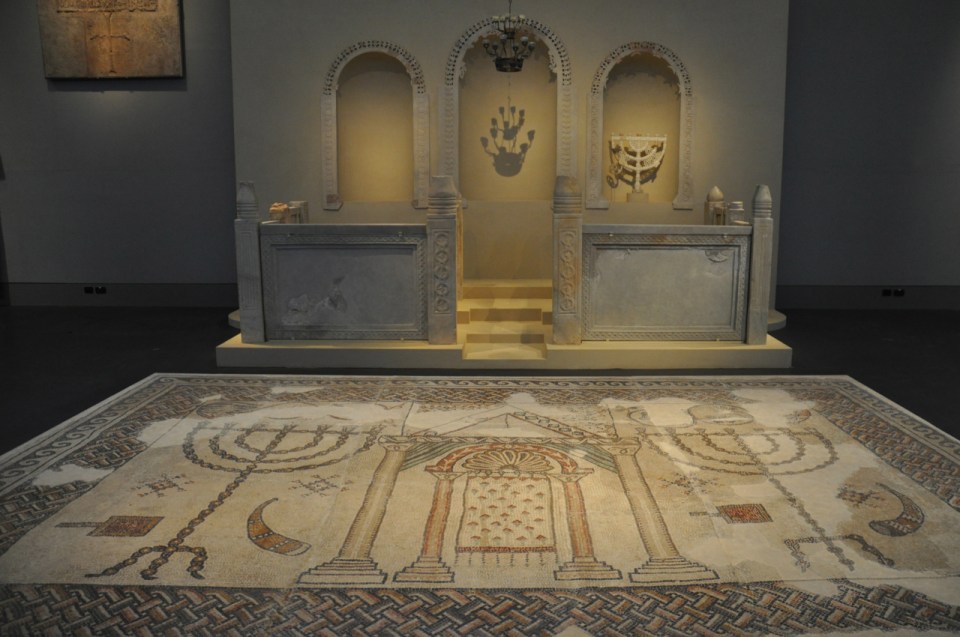
We’ll focus on the architecture of sacred space and check out various churches, in the basilica and martyrium form from the Byzantine period (4th to 7th century) and synagogues from the same period. We’ll see some amazing mosaics by visiting the  museum at the Inn of Good Samaritan, the archaeological sites of Sepphoris/Tzippori, and the synagogue at Beit Alfa. We’ll visit sites off the beaten path like the Kathisma church on the way to Bethlehem and Samaritan site on Mount Gerizim.

Synagogue mosaic floor at Israel Museum

Besides the Western wall, Judaism’s holy site, we will visit the Church of the Holy Sepulcher, the holiest site to Christianity and go up onto the Haram el-Sharif to see the Dome of the Rock and the Al Aqsa mosque, the third holiest site to Islam.

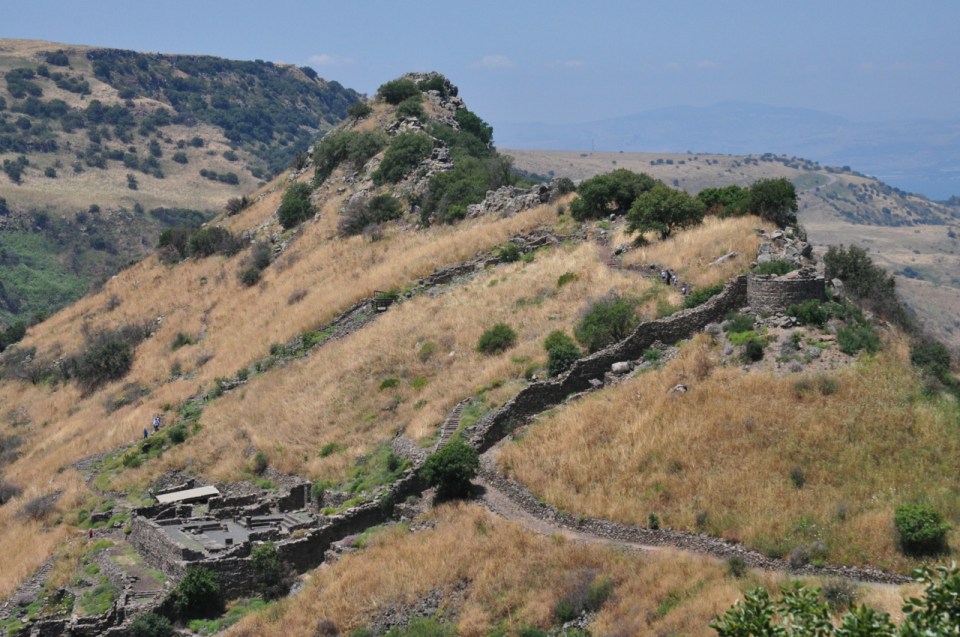
We’ll travel around the Sea of Galilee stopping at sites important to Christianity like Kursi, Capernaum and Magdala. We’ll even go up to the Golan Heights to the Jewish city of Gamla, the Masada of the north.

Gamla

For anyone who enjoys taking photographs, there will be plenty of opportunities and as an special incentive to join the tour, participants will be able to submit their best photographs from the tour to a special Pinterest site and will have a chance to win up to $1000. for the “best photo”.

If you’re interested in participating in an archaeological tour of the Holy Land, contact  me.

Photo of the Week – Mystical Tzfat

With the expulsion of the Jews from Spain in 1492, many prominent rabbis found their way to Safed (in Hebrew, Tzfat), among them the Kabbalists Isaac Luria and Moshe Kordovero; Joseph Caro, the author of the Shulchan Aruch and Shlomo Halevi Alkabetz, composer of the Sabbath hymn Lecha Dodi. They are buried in the cemetery, their graves traditionally painted sky-blue, at the foot of the mountain south of the city.

Safed came to be regarded as one of the four holy cities along with Jerusalem, Hebron and Tiberias. Safed is associated with the element of air, a reference to the mystical/spiritual branch of Judaism, Kabbalah that flourished there.

Mystical TzfatYou can click on the image for a larger view (which may take some time to load depending on your Internet connection). Please share this post with your friends by clicking on the icons at the end of this message.

The technical details – the photo was taken with a Nikon D90 digital camera in May (ISO 3200, 29mm, F13 at 1/800 sec).

Photographs on this website are © Shmuel Browns (unless marked otherwise) – if you are interested in purchasing one of my photos or using one of my photos for your own project please contact me.