Category Archives: Jerusalem

Dome of the Chain on Haram el-Sharif

The enigmatic building known as the Dome of the Chain was inaccessible and hidden for eight months by metal sheeting as the Waqf did some renovations on the structure. Just a few weeks ago the building was made accessible once again so I went and took these photographs.

Dome of ChainThe Dome of the Chain is not a mosque or a shrine and is one of the most ancient buildings on the Haram. It was probably built in 691 during the Umayyad period by Abd al-Malik who also built the Dome of the Rock. Some think the structure, because of its position in the precise center of the Haram, existed prior to Islamic rule in Jerusalem and refers back to the days of the Jewish temple or at least to the traditions that surrounded it. There is a tradition that the Dome of the Chain is the site where King David hung a chain that could not be grasped or touched by anyone deceitful, unjust or wicked and where his son King Solomon administered justice.

With the Crusader conquest it became a Christian chapel to St. James, restored as an Islamic prayer house by the Ayyubids and has been renovated by the Mamluks, Ottomans and the Palestinian-based waqf. It seems that the Mamluk sultan Baibars renovated it, refacing the mihrab with marble and reducing the number of outer columns. The ceramic tiles were added in the time of the Ottoman sultan, Suleiman the Magnificent.

Dome of Chain interiorOne of the most unusual things about the structure is that it combines an interior hexagon defined by marble columns with open arches supporting the dome surrounded by an eleven-sided polygon of columns with eleven open arches. Note that each of the column capitals is different. In the southern wall one arch has been closed as a mihrab. It is the third largest building on the Haram after the mosque of al-Aqsa and the Dome of the Rock with a diameter of 14 meters.

Dome interior

Closeup of Hanging lantern

Lantern hanging from the dome of Dome of the Chain


Ein Karem and Barluzzi’s Church of the Visitation

When you’re in Jerusalem take some time to enjoy walking around and exploring the village of Ein Karem (Hebrew of Spring of the Vineyard), today a neighborhood of Jerusalem and when you get hungry check out one of the restaurants (see below). The spring made it possible for settlement there dating from the Middle Bronze Age. According to Christian tradition,  Mary, pregnant with Jesus, met Elizabeth, pregnant with John at the spring.

There are two churches named St. John the Baptist, one a Franciscan church built in the second half of the 19th century on the remnants of earlier Byzantine and Crusader churches and an Eastern Orthodox church built in 1894 (restored in 1975), also on the remnants of an ancient church. Inside the Franciscan church are the remains of a Byzantine mosaic floor and a cave where, according to Christian tradition, John the Baptist was born. Below the building a mikve or Jewish ritual bath was found dated to the Second Temple period.

The Franciscan Church of the Visitation is located across the village from St. John. The ancient sanctuary there was built against a rock slope, the site where Zechariah and Elizabeth lived and where Mary visited them. An ancient cistern from which, according to tradition, Zechariah and Elizabeth drank, can also be found in the church; the stone next to it is said to have hidden the two from Herod’s soldiers. Tradition attributes its construction to Helena, Emperor Constantine’s mother.

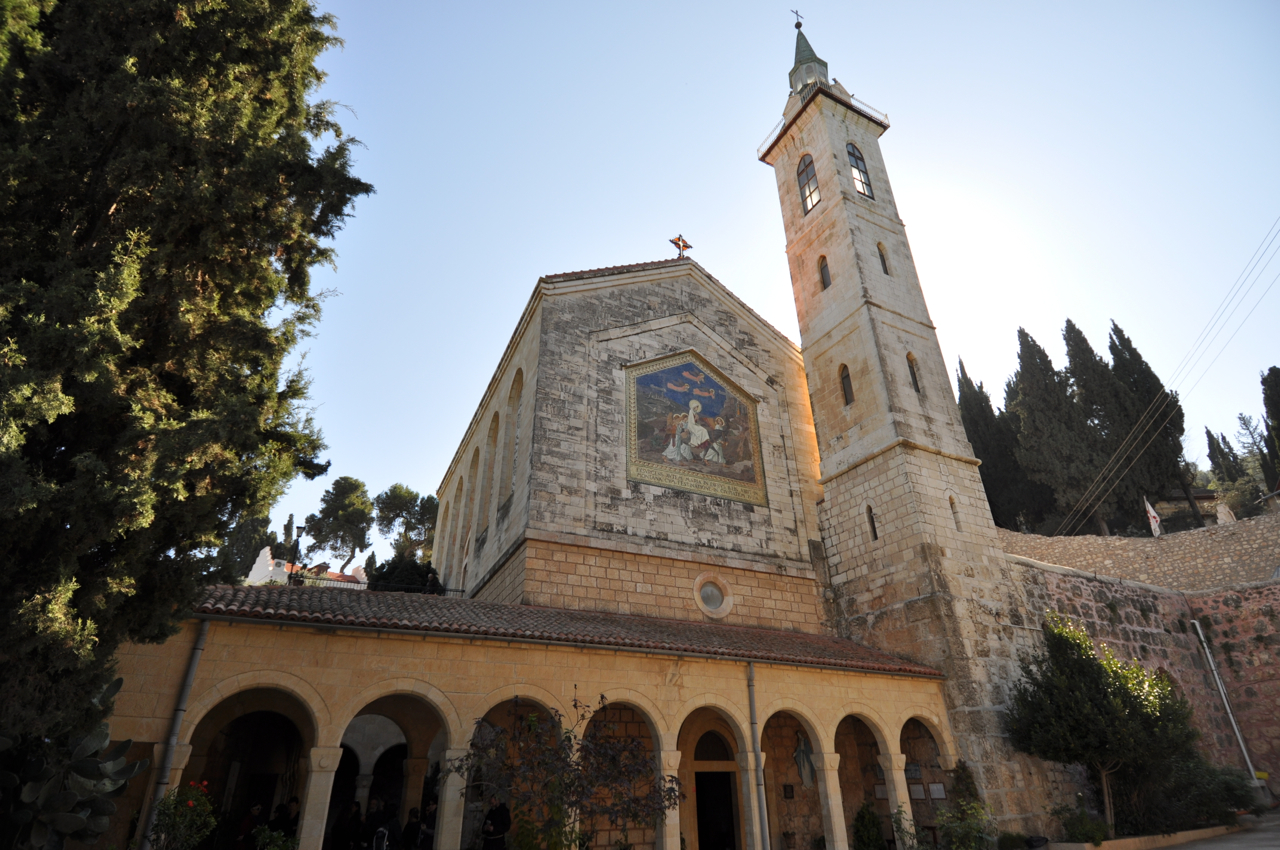
Barluzzi Church of VisitationOn the wall of the courtyard are ceramic tiles bearing verses from the Magnificat (the Canticle of Mary from Luke 1:46-55) in forty-two different languages. On the church’s façade is a striking mosaic commemorating the Visitation.

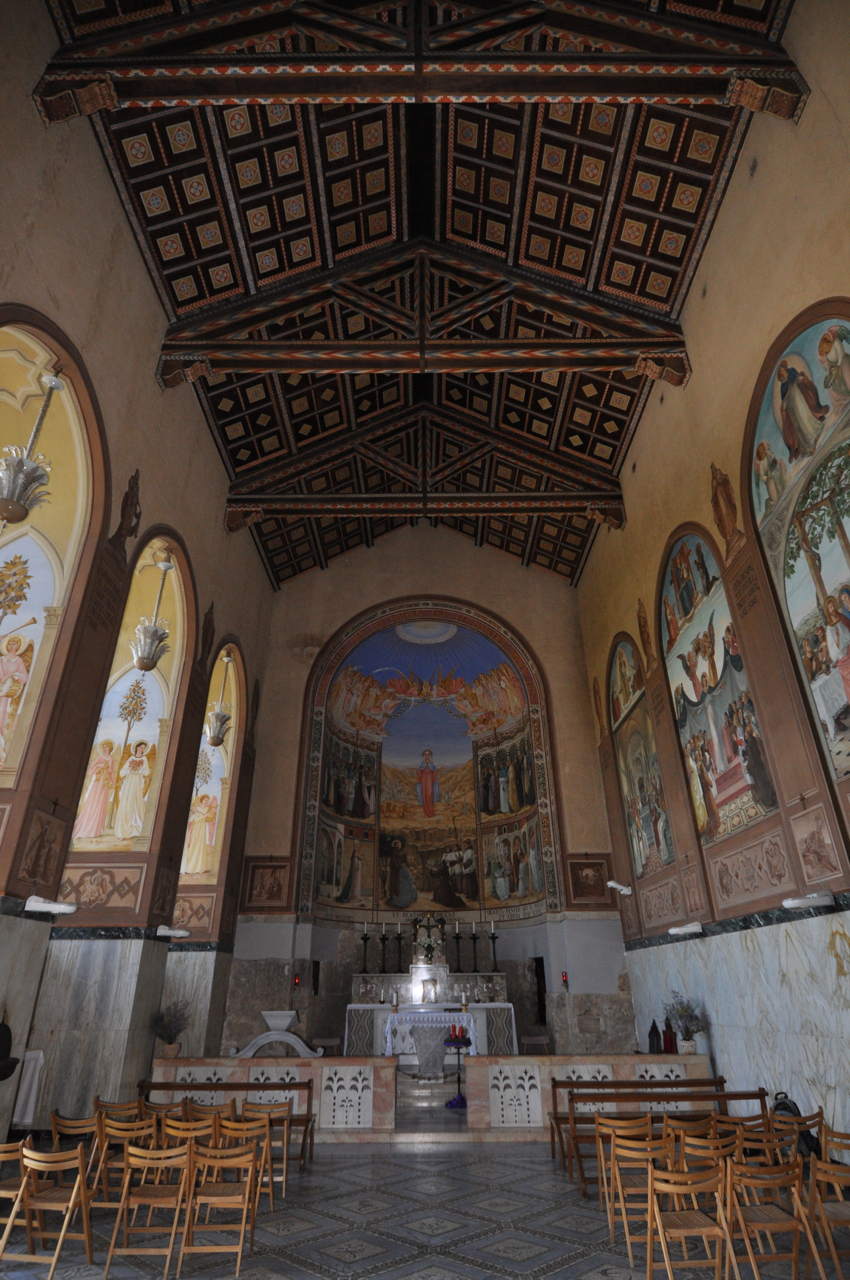
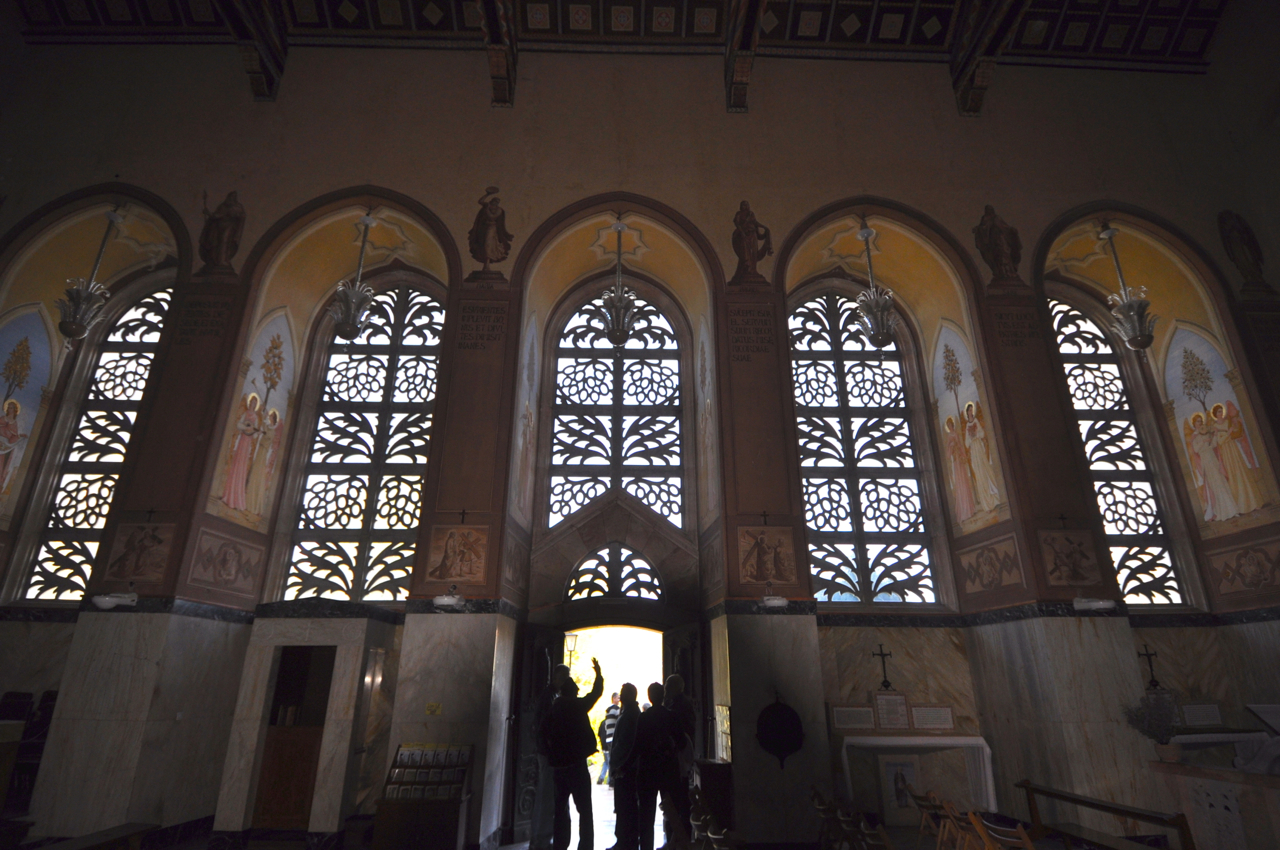
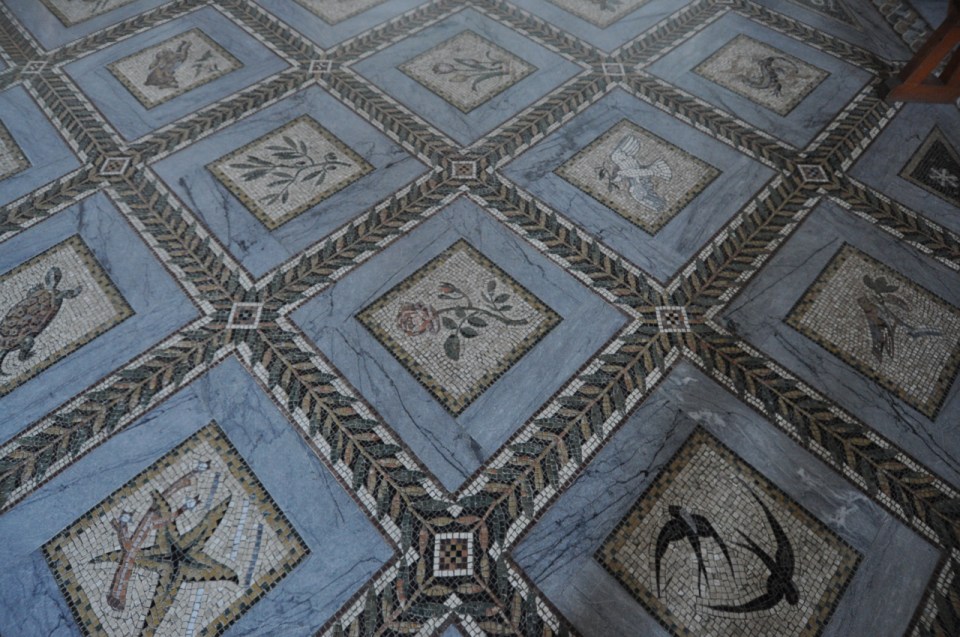
Visitation church InteriorThe lower level of the church was built in 1862, the upper level was begun in 1938 and completed by Italian architect Antonio Barluzzi in 1955. The upper hall is dedicated to Mary, and its walls are decorated with many paintings in her honor. The interior has Italianate frescoes depicting the Visitation, Elizabeth hiding her son John the Baptist, and Zechariah next to the altar in the Temple and beautiful mosaic floors. In one of the frescoes, there is an image of none other than Barluzzi himself.

Interior 2

Visitation church mosaic floor

Located up the hill is the Russian Orthodox Church, part of the Gorny monastery, nicknamed Moscovia by the locals, begun in 1905 and only completed in 2005, with its classic gold onions.

Take the opportunity to walk or meditate in the tranquil garden of Notre Dame De Sion monastery.

Restaurants

Pundak Ein Karem “with a garden blooming in and around its stone courtyard specializes in pan-European fusion cuisine of the decidedly unkosher variety; free WiFi.”

Karma “will have you eating like a Buddhist monk fallen off the wagon, a genre-defying culinary quality, with a traditional Middle Eastern taboon stone oven at its spiritual center.”

Café Inbal “small bake shop has a nice selection of classic light Israeli fare, kosher.”

Charlotte for those with a passion for a variety of grilled meats and delicious side dishes, kosher.

Esti and Perla “run by and in the home of two ladies by the names of Esti and Perla, who have resided in Ein Karem for over 50 years serves high-quality dairy food, specializing in Moroccan fare, kosher.”

Jerusalem the White City

I woke up this morning to Jerusalem covered in a blanket of snow. It’s not that I haven’t seen snow before, I grew up in Ottawa, Canada but it’s still pretty amazing to have snow in Israel. The meteorological service had been promising snow for Jerusalem since Tuesday. We bundled up and walked to the Old City and I shot photos until my camera lens fogged up.

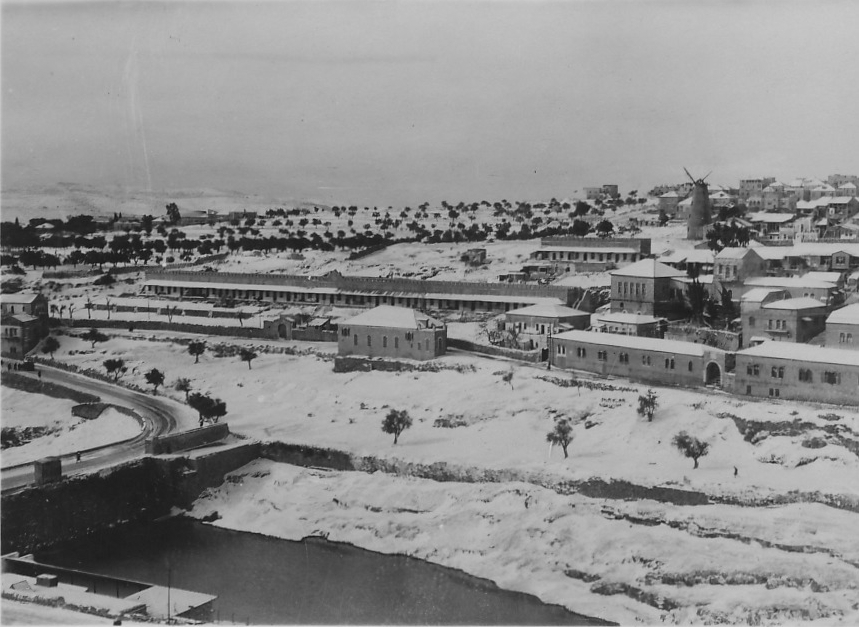
We walked from the German Colony past Cinemateque and Ben Hinnom valley up Mount Zion. I shot a photo of Yemin Moshe from there. While writing this post and organizing the photographs I came across this black and white photo, photographer unknown from 1920. Similar photo, the cypress and pine trees are bigger, Montefiore’s windmill was recently renovated.

Yemin Moshe Yemin Moshe in snow 1920

We walked through the Jewish quarter past the Byzantine Cardo and the Hurva synagogue. It was snowing and I caught the snow falling in the photo. The photo of the Hurva synagogue with minaret and palm tree has quite a painterly feel.

Byzantine cardo in snow

Hurva synagogue w minaret in snow

I had planned to go up onto the Haram el-Sharif but there was no access for non-Muslims and even the rooftop lookout at the Austrain Hospice was closed. There is a place with a good view above the Kotel plaza. This photo was shot with a 11-16mm wide-angle lens, giving quite a panorama.

Overlooking Kotel Plaza in snow

On our way home I got a nice photo of the “Tower of David” at Jaffa gate.

Tower of David

Archaeology in Israel Tour

I’m delighted to announce that Dan McLerran at Popular Archaeology and I are creating a phenomenal tour of archaeological sites in Israel that I will be guiding October 2013.
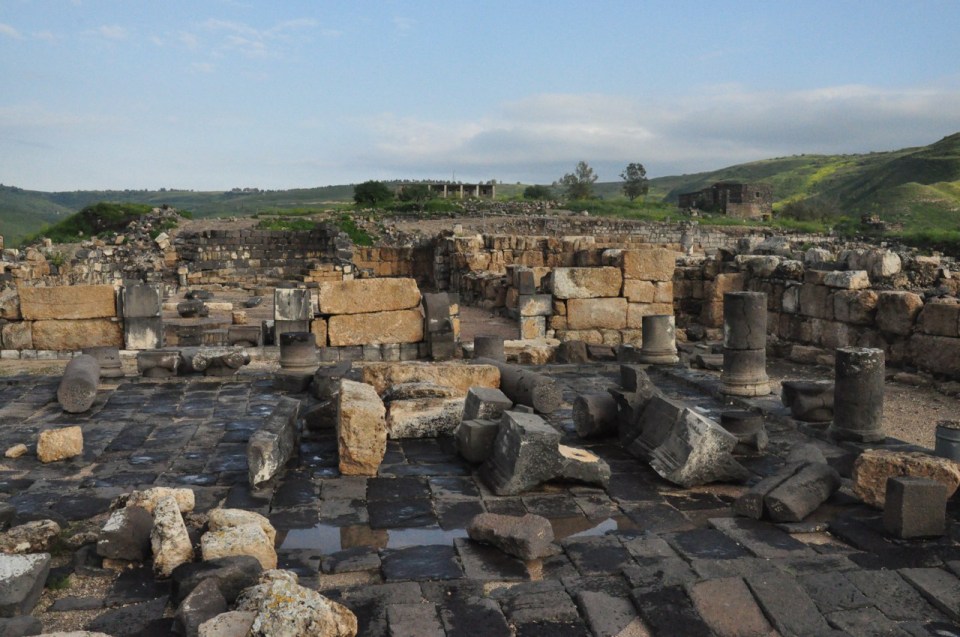
I invite you to join us on this adventure, 12 days of touring in Israel, where we’ll cover the famous sites like Megiddo and Hazor and uncover some of the less well-known gems like Sussita-Hippos, one of the Decapolis cities overlooking the Sea of Galilee that was destroyed in the earthquake of 749CE and never rebuilt.

Sussita excavation

We’ll start by going back 6500 years to the Chalcolithic period and tour up on the Golan Heights to learn about burial at that time. We’ll see dolmens, the megalithic tombs consisting of a flat rock resting on two vertical rocks that mark a grave. We’ll hike to the cultic site of Rujm el Hiri – is it a site that is connected to the calendar or to burial? At Ein Gedi we’ll see the ruins of a Chalcolithic temple. We’ll see artifacts at the Israel museum, examples of clay ossuaries and fine bronze castings of ritual objects.

We’ll follow in the path of the Kings from 1000BCE to 586BCE by traveling from Dan where a piece of a basalt victory stella in Aramaic was found mentioning the kings of Israel and the house of David. We will explore the City of David, the walled Jebusite city on the ridge between the Kidron and Tyropean valleys. We’ll walk through Hezekiah’s tunnel that brought the water of the Gihon spring to the Siloam pool inside the walls. From there we will follow in the steps of pilgrims to the Temple mount. Part of the 650m distance will be in Jerusalem’s drainage channel until we come out right under Robinson’s Arch. We’ll see the Broad wall, the remains of an 8 meter high wall that protected Jerusalem from the north in the time of the Kings.

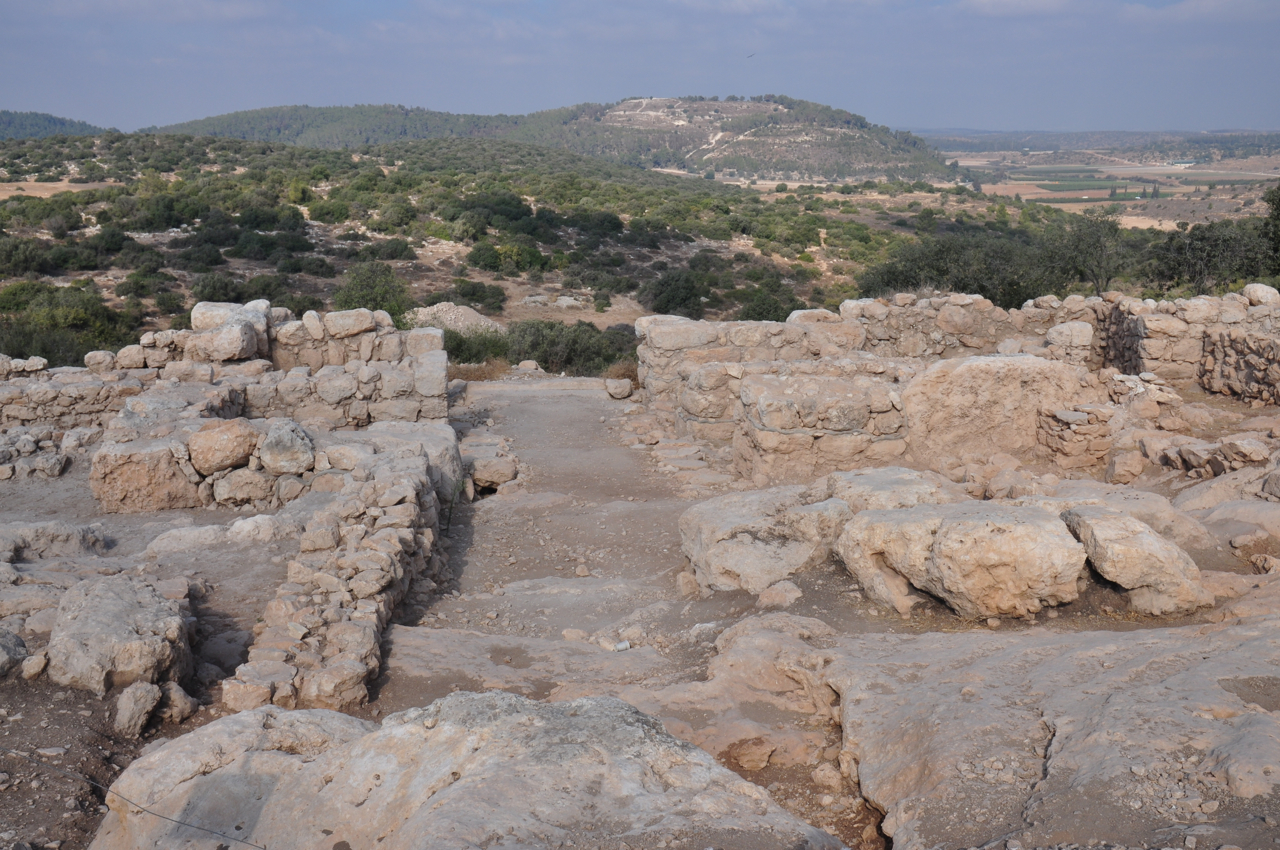
Khirbet Qeiyafa

We’ll explore the walled Judean city of Khirbet Qeiyafa, with two gates and hence identified as Shaarayim, situated on the border of Judea facing the Phillistines.

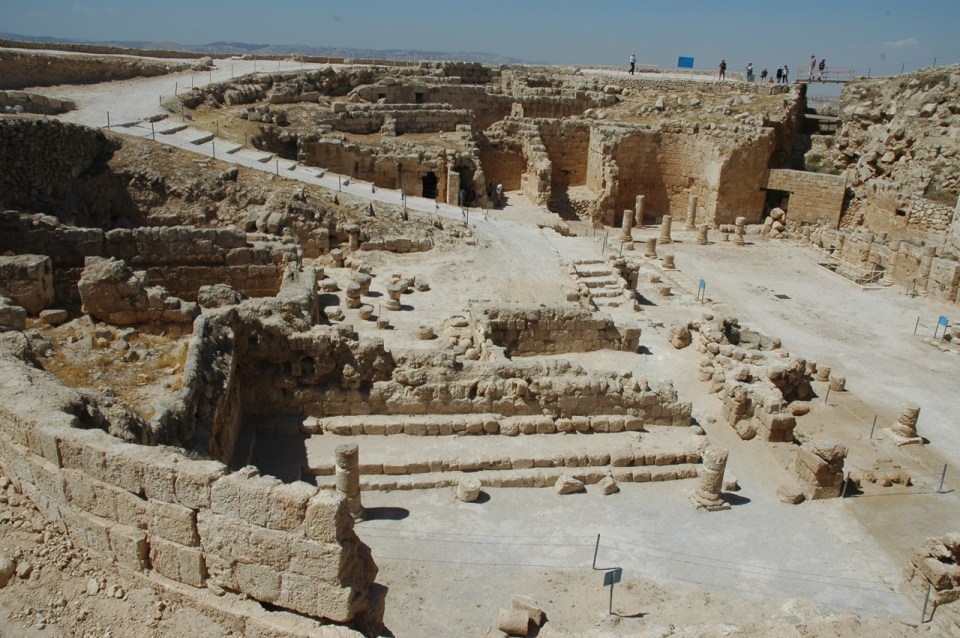
We’ll learn about the Second Temple Period, specifically the time of the Hasmoneans and King Herod who ruled under the auspices of the Romans. We’ll check out Herod’s impressive building projects. At Caesarea, we have the temple to Augustus, the protected harbor, the palace as well as a theater and a hippodrome later used as an amphitheater. At Sebaste there is another temple to Augustus. Josephus writes that Herod built a third temple at Banias. It’s unclear whether the temple was at Banias or nearby, perhaps at Omrit. We’ll visit Herod’s palaces at Masada, the Western palace and the 3 tier hanging palace on the northern end of the site. We’ll explore the palace and administrative complex at Lower Herodium and the palace/fortress on the top of a manmade mountain where the base of a mausoleum was discovered by Prof. Ehud Netzer in 2007.

Herodium Palace:fortress

We’ll visit the newly opened exhibit at the Israel museum Herod the Great: The King’s Final Journey, artifacts from Herodium on display for the first time. We’ll also visit the Second Temple period model that displays Jerusalem at its peak just before its destruction at the hand of the Romans. We’ll visit the Shrine of the Book that houses the Dead Sea scrolls and other artifacts and combine that with the archaeological site of Qumran by the Dead Sea where the scrolls were found.

We’ll focus on the architecture of sacred space and check out various churches, in the basilica and martyrium form from the Byzantine period (4th to 7th century) and synagogues from the same period. We’ll see some amazing mosaics by visiting the  museum at the Inn of Good Samaritan, the archaeological sites of Sepphoris/Tzippori, and the synagogue at Beit Alfa. We’ll visit sites off the beaten path like the Kathisma church on the way to Bethlehem and Samaritan site on Mount Gerizim.

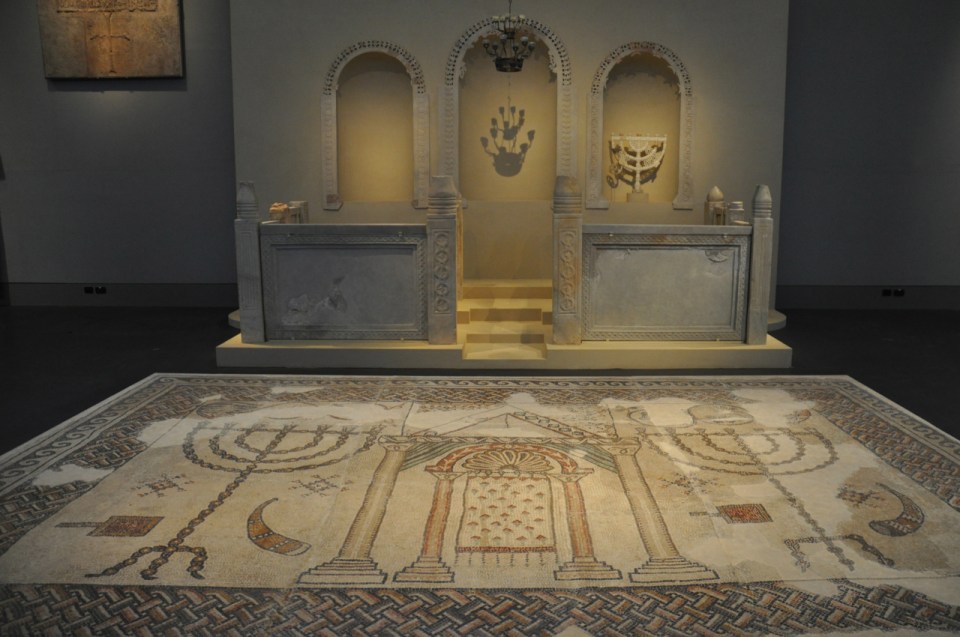
Synagogue mosaic floor at Israel Museum

Besides the Western wall, Judaism’s holy site, we will visit the Church of the Holy Sepulcher, the holiest site to Christianity and go up onto the Haram el-Sharif to see the Dome of the Rock and the Al Aqsa mosque, the third holiest site to Islam.

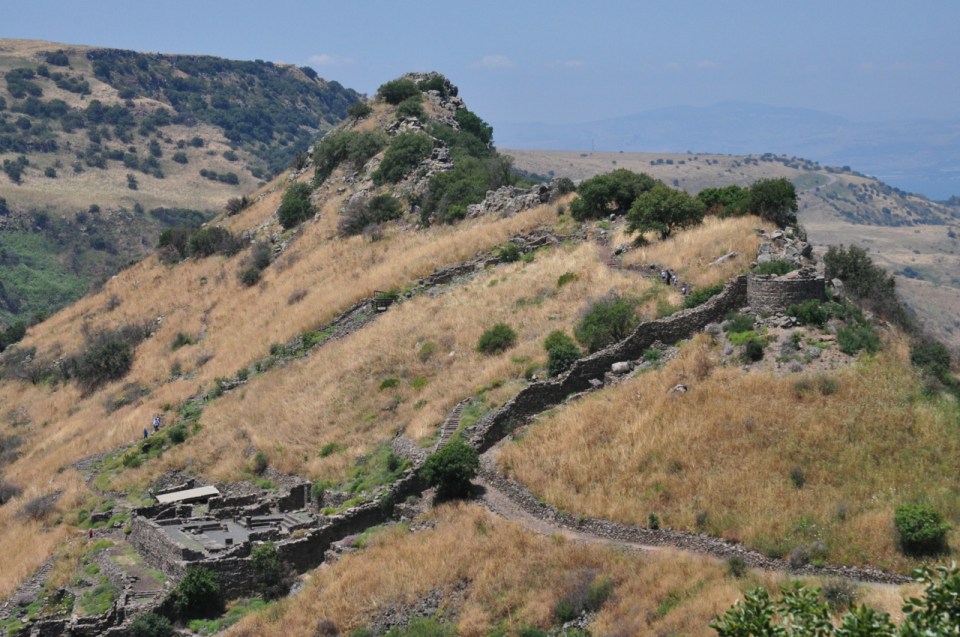
We’ll travel around the Sea of Galilee stopping at sites important to Christianity like Kursi, Capernaum and Magdala. We’ll even go up to the Golan Heights to the Jewish city of Gamla, the Masada of the north.

Gamla

For anyone who enjoys taking photographs, there will be plenty of opportunities and as an special incentive to join the tour, participants will be able to submit their best photographs from the tour to a special Pinterest site and will have a chance to win up to $1000. for the “best photo”.

If you’re interested in participating in an archaeological tour of the Holy Land, contact  me.

Photography and Visitors to the Holy Land

The Crimean War from 1853-56 was the first reported by daily newspapers and documented by photographs. Hungarian-Romanian photographer de Szathmàri took photos during the war and created albums which he personally offered in 1855 to Napolean III of France and Queen Victoria of England. British photographer, Roger Fenton was sent on assignment to the Crimea for 4 months in 1855 and managed to take over 350 large format photographs.  The Crimean War weakened the Ottoman Turkish empire that had been in power for almost 400 years. European countries recognizing the “sick man on the Bosphorus”, came to visit and stake their claims.

When guiding I point out how the 1860s were pivotal in Jerusalem’s development. In 1860 the British philanthropist Mose Montefiore had Mishkenot Sha’ananim built, the first apartments outside the walls of the Old City. The introduction of steamship travel made it easier to visit foreign countries and with the advent of photography it was possible to bring back images from your travels. One of the earliest such trips was a visit in 1862 to the Holy Land by the 21-year-old Prince of Wales that was documented by the photographer Francis Bedford.

Jerusalem from Mount of Olives, 1862 Francis Bedford

Jerusalem from Mount of Olives, 1862 Francis Bedford

Mark Twain reported on his travels to Europe and the Middle East in 1867 in Innocents Abroad and while in Jerusalem stayed at the Mediterranean Hotel at the same time that the British explorer, Charles Warren was there. The year 1869 marks the opening of the Suez Canal, Thomas Cook escorts his first tour group to Egypt and Palestine and the Austrian Emperor Franz Joseph visits the Holy Land, the first crowned head of a Catholic country to visit since the Crusades. In 1873 a group of German Protestants that had already settled at Haifa and founded the German Colony there bought land in Emeq Refaim in Jerusalem to build their colony. Christian Arabs left the Old City and built new homes creating the Greek Colony and Katamon neighborhood. Just before the end of the century, in 1898 the German Kaiser Wilhelm II and Augusta Victoria visited the Holy Land; the logistics were arranged by Thomas Cook & Son. The year 1898 is widely accepted as the start of the American Colony Photo Department which documented the Kaiser’s visit, although one of its members had produced photographs earlier.

Let’s go back to February 6, 1862 just eight weeks after his father’s death when Edward, Prince of Wales, and his entourage left England for Egypt. The group crossed Europe to Venice by train, where they joined the royal yacht Osborne for the journey to Alexandria. This was the starting point for the well-planned itinerary that had been chosen by Edward’s father Albert in consultation with a group of scholars and politicians, an extensive tour of the Middle East, visiting Egypt, Palestine, Syria, Lebanon, Turkey and Greece, part of the process of preparing him to be a model modern constitutional monarch. The group travelled on horseback, camping out in tents. Dr Stanley, spiritual advisor and Dean of Westminster, acted as tour guide because of his extensive knowledge and experience traveling in the East. He would provide a running commentary of both the history and Bible references as they related to the places they visited. Specifically, Jerusalem, Bethlehem, Hebron, Capernaum and Nablus were all names that were particularly significant because of their association with the Bible. The Prince, heir to the throne, would also be guardian of the church so these were places to know about.

April 3, 1862: Our tents were struck at 8.30am and we started at that time (on horseback of course) for Bethlehem, which we reached in about a couple of hours time, stopping on the way at Rachel’s tomb, and it was ascertained for certain that the tomb is on the site of the real one.

April 21, 1862: We lunched under a fig tree at 12 o’clock on the site of where once the city of Capernaum is said to have stood + Mr. Bedford photographed us ‘en groupe’

     – extracts from the Prince’s journal

British photographer Francis Bedford (1815-1894) was invited to make a photographic record of the tour, his most important Royal assignment. Some of the equipment could be taken with him but most had to be sent ahead, to be collected at Alexandria when they arrived. On the tour itself, Bedford would have needed porters to carry all the equipment, a large heavy camera, 10×12 inch glass plate negatives, chemicals, portable darkroom. Many of the materials were fragile and unstable, especially when exposed to extremes of temperature. For each photograph, Bedford had to coat and sensitize the plate, position it in the camera while it was still wet and then expose it. Once the image was captured the plate had to be developed and fixed, while excluding all light; lastly, the plate had to be washed. The photos are remarkable when you consider the conditions and that photography was in its infancy having been invented 21 years earlier.

Valley of Jehosaphat, 1862 Francis Bedford

Valley of Jehosaphat, 1862 Francis Bedford

 Garden of Gethsemane, 1862 Francis Bedford

Garden of Gethsemane, 1862 Francis Bedford

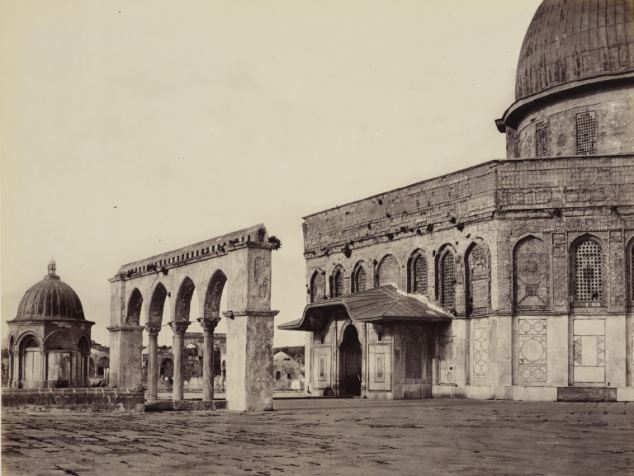
Dome of Rock, 1862 Francis Bedford

Dome of Rock, 1862 Francis Bedford

Dome of Rock, 1862 Francis Bedford

Dome of Rock, 1862 Francis Bedford


For those who can be in Edinburgh, the photographs from the Prince’s visit in 1862 taken by Francis Bedford, which belong to the British Royal Collection, will form part of a new exhibition Cairo to Constantinople: Early Photographs of the Middle East at The Queen’s Gallery, Palace of Holyroodhouse, from March 8, 2013.
Biodiversity at Jerusalem Botanical Gardens

A human is like a tree, like a human the tree also grows, like a tree a human life can be cut down and I don’t know…

…כי האדם עץ השדה  כמו האדם גם העץ צומח  כמו העץ האדם נגדע  ואני לא יודע

I feel my lifeblood being sapped by the ongoing rocket/missile exchanges between the Israel Defense Forces and Hamas. Israel is trying to protect us by getting rid of Hamas’ rockets and weakening Hamas. Hamas is trying to get Israel to lift the blockade of Gaza, to improve Palestinians’ living conditions in one of the most densely populated areas in the world. Hamas is also trying to make life so stressful and unbearable that we lose hope, with the aim, clearly outlined in their charter (1988), of uprooting us from this land.

This week I visited the Jerusalem Botanical Garden on the edge of the Givat Ram campus of Hebrew University, a tranquil retreat in the midst of the city, welcoming to all (explanatory signs are being put up in English, Hebrew and Arabic). Their vision statement makes it clear:

Just as biodiversity is a key to a healthy natural world, so human diversity is a cornerstone of a healthy society. We promote and encourage both.

The 30 acre park is divided into six geographical zones, European, North American, South African, Australian, Asian and Mediterranean and has more than 10,000 species of plants. I was delighted to find Sternbergia, a young sycamine sapling and not only the five species of oak trees indigenous to Israel but some 75 different oaks of the 700 species that exist in the world growing at the botanical gardens, a refuge for endangered species. More than just replicating the flora of Eretz Yisrael the botanical gardens teach respect and awe for the biodiversity of our world. There is an African savannah grass maze for children to explore, there is a section on herbs and medicinal plants, a path of Biblical plants, water plants and plants of the desert.

Jerusalem has two botanical gardens (the first planted in 1931 on Mount Scopus campus of the Hebrew University), two university campuses and two Hadassah hospitals. History explains why – the institutions on Scopus were cut off from Israel for 19 years when Jordan occupied the West Bank and East Jerusalem after the war in 1948. An Israeli convoy under Red Cross auspices delivered supplies and exchanged personnel every two weeks.  Scopus and Jerusalem were only reunited by Israeli paratroopers during the Six Day War in 1967.

In 1947 Tuvia Kushnir, a brilliant young man, was studying and researching the plants of Palestine (under the British mandate, before the State of Israel was declared) at the Hebrew University on Mount Scopus. Tuvia discovered a rare flower, the Galilee fumitory (Fumaria thuretii Boiss) near Kibbbutz Eilon in the Upper Galilee, the southernmost extent of its range. The flower was not seen again for 60 years until Prof. Avi Shmida and other botanists discovered 80 individual plants of Galilee fumitory in April 2012. Tuvia was one of the first iris researchers in Palestine and identified an iris that bears his name Iris tuviae (also known as the King Uzziae iris). And Tuvia identified a kind of crocus that grows only in the desert that was named after him, Colchicum tuviae.

On January 15th, 1948 Tuvia was part of a group of Haganah soldiers given the task of carrying supplies to the defenders of Gush Etzion (on Friday two rockets fell in the Gush, the first fired towards Jerusalem), 4 kibbutzim south of Jerusalem that were under blockade by Arab forces. They set out at 11pm on foot from Har Tuv, making a detour past the British police station so as not to be detected (it was a capital offense to carry arms) and past Arab villages. Three soldiers turned back when one soldier twisted his ankle and was unable to continue leaving 35, the march of the lamed-heh (two Hebrew letters that have the value 35). Towards dawn the group was discovered near the Arab village of Tsurif, the alarm was raised and hundreds of Arabs from the neighboring villages attacked the convoy. Though the British heard the shots they did not investigate until all was quiet. The Israeli soldiers fought until they had no more ammunition – all were killed including Tuvia. When the British arrived on the scene they found the bodies horribly mutilated making identification very difficult. Rabbi Arye Levin performed the rare Goral Ha-gra ceremony, a mystical procedure devised by the Vilna Gaon where the rabbi opened a Tanakh and was drawn to read certain verses which gave hints to the identity of the bodies.

2:15pm Jerusalem time  I’m at home writing this post. By the time we hear the siren there are about 15 seconds until we hear a distant boom. Channel 2 reports that the rocket fell somewhere near Bethlehem, about 6.5 km south of where I am sitting.

At the Jerusalem Botanical Gardens work has begun on a Children’s Discovery Garden that will offer Jewish, Muslim and Christian young people an opportunity to explore and discover the wondrous natural world, to learn that diversity is important and in the process meet each other. Discovery and play will be used to show how plants adapt to their environment and the interaction between the two. Activities will include a canopy walk in the treetops and a descent down to a roots exhibit. Perhaps plants which are apolitical, are concerned less with borders and which speak to us all can show us the advantages of diversity and living together.