Author Archives: Shmuel Browns

Unknown's avatar

About Shmuel Browns

I am a tour guide, licensed by the Israel Ministry of Tourism. I do tours throughout Israel, personalized to your interests, time and budget.

Visit Palestine with Shmuel

VisitPalestineWalking through the Arab shuq you might notice graphic posters displayed in a number of shops. Perhaps one of the most striking says VISIT PALESTINE with a graphic of the Haram el-Sharif. Two of the most popular places to visit in Palestine are Bethlehem and Jericho. I am now authorized to guide there so you can now visit Palestine with me.

Interesting thing is that the poster is not contemporary, not by a Palestinian artist or graphic designer and in fact, has nothing to do with “Palestine”, meaning the West Bank and Gaza. The poster is from 1936 when the whole area was Palestine under the British Mandate and the poster was designed by an Austrian Jewish artist living in Tel Aviv.

Moving from Vienna to Berlin to Paris and then Barcelona, Franz Krausz and his wife Anni managed to flee Europe, came to Palestine in 1934 and settled in Tel Aviv. Krausz was a pioneer of art for advertising and designed posters for Israeli companies like Dubek cigarettes and Elite, the chocolate and candy manufacturer. Krausz most dynamic and colorful work was hand-painted gouache, sometimes based on photographic studies shot by his wife. My good  friend and artist, Bob Gottlieb is living in Louisville, KY with my photograph of the “Petrified Trees” in the Large Makhtesh from my calendar and is planning to do a painting of the scene. Anyone else interested in trying their hand at painting from my photographs? For an example of a photograph and painting of the same scene, see my post on Banias stream.

The “Visit Palestine” poster is Krausz’ best-known image, with just those two words in English, no Hebrew or Arabic, done using only six colors. On the left foreground of the poster is a tree in silhouette, perhaps an olive, or oak or carob, framing a view of the Haram el-Sharif and Dome of the Rock, even the Dome of the Chain is shown, with Jerusalem behind – the view of the city is from the Mount of Olives. Although prolific and one of Israel’s most-accomplished graphic designers Krausz made very little money from his frugal clients.

ComeSeeIsraelYou might notice two other graphic posters in the Arab shuq. One, with English and Hebrew, has the words Tourism in Palestine as the caption at the top (in Hebrew, the text is Tourism in the Land of Israel). The main image is a gentleman, dressed in white, with a British explorer hat and high boots pointing at a map of Palestine, ostensibly a guide.

Around the main image are small icon-like drawings of places of interest (certainly a peculiar list of sites for a tour), on the left:

  • Mosque of Omar, ie. Dome of the Rock
  • Herzliah, ie. Herzliah gymnasia (high school in Tel Aviv)
  • Cave of Machpelah
  • the town of Rishon LeZion

on the right:

  • Tower of David
  • Bezalel Art Academy in Jerusalem
  • Rachel’s Tomb
  • Metulah

The poster is an advertisement for “The Association of Jewish Guides, Properly Trained In All Subjects That Make a Good Guide, Is At Your Service Fixed Rates Apply to the Office” and to encourage the purchase of craft items made in the Holy Land in order to help it’s economy and the artists who lived here.

Come to PalestineThe other poster has Come to Palestine on the bottom. It has the words “Society for the Promotion of Travel in the Holy Land” across the top, with two circles, icons of the Dome of the Rock and Tower of David (like the previous poster). Below is an idyllic painting of a palm tree overlooking Tiberias and the Sea of Galilee with a snow-capped Mount Hermon in the distance, with shepherds sitting on the hillside beside an almond tree with blossoms. The scene is viewed through a horseshoe arch, the arch starts to curve inwards above the level of the capital or impost, a form developed during the early Islamic period.

Under the painting is a quotation from Song of Songs 2:11 For lo, the winter is past, the rain is over and gone…

The whole thing, both Biblical and Zionist themes, is done in a style influenced by the European jugendstil (similar to Art Nouveau) and by traditional Persian and Syrian styles. Both posters were designed by Zev Raban of the Bezalel Art Academy in Jerusalem in the mid 1920’s to promote tourism to Palestine.

Under the influence of Boris Schatz, the founder of the Bezalel Academy, Raban moved to Palestine in 1912 during the wave of immigration known as the Second Aliyah. He joined the faculty of the Bezalel school, and soon took on a central role there as a teacher of repoussé, painting, and sculpture. He also directed the academy’s Graphics Press and the Industrial Art Studio. By 1914, most of the works produced in the school’s workshops were of his design.

For other examples of Raban’s graphic work reproduced on ceramic tiles visit Bialik House in Tel Aviv. At the intersection of Rothschild Boulevard and Allenby Street, Lederberg House also has some ceramic murals: a Jewish pioneer sowing and harvesting, a shepherd, and Jerusalem with a verse from Jeremiah 31:4, “Again I will rebuild thee and thou shalt be rebuilt.”

Photo of the Week – Dancing Clouds

This photo was taken at the end of the first day of hiking the Israel trail from Eilat. It is one of those less common landscapes because it was shot vertically to get more sky in the image.

Dancing clouds Eilat

The technical details – the photo was taken with a Lumix point and shoot camera on February 28th at 6:47pm (ISO 250, 6.9mm, F3.7 at 1/30 sec).

Please share this post with your friends by clicking on the icons at the end of this message.

Photographs on this website are © Shmuel Browns (unless marked otherwise) – if you are interested in purchasing one of my photos or using one of my photos for your own project please contact me.

Related articles

Israel Roundup

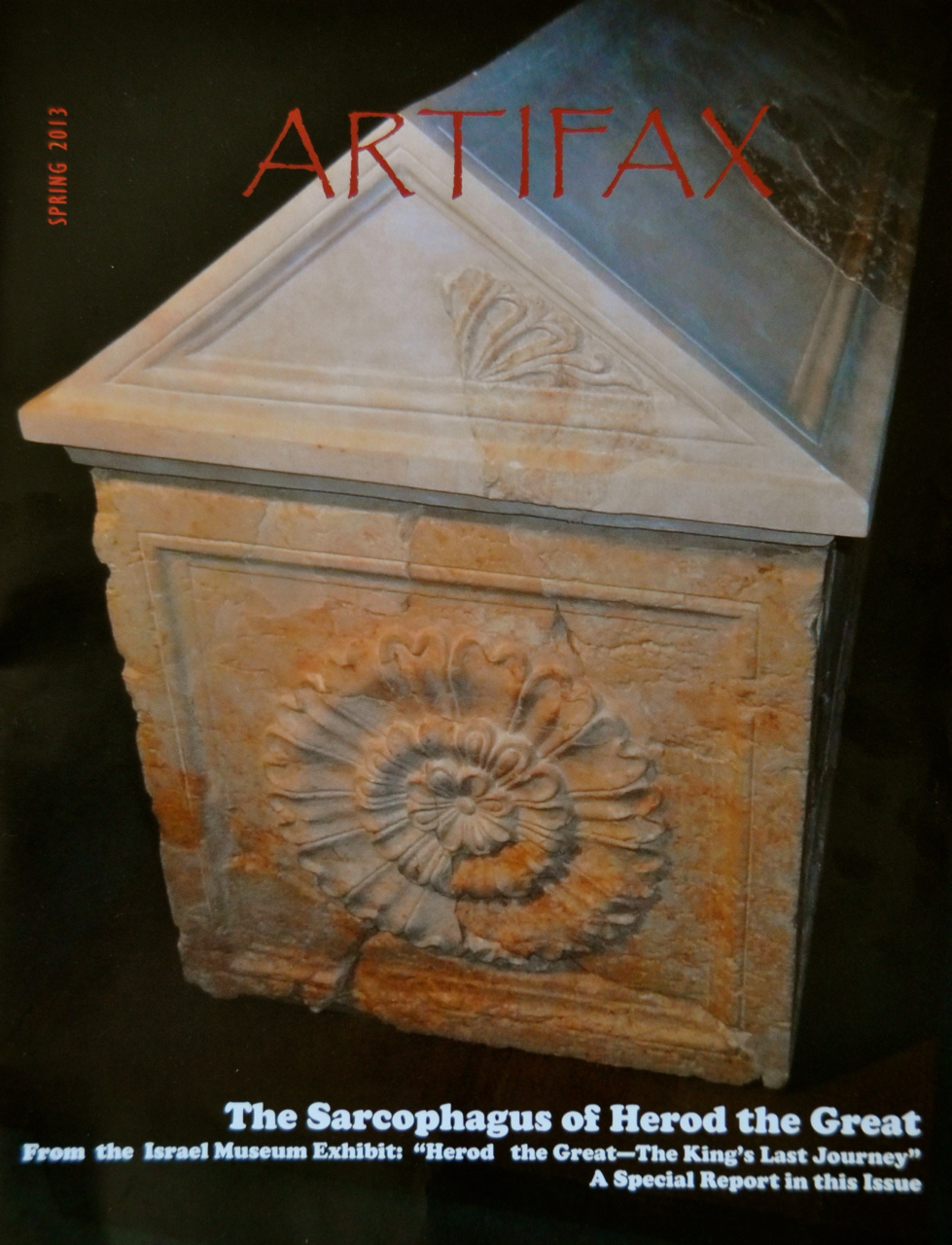
The Spring 2013 edition of ARTIFAXArtifax cover magazine is available – my photo graces the cover and the lead article, Herod’s Magnificent Obsessions, is my description of the Herod exhibit at the Israel Museum, with my photographs.

Dead Sea and Mount Everest

Two pieces of stone from the area of Israel’s Dead Sea, formed into a two-foot sculpture by Israeli artist Jojo Ohayon, has been placed in the Sagarmatha National Park of Nepal, at the southern part of Mt. Everest. Israel is planning to erect a sculpture built out of rock from Mount Everest and place it near the Dead Sea next month.

A few years ago I made a similar connection with an exhibit of my photographs from the Dead Sea, the lowest place on earth, in Kathmandu, Nepal in the shadow of Mount Everest, the highest place on earth.  https://israeltours.wordpress.com/photography/photo-exhibit/

Petroglyphs

I just found out about an open colloquium, Mount Sinai: Mount Karkom, May 12-13, 2013 in Mizpe Ramon, honoring the pioneers of Israeli desert archeology and an off-road Jeep trip to Mount Karkom – sounds incredible. Unfortunately, when I went to register, registration was full.

I’ve posted some photos from a hike I did near Mount Arkov in the Negev where we saw a lot of petroglyphs similar to those at Mount Karkom. https://israeltours.wordpress.com/2013/03/10/photo-of-the-week-tumulus-negev/

Jerusalem Botanical Gardens has developed an online course, Flora of the Holy Land, that features more than 100 plants, providing information, stunning photographs, video clips, maps and more. The course tells the fascinating role played by plants in the Bible, about the environmental wisdom of the ancient texts and the contribution that plants of the area have made to human settlement and civilization. http://www.en.botanic.co.il/Pages/Show/122

Work is continuing on First Station, Jerusalem’s new meeting place for food and culture, at the original railway station built in 1892, terminus of the Jaffa-Jerusalem Railway. It is scheduled to open May 14. As of today the visitors center where you can get information, book a Segway or electric bicycle tour and buy souvenirs and the Re:bar concession are open.

In a July 2012 article in Ha’aretz, Yaakov Kahlon, Senior Deputy Mayor of Jerusalem shares his vision about the future of Jerusalem.

... hot-air balloon, so you can go up and see the city from above. The Ottoman-era train station, along with a large multiplex cinema that is under construction in nearby Abu Tor, are meant to provide an entertainment nexus that will be open on Shabbat. It will include a Ferris wheel and a skate park, and from there a promenade with a bicycle lane that will connect directly to the Jerusalem Theater.

So far, all we’ve seen is First Station.  http://www.firststation.co.il/en/

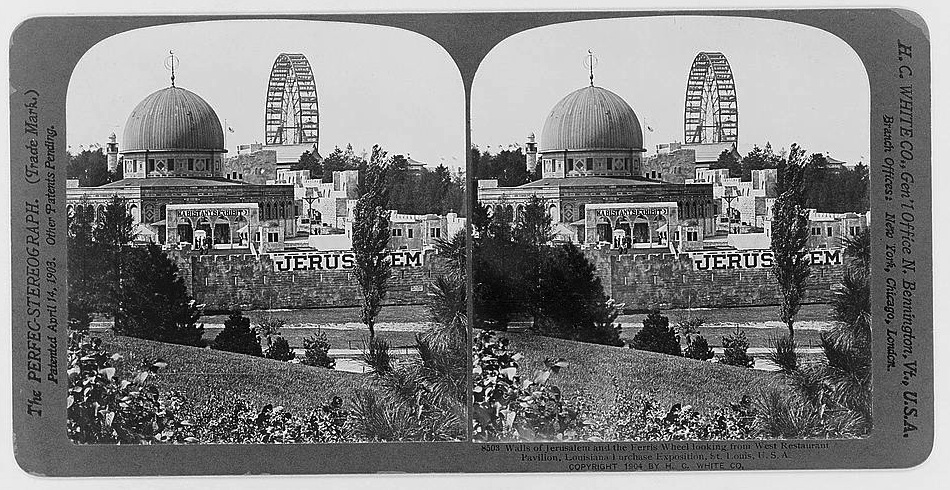
Talking about ferris wheels, here is a double photo of Jerusalem’s Dome of the Rock with ferris wheel in the background for use with stereoscopic 3D glasses – check out other photos (mostly from the Library of Congress, American Colony Eric Matson collection) at http://www.israeldailypicture.com.

Ferris Wheel Jerusalem

In his book, God’s Sacred Tongue: Hebrew & the American Imagination, author Shalom Goldman explains:

At the 1904 World’s Fair, the Louisiana Purchase Exposition in St. Louis, there was a massive model of Jerusalem’s Old City. It sprawled over 10 acres of the fairgrounds and included grand models of the Dome of the Rock and the Church of the Holy Sepulcher.  As Israeli scholar Rechav Rubin remarked: ‘the most astonishing fact about the enterprise is that several hundred people, Moslems, Jews, and Christians, were brought from Jerusalem to St. Louis.  There they lived and worked within the model, dressed in their colorful costumes… and had to entertain and guide the visitors through its streets and sites.’


Bethesda Pool and Church of Santa Anna

Near Lion’s Gate is a large wooden door that gives access to the White Fathers’ compound and one of my favorite sites in Jerusalem’s Old City – Bethesda pools and the Church of Santa Anna.

Mary (mother of Jesus) was born to Anna and Joachim who lived near the Bethesda pools.  Because Jerusalem is on the edge of the Judean desert water has always been crucial for the residents of the city and the first pool was built in the 8th century BCE, when a dam was built across the valley, collecting rain runoff in a reservoir (40×50 meters), known as the Upper Pool. A sluice-gate in the dam allowed the water height to be controlled, and a rock-cut channel brought the water into the city. Around 200 BCE, the channel was enclosed, and a second pool (50×60 meters) was added on the south side of the dam.

Bethesda pool

In the 1st century BC, natural caves to the east of the two pools were turned into small baths, as part of an asclepieion, a healing temple. As it was outside the city walls, scholars think it likely that the Roman garrison of the nearby Antonia Fortress built the site as they would have been able to protect it. According to Christian tradition the site is one of two places in Jerusalem where Jesus performed a miracle, healing a paralytic of 38 years (John 5:1-15).

In the mid 1st century CE, Herod Agrippa built the third wall enclosing the northern area of the city and bringing the asclepieion within the walled city. When Hadrian rebuilt Jerusalem as Aelia Capitolina, he placed a roadway along the dam, and expanded the asclepieion into a large temple to Asclepius and Serapis. In the Byzantine period, 5th century, a large church was built on the dike, requiring support of two rows of arches.

After the Crusader conquest of Jerusalem in 1099, the Byzantine church, destroyed by the Persians in 614 CE, rebuilt by patriarch Modestus and destroyed in 1009 by the Fatimid Caliph Al-Hakim, was rebuilt on a smaller scale. A new Romanesque church, named for Saint Anne was completed in 1138 CE by Arda, widow of Baldwin I, the first Crusader King of Jerusalem, built over the site of a grotto believed by the Crusaders to be the birthplace of Mary. After the conquest of Jerusalem by Saladin it was transformed into a school for Islamic jurisprudence. Over time, the buildings fell into ruin. In 1856, the Ottomans, in gratitude for French support during the Crimean War gave the site to France. It was subsequently restored, but the majority of what we see today is original.

Santa Anna interiorThe three-aisled basilica incorporates cross-vaulted ceilings and columns, clean lines and an unadorned interior. Because of the fine stonework and large volume of the church the acoustics are amazing. The altar is by the French sculptor Philippe Kaeppelin – on the front of the altar are depicted the Nativity, the Descent from the Cross and the Annunciation; on the ends the teaching of Mary by her mother and her presentation in the Temple.

Kaeppelin altar

Photo of the Week – Banias Stream

Last week I was guiding on the Golan, the weather was glorious and we hiked to the Banias waterfall in the Mount Hermon (Banias) nature reserve. If you haven’t been there for a while, the parks authority has installed a wooden walkway where you walk just above the Banias stream. FYI, the same admission fee also gives you entrance to the Banias archaeological park.

dsc_0568

The technical details – the photo was taken with a Nikon D70 digital SLR and 18-200mm lens in September (ISO 200, 18mm, F7.1 at 1/30 sec).

The Banias Spring emerges at the foot of Mount Hermon and flows powerfully through a canyon for 3.5 km, eventually cascading over a cliff, not the highest but probably the most impressive waterfall in Israel. Nine kilometers from its source, the stream meets the Dan and together they form the Jordan River that flows into the Sea of Galilee.

From Banias we drove to the village of Nimrod, the highest settlement in Israel at 1110 meters to taste some artisan cheeses at the Witch’s Cauldron and Milkman restaurant. On display were some oil paintings by the artist Diego Goldfarb (whose gallery is next door) – I liked  one of the Banias stream (photo taken with my iPhone). If there are any artists out there who would be interested in doing paintings from my photos please contact me.

Banias

Please share this post with your friends by clicking on the icons at the end of this message.

Photographs on this website are © Shmuel Browns (unless marked otherwise) – if you are interested in purchasing one of my photos or using one of my photos for your own project please contact me.

Related articles

Tzfat Synagogues

Visitors who are impressed with the architecture and style of the churches in the Holy Land often ask to see similar synagogues. When in Tzfat it’s worth visiting some of the synagogues.

The Ari Ashkenazi Synagogue

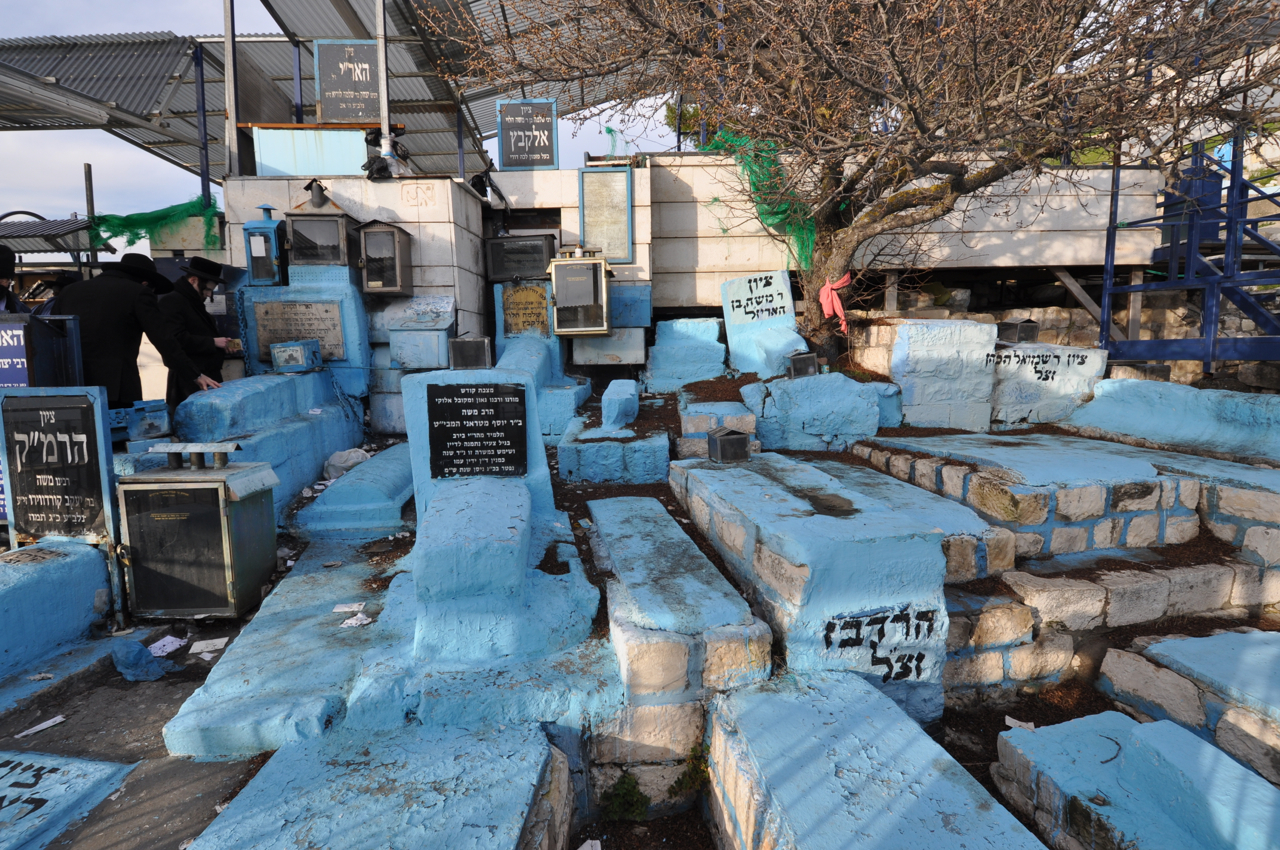
The synagogue was built in the sixteenth century on the northern edge of the Sephardic neighborhood by Spanish exiles who had emigrated from Gerigos, Greece. Kabbalists, mostly followers of Rabbi Moshe Cordovero frequented the synagogue and in 1570 Rabbi Isaac Luria (known by his acronym “the Ari”) joined them – for a short two years until his death. On the Eve of Sabbath, they walked to a nearby field, the Hakal Tapuchin, (apple orchard) to welcome the Sabbath bride to the melody of Lecha Dodi written by Rabbi Shlomo Alkabetz. Cordovero, the Ari, Alkabetz and other kabbalists are buried in the cemetery, their graves covered in bright, sky blue paint.

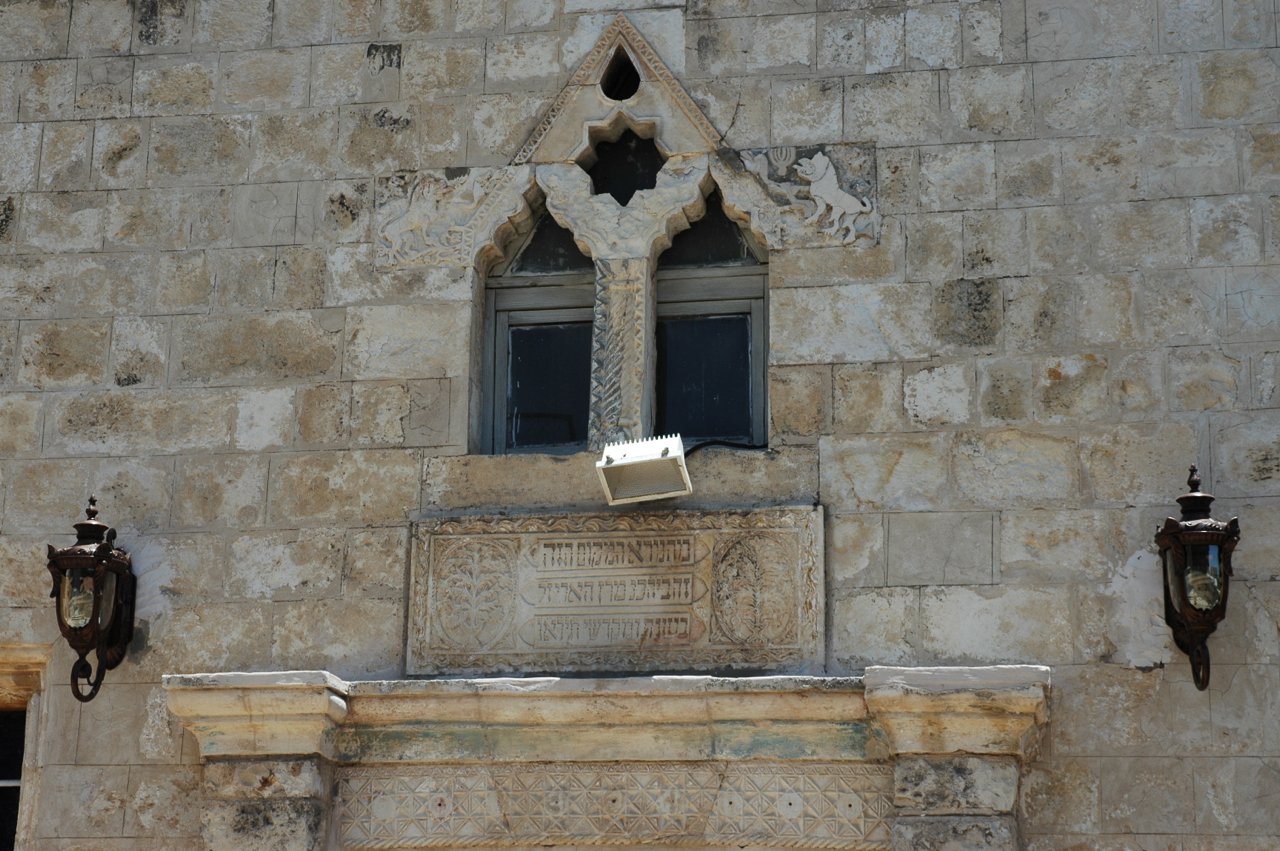
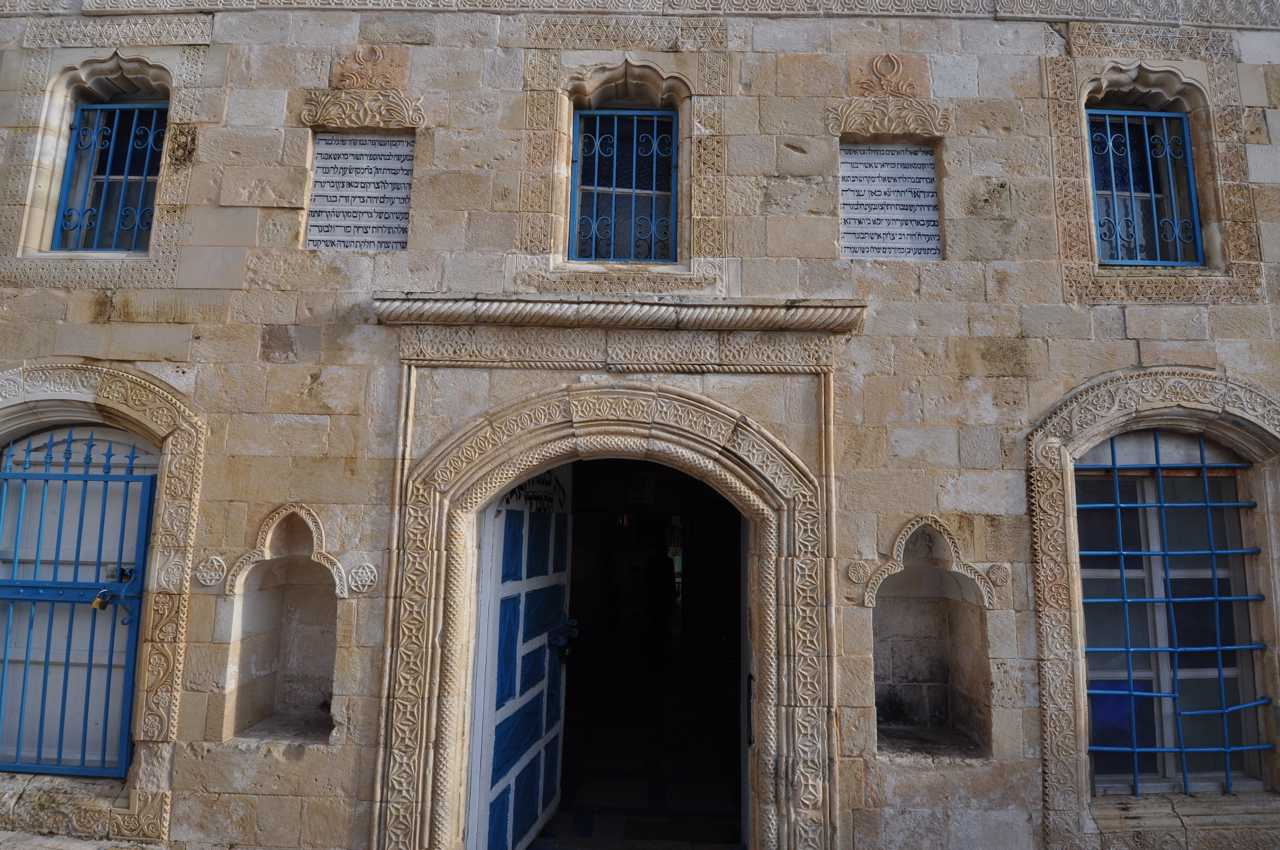
Tzfat cemeteryIn the eighteenth century, a large group of Hasidim from Europe arrived and the synagogue began to be called “the Ashkenazi Ari Synagogue.” It was destroyed in the earthquake of 1837, and rebuilt in 1857. Notice the inscription in Hebrew that appears above the entrance, which in Hebrew numerology is equivalent to “and My Temple shalt thou revere”.

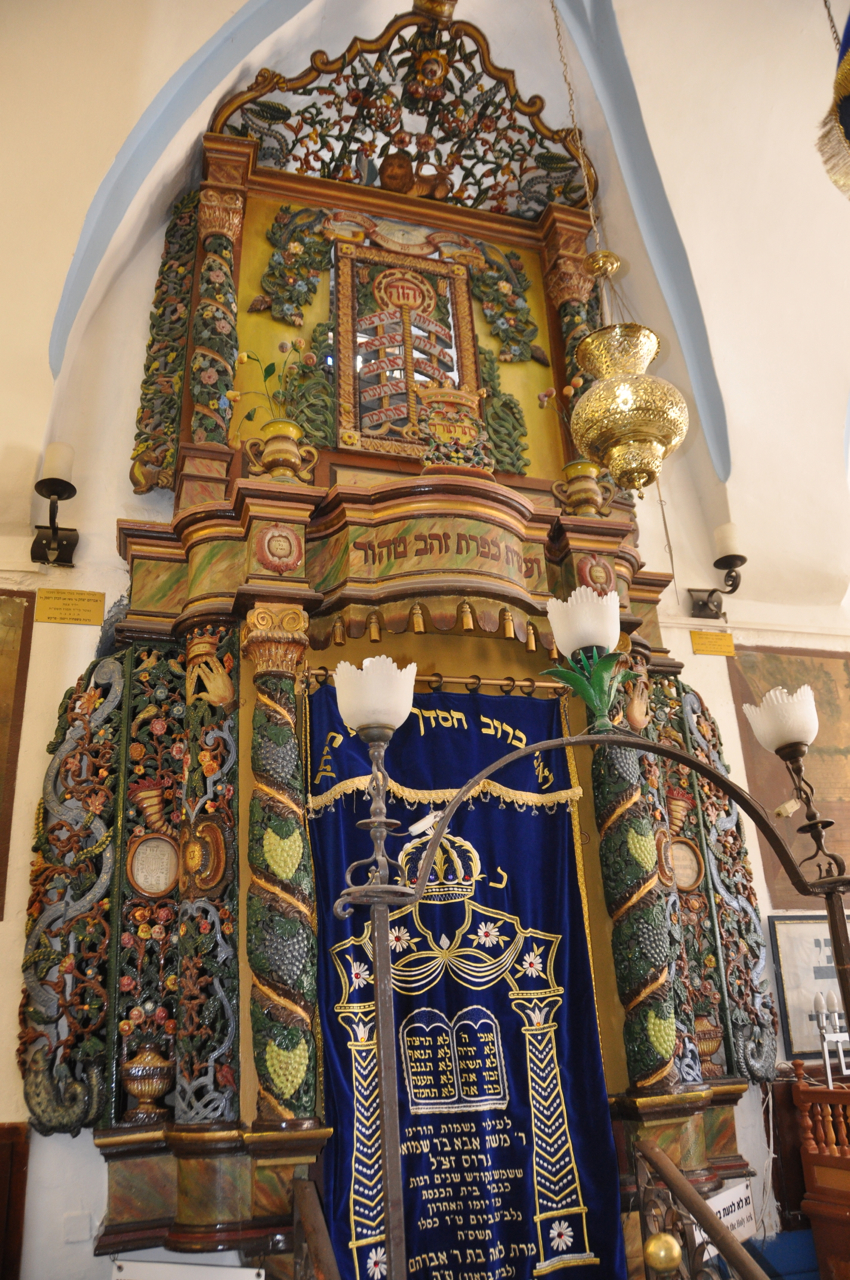
Ari synagogueThe Holy Ark was carved from olive wood by a craftsman from Galicia, Poland, in the style of the synagogues of Eastern Europe. The craftsman was a non-Jew who was unaware of Judaism’s adherence to the second commandment against graven images. At the top of the ark he placed a human face – this was transformed into an anthropomorphic image of a lion, alluding to the acronym Ari, which means lion.

Ark in Ari synagogue

The Ari Sephardic Synagogue

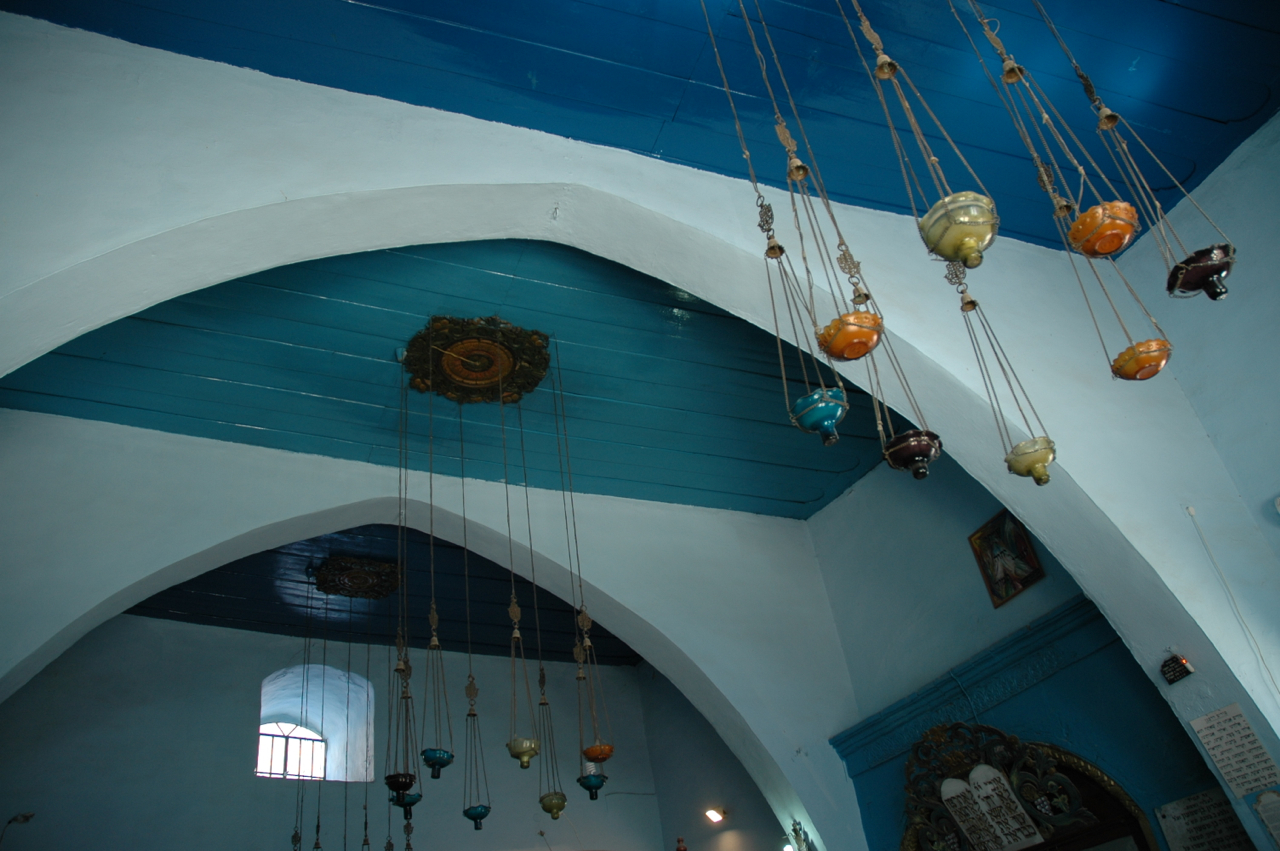
Down by the cemetery there is another synagogue, Eliyahu HaNavi, the oldest synagogue in Safed that historical sources tell us existed as early as 1522 and was used by North African Jews. The Ari frequently prayed in this synagogue, preferring this location over others because of the view of Mt. Meron and the tomb of Rabbi Shimon Bar Yohai. The Ari liked to sit in a little alcove on the eastern side of the synagogue studying Kabbalah, and that while he was absorbed in his studies, the prophet Elijah appeared to him.

Ari Sephardic synagogueMost of the structure was destroyed in the massive earthquakes that struck Tzfat in 1759 and 1837. In 1840, the Italian Jewish philanthropist Yitzhak Guetta donated money for the renovation of the synagogue.

Alsheikh synagogue

The only synagogue in Tzfat which was not destroyed by either the 1759 or the 1837 earthquake is the Alsheich synagogue named after Rabbi Moshe Alsheich, one of the foremost kabbalists of his day. He gave weekly sermons on the Torah portion of the week at the synagogue with kabbalistic commentaries to which the Ari and Rabbi Yosef Karo attended.

Alsheich synagogueThe Alsheich oversaw the construction of the synagogue which was erected in the style of 16th century Sephardic synagogues but had no women’s gallery. After 1759, the synagogue was renovated and the workmen inserted beams and peaked arches in the style of the Bukharan Jews of Samarkand which enabled it to withstand the devastating earthquake of 1837. One of the most valued items in the synagogue is the Torah scroll cover inscribed with the year 1434.

Abuhav synagogue

The synagogue is named after the fifteenth century kabbalist, Rabbi Isaac Abuhav, who is considered one of the great sages of Castile, Spain.

Tradition states that Abuhav, who never left Spain, designed the synagogue and his disciples erected the building when they arrived in the 1490s after their expulsion from Spain. Another legend claims that Abuhav came to Rabbi Ohana, a kabbalist from Fez, Morocco in a dream and asked for his help to transport the synagogue miraculously from Spain to Safed. The kabbalists gathered together at midnight in the House of Study, after fasting and immersing in the mikve (ritual bath) – in Toledo, a whirlwind with frightening power ripped up the synagogue from its foundations and set it down in an empty field in Tzfat.

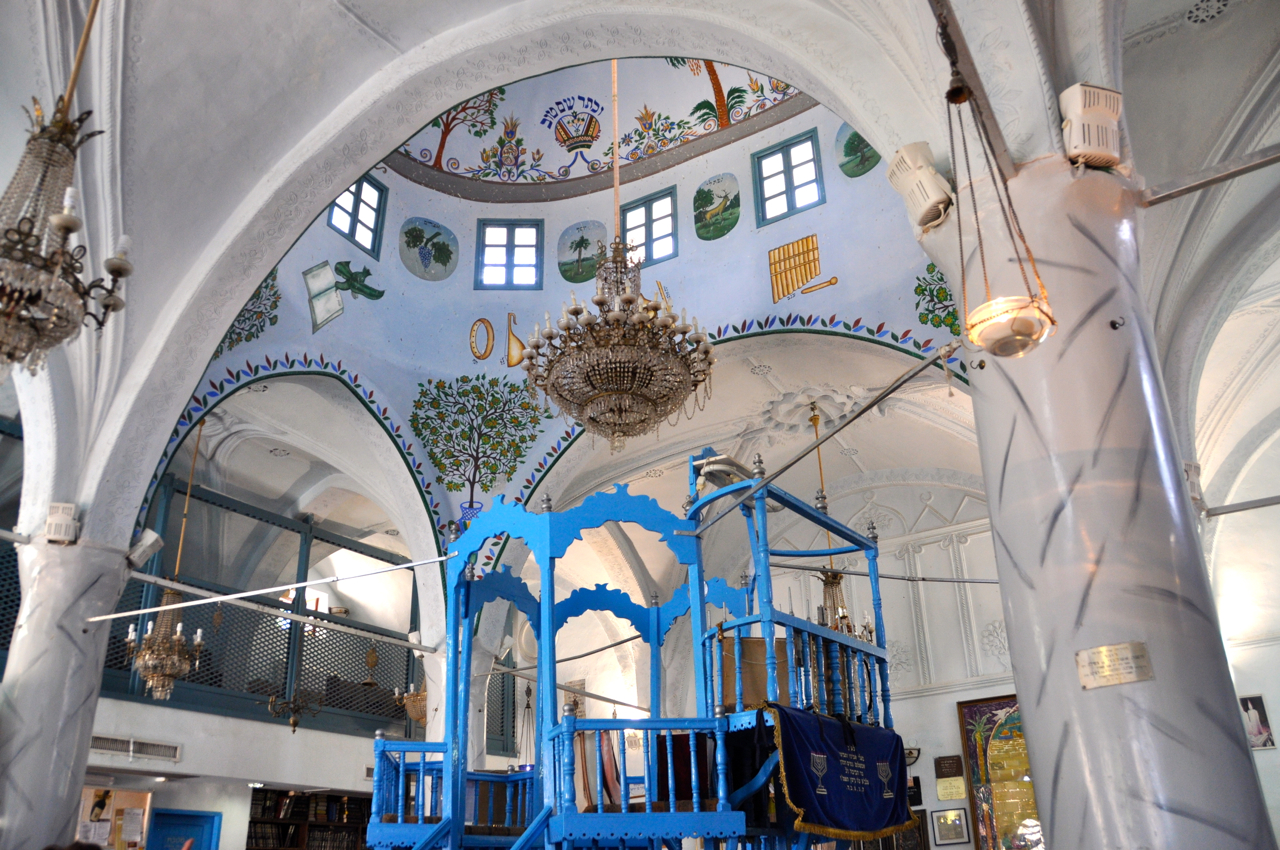
Abuhav synagogueThe synagogue has three Arks on its southern wall, the only wall left standing in the 1837 earthquake. The bima is in the center and the benches for the congregation are arranged around it, as was customary. The interior of the synagogue dome is decorated with paintings of musical instruments that were used in the Temple in Jerusalem. The crowns mentioned in Pirkei Avot 4:13 represent the crowns of Torah, the priesthood, royalty, “a good name” and a crown unique to Tzfat, the crown of redemption. In keeping with the numerological tradition of Kabbalah, the design of the synagogue has numerical significance: 1 bima, 3 Arks, 4 central columns that represent earth, water, air and fire, 6 steps up to the bima, 10 windows in the dome represent the Ten Commandments and there are pictures symbolizing the 12 tribes of Israel.

In the rightmost ark, is a Torah scroll that is 650 years old, written by Rabbi Abuhav, conceivably the oldest Torah scroll still in use. It is only taken out for reading three times a year: Rosh Hashanah, Yom Kippur and Shavuot. Among Abuhav’s pupils was Rabbi Ya’acov Beirav, who later moved to Tzfat and became one of its foremost sages. It may have been Beirav who brought the Torah scroll to Tzfat. Another Torah scroll in the Abuhav Synagogue is the scroll of Rabbi Ohana.