Tag Archives: postaweek2011

Archaeological Ruins at Cypros

The site of Cypros above Wadi Qelt occupies a commanding position overlooking the Jerusalem-Jericho highway and a spectacular view of the Jericho Plain and the Dead Sea (a good place to take photographs). Originally a Hasmonean fortress, Pompey destroyed it in 63 BCE and King Herod rebuilt it as a palace-fortress and named it for his mother, as recounted by Josephus. After 1967 the Israeli army used it as an outpost of bunkers, today it lies deserted.
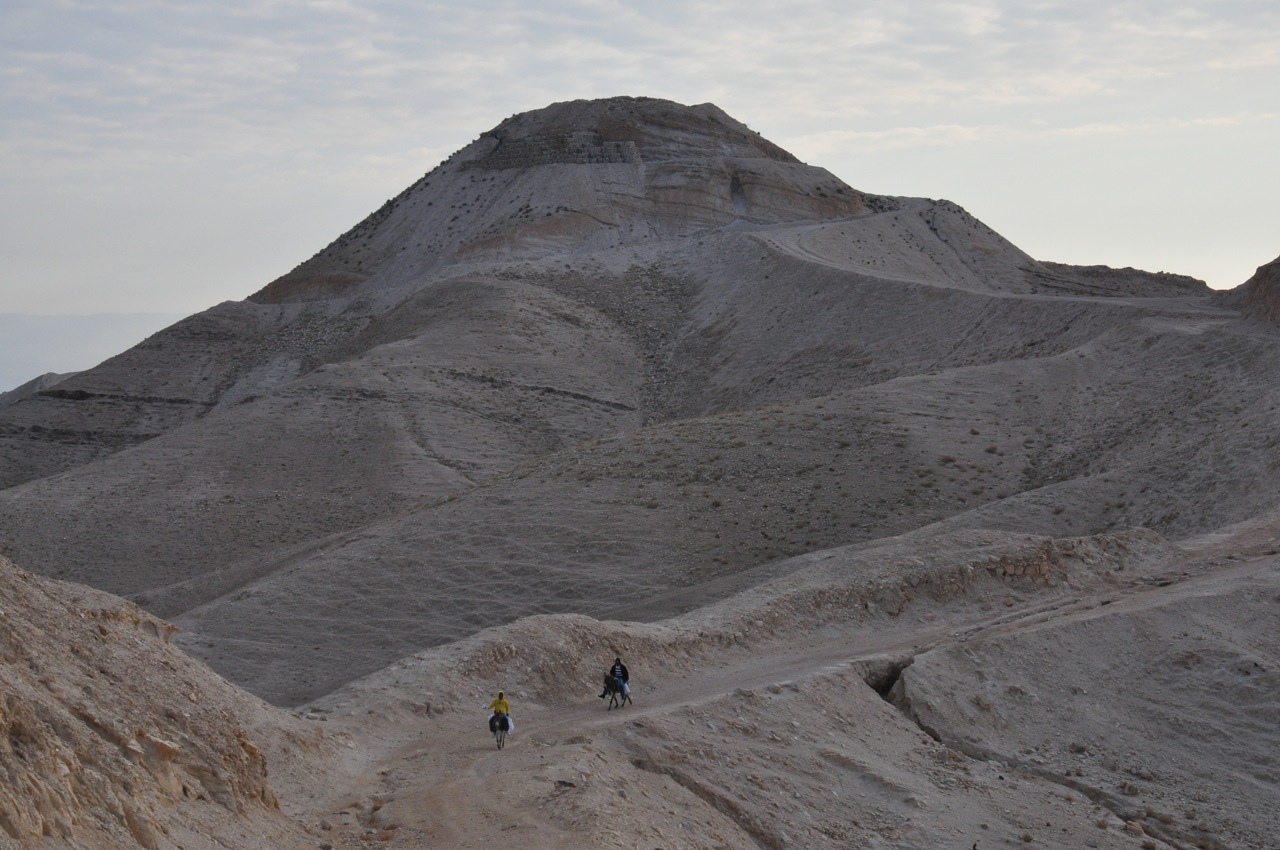
In 1974 Netzer and Damati did preliminary excavations and then left it in ruins. Cypros consists of 2 parts – a palace-fortress on the mountaintop and additional buildings 30 meters below the summit (perhaps Herod got the inspiration for the palace-fortress at Herodium from this site). It’s a short hike from the parking lot entrance to St. George’s monastery in Wadi Qelt to Cypros.
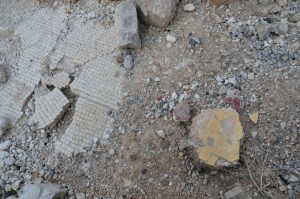
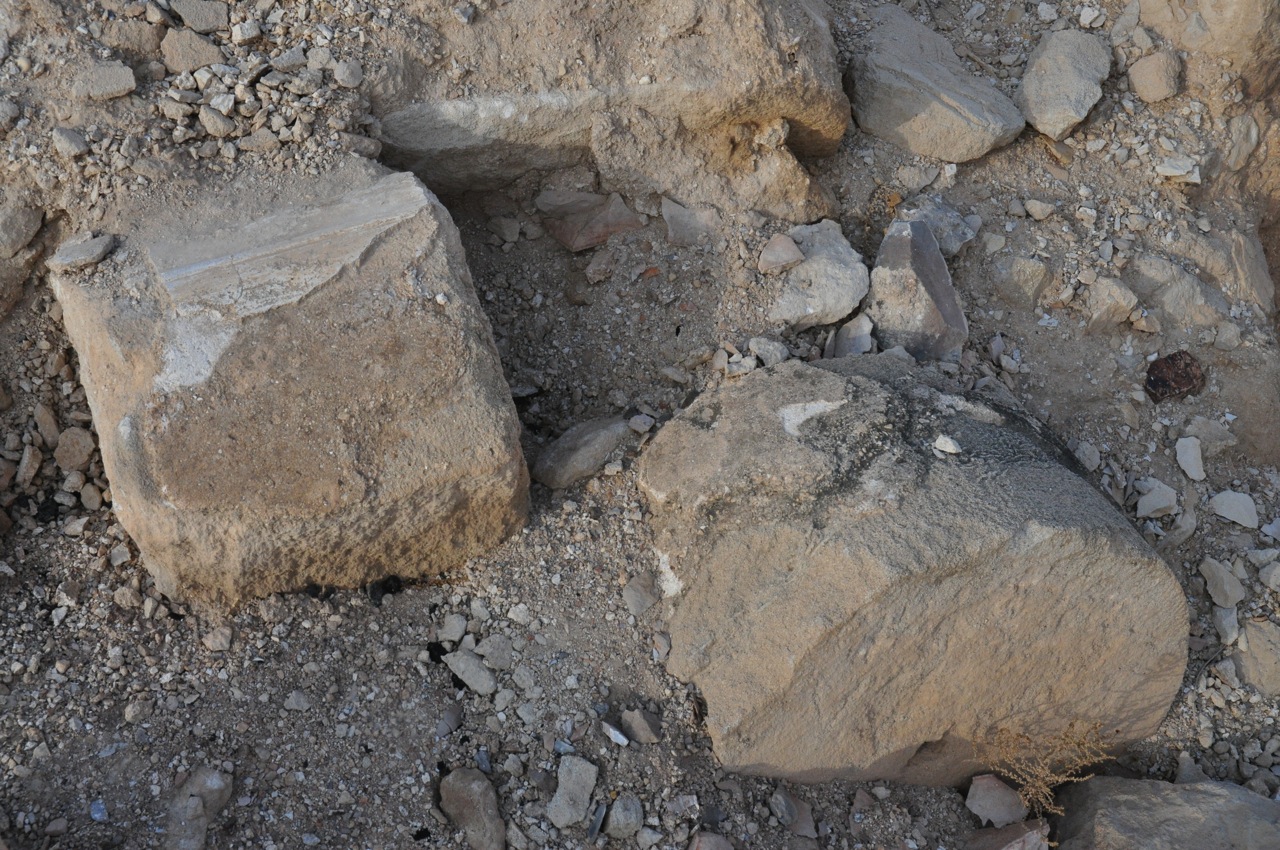
The ruins are not in good condition but there is something special to exploring a site the way an archaeologist might see it as opposed to a site that has been prepared for visitors. The remains of 2 bathhouses are still exposed, one on the mountaintop and the other below that suggest the grandeur of the site in Herod’s time. The remains of a simple white mosaic floor and pieces of plaster with red and yellow from the wall frescoes and the stone pedestals from the hypocaust floor of the calderium can be seen. There are also some sections of columns, one with some of the original plaster.
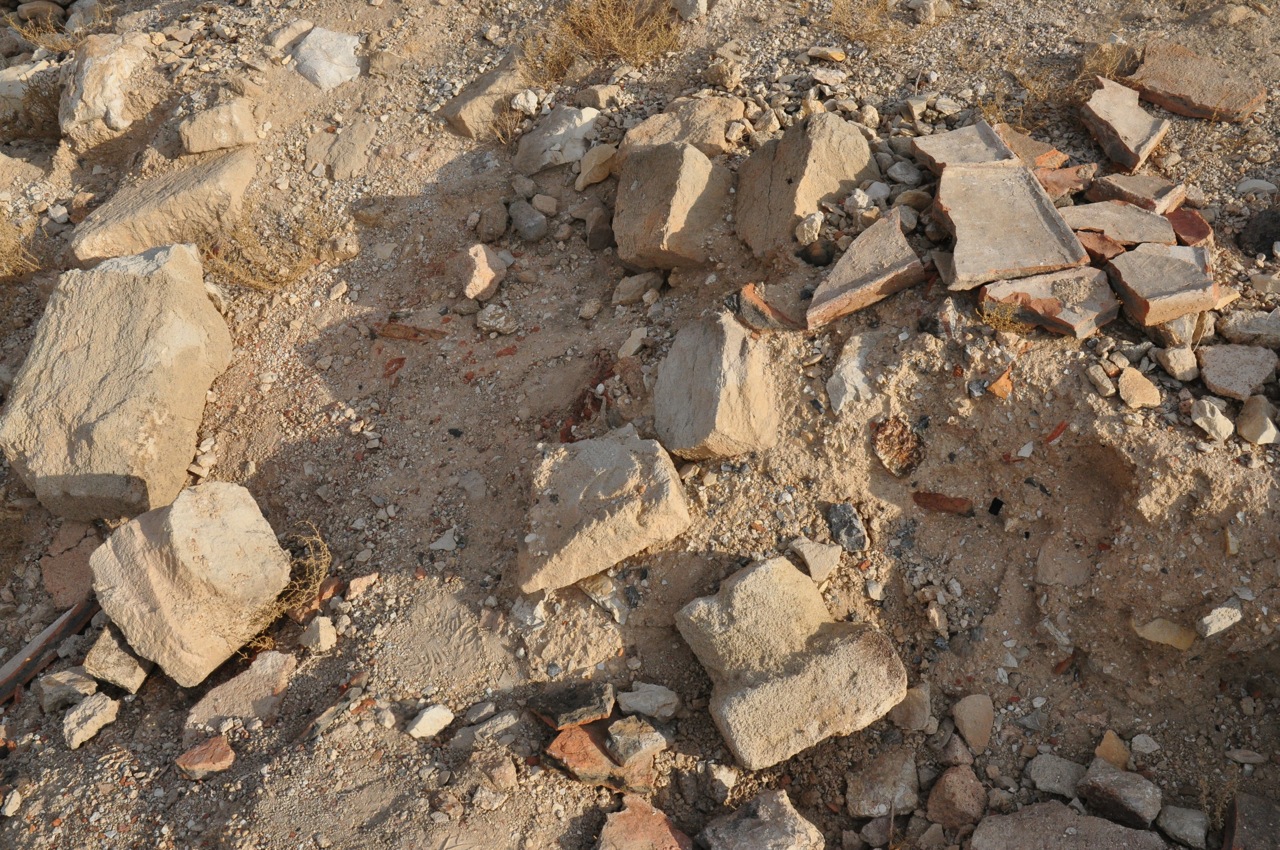

Click on the above thumbnail photos to see larger images.

Beside a mikve (ritual bath) the most unusual element found in situ, is a large stone bathtub – today its position is marked by a concrete recess, the bathtub is at the Rockefeller museum.

Down below in the bathhouse pieces of ceramic pipes that were attached to the walls of the calderium and broken ceramic discs that were piled one on another to hold up the hypocaust floor can be seen.

Walking around the site I came across a few broken pieces of terra sigillata (the first examples that I’ve found at an archaeological site), a type of fine, red-gloss Roman pottery that would have been imported from Italy or Gaul, additional evidence of Herod’s grand lifestyle.
Rosh HaNikra – Cliffs and Grottos

Geography

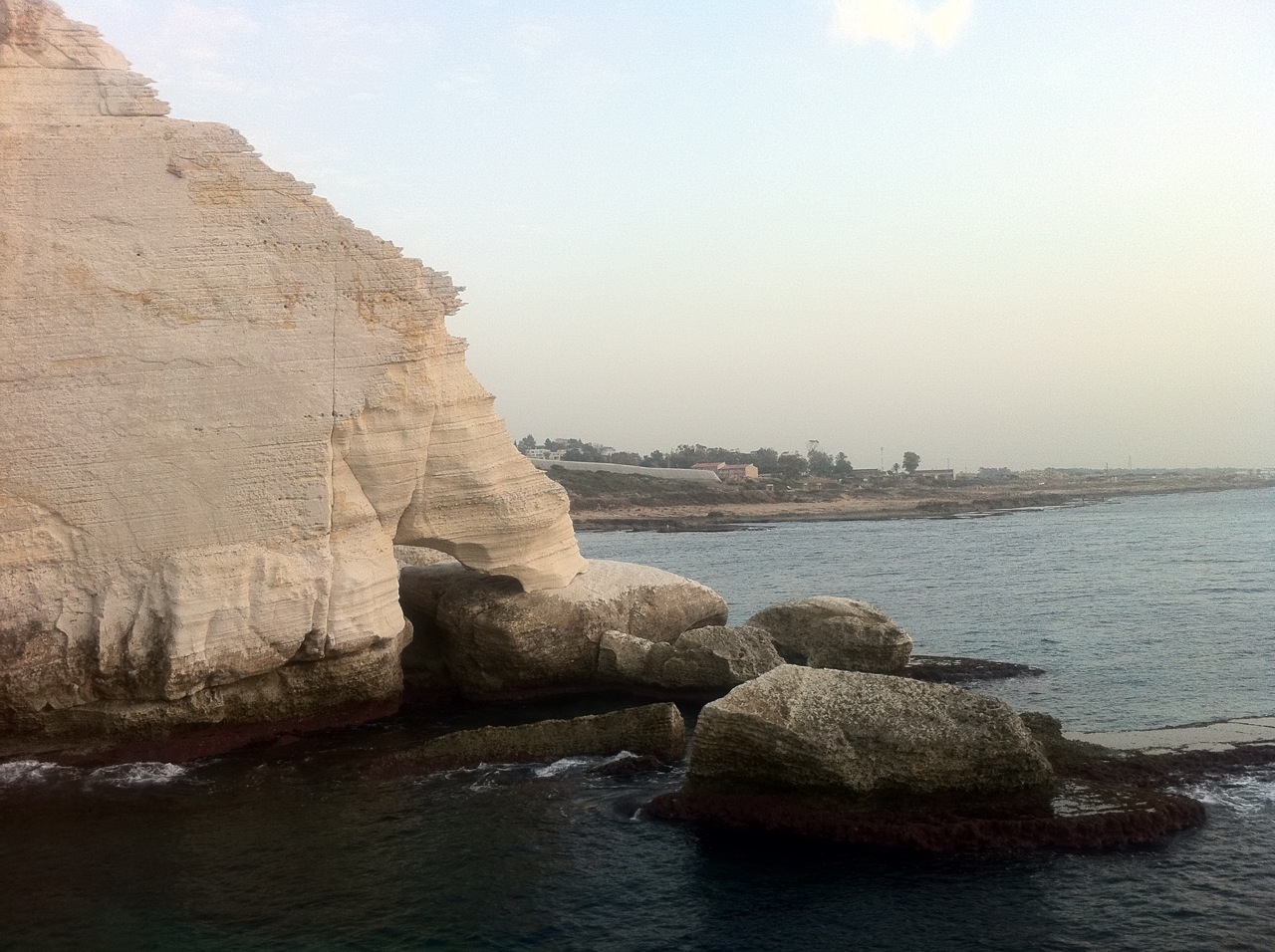
The chalk cliffs of Rosh HaNikra (Head of the Grottos: 33°5′35.24″N 35°6′17.16″E) along the Mediterranean coast mark the border between Israel and Lebanon. The cliffs are a unique geological formation in Israel, made of soft chalk, they descend from the ridge into the sea without an intervening section of beach, consequently they block and hinder movement along the coast.

The cliff consists of 3 layers of rock from the Cenoman period 100 million years ago:

  1. the bottom layer is hard limestone, most of which is under the sea,
  2. the middle layer reaching a height of 70 meters is soft chalk with dark flint and fossils embedded in it,
  3. the top layer is hard chalk and dolomite, similar to limestone.

The grottos are cavernous tunnels started by geological and biological  processes: cracks in the rock formed when seeping rainwater made small caves; duckweeds and other microorganisms on the soft chalk cause it to crumble. Crashing waves took over (with an estimated power of 250 tons per square meter during winter storms) and over thousands of years eroded the soft chalk to form the grottos.

History

Alexander the Great in 323 BCE passed this way, then the Selucids and Ptolemies and later the Arabs, then the Crusaders. The British army cut a road for vehicles during WWI; in 1943 they blasted three tunnels through the cliff joined by a bridge over the grottos so trains could carry soldiers and supplies between Cairo and Istanbul. On the nights of June 16 and 17, 1946, under cover of darkness and cloudy weather, the Carmel unit of the Haganah blew up the bridge during the operation Night of the Bridges. In one night the Haganah destroyed eleven bridges linking Palestine to the neighboring countries Lebanon, Syria, Jordan and Egypt, immobilizing transportation and a blow to British prestige. Twelve days after the attack the British authorities retaliated by imposing a curfew on Jewish communities and launching a security operation known as Operation Agatha or Black Saturday. With the involvement of 100,000 British troops they arrested 2,700 Jews, including many in senior leadership positions. In addition the British confiscated important papers about the Jewish underground which were taken to military headquarters at the King David Hotel in Jerusalem. On July 22, 1946, the Irgun in consultation with the Haganah bombed the King David Hotel. When the telephone warnings went unheeded and the hotel was not evacuated, 92 people were killed and the southern wing of the hotel destroyed.

Rosh Hanikra was the site where in 1949 Israeli and Lebanese officials signed an armistice agreement ending the War of Independence.

In the past, the only access to the grottos was from the sea and experienced divers were the only ones capable of visiting. In 1968, a tunnel was hewn into the cliff to give access to the grottos and then a cable car, “the steepest in the world” was installed to take visitors up and down. If you like cable cars, try to ride the other 3 in Israel, at Masada, Menara cliffs and from Bat Galim up to Stella Maris – all have great views (so don’t forget your camera)!

There is also a promenade along the shore that follow the British railroad tracks, through the Rosh HaNikra nature reserve to the Betzet beach, where every year giant sea turtles lay their eggs. Along the way, you can see some pools that the Phoenicians quarried and used to evaporate seawater to get salt,  grow snails for the blue techelet and purple dyes and as wine vats.

Caesarea-Maritima, Herod’s Promontory Palace

On the Mediterranean coast, 40 km north of Tel Aviv was a small, sleepy Phoenician town founded about the 3rd C BCE with a modest port called Strato’s Tower. All that changed when King Herod chose the site for the development of a large, protected harbor that could be used year round. This boosted trade and commerce (and made a lot of money for Herod) and enabled closer ties with the centers of the Roman empire. Caesarea was a well-planned urban center, a walled city with streets laid out in a grid, warehouses, a Roman temple, a large theater (the first one in Israel according to Netzer), a stadium/hippodrome, public baths and according to Josephus several palaces. There was plenty of water for the city brought by an aqueduct and later in the time of the Emperor Hadrian by a second aqueduct built by the Tenth Roman Legion. To date, only a small percentage of the city has been excavated.

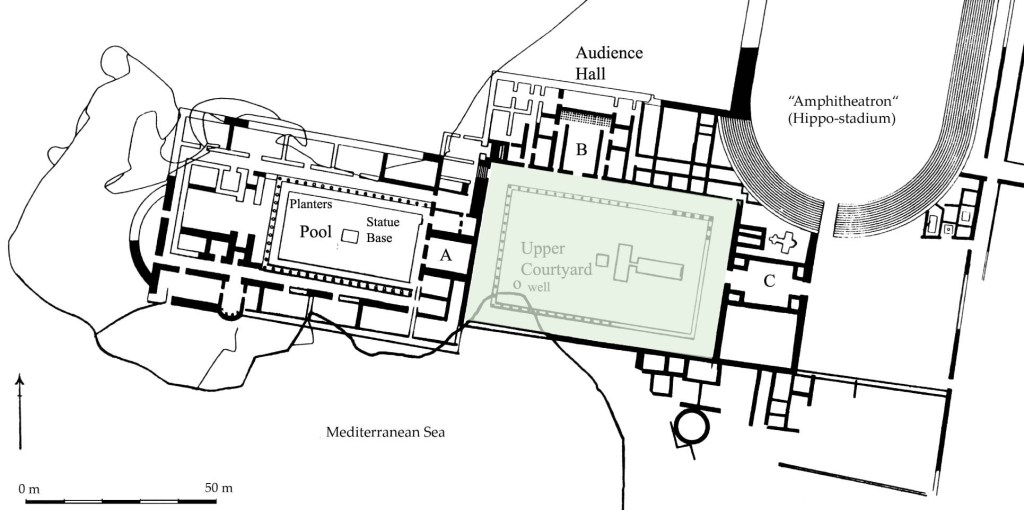
In Josephus there is a detailed description of Herod’s palace, preceding even the harbor which was an exceptional feat of engineering and probably a great source of pride to Herod. Its location on a promontory jutting 100 meters out into the sea makes it another of Herod’s unique palaces. The placement of a pool in the center (where one would expect to find an internal courtyard) shows Herod’s exceptional building style. The other two natural promontories at Caesarea were used to anchor the harbor. All of the pool is hewn into the kurkar sandstone bedrock, coated with hydraulic plaster and from the outset was filled with fresh water and was intended for swimming and bathing. Evidence that pozzolana cement was used in the construction of features of the pool is further evidence that it was constructed at the same time as the harbor.

Some scholars regarded the pool as a fishpond and the entire structure a piscine, or fish market of sorts based on a network of open channels, intermediate pools and sluices linking the pool with the sea but according to Netzer this was at a later stage, 600 years after Herod when the pool was put to secondary use. Many fallen drums, pedestals and capitals were found at the bottom of the pool presumably from rows of columns that framed a peristyle courtyard. The pool is bordered on the east by the triclinium (formal dining room) and on the west by additional rooms closer to the sea. The floors of the triclinium and smaller rooms on each side had elaborate, geometric mosaic floors.

Plan of the Promontory Palace (J.H. Williams and A. Iamim): a) first phase (c. 22-15 BC) ; b) second phase (c. 15-4 BC)
From https://www.baslibrary.org/biblical-archaeology-review/19/3/7

Additional excavations in 1976 followed the development of the east wing during the Roman period. Beside the triclinium was added a small caldarium, whose hypocaust and furnace were well preserved. One of the tiles of the furnace has the stamp of the Legion X Fretensis. Excavators found two inscribed marble columns with six dedicatory inscriptions that reveal important new information about officials of Caesarea from the 2nd-4th C CE.

Caesarea was battered by a strong storm in December 2010 (see Haaretz article) and 1000 year old artifacts were swept into the sea and lost forever (on my recent visit to the park I saw Park Authority staff working to cleanup the damage to the palace).

Besides the architecture there is also the human drama. Josephus describes many incidents in peoples lives that happened in Herod’s palace. Agrippa I died in the palace after opening the Games and blaspheming in the stadium (Acts 12:20-23). A hall in the Upper Palace was the destination of the apostle Paul for a hearing before Antoninus Felix (Acts 23:35.). Later, Herod Agrippa II and his sister Berenike visited a new governor, Porcius Festus, and heard Paul’s self-defense there (Acts 25:23). Josephus relates a demonstration outside of the palace demanding the removal of Roman standards with the images of humans and animals from Jerusalem. Pilate had the Jews held in the stadium and threatened to kill them but backed down. Found in secondary usage at the theater was a dedicatory inscription inscribed with the name Pilatus (there is a copy in the peristyle courtyard of the palace, the original is on display at the Israel Museum).

Hurva Synagogue views

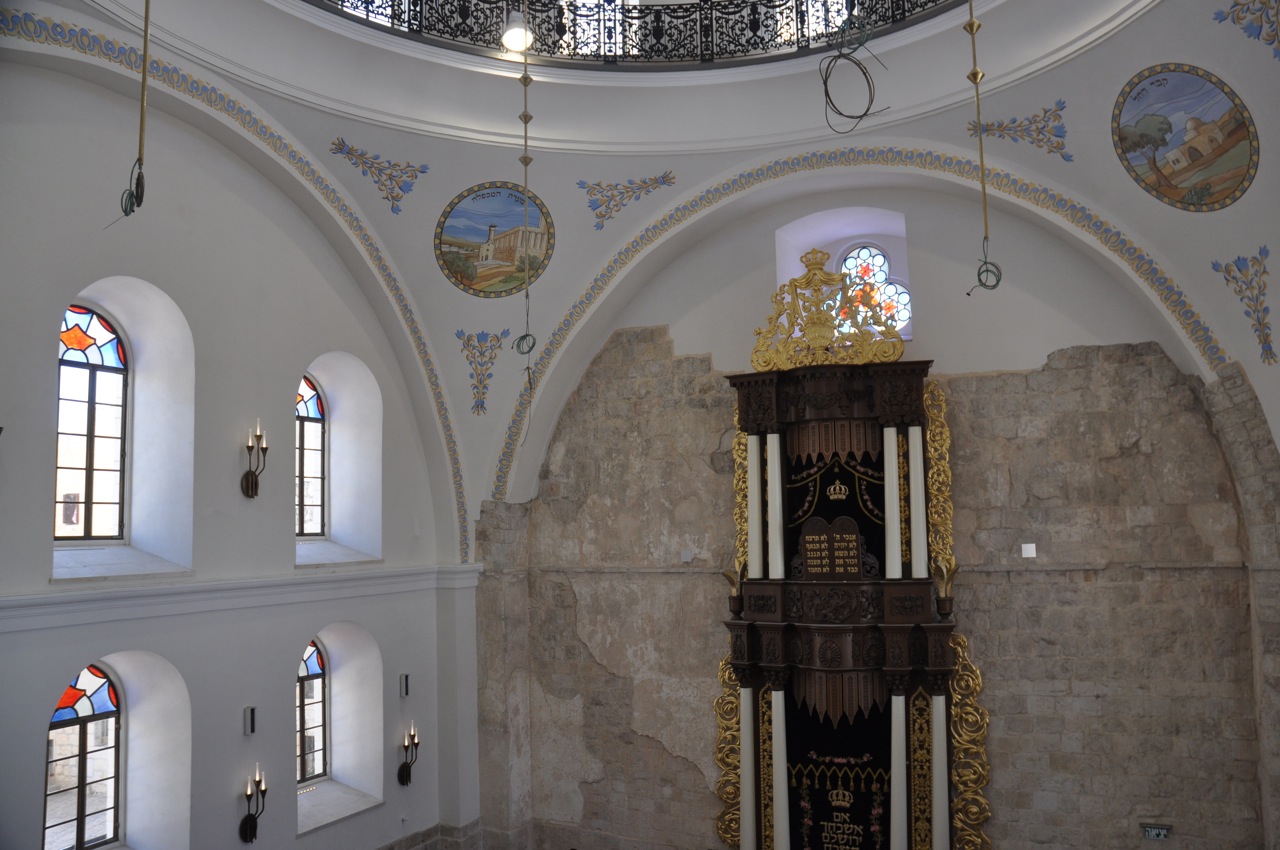
The Hurva was the main Ashkenazi synagogue of the Old City and stood as a landmark for almost 100 years until it was blown up by the Jordanian Legion after they had captured the Jewish quarter on May 27, 1948. It took until 2005 to decide to rebuild the synagogue which was completed in March 2010. I visited it shortly afterwards on a Shabbat morning for services. Make sure to go down into the basement (by the washrooms) to see the discovery of a mikveh (ritual bath) from the Second Temple period and an east-west Byzantine street. The second time I joined a weekday tour of the synagogue but we weren’t allowed into the main sanctuary. The guide was only able to show us the inside of the synagogue from the women’s balcony but we were allowed to go up to the roof. The Hurva synagogue is the only site that I am not permitted to bring people (therefore I skip the Hurva and tell its fascinating story outside) – that privilege goes to local guides that work for the Western Wall Heritage Foundation and you have to reserve a place in advance.

One of the highlights was the view of Jerusalem from the balcony around the dome. Here are 5 photos (shooting clockwise) taken from the height of the dome: 1) looking towards the Christian quarter, domes and bell tower of the Church of the Holy Sepulcher, bell tower of German Church of Redeemer and dome of Alexander Nyevsky Church, 2) view over the Jewish and Muslim quarters with Mount Scopus in the background, 3) Dome of the Rock, Mormon University and Augusta Victoria, 4) dome of Al Aqsa Mosque and Jewish cemetery on Mount of Olives 5) view towards Armon HaNatziv, Mount Zion, Dormition Abbey, Armenian quarter.

This slideshow requires JavaScript.

Mosaics at Inn of Good Samaritan

On the main highway <1> between Jerusalem and Jericho is a site identified with the Inn of the Good Samaritan (mentioned in the parable in Luke 10:25-37). Remains from the first century BCE to the first century CE were found throughout the area. Abundant finds from this period include pottery, clay lamps, glass vessels, metal implements and numerous coins attesting to intensive activity that befits an inn for Jewish and then Christian pilgrims and travelers making their way between Galilee and Jerusalem.

Byzantine artifacts

In the Ottoman period, a rectangular structure was built over the southern wall of the Crusader fortress. This building underwent numerous alterations and was restored after being damaged during WWI. It served as a roadside inn guarding the Jerusalem-Jericho road from attacks by brigands as it had for centuries.

Since the parable of the good Samaritan includes men of three faiths, the newly opened museum has chosen to display the mosaic floors and other artifacts found in churches and Jewish and Samaritan synagogues in Judea, Samaria and Gaza, you can see part of the mosaic floor of a 6th C Jewish synagogue that stood in Gaza (I even got to do some conservation work on the mosaic).

It is fascinating to see the similarities and differences among the images displayed in mosaic.

Mosaic Khirbet Huriya

The art of mosaic began in the Greek world around the 4th C BCE and reached Israel during the Hellenistic period. It continued to develop and by the end of the Second Temple and Roman periods simple, plain and geometric mosaics became more ornate, complex with representations of flora and fauna, people, instruments, religious symbols. It became the chief means of paving public buildings, private homes, bath houses, churches and synagogues.

Places Nearby

Take the cutoff to Maale Adumim to visit the Martyrius monastery (there is a combined entrance ticket; note you need to phone in advance), the largest in the Judean desert. Inside the complex the main church was paved with colorful mosaics in geometric patterns interspersed with pictures of animals; the refectory floor, discovered intact, is covered with mosaics in geometrical designs and the kitchen was also paved with mosaics.

On the opposite side of the road along Wadi Qelt visit one of Herod’s fortresses, named after his mother, Cypros. There are 2 bath houses with remains of mosaic floors.

If you are planning a trip down to the Dead Sea and Ein Gedi don’t forget to take a few minutes to check out the mosaic floor in the synagogue (your entrance ticket to the nature reserve is good for the archaeological park). The synagogue has a detailed 18 line inscription in Hebrew and Aramaic including the 12 signs of the zodiac (indicated by their names but not depicted graphically as in most other synagogues of the same period, eg. Tiberia, Bet Alfa, Tzippori). The central hall has 4 birds within a medallion, peacocks grasping a bunch of grapes, a menora and geometric patterns.