Category Archives: Desert

Mar Saba, a Judean Desert Monastery

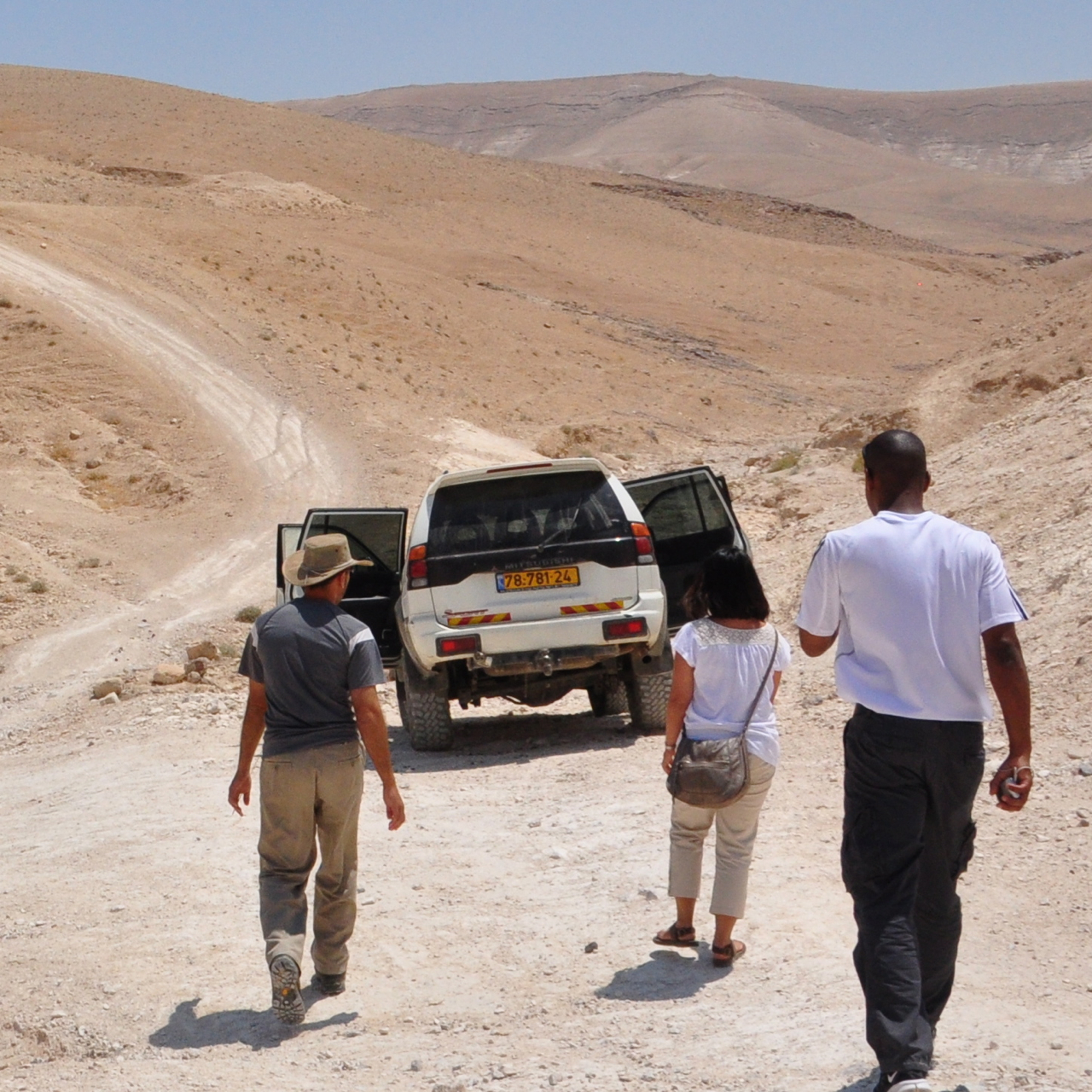
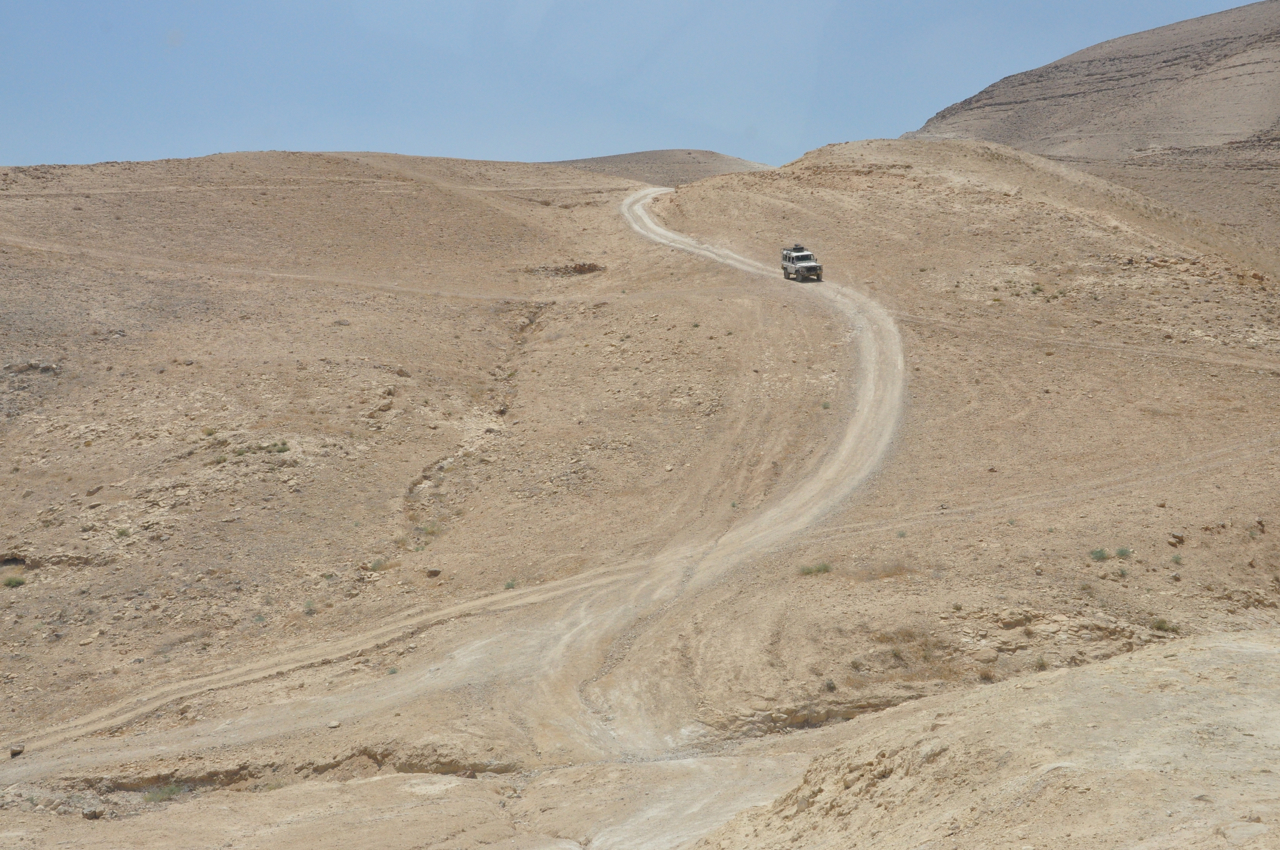
Jerusalem sits on the edge of the Judean desert which make exploring this area a great day trip. It’s a fun adventure to take a jeep and drive off road where all you see is a barren landscape and suddenly bump into camels or have a a cluster of buildings come into view over the hill. It’s also a great place for a photo shoot.


Christian monks came to the quiet of the Judean desert in the early 4th century identifying with Moses, Elijah, Jesus and others who spent time here. Mar Saba, who lived at Euthymius for 12 years before receiving permission to live alone in the desert, found the spring and caves in the Kidron valley. Some 15 years later, in 483CE he built a laura, a cluster of caves for hermits around the monastery, that bears his name to this day.

This is the largest monastery complex in the Judean desert, multiple buildings enclosed by a wall and tower for protection. He directed it for 50 years. At its peak it accommodated hundreds of monks, today there are about 20 monks who live there. Women are not allowed inside the monastery, the closest they can get is to view the complex from the Women’s Tower; interesting that meat and apples are also prohibited.

As a guide, I can take you to experience the desert and discover that isolated monastery in the Kidron valley.

For more information about Mar Saba, including photographs inside the compound see the entry at the excellent BibleWalks site http://www.biblewalks.com/sites/MarSaba.html

It’s worth combining a visit with other sites in the area, the monastery of St. George tucked into the cliff in Wadi Qelt, the monastery of Euthymius and Martyrius, in the midst of an Industrial park and housing project respectively, museum of mosaics at the Inn of the Good Samaritan and Qasr el Yahud, the site on the Jordan River where according to tradition John baptized Jesus.

Dead Sea Shrinking

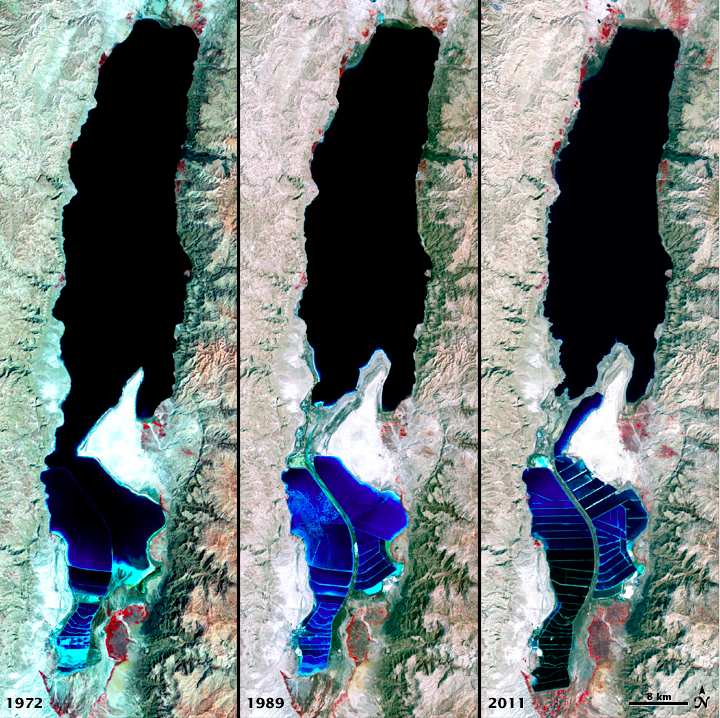
Dead Sea Shrinking (1972, 1989, 2011)

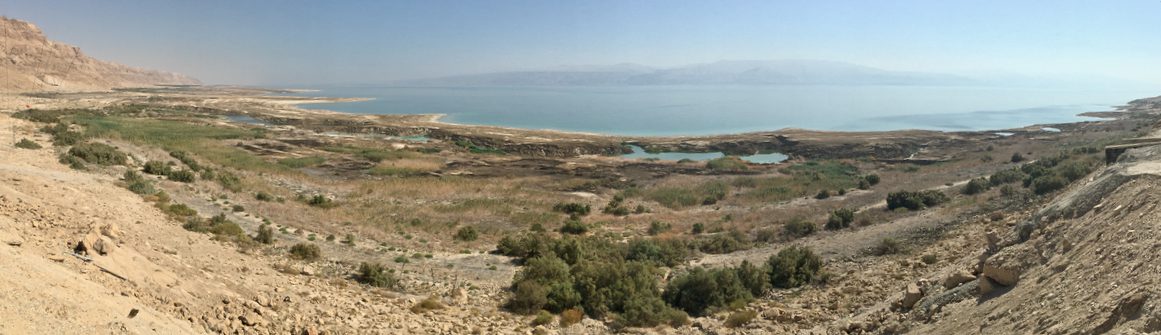
The Dead Sea is less than an hour drive from Jerusalem so it’s an area that I guide often. I always point out the two black lines on the rocks to the right of the highway across from Ein Feshka, the levels of the sea as recorded by the Palestine Exploration Fund in the 1920s and explain that the Dead Sea is shrinking by a meter a year. I usually get asked how the Dead Sea has changed over time. These satellite photographs from Nasa’s Earth Observatory website show it clearly.

The false-color images above were captured by the Landsat 1, 4, and 7 satellites on September 15, 1972, August 27, 1989 and October 11, 2011.
All three images include a combination of near-infrared, red, and green wavelengths. Deep waters are blue or dark blue, while brighter blues indicate shallow waters or salt ponds (in the south). The pale pink and sand-colored regions are barren desert landscapes, while green indicates sparsely vegetated lands. Denser vegetation appears bright red. Near the center is the Lisan Peninsula, which forms a land bridge through the Dead Sea.

For more information about the Dead Sea check out my blog post here.

Hiking Nahal Mikhmas

On Monday we drove out of Jerusalem on highway 437 past Pisgat Zeev to get to the starting point of our hike in the northern Judean desert. On the way, about 5km north of Jerusalem on the left along the watershed ridge at 839m above sea level is Gibeah (of Saul) or Givat Shaul usually pointed out as the location, Tel el-Ful, where King Hussein of Jordan began construction of his Royal Palace in the 1960s.

The site has a number of important Biblical/historical references:

• The Concubine of Gibeah, and the ensuing Battle of Gibeah between the Israelite tribes against Benjamin (Judges 19-21)

• Israel’s first king, Saul, reigned from Gibeah for 38 years (1 Samuel 8-31)

• Prophetic mention during the period of the Divided Kingdom (Hosea 5:8, 9:9, 10:9; Isaiah 10:29)

• The encampment of the 10th Roman Legion in their assault on Jerusalem in 70CE (Josephus, War of the Jews)

Just before we arrived at our destination on the right we passed another site, Qubur Bani Israel (Tombs of Children of Israel), 4 large narrow rectangular walled structures measuring 15 by 3 meters which rise from a rocky plateau overlooking Wadi Qelt. The megaliths still have two or three rows of gigantic, rough-hewn stones carefully in place. The name refers to the site being an ancient Jewish burial ground in the territory of Benjamin; archaeologists estimate the date as 2000BCE. A theory proposed by Noga Reuveni (who also established the biblical gardens of Neot Kedumim) is that in fact this site marks the tomb of Rachel who was buried “on the road to Efrat, now Bet Lehem (Bereishit 35:19)”. There is a city Farah settled near the spring Ein Farah that is mentioned among the cities of Binyamin (Joshua 18:23) and it is not unreasonable to posit that it was alternatively called Efrat (same Hebrew root). Since the city was in an area of wheat and barley, it was later renamed (like other cities) Bet Lehem. This also matches the description to Saul before his return home to Gibeah.

When you leave me today, you will meet two men near the tomb of Rachel in the territory of Benjamin (1 Sam. 10:2)

This should have been a clue that this was not going to be just a nature hike.
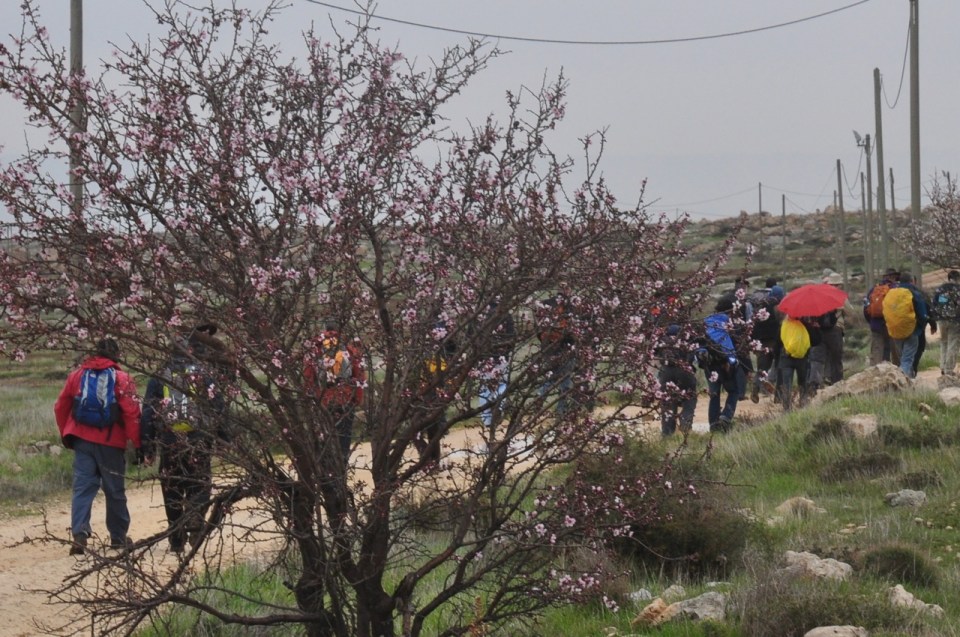
We started hiking from Geva Binyamin, also called Adam. Because the area is in Judea and Shomron/the West Bank we had to arrange clearance with the army and get the security officer to open the gate from the settlement. Geva Binyamin was founded in 1984 and in 2007 had a population of 3500 people. It sits between the Arab towns of Jabah and Mikhmus that recall the towns of Geva and Mikhmas mentioned in the Bible.

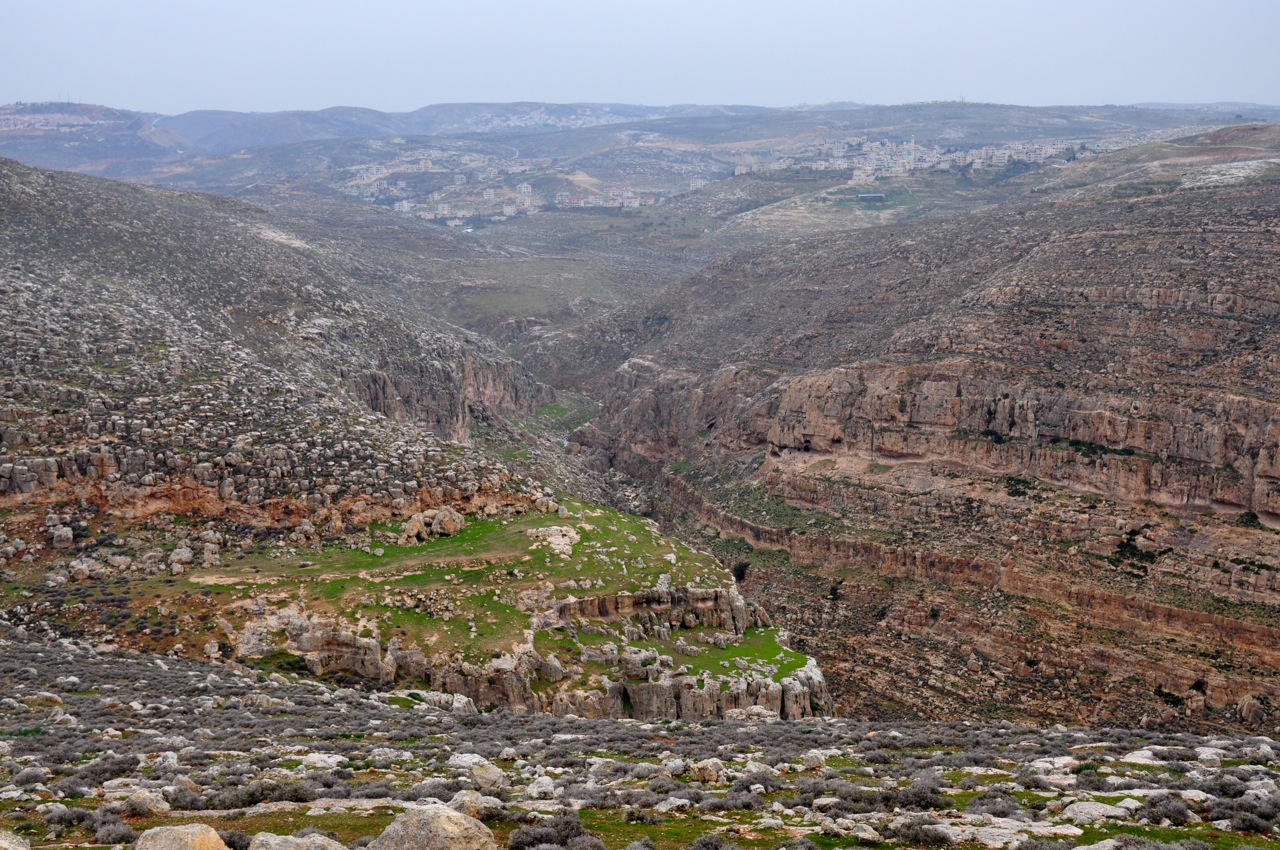
Open a TaNaKh and read 1 Samuel, chapters 13 and 14 for the account of the battle between King Saul and his son Jonathan against the Philistines. The Israelite forces are camped at Geva and the Philistines are on Mikhmas with the wadi separating them. Jonathan sneaks out of the camp at night and hidden by the deep walls of the canyon makes his way to the Philistine garrison… We were standing on the ridge reading the account of the battle, overlooking the area where it took place.

The black trail follows the ridge above Nahal Mikhmas. Hidden among a pile of rocks is the spring of Ein Suweinit. Many caves can be seen and we stopped at two of them, El-Jai is one of the largest in the Shomron.

From there we descended the steep cliff to the nahal, actually quite challenging because of the slippery rocks and mud.

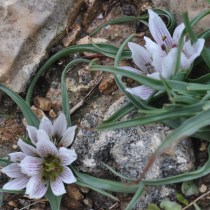
Because of the rains we saw two flowers, the tiny purple Grape Hyacinth, in Hebrew, Kadan and bunches of white Desert Bulbs, Bezalziya.

Dark Grape Hyacinth (Muscari commutatum), also bulb, cluster of tiny flowers like jugs that hang upside down to protect the pollen from rain.

A rosette of grey-green leaves emerges before the flowers, 6 petals with a stamen on each, blooms for 5-6 weeks which is long for bulbs, grows among rocks to protect the bulbs from being dug up by porcupines and other animals.
Where Nahal Mikhmas joins Wadi Qelt the trail changes to red and we followed it to the left/east to Ein Mabu’a/Ein Fawwar. This spring is an artesian or karstic fountain, which flows from a cave into a round concrete pool built by the British in the 1920s. Until the Six Day War, the water was pumped to East Jerusalem, but today it is no longer used. In the Second Temple period an aqueduct brought water to the fortress at Cypros and there is a mosaic floor from a Byzantine church. If mosaics interest you then visit the nearby museum at Inn of the Good Samaritan.
Hiking the Makhtesh

Approximately 50km from the development town of Dimona named after the Biblical city of the same name mentioned in Joshua 15:21-22 are two examples of makhteshim or erosion cirques, unique to the Negev and Sinai deserts. So far geologists have only identified 7 makhteshim, Makhtesh Ramon, Makhtesh HaGadol, Makhtesh HaKatan and two even smaller ones on Har Harif in the Negev; there are two in the Sinai. One of the special things about the Makhtesh HaKatan is that because of its small size you can view it in its entirety, a 5km by 7km oval shaped bowl with steep walls of resistant rock, in this case limestone and dolomite that covered a softer layer of chalk and Nubian sandstone that comes in colors of pink, purple, yellow and green.

There are two access points into the makhtesh, Maale Hatzera on the northern wall is more gentle, an ancient camel pass and Maale Eli. We started our hike from Maale Eli a route originally discovered by local Bedouin that traverses the steep limestone (from the Cenomanian epoch 100 million years ago) walls of the makhtesh connecting the floor of the makhtesh with Hatzera Ridge. I’ve heard various reasons for the name – Eli means upper from the same root as ascend; Eli means pestle to the bowl-shaped mortar of the makhtesh. In fact, it is named after Eli Ben Zvi, son of Rahel Yanait and Yitzhak Ben Zvi who was the second president of Israel. Eli was wounded during a training exercise with the Palmach in the makhtesh in the 1940s and this ascent was discovered in evacuating him to the nearest road joining Beersheva to Maale Aqrabim, the Scorpion Ascent built by the British. Like Masada the Makhtesh HaKatan became a symbol of knowing the desert and the land of Israel by a people who had come home after 2000 years of exile.

We descended the steep walls of the makhtesh on a serpentine trail with the aid of rungs and railings, 400 meters to the floor of the makhtesh. From there we followed the red trail east (also marked as part of the Israel trail) passing hills and cliffs of colored sandstone to the mouth/exit of the makhtesh. The colors are produced by iron oxides, the sand from erosion of the Arabo-Nubian Massif carried all the way here by riverbeds. The hike is suitable for good hikers and should take about 4 hours.

By the paved road that leads to the exit is an electricity tower and piled at various levels are branches that look like the nest of some large bird – they were deposited there in 1994 and 2004 when there were torrential rains and the water reached that high.

For those looking for a long day hike you can follow the Israel trail starting at the Tamar fortress and descending into the makhtesh at Maale Hatzera. You walk south on the blue trail to the mouth of the makhtesh and when you get to the water pumping station you take the red trail west across the makhtesh climbing up at Maale Eli. Continuing another 10km to the Makhtesh HaGadol will take you past the spring of Ein Yorqeam, definitely worth a visit.

The British figured that it would be worth drilling for oil in the makhtesh, erosion has already gotten rid of the hard rock and hundreds of meters of sand. They did not find any but for the same reason it is worth drilling for water. The sand in the makhtesh acts as a large aquifer though the water is quite salty. The water is piped to a reservoir on Mount Tzafit from where it is used by industries on the Rotem Plain.

Hiking Nahal Og

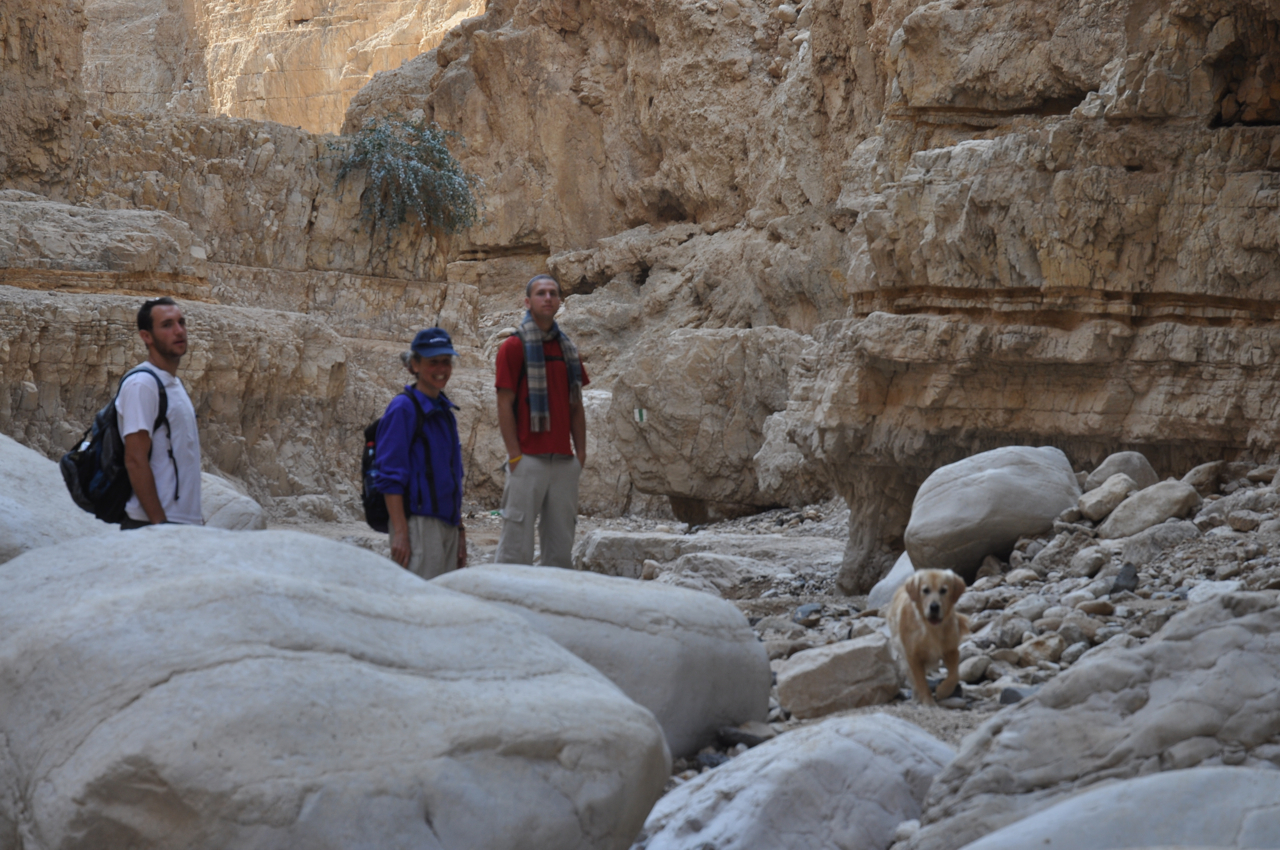
This is a real gem of a hike. Nahal Og is less than a half hour from Jerusalem in the Judean desert. It’s picturesque in a rugged, desert kind of way so it’s a good opportunity for taking photographs of the scenery and of course your family/group.

You might find that parts of the hike are challenging but this is a hike that is doable by parents and kids. There are three places where metal rungs have been hammered into the rock to give you hand and foot holds to help you traverse the steep rock faces. In the winter months there will be parts of the trail that have filled with water that you will have to cross.

The trail is a loop so you end back where you parked your car and in fact, you can do the trail in either direction, depending on whether you want to ascend or descend the rungs. Most people find that climbing up the rungs is easier than going down. The hike itself should take you about two hours.


To fill out your day combine the hike with one of the many other attractions in the area, the mosaics at the Inn of the Good Samaritan, St George’s monastery in Wadi Qelt, the archaeological site at Qumran, a float in the Dead Sea.

Hiking Wadi Qelt – St George Monastery

Hiking Wadi Qelt is best in the early morning on the way down to the Dead Sea, a great place to experience the Judean desert and for photographs of the desert landscape.

From Jerusalem on highway <1> take the left at Mizpe Yericho, left again and left at the T. Park the car here for a great view of Wadi Qelt/Nahal Prat. Follow the black trail down to the stream bed. Here you will see the remains of the stone arches of the bridge of the aquaduct.

Continuing another 450 meters you’ll come to a wooden bridge that crosses Nahal Prat and to your left is the Ein Qelt pool. There are two possibilities from here: hike west along the streambed to a string of pools in Lower Nahal Prat or east along the red trail which will take you after about 2 kilometers to the monastery of St George of Koziba perched on the northern cliff.

From the monastery you can climb up to the road where you drive back to the highway or continue to the ruins of Herod’s fortress at Cypros.

Christian monks began to settle in the Judean Desert in the early 4th century identifying with Moses, Elijah, Jesus and others who spent time in the desert, as a respite from the secular world. By the fifth to seventh centuries, there were some 65 monasteries in the area: St. George, Martyrius, Euthymius, Deir Hijla, Mar Saba can be visited to this day.

Originally founded as a laura, a cluster of cells or caves for hermits about 420 CE, a small chapel was added later and about 480CE St. John of Thebes transformed the site into a monastery. In the 6th century it became known as St. George under the leadership of Gorgias of Koziba, born in Cyprus about 550 CE. The Persians destroyed it in 614 and it was rebuilt during the Crusader period but abandoned when the Crusaders were defeated and was reported in ruins by a pilgrim who visited in 1483. In 1878 a Greek monk, Kalinikos, settled here and restored the monastery, completing it in 1901.

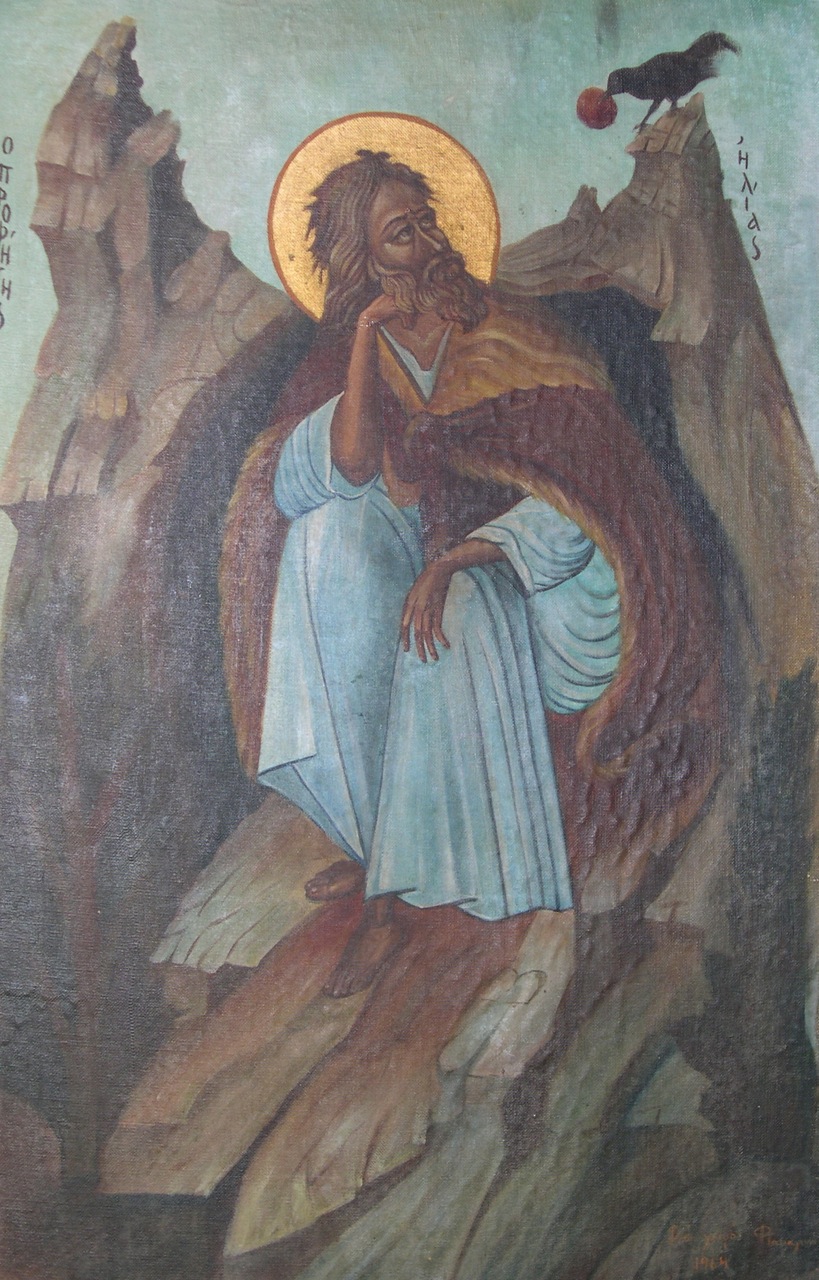
According to tradition this is the place where Elijah stayed when God commanded him to leave King Ahab during the drought and was fed by ravens:

5 So he went and did according unto the word of the LORD; for he went and dwelt by the brook Cherith, that is before the Jordan.

6 And the ravens brought him bread and flesh in the morning, and bread and flesh in the evening; and he drank of the brook.

I Kings 17

There is also the story that Joachim, father of the Virgin Mary, hid here for forty days bewailing the barrenness of his wife Anne, whereupon an angel came to him to announce that Anne was pregnant with a daughter.