Category Archives: Architecture

Art and Architecture, Jaffa

The Tachana (“Station”) complex includes the historic train station built in 1892, the freight terminal, German Templer Hugo Wieland’s tile factory and cement works and the Wieland family’s home. Today the complex has been renovated and houses restaurants and cafes, fashion, art, antique and jewelry boutiques, a large art bookstore, galleries and every Friday an organic food market. Notwithstanding the commercial aspect, it’s still a historic site and standing on the station platform it’s easy to imagine being transported back to a time of steam engines, pilgrims and pioneers.

The German Templers Society (Tempelgesellschaft) were a Protestant sect who originally settled in Haifa and established the German Colony there; subsequently they built settlements in Sarona and Jerusalem. After the visit of the German Kaiser Wilhelm II in 1899, another wave of pioneers founded Wilhelma, Walhalla, Bet Lehem HaGlilit and Waldheim. The colony’s oranges were the first to carry a “Jaffa Orange” brand, one of the better known agricultural brands in Europe, used to market Israeli oranges to this day. The Templers established a regular coach service between Haifa and other cities and made an important contribution to road construction. They  were architects and engineers, ran hotels, beer gardens and promoted the country’s tourist industry.

The Wieland family came to Israel in 1900 and established its building materials factory beside the Jaffa train station and the nearby Templer neighborhood. The patriarch, Hugo Wieland, built the villa in 1902 as a single storey structure; a second storey was added a few years later to accommodate the family of 12. The building was designed in the Templer style, stone buildings with a tile roof, wooden shutters, balcony. The front room served as a lounge and was the most beautiful and impressive room in the house, it had a painted ceiling and coal fireplace for heating. The floors were made of decorative tiles produced by the family factory.

During restoration work, some paintings of scenes of women, drinking and dancing, were discovered on walls in one of the rooms. Originally the thought was that these were copies of caricatures from a German magazine. In further investigation it was discovered that these painting were done by Gerd Rothschild, partner with Zev Lipman in Roli Graphic Studio, between 1942-1946. Rothschild learned graphic design in the first class of the Bezalel School of Art in Jerusalem. He was enlisted into the British army as a cook but when his artistic talent was discovered he wandered from British base to base in the region – Palestine, Libya, Egypt, Transjordan, Syria, Lebanon and Cyprus painting on walls. In later years, Rothschild used art therapy to work with children with disabilities and painted murals in pediatric psychiatric wards. He died in 1991 at the age 72. The British used the buildings in the Jaffa rail yard as a base for supplies after the German Templers were deported to Australia during WWII.
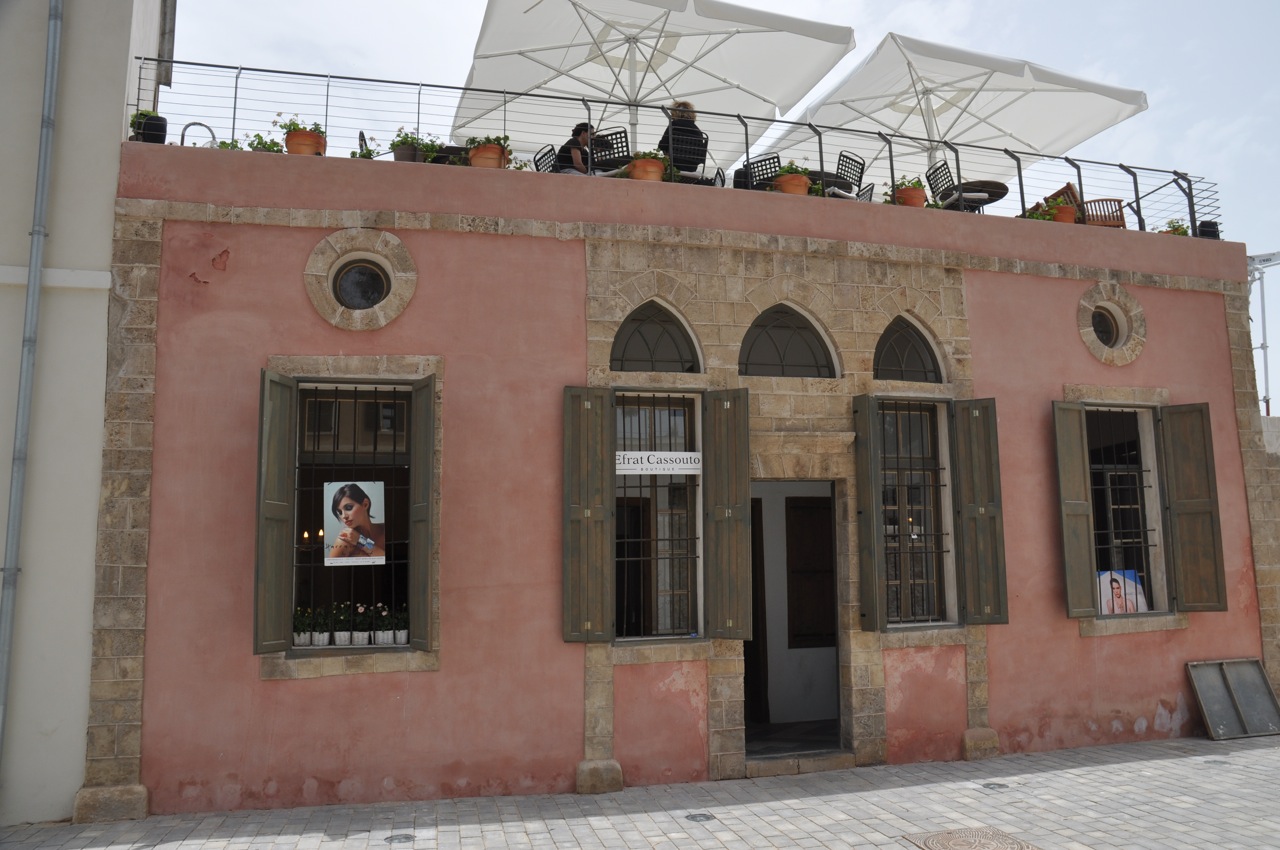
Another atmospheric building is the Red House, an example of typical Arab construction in the Jaffa area that got its name from the red plaster used on its walls. This building was probably built before the Wieland villa as part of the Manshiya neighborhood, adjacent to the train station complex. A unique feature is the western entrance accented with chiseled sandstone left unplastered which frames the symmetrical series of three openings. Two round openings on the facade, common in Arab buildings are for ventilation.
Bauhaus Architecture Tour

Bauhaus style was influenced by the 19th century English designer William Morris who argued that art should meet the needs of society and there should be no distinction between form and function. It was marked by radically simplified forms, the absence of ornamentation, by harmony between the design of an object or building and its function and the idea that mass-production was reconcilable with the individual artistic spirit. These criteria were a good match for the modern city of Tel Aviv, a new Israeli city built in 1909 on sand dunes of the Mediterranean coast.

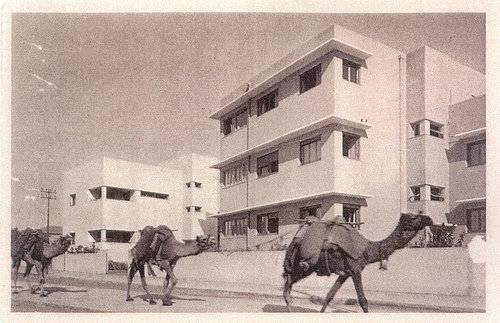
From a postcard, published by S. Adler, Haifa  Photo by J. Benor-Kalter

In 1925 as Tel Aviv grew, the innovative Scottish urban planner Patrick Geddes submitted a master plan for the city where he laid out the streets and decided on block size and utilization – Geddes did not prescribe an architectural style for the buildings in the new city. The impetus for large-scale construction came from the rapid influx of Jewish immigrants from Europe who grew in numbers from about 2,000 in 1914 to about 150,000 in 1937. In the 1930s, Jewish architects who had studied the architectural ideas of the Bauhaus school fled the rise of Nazism in Germany and converged on Tel Aviv. The residential and public buildings were designed by these architects, who took advantage of the absence of established architectural conventions to put the principles of modern architecture into practice. With their emphasis on functionality and inexpensive building materials, it was perceived as ideal for Tel Aviv. The result is that Tel Aviv has the largest concentration of International style buildings, recognized by UNESCO in 2003 when the “White City” was declared a World Heritage Site.

Here on the shores of the Mediterranean the “International” architecture had to be adapted to suit the hot and sunny climate.

  • White and light colors reflected the heat.
  • Walls not only provided privacy but protected against the sun.
  • Large areas of glass that let in the light, a key element of the Bauhaus style in Europe, were replaced with small recessed windows that limited the heat and glare.
  • Long narrow balconies, each shaded by the balcony above it, allowed residents to catch the breeze blowing in from the sea to the west.
  • Slanted roofs were replaced with flat ones, providing a common area where residents could socialize in the cool of the evening.
  • Buildings were built on pillars (pilotis) to allow the wind to blow under and cool the apartments, as well as providing a play area for children.

Here are 2 highlights from the Bauhaus tour.

Soskin House (1933, Ze’ev Rechter)

In 1934 Avraham Soskin closed his photographic studio at 24 Herzl Street and moved his family and typesetting business to the two winged house at 12 Lilienblum Street. Considered Tel Aviv’s first and foremost photographer because his work provides a rich documentation of the city’s early years [another idea for a tour: photographs by Matson, Soskin, Phillips, Rubinger and the sites today], Soskin (1884-1963) immigrated to Palestine in 1905.

Architect Ze’ev Rechter (1898-1960) returned from his studies in Paris in late 1932 and designed the house for Soskin.

The facade is divided into two major fields defined according to Golden Section proportions: the first is located on the east, shaped as a vertical rectangle that anchors the structure to the ground; the second is a horizontal rectangle pulled from the vertical rectangle. The building was renovated in 2005 and made into a number of apartments.

Engel House (1933, Ze’ev Rechter)

IMG_2013
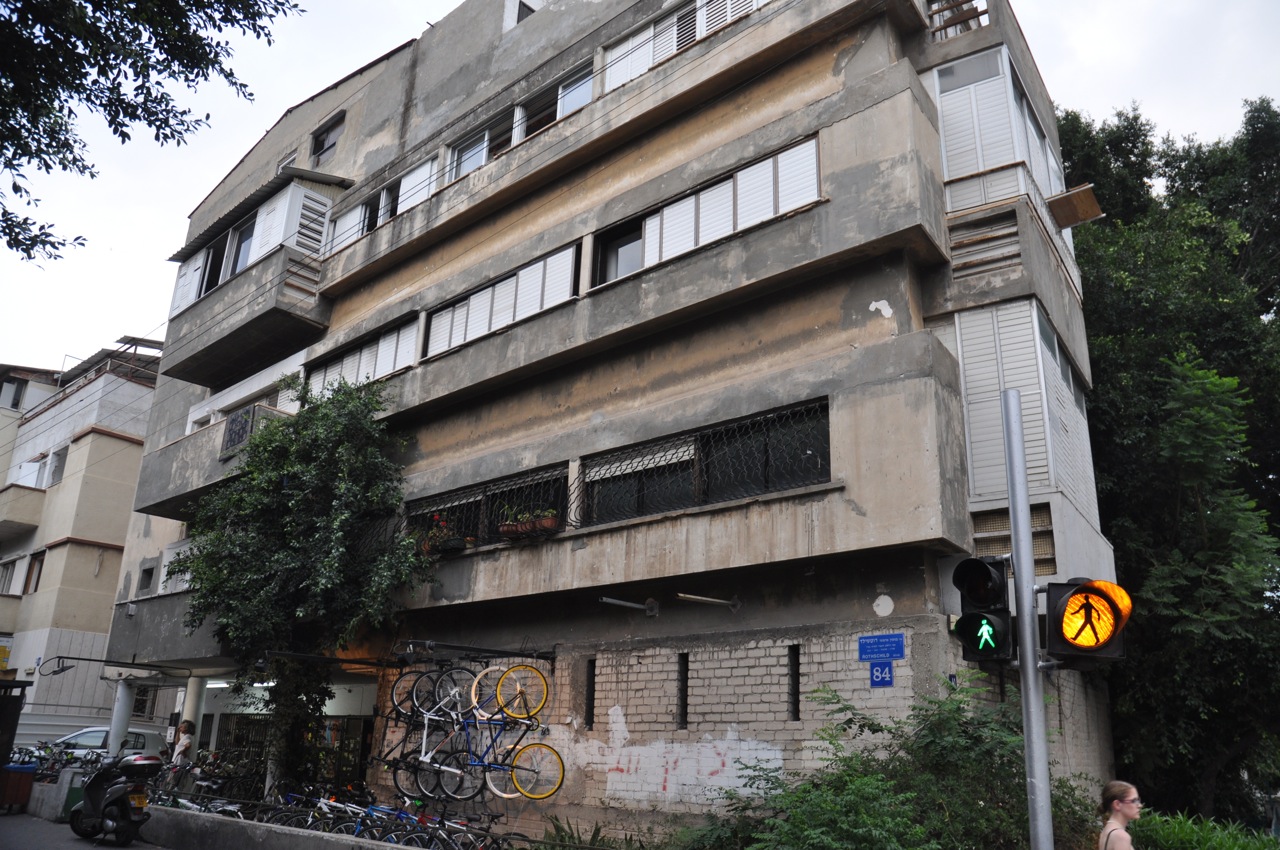
A large residential building of apartments this is the first structure in the city that was built on pillars, a modification to Bauhaus style to address the hot Tel Aviv weather, so that air could flow under the building to cool it. The space under the pillars was closed-in during WW II for use as a British headquarters but re-opened in the renovation. Located on the roof was an exercise room and a roof garden and concrete pergola in the style of Le Corbusier for the enjoyment of the tenants. Engel House was built in a u-shape around an inner courtyard, facing Mazeh St. Horizontal emphasis was created by protruding window frames around the wide, strip windows (another modification for climatic conditions). The convergence between the balconies of the two facades creates plays of mass and light and shade. For many years the building was not well-maintained but now a serious renovation has brought the building back to its roots.

Ze’ev Rechter designed the building and rented a spacious apartment there.

Tour of Herodium Palace Complex

In Ehud Netzer’s book on the Palaces of the Hasmoneans and Herod the Great he writes:

In its day, Herodium was one of the largest palaces in the Greco-Roman world. It is actually the most spacious one of that time that is known to us from archaeological studies.

When I guide Herodium, I include a comprehensive tour of Lower Herodium, outside the archaeological park and the area that Prof. Ehud Netzer excavated in 1972 looking for Herod’s tomb. I point out

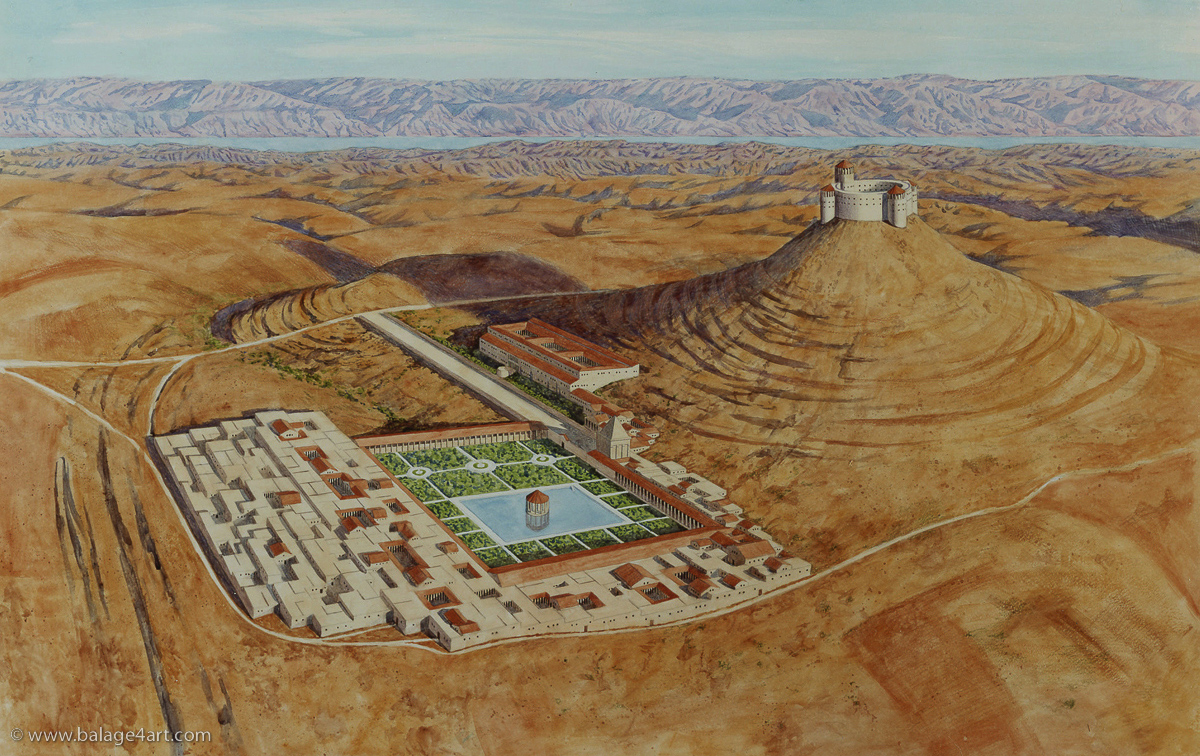
  • the overall planning of the site – the relationship between the palace/fortress on a man-made mountain south of the site and the palace complex at its foot
  • the concentration of structures around the pool, more characteristic of present day complexes such as a university campus or large hospital
  • the addition of formal gardens against the background of the barren Judean desert
  • where and how Herod overcame the topography and lack of water to build Herodium
  • Netzer’s discovery of the Monumental building where he thought Herod was buried

In its current state it can be difficult to imagine what Herodium must have looked like. Then I was introduced to the Hungarian-born artist and illustrator, Balage Balogh. Balogh has done paintings where he has recreated (Biblical) settings with a startling degree of accuracy based on a combination of intensive archaeological investigation, scriptural and ancient text research and a measured dose of interpretive insight. He has kindly given me permission to include his illustration of Herodium here. To better picture the ancient world check out his website at
http://www.archaeologyillustrated.com/


(Click on the image to view it in more detail)

墨絵 Jerusalem Sumi-e

My son Amitai and I had the privilege to study 墨絵 sumi painting together with a master, Jan Zaremba, for a couple of years when we were living in Cambridge MA. Amitai was 12 years old when he started sumi, at the time of this post he is 20 and serving in an elite combat unit in the Israeli army. Not being able to study with Jan is one of the few things that I deeply miss since coming back to Israel. The pine tree in this painting is inspired by a traditional sumi painting, the scene of Jerusalem in the background is my creation. I did this painting shortly after returning to Jerusalem, for an artist and friend, Avraham Yakin, on his 80th birthday.

It might seem strange to think about Japanese art and culture while in Israel, you probably are here to explore and experience the history, religions, archeology, etc. of this land. However, if you are going to be in the north, you might want to visit the Tikotin Museum of Japanese Art in Haifa, the only one of its kind in the Middle East. Felix Tikotin, an architect by profession, was an internationally renowned collector and dealer in Japanese works of art. For more than forty years he amassed his valuable and rare collection and organized exhibitions of Japanese art in many museums. During the Second World War, because he was Jewish, Felix Tikotin had to flee for his life from the Nazis; he hid his collection in Holland to prevent it from falling into their hands. After the war, Tikotin decided that his unique collection should be taken to Israel.

Tikotin purchased the “Kisch House” and in accordance with his ideas and plans, a Japanese pavillion to be used as an exhibition hall was added. In 1995 a new wing was added to the existing hall. It was designed by one of the renowned architects of Japan Junzo Yoshimura (1908-1997) of Tokyo, together with the Israeli architect Professor Al Mansfeld (1912-2004) of Haifa. Mansfeld is known as the architect of the Israel Museum in Jerusalem who with architect Ms. Dora Gad in charge of the interior design were awarded the Israel Prize. The Tikotin Museum’s collection comprises some 7,000 items of art and crafts – paintings, prints, drawings, painted screens, textiles, antique illustrated texts, ceramics, miniature carvings (netsuke), lacquer and metal work, antique swords and functional art works, mainly from the 17th to 19th centuries, as well as a collection of modern Japanese art.

Another connection between Japan and Israel is the story of Chiune Sugihara (杉原 千畝) the Japanese Vice Consul to Latvia during World War II. Sugihara single-handedly provided transit visas to more than 6000 Jewish refugees from German-occupied Poland and residents of Latvia who would otherwise have perished in Nazi Europe, risking his career and his family’s life. In 1985, Israel honored him as Righteous Among the Nations for his actions and a tree was planted in his honor at Yad Vashem.

Olive Park, Ramat Rahel

Concepts of rootedness and disconnection which mark the complex relation of our civilization with the earth are central to the world of oppositions manifested in the sculpture’s plastic form. Olive trees, ancient symbol of strength, fertility and peace, continue their life in a transplanted and disconnected state.

Ran Morin, environmental sculptor

The park lies at an elevated and windy location overlooking Jerusalem and Bethlehem with views over the Judean desert, Herodium and as far as the Dead Sea. In preparing the park, mature olive trees were transplanted in 1987 from the experimental orchard of Prof. Shimon Lavee of the Vulcani Institute in Rehovot. Besides various types of olives that grow in Israel, there are olive trees that originate from Greece, Italy, Spain, France, Turkey, Algeria, Morocco, Argentina and the USA.

In the center of the park is a structure of 3 steel columns covered with basalt stone aggregate that form a triangle, sitting on a stepped platform of concrete and Jerusalem boulders. On the top of the columns, 11 meters in the air, three 80 year old olive trees are growing, supported by a customized drip irrigation system.

Part of the artistic project deals with the properties and spiritual harmonies of the number three: 3 monotheistic religions, 3 forefathers of the Jewish people, 3 Magi who came to visit Jesus, etc. The location at the edge of the desert and near a blood-stained political border connects the different elements in its surroundings and relates to more ancient periods when olive trees and plowed earth were characteristic of man’s intervention in this arid landscape.

Morin’s projects can be construed to have political undertones, mainly because it can’t be avoided in Jerusalem and the areas where he works. Personally, however, Morin tries to stay away from such sensitive issues. It’s hard though: “I am dealing with earth and olive trees and actual places where there are borders. A Palestinian once told me, ‘Okay we don’t have to fight over the land; we can grow the trees in the sky’.”

Yerushalayim shel maala, heavenly Jerusalem. If we could only bring it down to earth.

Aqueduct at Caesarea

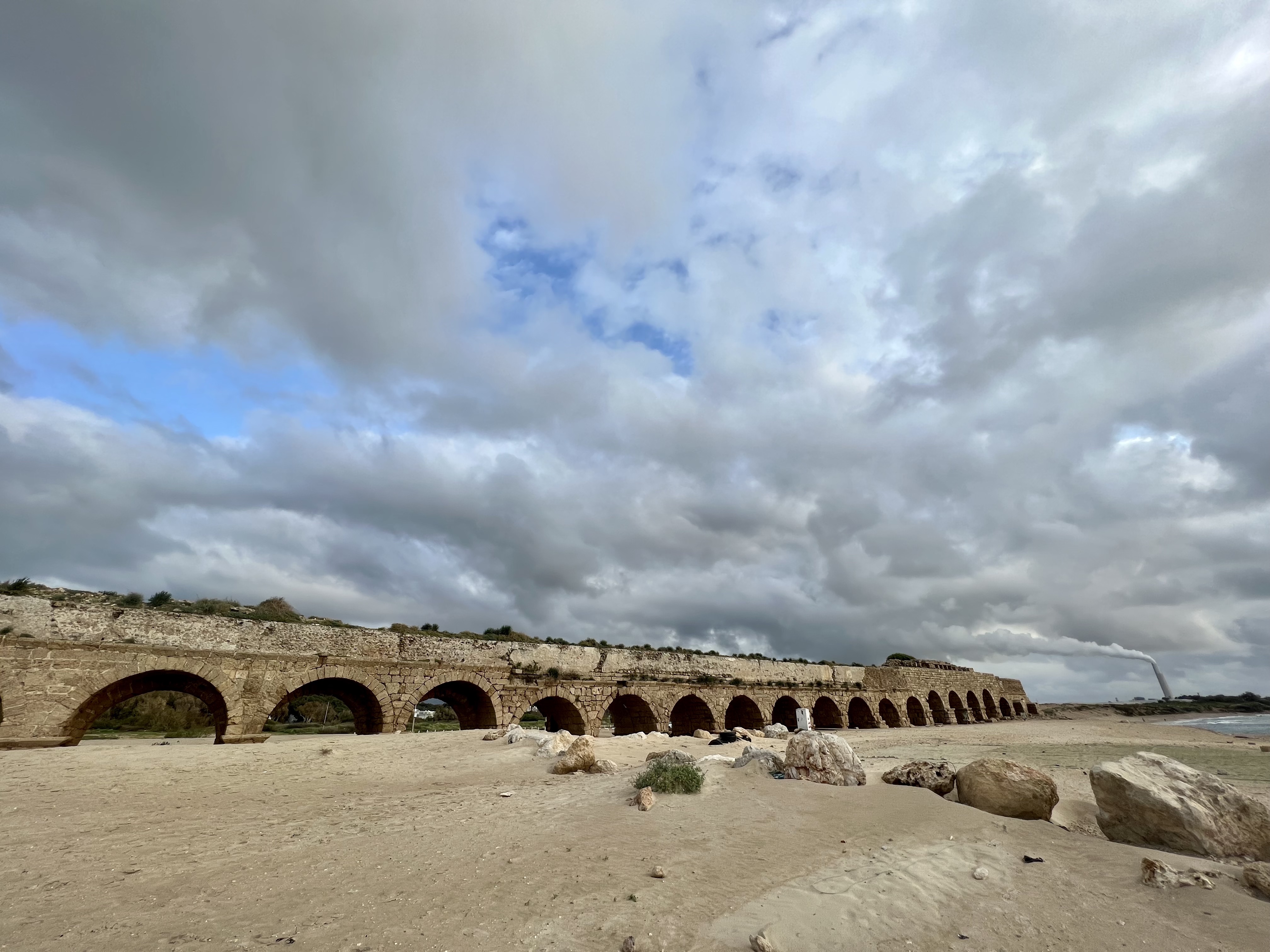
The first aqueduct (one closest to water) was built by Herod at the time the city of Caesarea-Maritima was founded and brought water from the Shuni spring, south of Mount Carmel, about 10KM to the northeast of the city. The water flowed on a single raised channel supported on kurkar arches.

When this was not sufficient, a second “lower” aqueduct was built by the Legions of the Emperor Hadrian (2nd C CE). It brought water from Tanninim (Crocodiles) river. This section, with a tunnel of about 6KM long, was tapped into the older aqueduct, and doubled its capacity and its width. The builders used the same building materials and style, so it may be difficult to see that the pair of channels were built at different times. The aqueduct continued to supply water to Caesarea for 1200 years.

To find the start of the second aqueduct drive just past the entrance to Beit Hanania you will find the northern section of the aqueduct and the second aqueduct (Hadrian) connecting to the older one (Herod).

Aqueduct at Beit Hanania

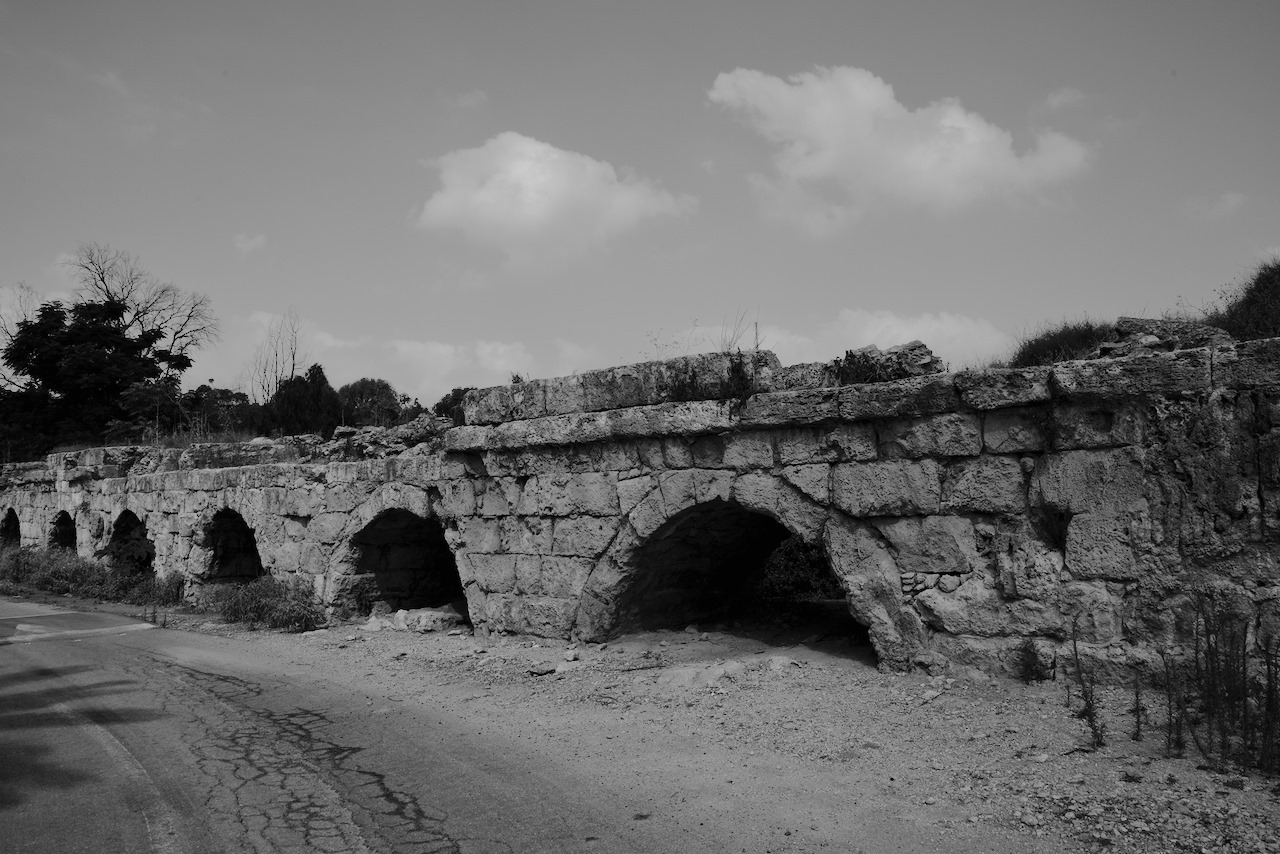
In this section there are two stone tablets that were placed into the wall by its builders, the legion of the Emperor Hadrian. The right tablet clearly shows: “IMP CAES(ar) TRIAN HADR(ianus)”. The other tablet is of the Tenth Legion (the Imperial eagle without its head standing on a wreath).

IMG_5984

The Israel Trail winds its way beside the aquaduct, through the Arab town of Jizr a-Zarka and then south along the coast to Caesarea.

DSC_0195

On the beach closer to the Caesarea archaeological park there is another section of the aqueduct.

Aqueduct just north of Caesarea

In fact it makes a great hike with the whole family following the aqueduct at Caesarea north along the beach to Dor (where you can visit the Mizgaga museum) or continue a little further to Hof Habonim.

Related articles