Byzantine Church, Hirbet Midras

Amir Ganor is not your usual archaeologist. Although he works for the Israel Antiquities Authority he packs a handgun because his primary responsibility is apprehending thieves who plunder sites for valuable artifacts to sell on the antiquities market. In this case a group of Palestinians were breaking into the complex of tunnels and caves in the Judean Coastal Plain or shefela in the area of Beit Guvrin, specifically Hirbet Midras, looking for coins and other treasure. This led Ganor to the site where a large stone lintel was uncovered.

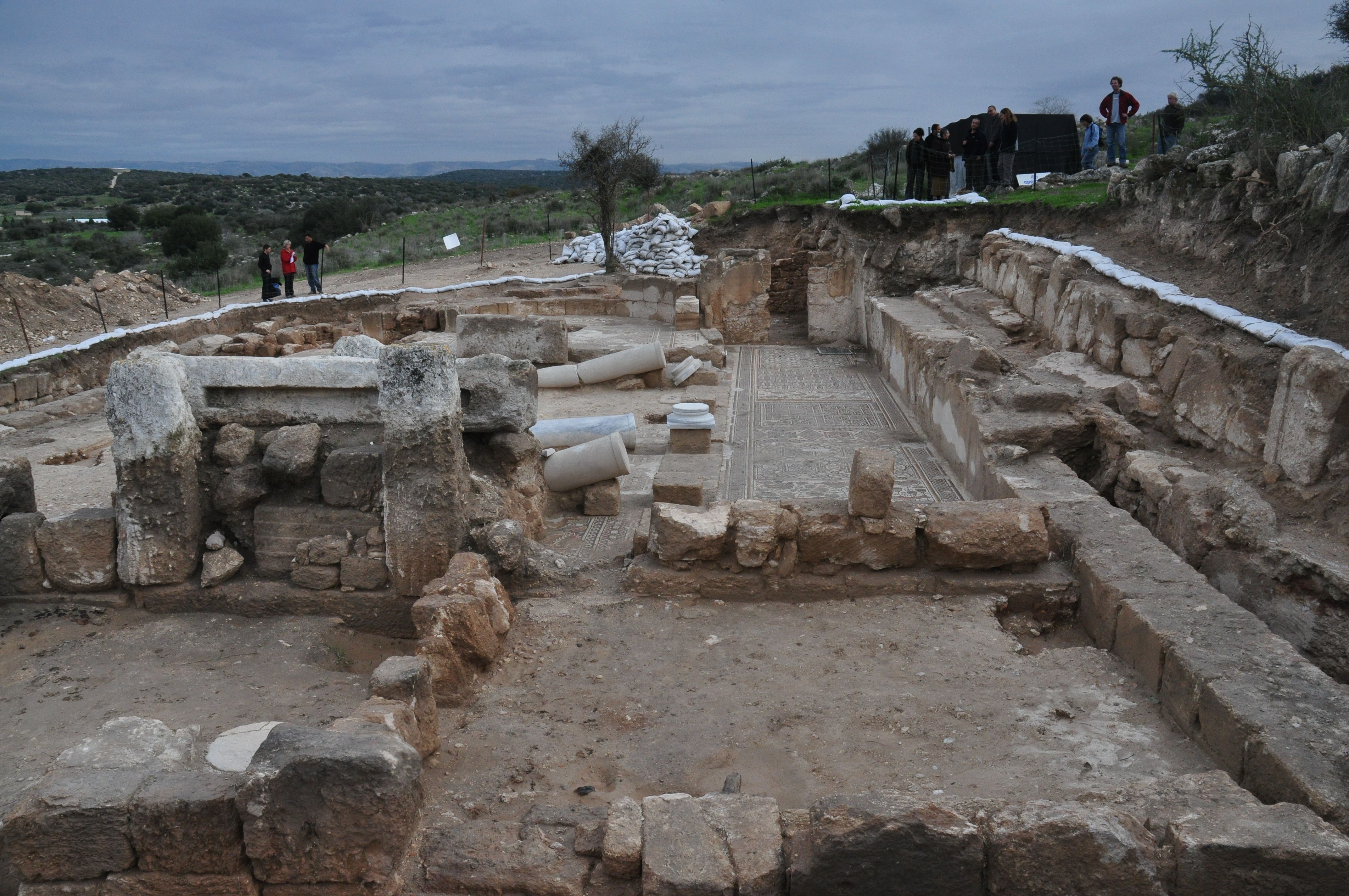
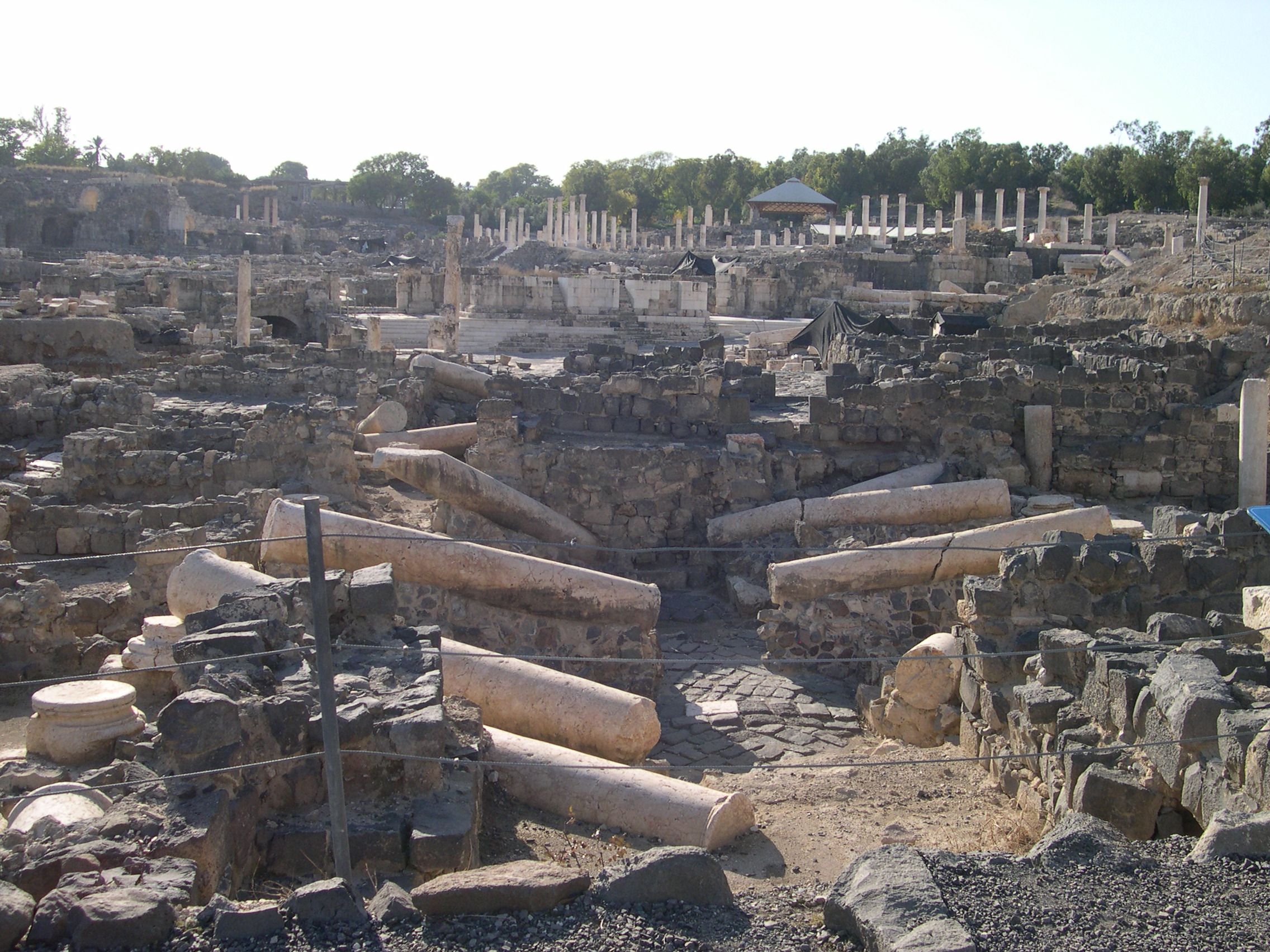
The same lintel was first uncovered in the 1980s and based on the expert opinion of Prof. Amos Kloner was thought to be from a synagogue since it was almost identical to one found in the north at Hirbet Nevoraya. Ganor requested approval and support from the Antiquities Authority to excavate the area to discover more about the public building. Within a short time very impressive and beautiful floor mosaics were uncovered. Large dressed stones with what look like Byzantine crosses were discovered when the plaster covering them fell off. Combined with the architectural details, an apse, a crypt, mosaic floors, it seems that the building was a church. The church was destroyed by an earthquake some 1,300 years ago and lay mostly covered until the 19th century. The columns and capitals are displayed exactly as they were found, lying parallel on the ground and the northern wall is angled out from the movement of the earthquake.

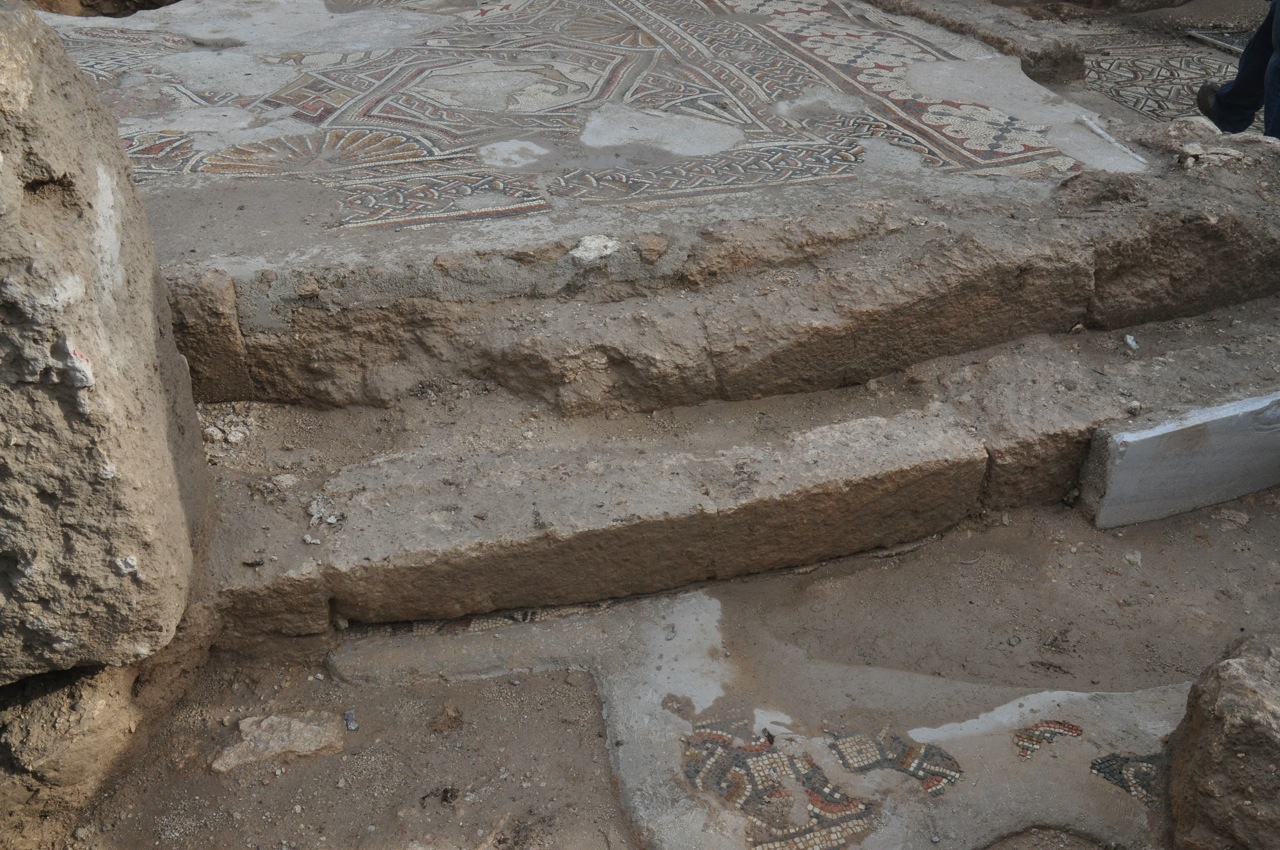
There are several construction phases, in the last two the building was used as a splendid church. However, in the first phase the excavation shows that the later church was built inside a large public compound from the Second Temple period. The church, in its last phases, was built as a basilica, a central nave and two wide aisles that are delineated by eight marble columns with magnificent capitals which were specially imported (the eight bases can be seen but only 3 capitals and columns remain). The front of the church had a large flagstone courtyard, a narthex, and at the end of the nave is a raised bema or platform (that was added later – you can see that the mosaic floor continues under the bema).

All of the floors in the building were adorned with incredible mosaics, that are extraordinarily well preserved; these include both geometric designs and floral, fauna, fish, birds and fruit. Today I went out to the site to photograph the mosaics (before they are covered to protect them until the site can be readied for visitors). You can view them at https://israeltours.wordpress.com/2011/02/04/mosaics-hirbet-midras/

Located behind the bema are two rooms, one paved with a marble floor and the other that led to an underground tomb that was empty.

Beneath the entire building is a subterranean complex in which there are rooms, water installations, traps and store rooms for hiding. Among the artifacts discovered are coins from the time of the Great Revolt (66-70 CE) and the Bar Kokhba uprising (132-135 CE), stone vessels, lamps and various pottery vessels that are characteristic of the Jewish population from the settlement at that time.

Scholars who visited the site during the excavation proposed identifying the crypt as the tomb of the prophet Zechariah. Early Christian sources identified his burial place in the village of Zechariah which was discovered in 415CE. In light of these sources, including the Madaba Map (the building with the apse with the Greek, ΒΕθΖΑΧΑΡ to its left is Bet Zechariah), scholars think the church at Hirbet Midras is a memorial church meant to mark the tomb of the prophet Zechariah.

Jerusalem Armenian Ceramics

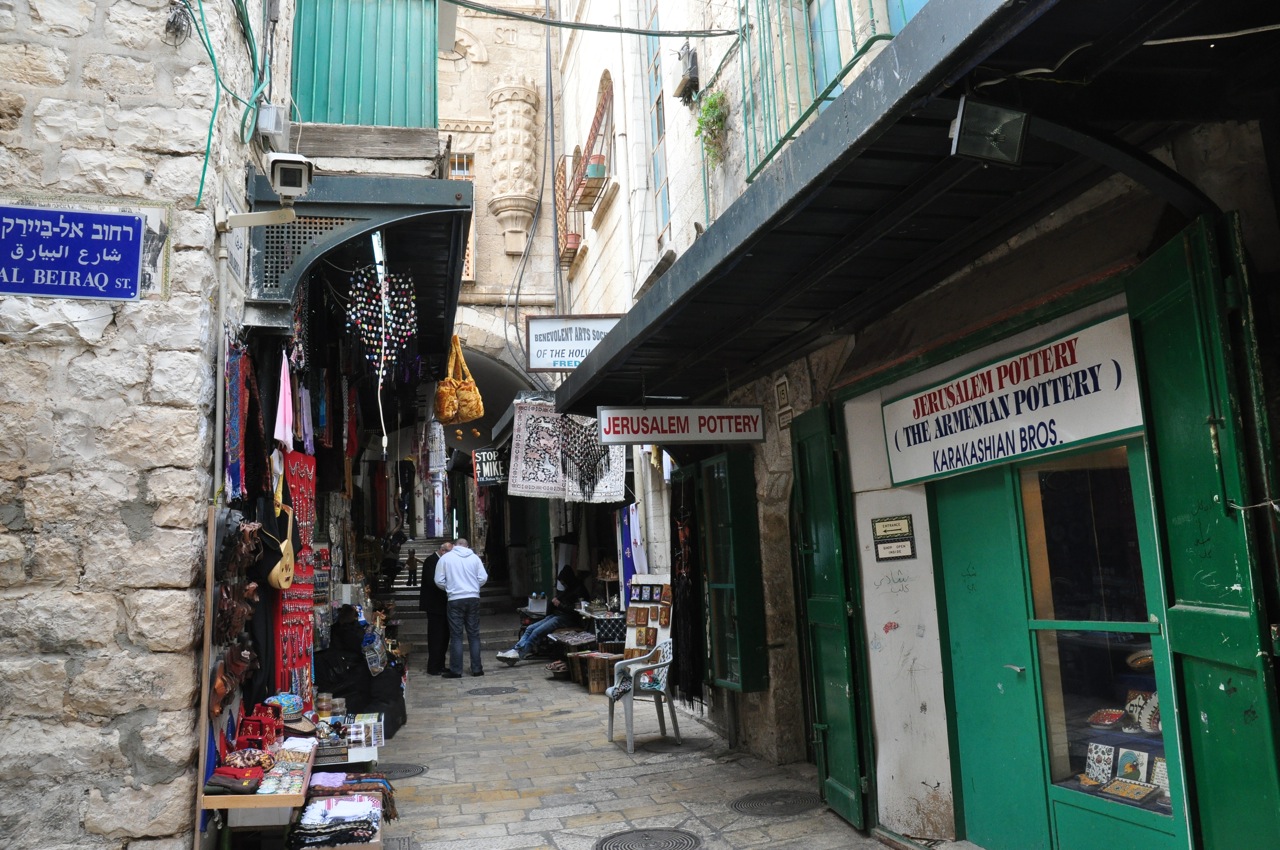
Walking the streets of the Old City your first introduction to Armenian ceramics may be the tiles designed by Mr. Karakashian that display the names of streets in Hebrew, Arabic and English. Please note that much of the painted pottery that you see in the souvenir shops in the Arab market is done in Palestinian workshops in Hebron.

The Armenian community in Jerusalem goes back to the 5th century and in the Old City they live primarily in one of the 4 quarters, a walled neighborhood within the walls to the right from Jaffa gate called the Armenian quarter. Their religious center is the Cathedral of St. James that goes back to the 12th century. The Crusader King Baldwin II married the Armenian princess Morphia who bore him 4 daughters, the eldest, Melisende was married to Fulk, Count of Anjou who was King of Jerusalem and ruled in her own right from 1129-1161. She is buried in the Tomb of Mary in the Kidron valley. From at least the 17th century numerous ceramic tiles by Armenian artists from Kutahya and Iznik were sent as gifts to the Cathedral and  the Church of the Holy Sepulcher.

After the British defeated the Turks, Ronald Storrs was the military governor of Jerusalem and one of the projects was to repair the 16th century ceramic tiles of the Dome of the Rock. David Ohannessian who had fled from the city of Kutahya, Turkey to Jerusalem and was known to Mark Sykes was recommended to Storrs. Ohannessian set up a workshop first on the Haram el Sharif and then later on the Via Dolorosa. Although the project fell through due to lack of funds he started producing ceramic wares and tiles to sell. An Armenian told me that the Muslims didn’t allow the Armenians who are Christian to work on the building.

Many recognize David Ohannessian as the founder of local Armenian ceramics based on the Iznik tradition and a bridge between the ceramic artistry of Turkey and what was to be developed later in Jerusalem. Ohannessian created tiles for buildings in Jerusalem until 1948 when he left for Beirut. You can see examples of these tiles at the Rockefeller museum and in my neighborhood, on the facade of originally Christian-Arab buildings, at 25 Emeq Refaim (I lead a tour of the German Colony that includes the Armenian story in the fascinating history of the German Templars) and next door to my house, at 24 Hazefira. Be on the lookout for other examples as you explore the city, buildings on Jaffa Road, in Talbiye, American Colony Hotel, St. John’s hospital (today the Mount Zion Hotel), Scottish Church of St. Andrew.

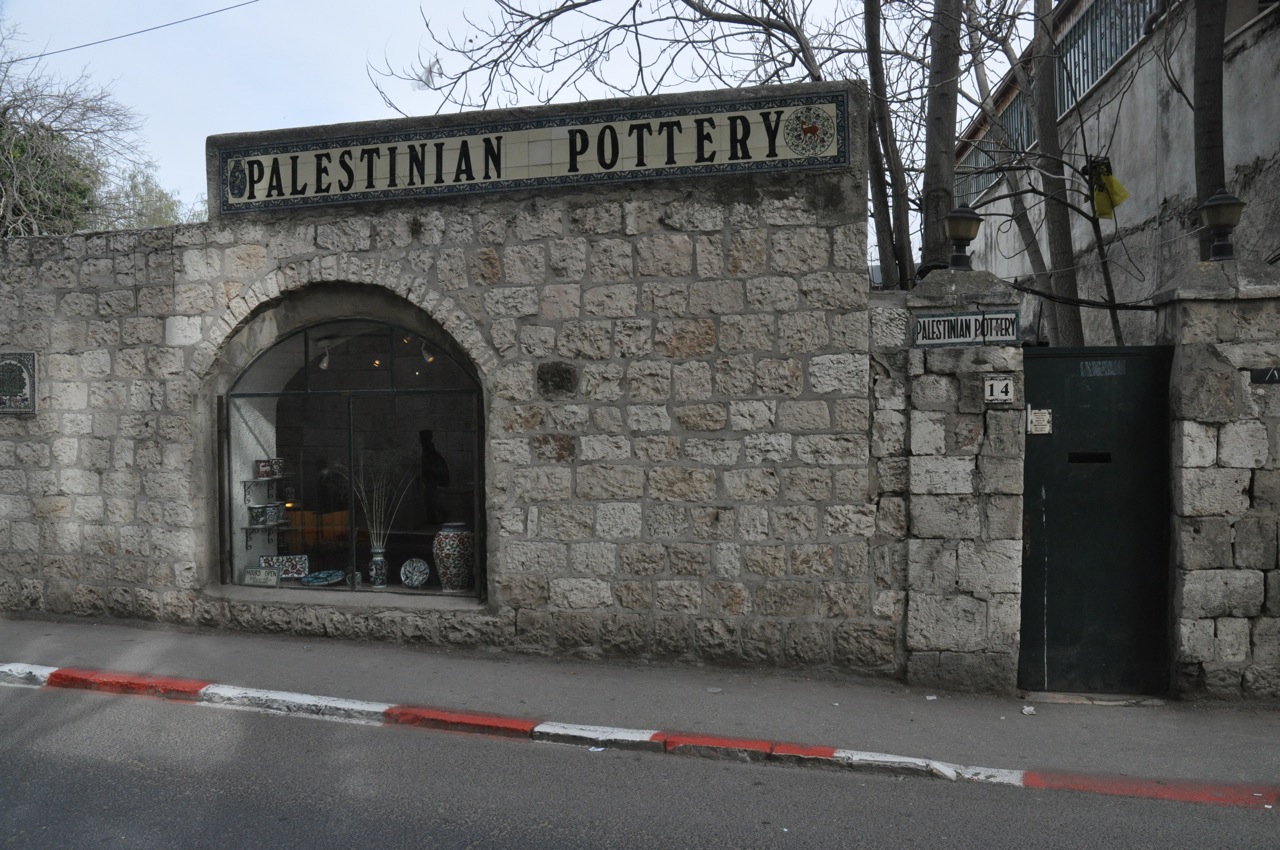
In 1922 Balian and Karakashian opened their own workshop at 14 Nablus Road where the families worked and lived for more than 40 years. Ballian was the master potter and Karakashian the painter artist and they passed on their skills and traditional craft to the next generation. It was here that the transformative process took traditional Kutahyan Armenian ceramics and created a uniquely Jerusalem pottery, the introduction of an art form that had not previously existed  in the city. It is a major contribution to decorative art, creating an artistic language that combines Eastern and local elements.

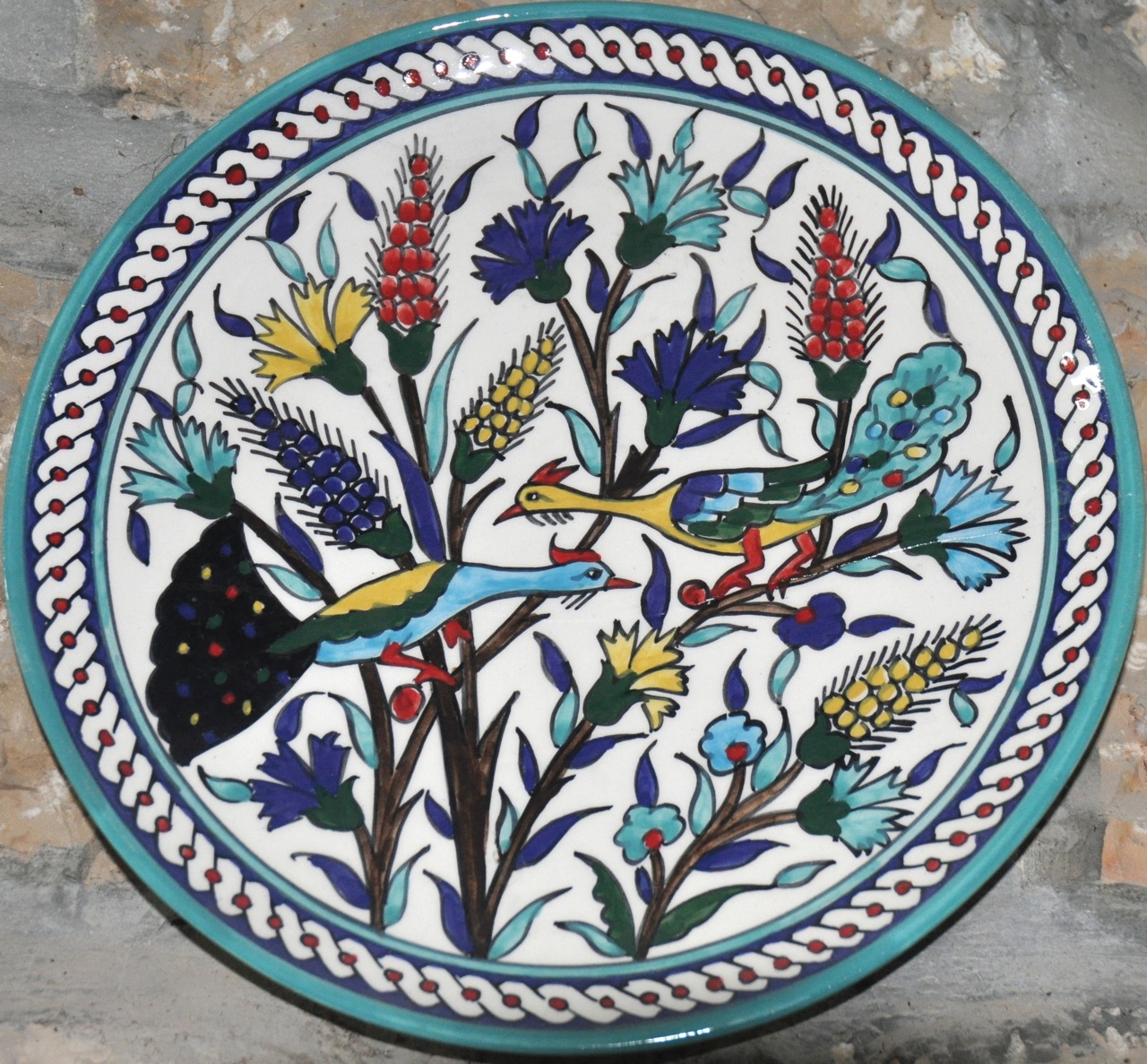
Their repertoire of forms was grounded in the traditional designs of Iznik (carnations, tulips, almond blossoms and saz leaves) and Kutahya (white or blue background with discretely outlines images) and included themes from the Bible. Two mosaic pavements in particular seems to have inspired them: the 6th century Bird Mosaic in the Armenian chapel and an Umayyad mosaic from the 8th century at Khirbat al-Mafjar (Hisham Palace) near Jericho. As they worked the two artists created new forms of their own inspired by local sources. Their first major project was a series of tile panels for the walls of the courtyard where the Patriarchs are buried in the Armenian Cemetery on Mount Zion. Their last work together done in 1963 were three rectangular tile pictures in the center of which are arched niches enclosed behind latticework doors for the facade of the Cathedral.

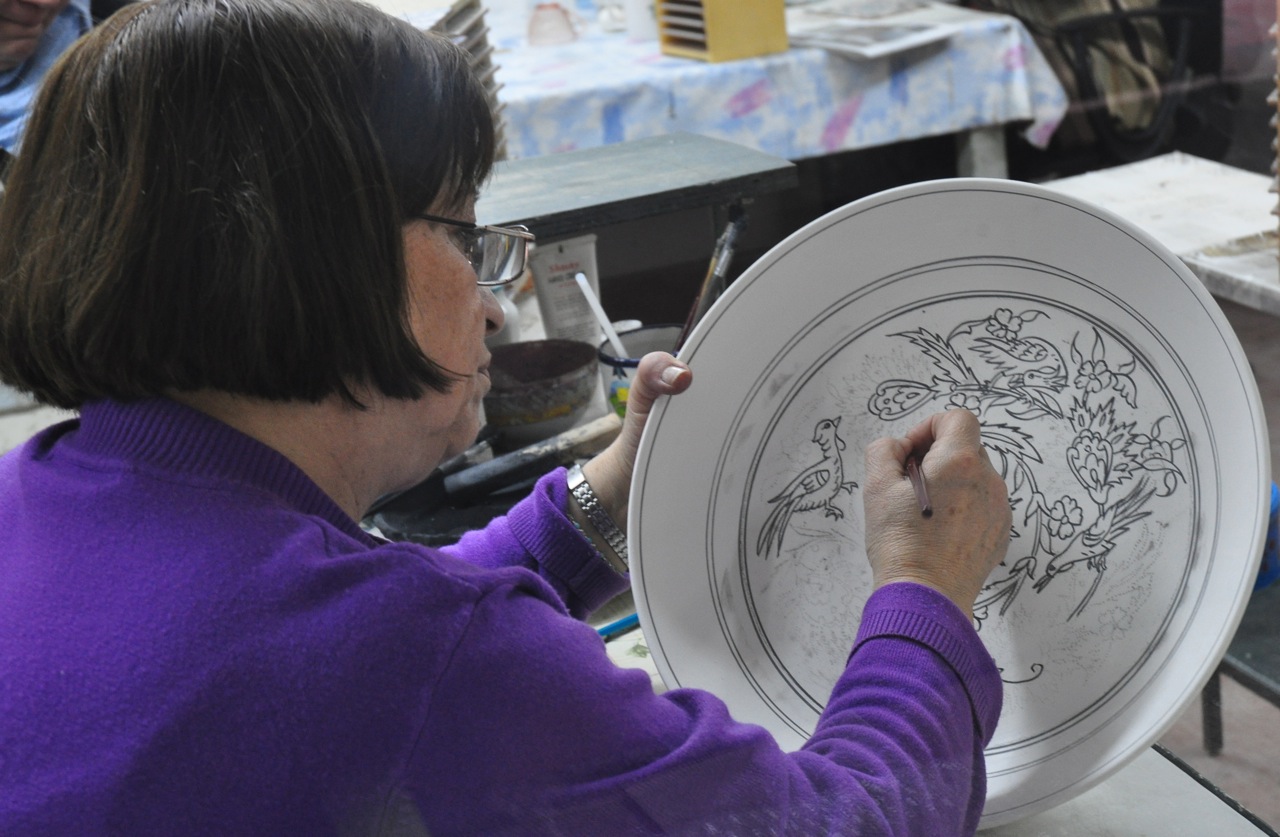
The designs were created by the master painter as drawings on paper. The paper design would be perforated along the lines so that the copyists could transfer them to the ceramics. The copyist-artisans would then paint the outlines in black and then colored glazes would be painted onto the ceramic. When the Balians and Karakashians separated in 1964, the traditional patterns, property of the joint workshop were divided between them.

In 1965 the Karakashian family moved to live and work in the Old City, where they created a studio, “Jerusalem Old City” on the Via Dolorosa between El Wad and Khan El Zeit (recently they moved to 3 Greek Orthodox Patriarchate Street in the Christian quarter). The main designs are those of arabesques, various bird designs, flowers, grapevines, a fawn, fish and biblical scenes on ceramic vessels and tiles.

http://www.jerusalempottery.biz/about_us/aboutus.htm

The Balian studio, called Palestinian Pottery, is still at the original 14 Nablus Rd location.

https://armenianceramics.com/about/

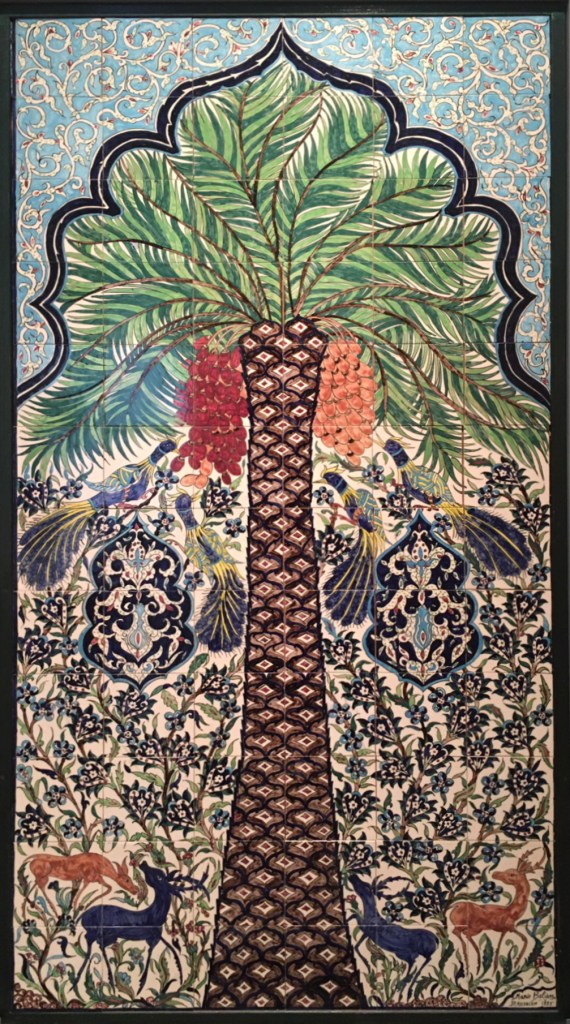
The creative force behind the Balian workshop was Marie Balian, who had studied painting in Lyon, France. One outstanding example is her dialogue with the images of the tree, gazelles and lion from the Hisham Palace painted in various combinations. By the early 1980s Marie Balian was working on larger compositions of many tiles, as if they were monumental canvases.


In 1986 she created a multi-tile triptych for the “Sukkoth patio” of the President of Israel’s residence which included pomegranates, date palms and grapevines (from the seven species that grow in the Land of Israel).

For an excellent book on the subject check out
Kenaan-Kedar, Nurith, The Armenian Ceramics of Jerusalem: Three Generations 1919-2003, Yad Izhak Ben-Zvi Jerusalem, Eretz Israel Museum, Tel Aviv, 2003.  ISBN 965-217-217-0

Sato Moughalian, the grand-daughter of David Ohannessian published a book in 2019 about his life and art, Feast of Ashes.

Two Churches: Mary and Jesus

Two Churches: Old and New

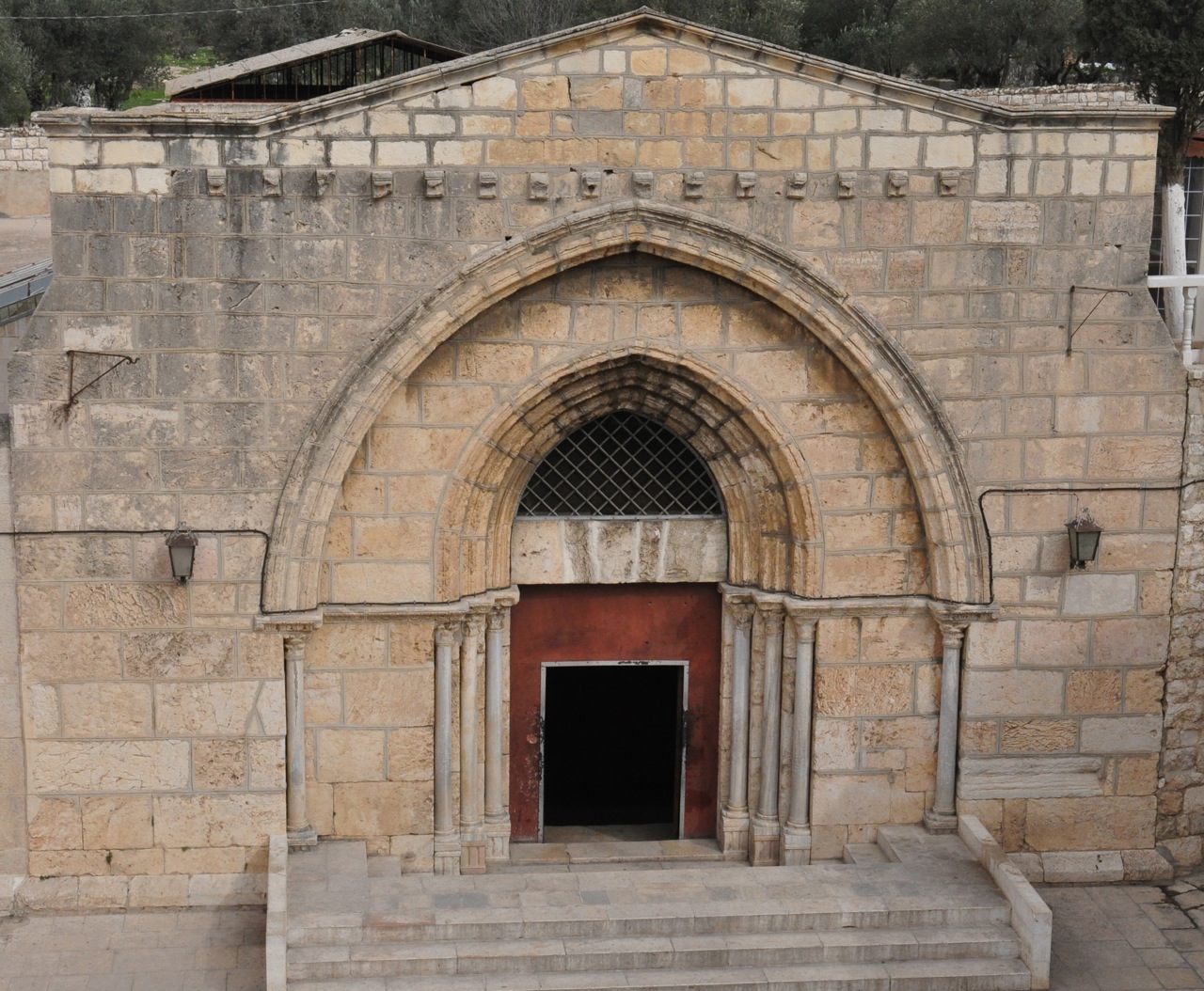
In the Kidron valley is a church built on a rock cut cave that is the tomb of Mary, mother of Jesus. Through the centuries the cruciform (in the shape of a cross) church was destroyed many times but the facade and wide staircase descending to the tomb is from the Crusader period. On the left side of the staircase a chapel to Joseph, Mary’s husband, on the right a chapel to Mary’s parents, Joachim and Anne; Queen Melisende is also buried there. Today the Greek Orthodox Church is in possession of the shrine, sharing it with the Armenian Apostolic Church (the Syriacs, the Copts, and the Abyssinians have minor rights). A niche on the southern wall is a mihrab indicating the direction of Mecca, installed when Muslims had joint rights to the church.

In a courtyard off the Via Dolorosa in the Old City is a small church that reminds me of the Crusader church. The Church of the Flagellation, marks the Second Station of the Cross, where according to tradition, Roman soldiers flogged Jesus and placed a crown of thorns on his head after he was brought to Pontius Pilate. The architect, Antonio Barluzzi, rebuilt this church in 1929, in medieval style over ancient ruins. Barluzzi designs churches so that the style and decoration preserve the history and recall the events that happened at the site. The facade has one central opening with a Crusader style pillow-shaped arch that incorporates a crown of thorns. There are 10 icons under the roof, a crown of thorns, two representations of a cat of nine tails (see if you can recognize the others, for example there is an image of a rooster and 3 stars*). The floor is made of small, inlaid colored stones in geometric patterns.

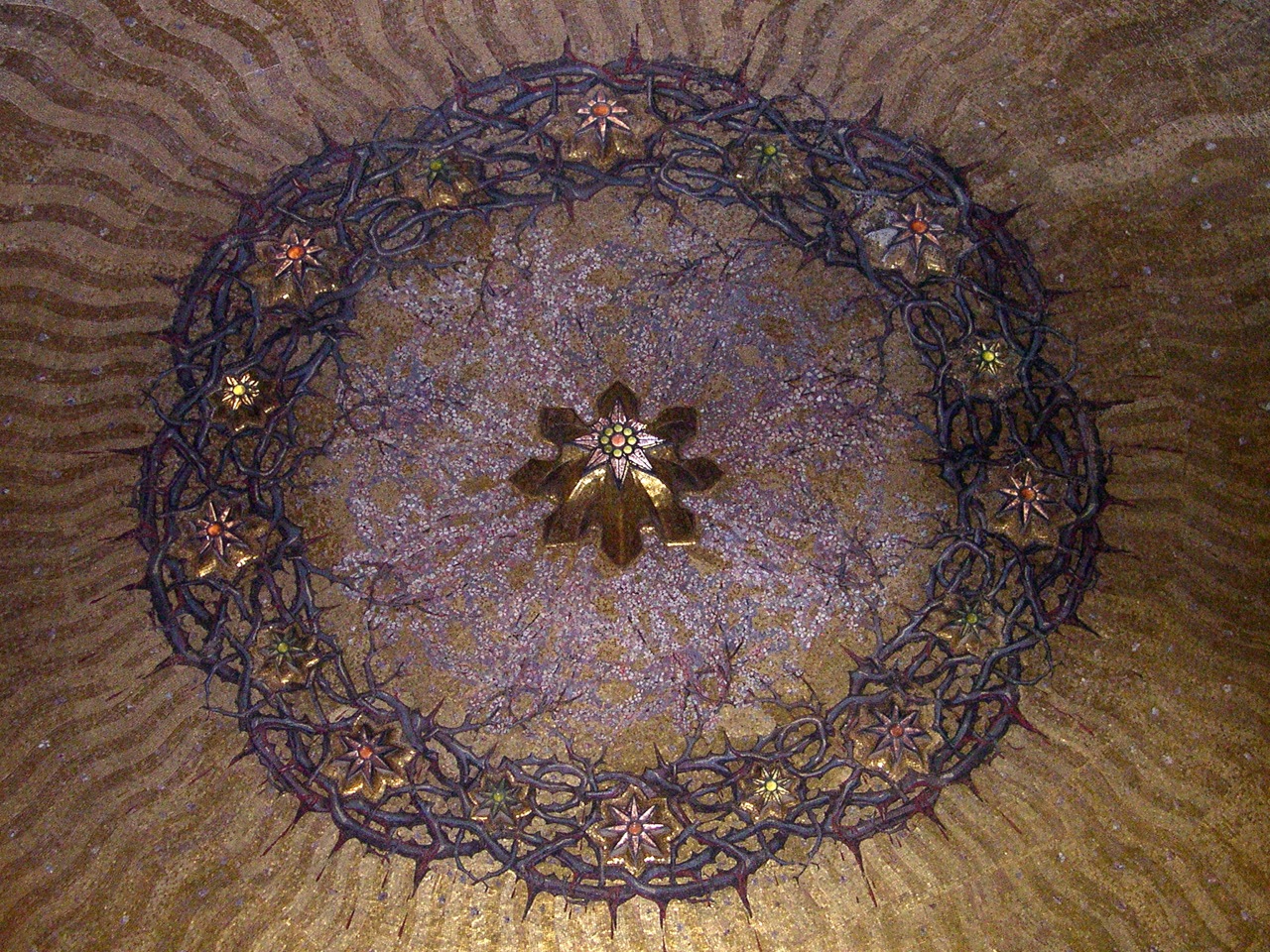
Probably the most impressive part of the church are three large stained glass windows: on the left, Pilate washing his hands of the affair, on the right, the victory cry of Barabbas, in front, the flogging of Jesus wearing the crown of thorns amidst the soldiers. Above is a dome in gold mosaic and decorated with a crown of thorns intertwined with flowers.

Click on the thumbnails above to display a larger image (these are quite incredible stained glass images). Included below is a closeup of the dome.

Near the church of the Tomb of Mary are two other Barluzzi churches, the Church of the Agony at Gethsemane, also known as All Nations and the Franciscan chapel farther up the Mount of Olives, Dominus Flevit. You can contact me about arranging a tour to visit Barluzzi churches including:

  1. St Veronica Church, VI Station of Via Dolorosa
  2. Chapel, XI Station in Church of Holy Sepulcher
  3. Church of Visitation, Ein Kerem
  4. Church of Bethpage
  5. Mount of Beatitudes, Galilee
  6. Church of Transfiguration, Mount Tabor
  7. Chapel of the Shepherd’s Field, Beit Sahour
  8. Church of St Lazarus, El-Azariya

* Rooster and 3 stars refer to Jesus’ prophecy at Gethsemane that Peter will deny him 3 times before the cock crows

Hurva Synagogue

In the winter of 1700, charismatic rabbi Judah he-Hasid Segal arrived in Jerusalem from Poland with about 500 followers (some say as many as 1000). You can imagine the reaction, at a time when the entire Jewish population of Jerusalem was about 500 people. They were mystics who were intent on bringing the Messiah and some say believers in the false messiah, Shabbetai Zvi. Within a few days of their arrival the rabbi died, some say he was poisoned. His followers struggled without a leader but managed to build forty dwellings and a small synagogue in the Ashkenazic Compound. Then they began to build a larger synagogue, but between bribes to Ottoman authorities, unexpected construction costs and other financial burdens they exhausted their funds. They took loans from local Arabs to complete the project. When the loans were still outstanding in late 1720, the Arab lenders lost patience and the synagogue was burned down, some say that 40 Torah scrolls were destroyed in the fire. The Ashkenazi Jews were banished from the city and the synagogue was left in ruins and became known as the Hurva, the “Ruin of Rabbi Judah he-Hasid”.

It took almost 100 years, in 1815, when Rabbi Menachem Mendel of Shklov, leader of the Tzfat Perushim, moved to Jerusalem with a group of followers, disciples of the Vilna Gaon. They wanted to reclaim the Ashkenazic Compound and to rebuild the Hurva synagogue, which had symbolized the expulsion of Ashkenazi Jews from Jerusalem. They believed that the “repairing” of an earlier destruction would have kabbalistic significance and be a prerequisite for bringing the Messiah.

There were a lot of difficulties in getting a firman, permission from the Turkish authorities to rebuild the Hurva. In 1829 Shlomo Zalman Zoref, a Lithuanian-born silversmith tried unsuccessfully but in 1836 he finally got a firman. Some say that it did not include permission for a synagogue in the Ashkenazic Compound but only for dwellings in the area. They managed to build two small synagogues. Although there was an injunction which absolved the Ashkenazim from repaying the debt and the Turkish Statute of Limitations cancelled out the debts of Judah he-Hasid’s followers Arab creditors interfered with the work and Zoref had to appease them with annual bribes. In 1851, Zoref was struck on the head with a sword and three months later died of his wounds.

Only in the early 1850s were the Perushim ready to attempt the building of a larger synagogue on the Hurva’s original site. With the help of the British they finally received a firman from the Ottoman sultan Abdulmejid I in 1854 to rebuild the synagogue according to a plan by his official architect, Assad Effendi. Built in neo-Byzantine style, it was supported by four massive pilasters at each corner over which soared a large dome that stood 24 meters high. The inside of the dome was painted sky-blue and strewn with golden stars. Numerous crystal chandeliers hung from the dome. Frescoes with religious motifs, such as the Star of David, the menorah, Mount Sinai and the Ten Commandments, adorned every wall. In the four corners were drawings of four animals in accordance with the verse in Pirkei Avot:

Be strong as the leopard and swift as the eagle, fleet as the deer and brave as the lion to do the will of your Father in Heaven.

The Holy Ark had the capacity to house 50 Torah scrolls and was built on two levels. It was flanked by four Corinthian columns surrounded by Baroque woodcuts depicting flowers and birds. The Ark together with its ornamental gates were taken from the Nikolaijewsky Synagogue in Kherson, Russia, which had been used by Russian Jewish conscripts, forced to spend twenty-five years in the Czar’s army. The synagogue was dedicated in 1864 and called Beis Yaakov, in memory of Jacob Mayer de Rothschild but it continued to be referred to as the Hurva. It stood as a beacon above the walls of the Old City along with the dome of the Tiferet Israel synagogue.

On May 25, 1948, during the fighting in the Old City Major Abdullah el Tell, commander of the Jordanian Legion, wrote to Otto Lehner of the Red Cross that unless the Haganah abandoned its positions in the Hurva synagogue and its adjoining courtyard, he would be forced to attack it. Moshe Russnak, commander of the Haganah in the Old City, ignored his request, knowing that if the Hurva fell, the Jewish Quarter would be lost. On May 27, el Tell, after receiving no reply, told his men to “Get the Hurva Synagogue by noon.” Fawzi el-Kutub executed the mission by placing a 200-litre barrel filled with explosives against the synagogue’s northern wall. The explosion resulted in a gaping hole through which the Legionnaires burst through. A short while later, after the Arabs had captured the area, another huge explosion reduced the 84 year old synagogue together with the Etz Chaim Yeshiva to ruins. The Tiferet Israel synagogue was also destroyed.

Following the Six-Day War, plans were sought for a new synagogue to be built on the site, part of the overall rehabilitation of the Jewish Quarter. Leading the campaign to rebuild the Hurva was Zoref’s great-great-grandson, Ya’acov Salomon. He consulted Ram Karmi, one of Israel’s leading young architects, who magnanimously recommended Louis Kahn, a world-renowned architectֿ for the job. Kahn came to Israel to tour the site in the Jewish quarter and made a trip to the nearby Judean desert to visit two isolated Greek Orthodox monasteries, St George’s in Wadi Qelt and Mar Saba in the Kidron. Kahn was deeply moved by the experience and inspired to design a synagogue that he felt expressed the spirit of Jerusalem, its history and religion.


Kahn model Hurva Synagogue, from Kent Larson

Kahn model Hurva Synagogue, from Kent Larson

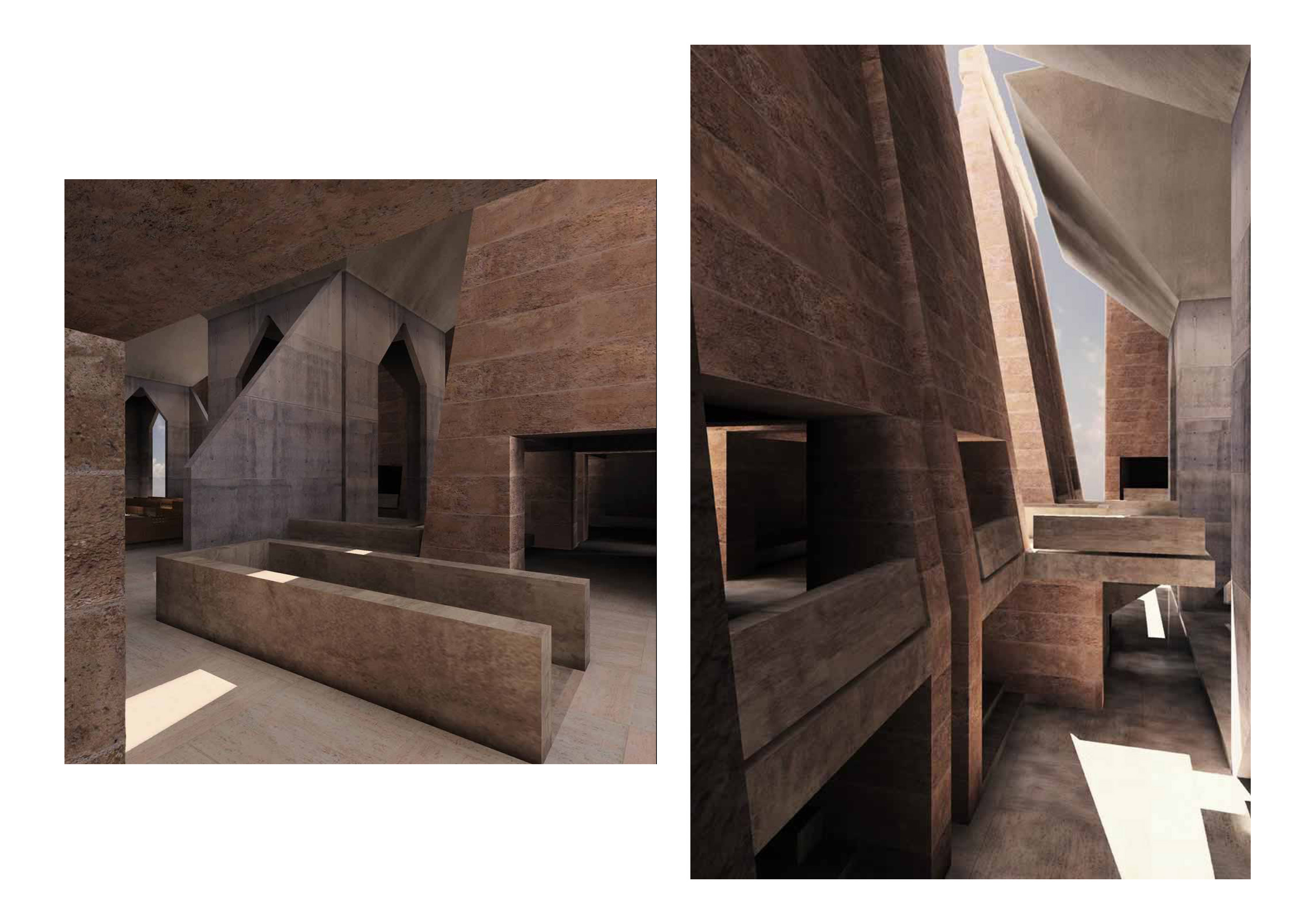
Between 1968 and 1973, Kahn presented three plans for the reconstruction. Each left the ruins of the Hurva in place as a memorial garden, with a new structure on an adjacent lot and a promenade, the “Route of the Prophets”, leading to the Western Wall. Kahn proposed a structure within a structure, the outer one composed of 16 piers covered in Jerusalem stone cut in blocks of the same proportions as the Herodian stones of the Western Wall. In the bases of the four corners of the two-story, 12 meter high structure would be small alcoves for meditation or individual prayer. The inner chamber, made of four inverted concrete pyramids supporting the building’s roof, would be used for larger communal prayer services.
Model of Kahn's Hurva synagogue, from Kent Larson

Model of Kahn’s Hurva synagogue, from Kent Larson

Unfortunately, Kahn died of a heart attack in the men’s washroom at Penn train station in New York City in 1974, a few weeks before he was to return to Jerusalem for consultations on what many regard as his greatest unrealized plan, the reconstruction of the Hurva synagogue. With Kahn’s passing his plans, through a combination of bureaucratic inaction and aesthetic timidity, died with him. Instead, in 2000 it was decided to rebuild the Hurva in its original 19th century Ottoman style.

But Kahn’s plans haven’t been totally forgotten. In the mid-1990s, MIT architecture professor Kent Larson used Kahn’s plans and new modeling software to create dramatic color images of what the Hurva might have looked like, both from inside and out, complete with lighting and shadow. If such tools had existed when Kahn was living, it would have been clearer what a masterpiece we were being offered.

Model of Kahn's Hurva synagogue, from Kent Larson

Model of Kahn’s Hurva synagogue, from Kent Larson

Like the redevelopment of the World Trade Center site it raises broader questions about how to rebuild on a site defined in large part by a history of destruction. For most of its history the site housed a ruin and encapsulates not only the long conflict between Arabs and Jews in the Holy Land but also how we, Jews living in Israel, commemorate our past and envision our future.


Contact me about a guided tour like Kahn’s starting with a visit to St George and Mar Saba monasteries in the Judean desert and then an overview of the Old City and the story of the fall of the Jewish quarter, its destruction in 1948 and rebirth after the Six Day War.

Bet Shean – Scythopolis

Bet Shean situated at the junction of the Jordan River valley and Nahal Harod that connects to the Jezreel valley, is an important crossroads because it controls access from the interior to the coast and from Jerusalem to the Galilee. It was called Scythopolis from the Hellenistic period onward and according to Greek mythology was founded by Dionysus. In 63BCE it was conquered by the Roman general Pompey and made a part of the Decapolis, a loose confederation of ten cities that were centers of Greco-Roman culture. It was the largest city according to Josephus and only one west of the Jordan River and is mentioned several times in the New Testament (Matt 4:25; Mk 5:20). This was the period of Pax Romana and the city prospered, evidenced by a high-level of urban planning and extensive construction the remains of which can be seen today in the archaeological park.

You can explore the site and visit the best preserved Roman theatre, a public bathhouse, two magnificent colonnaded streets, a Roman temple, a decorative fountain building (nymphaeum) and other landmarks of a Roman city.

Ancient sources indicate that Scythopolis had a mixed population of pagans, Jews, Samaritans, and Christians. At the western end of Tell Ictaba stood the sixth century Monastery of Lady Mary with a beautiful mosaic floor that depicts the 12 months and the sun and moon as human figures. Outside the city wall a Samaritan synagogue dating to the 5th–early 7th centuries CE was discovered. Its apse is oriented northwest towards Mount Gerizim (not south towards Jerusalem) and the floor is covered by a beautiful mosaic with geometric and plant motifs, but no human images. Another synagogue known as the “House of Leontis” perhaps part of an inn was found with a mosaic floor depicting geometric, animal, and plant motifs, and in the center, a medallion containing a menorah and the Hebrew word shalom. Another mosaic in the complex depicts scenes from Homer’s Odyssey, a five-branched candelabra and scenes of the Nile.

In 634, the second caliph, Omar Ibn al-Khatab took the city on his march through to Egypt. and it reverted back to a variation on its Semitic name, Beisan. The Muslims and Christian majority lived together but the city declined, additional structures were built on the streets themselves, narrowing them to mere alleyways, and makeshift shops were opened among the colonnades. Visitors to the Israel museum can to see the gate of the Umayyad shopping street inlaid with Arabic mosaic inscriptions. On January 18, 749 Beisan was completely devastated by a massive earthquake. A few residential neighborhoods grew up on the ruins but the city never recovered its former glory.

Looking across the site you can’t but notice a hill that rises 50m above the city. It’s worth climbing the stairs to the top for a spectacular view of the city and Bet Shean valley. Looking over the fertile surrounding countryside Rabbi Shimon ben Lakhish (ca. 350CE) wrote that if the Garden of Eden is in the Israel, then its gateway is Beth-Shean (Eruv 19a). This tel was first investigated from 1921 to 1933 by archeologists from the University Museum of the University of Pennsylvania. As a result of their work, Bet Shean became the first tel in Israel to produce a complete stratigraphic sequence spanning more than 18 layers of occupation from the late Neolithic period (fifth millennium BCE) through medieval times.

Level IX dated to around 1450BCE, was an Egyptian garrison after Thutmose III’s victory against an alliance of 300 Canaanite rulers.

A few hundred years later, the Philistines conquered it (it was they who fastened Saul’s body to the wall of Bet Shean after the famous battle on Mount Gilboa: 1 Samuel 31.8–11). Bet Shean became part of the kingdoms of David and Solomon, and was eventually destroyed in a fire, apparently at the hands of Tiglath-Pileser III, King of Assyria in 732 BCE.

Exploration of the Roman-Byzantine city of Scythopolis at the base of the tel began much later in the 1980s by Mazor of the Israel Antiquities Authority and Foerster and Tsafrir of the Hebrew University. More recent excavations of the tel are reported in detail at
http://www.rehov.org/project/tel_beth_shean.htm

Ohel Yitzchak Synagogue

In 1867 a courtyard between Cotton Merchants’ Gate (Bab al-Qattanin) and the Gate of the Chain (Bab al-Silsileh) and less than 80 meters from the Western Wall was purchased from the Muslim Khaladi family* by the Hungarian Jewish community. They founded a kollel, called Shomrei Ha’Chomot (Guardians of the Walls) and a yeshiva known as Or Ha’Meir and studied Torah around the clock in 3 shifts. After a visit by Rabbi Yitzhak Ratsdorfer, a Belz Hassid and diamond merchant in 1891, they built two synagogues, Beit Yitzchak and Ohel Yitzchak, financed by and named for him.

The magnificent synagogue was completed in 1904 and was on a par with the more famous Tiferet Israel and Hurva synagogues in the Jewish quarter. In 1938 because of the Arab riots the site had to be abandoned and the community relocated to Mea She’arim. During the 19 years of Jordanian Legion, the synagogue was looted and vandalized until it was a ruin, the story of more than 50 Jewish religious institutions in the Old City.

The site lay deserted until about 15 years ago, when Moskowitz bought it and financed the synagogue’s reconstruction and a comprehensive archaeological dig. In cooperation with the Israel Antiquities Authority who did the research to find old photographs and drawings of the site (I saw similar detailed documentation prepared by the IAA for the renovation of a building in Akko that will become the new Effendi Hotel) they reconstructed the building over a 10 year period using remnants of the destroyed building found at the site whenever possible. In the excavation begun in 2004 they found three steps dating back to the Second Temple period going east towards the Western Wall suggesting a monumental staircase leading to Warren’s Gate, the closest entrance to the Holy of Holies (I’ve heard that the synagogue and staircase have been connected to the Western Wall tunnels). Every historical period was represented but a major discovery was a giant public bathhouse from the Mameluke period (14th C), which lies below the entire site. According to IAA archaeologist Yuval Baruch, this is the most complete relic of the Mameluke period ever discovered in Jerusalem.


* Not far from the synagogue, along Bab al-Silsileh street in a 13th C Mameluke building is the Khalidi Library, the largest and finest private Palestinian library, and one of the largest private collections of Islamic manuscripts in the Arab world. Some of these are handwritten, one of a kind manuscripts and even autograph works written by hand by the original author (umm in Arabic). One such umm dated 1201 is a very richly decorated makrumah, or presentation copy, gilded with floral and geometric motives, a personal horoscope and family tree prepared for Salah al-Din Yusuf ibn Ayyub sultan of Egypt and Syria who defeated the Crusaders.

The library reading room is housed in the turbah, or burial place, of Amir Husam al-Din Barkah Khan and his two sons. Barkah Khan, who died in 1246, was a military chieftain of Khwarizmian origin who fought in Syria and Palestine in the 1230’s and 1240’s. His daughter was married to the formidable Mameluke sultan Baybars (1260-1277), who relentlessly fought the Crusaders. The two pairs of lions at Lion’s Gate are the symbol of Baybars.