Mary Magdalene

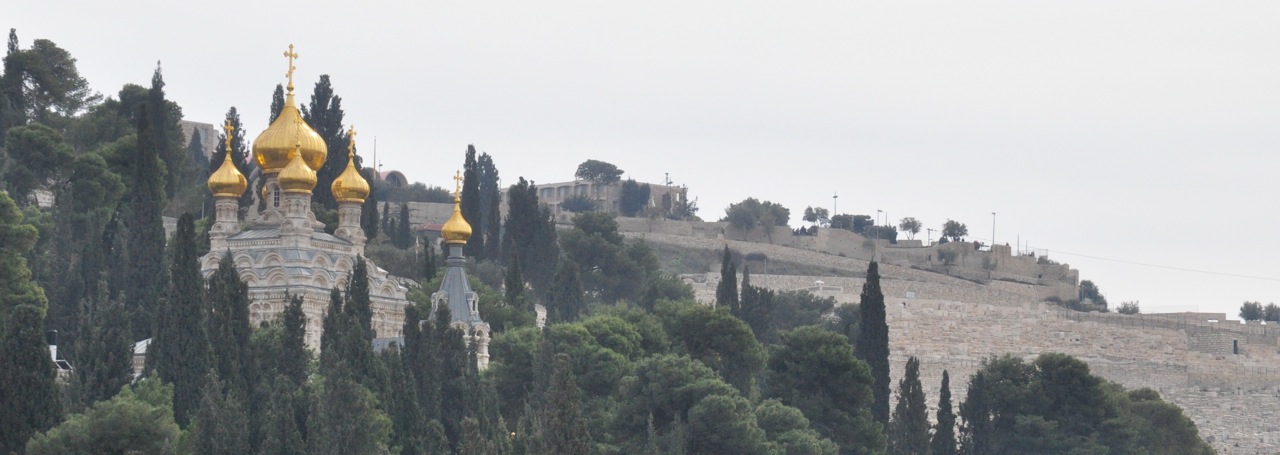
You can’t miss the church on the slope of the Mount of Olives, its seven gilded, onion-shaped domes sparkling in the sunlight. This is the Church of Mary Magdalene built by Czar Alexander III of Russia in 1886. Dedicated to Alexander’s mother Maria Alexandrovna, it was called the Church of Mary Magdalene after her name-saint from the town of Magdala on the western shore of the Sea of Galilee.

Mary Magdalene is mentioned as one of the women who “ministered to him [Christ] of their substance”. The New Testament also tells the story of an exorcism on Mary that cast out seven demons (Luke 8:3). One of the best-known women in the New Testament, Mary accompanied Jesus on his last journey to Jerusalem, was present at the crucifixion and was the first person to see Jesus after the resurrection (Mark 16:9). Though she was very close to Jesus, she was never recognized by Christianity as one of the Apostles.

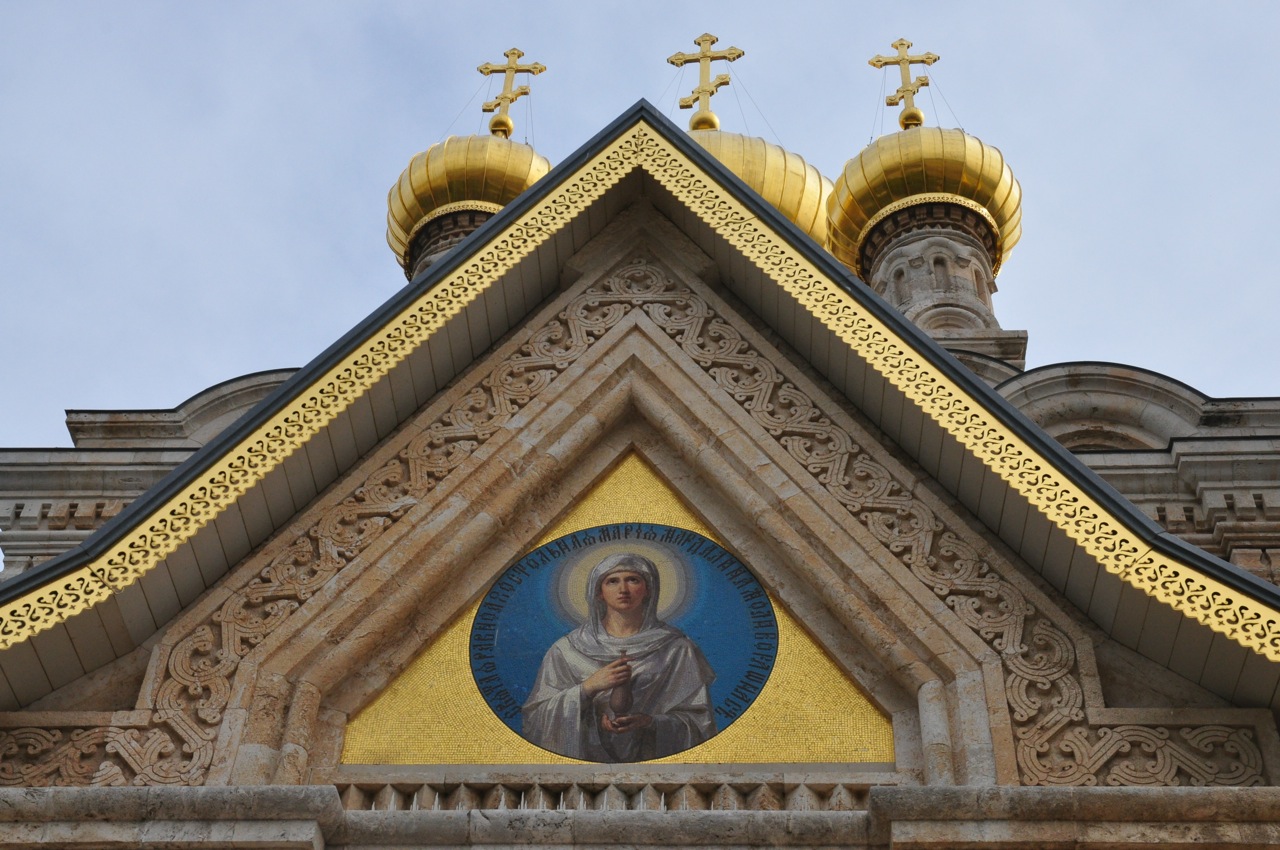
Above the main entrance to the church, located on the second level, is a gabled roof trimmed with a lace pattern in gold. A circular blue mosaic depicting Mary Magdalene piously robed in white is superimposed on a gold triangle in the gable,which is bordered with an intricately carved stone pattern. On the left side of the building is a bell tower ringed with squat squarish pillars topped by a large grey cone with several dormer like windows, a gold onion dome perched on top.
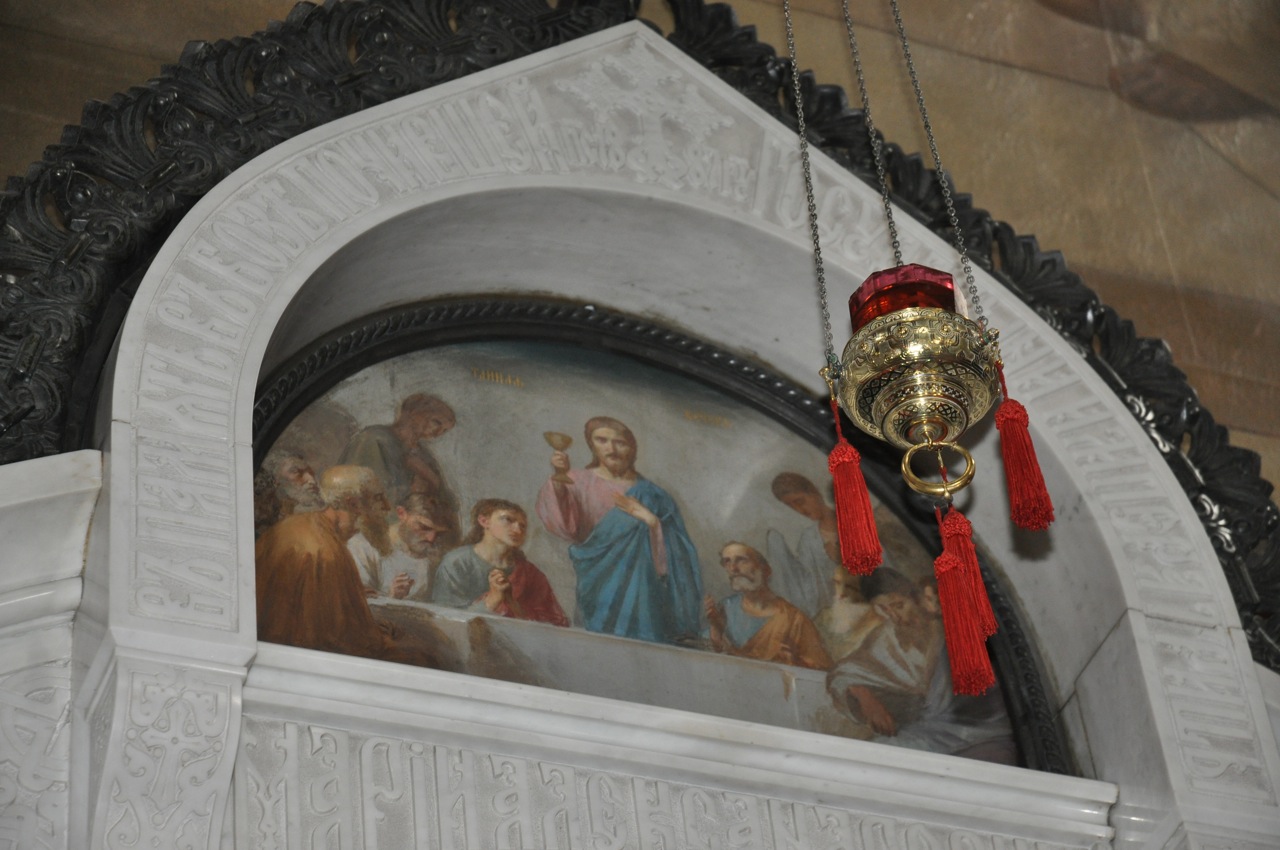
Inside the church decorated in shades of burnt orange in various patterns hangs a large metal chandelier which has small oil lamps for light. The iconostasis, a wall separating the nave from the sanctuary and altar in an Eastern church, consists of a series of arches of beautifully carved white marble, with paintings by Vereshoguine, one of Mary Magdalene. In the middle in an arch above the Holy Doors is the traditional scene of the Last Supper (click on the image to see it larger).
Six tiny paintings on the doors depict the four evangelists, the Virgin Mary, and the angel Gabriel. Over the arches of the iconostasis and high up on the other three walls are scenes with Mary Magdalene painted by Ivanov.

One of Russia’s most extraordinary saints lies in state within the church. She was Russian Grand Duchess Elizabeth Fyodorovna put to death by the Boshevists in 1917, wife of the Czar’s brother Sergei (assasinated in 1905) and sister to the Czar’s wife Alexandra. She was the creative force behind the church and supervised the artwork.

Visiting the church takes planning due to the limited hours it is open (Saturday, Tuesday and Thursday from 10am to noon) so until then check out this virtual tour at http://www.3disrael.com/jerusalem/church_magdalene2.cfm

If you are on the trail of Mary Magdalene search out the church of Saint Etienne, outside of the Old City walls just north of Damascus gate. Named for Saint Stephen, the first Christian martyr, this is a Catholic church of the Dominican order. You can’t help but notice the painting of Mary Magdalene on your right as you enter the church.

For another Russian Orthodox church with gold onions visit the Gorney monastery compound in the village of Ein Kerem southwest of the city where Mary came to visit her sister Elizabeth and where John the Baptist was born (Luke 1:39).
Acre Prison Break

“The first encounter with Acre Prison was terrifying. With your hands and feet shackled, you get off the truck next to a deep moat that reminds you of images of medieval castles that you may have seen in the movies. A fortress wall of seemingly infinite height towers before you. A narrow bridge leads to an opening in the wall. This is the bridge to a place that none has ever escaped from…”

Mendel Malatzky, Irgun prisoner, 1947

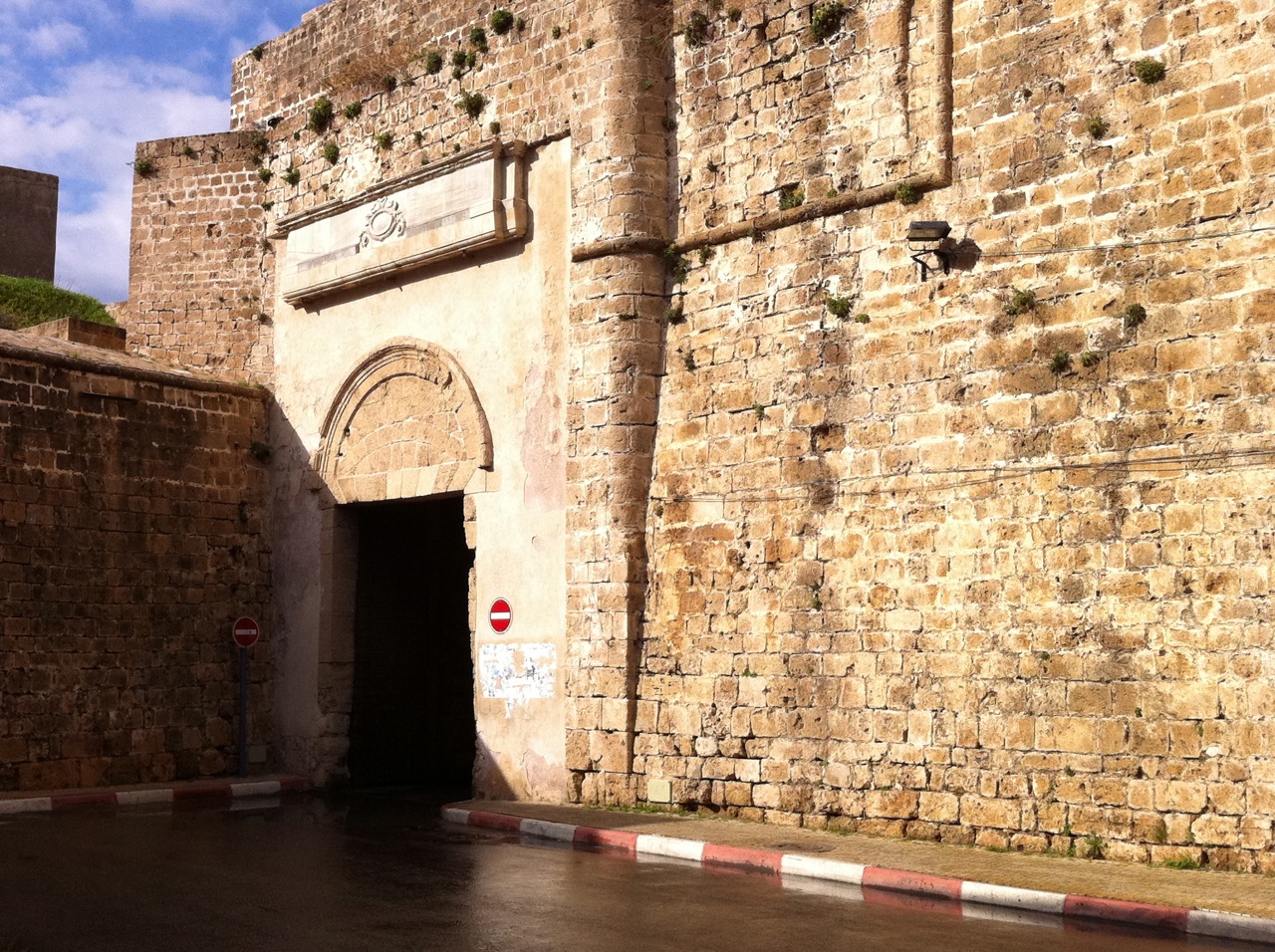
The fortress was built by the Bedouin sheikh Daher el Omar in the mid 18th century on the ruins of the Crusader citadel and was further fortified by al Jazzar. Under the British mandate, the fortress served as a jail, where Jewish underground fighters were imprisoned and where 8 Irgun members went to their death on the gallows. Acre was the most secure prison in the country.

Despite this, the Irgun looked for a way to enable their escape. The break came when an Arab inmate mentioned that he had heard women’s voices while working in the oil storeroom (in the south wing of the prison). This was reported to Eitan Livni (father of Tzipi Livni), the most senior Irgun prisoner, who deduced that the south wall of the prison bordered on a street or alley of Old Akko. The information was conveyed to the Irgun general headquarters where they concocted a plan to exploit this weakness for a break-in.

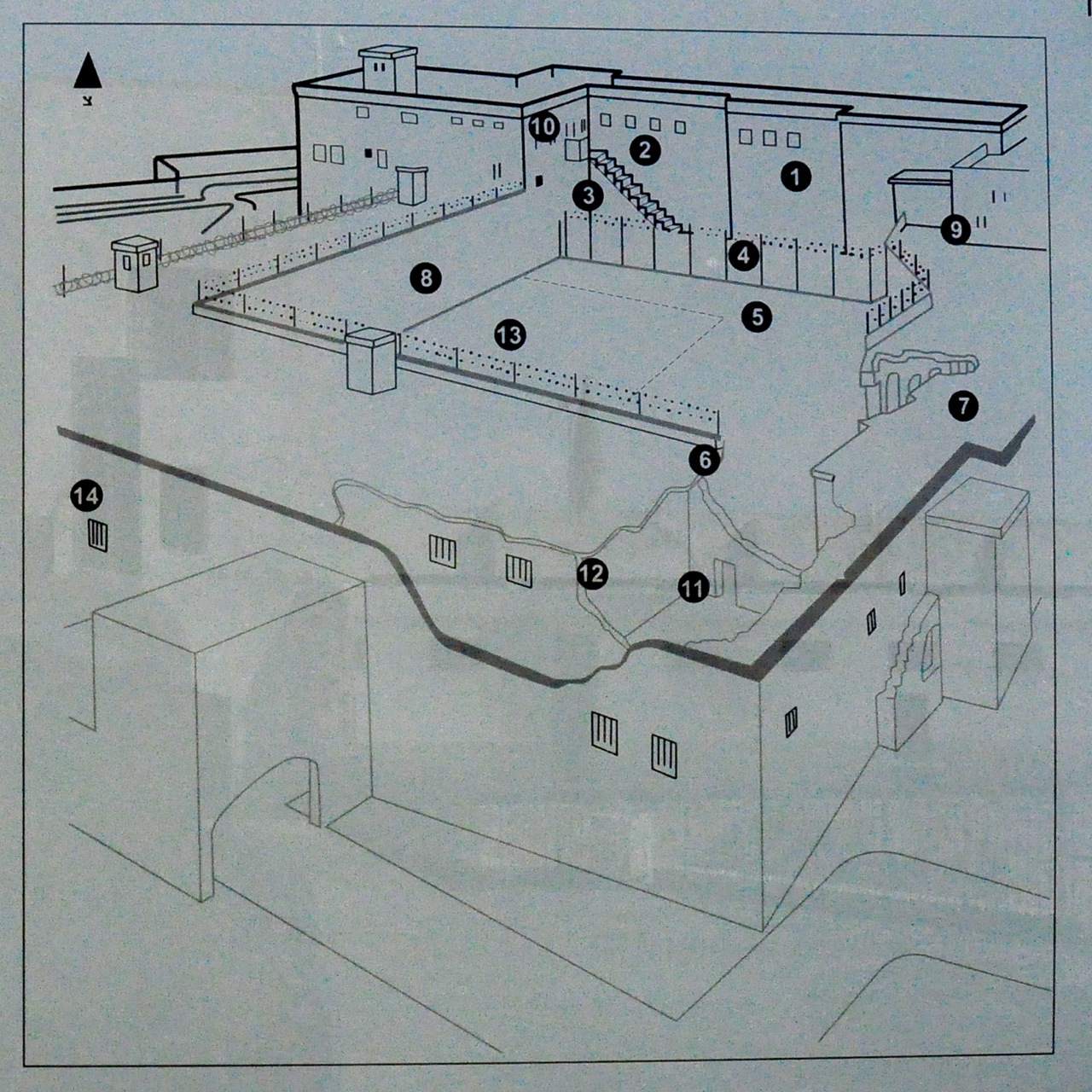
  1. Administration Wing
  2. Hospital
  3. Gallows and Memorial Floor
  4. Visitors’ Wall
  5. Prison Yard
  6. Arab Prisoners’ Wing
  7. Jewish Prisoners’ Wing
  8. Service Wing
  9. Workshops
  10. Jabotinsky Wing
  11. Iron gates that were broken through during the break-in
  12. Archaeological excavations
  13. Prison yard
  14. Break-in point

The logistic preparations were complicated: the Irgun had to purchase a truck, a jeep, two military pickup trucks and make them look like British army vehicles, British army uniforms were acquired and the men were given “English” haircuts. They set out in the convoy of vehicles for Akko to get into position, the two military vans entered the market, while the 3 ton military truck waited at the gate.

The jailbreak was planned for May 4th, 1947 when prisoners would be exercising in the yard to occupy the guards and the cells would be open, the same day the United Nations General Assembly convened to discuss the Palestine issue.

A military engineering unit of the Irgun made its way to the hamam, the Turkish bath house, and pretending to be telephone technicians used ladders to climb onto the roof with the explosives and placed them against the window bars. At 4:22pm there was a loud explosion that blew off the windows and made a hole in the southern wall.

Forty-one prisoners ran from their cells and using explosives that had been smuggled into the prison blew off the iron gates closing the corridors to reach the place of the break-in. From there they went out onto the roof of the hamam and into the alleyways of Old Akko.

Some jumped into the van, others ran through the streets of the market to the Land Gate where the truck was waiting.

Of 41 escapees (30 Irgun, 11 Lehi), 27 inmates succeeded in escaping (20 Irgun,7 Lehi), 6 escapees and 3 fighters were killed and 8, some of them injured were caught and returned to jail; also arrested were five of the attackers. The Arab prisoners took advantage of the commotion and 182 of them escaped.

The action was described by foreign journalists as “the greatest jail break in history.” The New York Herald Tribune wrote that the underground had carried out “an ambitious mission, their most challenging so far, in perfect fashion”, while in the House of Commons, Oliver Stanley asked what action His Majesty’s Government was planning to take “in light of the events at Acre prison which had reduced British prestige to a nadir”.

Three out of the five men captured (Avshalom Haviv, Meir Nakar and Yaakov Weiss) were sentenced to death and died on the gallows in the Acre prison. In retaliation, the Irgun kidnapped two British sergeants, Clifford Martin and Mervyn Paice. When the British did not relent and executed the Irgun men, the Irgun hanged the two sergeants.

Today the Acre Prison is a museum where you can walk through the different cells, offices and workshops of the prison and through a series of dramatic videos experience what it was like. The tour ends at the room with the gallows.

From the prison you can visit the hamam and and learn about the tradition of the Turkish bath and some history of Akko. There is much to see and I’d be happy to take you exploring Akko.

Sites around Akko

There are many well-known sites in Israel that are popular, that visitors see again and again while missing out on other hidden gems. Many people have seen the Chagall Windows at Hadassah hospital in Jerusalem but far fewer probably know about the stained-glass windows that Israeli artist, Mordecai Ardon designed. Many people have visited Yad Vashem but far fewer have visited Lohamei HaGetaot, a kibbutz near Akko founded by those who fought and survived the Nazis.

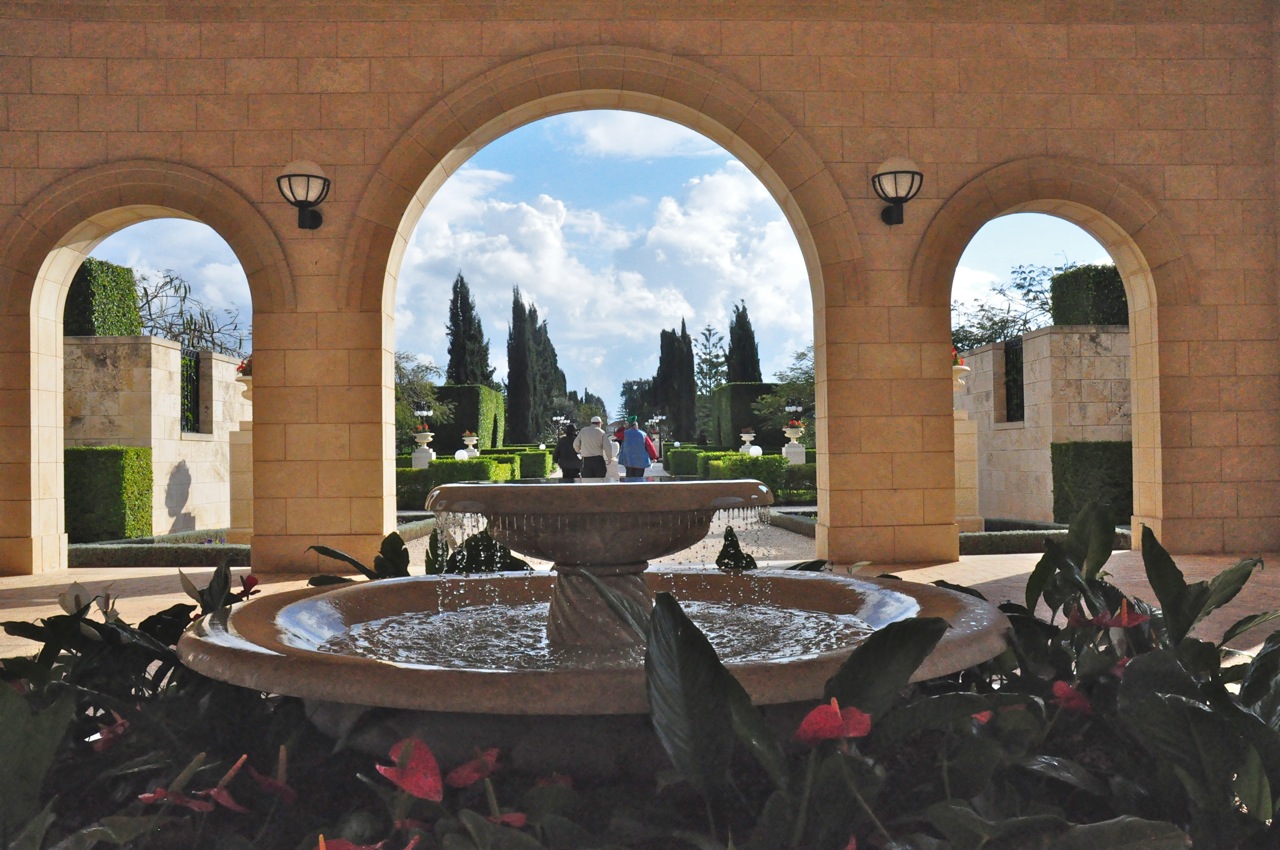
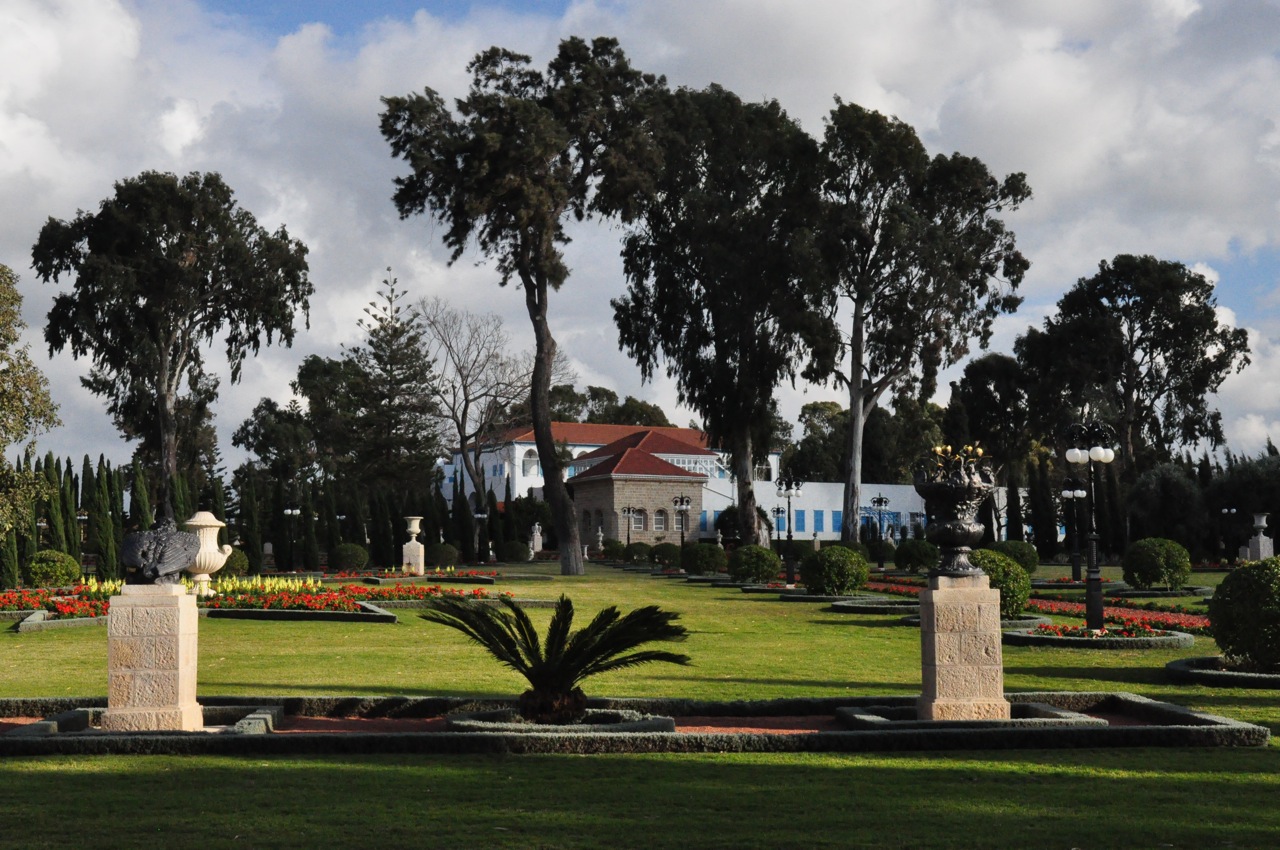
Many people are familiar with the Bahá’í gardens in Haifa but far fewer have visited the Bahá’í gardens just north of Akko. The gardens in Haifa comprise a staircase of nineteen terraces extending all the way up the northern slope of Mount Carmel. The golden-domed Shrine of the Báb, the resting place of the Prophet-Herald of the Bahá’í Faith, stands on the central terrace, looking across the bay towards Akko. There the gardens at Bahjí reflect the beauty and serenity of the Haifa gardens.

The gardens form a large circle surrounding the historic mansion where Bahá’u’lláh, the Prophet-Founder of the Bahá’í Faith, lived during the final years of his life after he was released from Acre Prison by the Ottoman Turks and the shrine where he is buried.

Later during the British Mandate period, Jewish resistance fighters were held in the Acre prison and 9 died there on the gallows. Today the prison is a museum and has been recently updated to dramatically retell the story of the Hagana, Irgun and Lehi struggle with the British, definitely worth a visit. There is another less well-known museum to the underground prisoners in Jerusalem in the Russian compound.

The Old City of Akko was designated a UNESCO World Heritage site in 2001. In July 2008, the Bahá’í Gardens in Haifa and Akko were listed as UNESCO World Heritage sites, in recognition of their “outstanding universal value” as holy places and places of pilgrimage. Like all great works of art, these extraordinary sites are tangible expressions of the human spirit.

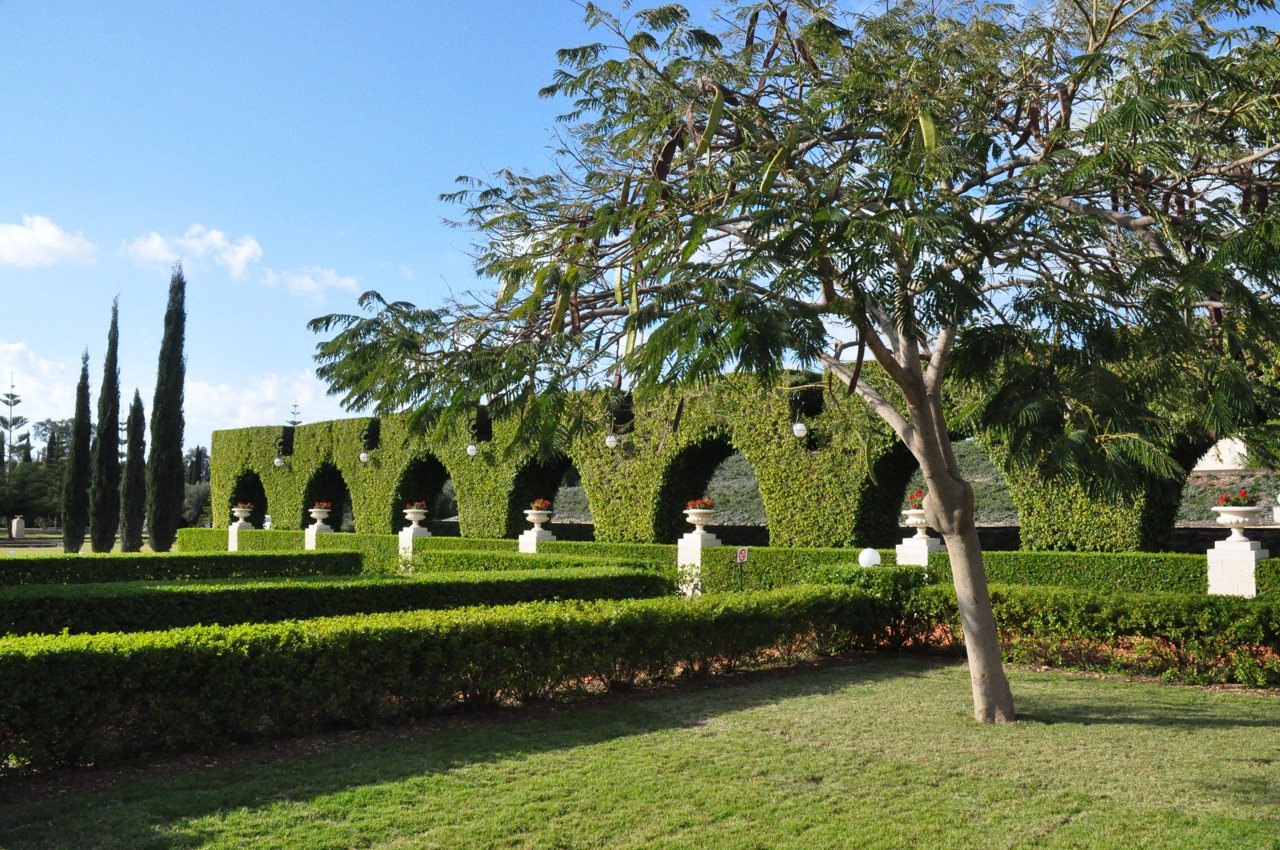
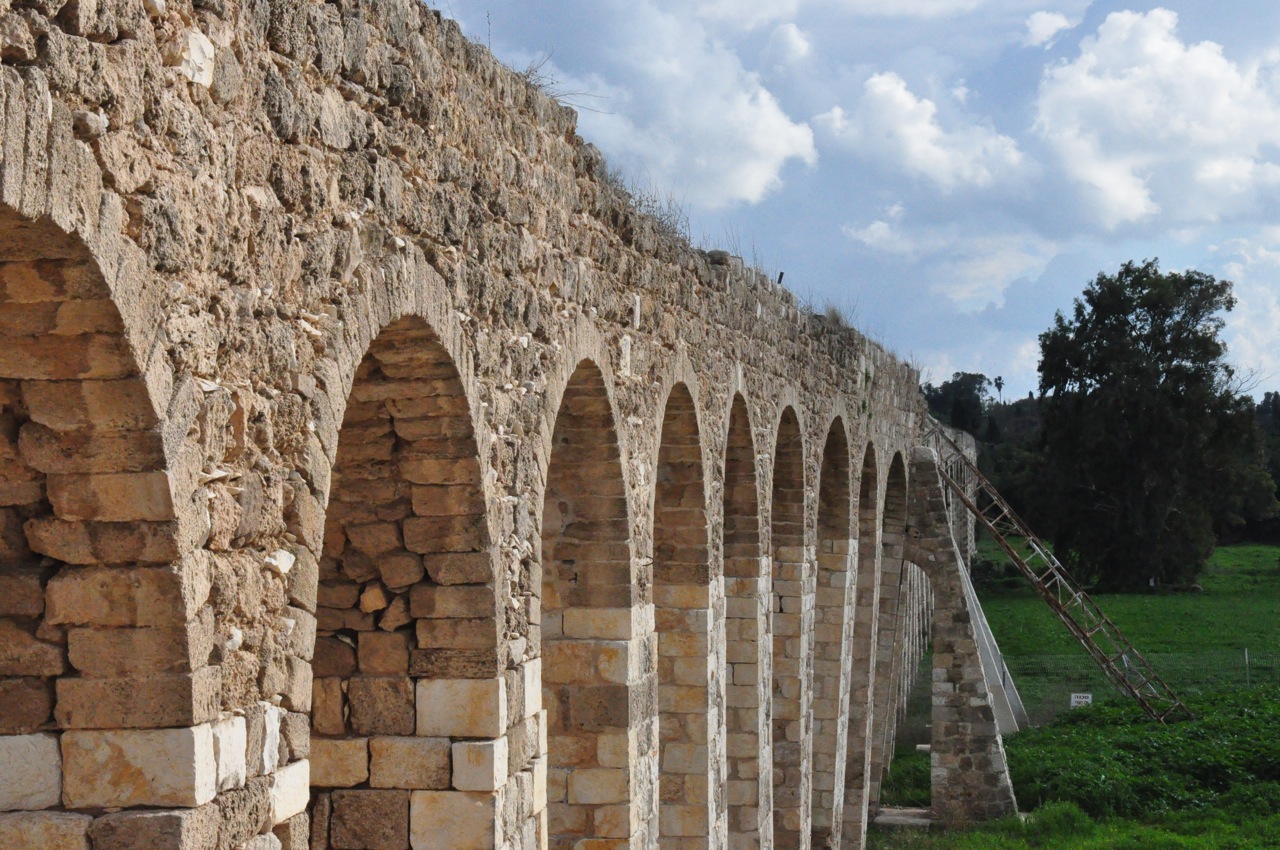
One of the striking formations near the entrance is a trimmed hedge in the form of an aqueduct. Many people are familiar with the aqueduct that Herod built, onto which the Romans tacked a second aqueduct to bring water to Caesarea but there is another less well-known aqueduct. Just north of Akko, by Kibbutz Lohamei HaGetaot is an aqueduct from the Ottoman period built on an earlier one from the Hellenistic period that was built to bring water from the Cabri springs to Akko.

Kibbutz Lohamei HaGetaot was founded in 1949 by a community of Holocaust survivors, members of the Jewish underground in the ghettos of Poland, and veterans of partisan units. Integral to the kibbutz from the beginning was the Ghetto Fighters’ House – Itzhak Katzenelson Holocaust and Jewish Resistance Heritage Museum for documenting and researching the Holcaust. The museum serves as a testimony to the stories of the survivors and an expression of the return of the Jewish people to our land.

Beside it is Yad Layeled (Monument to Children), an educational center commemorating the one and a half million Jewish children murdered in the Holocaust. The building was designed by Ram Carmi of two main architectural elements: a central 3-story cone and a descending ramp that encircles the cone and defines the path through the space. The space is lit by natural light that enters through a circular stained-glass window on the domed ceiling of the cone that becomes dimmer as you descend until you reach the innermost sanctum and eternal flame.

Yad Layeled gives the visitor an intimate view of the children’s world during the Holocaust and opens a door to their dramatic experiences and pain. It is unique in that it is intended to reach out to young people (ages 10 and up). The other permanent exhibitionis dedicated to Dr. Janusz Korczak, a Polish-Jewish doctor, author and educator who devoted his life to children. Many people visit Yad VaShem but fewer people know about Lohamei HaGetaot. That’s a good reason to hire a guide – a guide can take you places and share experiences that you probably won’t discover on your own.

Ardon Windows

photo, Mordecai ArdonMordecai Ardon (1896-1992) was born into an Orthodox Jewish family in Tuchów, Galicia (then Austria-Hungary, now Poland) but lived a secular life. From 1921 to 1924 Ardon studied at the Bauhaus under Klee, Kandinsky, Feininger and Itten. The influence of the Bauhaus and especially Paul Klee on his artistic development was profound. After graduating from the Bauhaus he studied the painting techniques of the Old Masters, especially Rembrandt and El Greco under Max Doerner in Munich. Combining these seemingly contradictory techniques gives Ardon’s colors their depth and richness.

In 1933 he immigrated to Palestine under the British Mandate. He joined the faculty of the newly formed Bezalel Arts and Crafts School in 1935, five years later he was elected director. Through the fifties he lectured at the Hebrew University on art appreciation and was artistic advisor to the Israel Ministry of Education and Culture.

Professor Ronen, of Tel Aviv University in speaking of Ardon said:

Ardon conceived colour as possessing an absolute aesthetic and spiritual value. He therefore always strove to create the most beautiful colours possible, the deepest blue, the warmest red, the most shining yellow, the most saturated green.

Ardon believed in pure art devoid of any political or social message. He believed that a painting should be appreciated and judged solely by its inherent artistic elements, such as colour, composition and their interplay. He rejected literary, symbolic or, indeed, any other additional meaning attributed to a work of art.

Ardon loved colors and ‘pure art’ but filled his works nevertheless with mystical connotations, Jewish symbolism and enigmatic scenery. He was appalled by the horrors of war and injustice and these themes too seeped into his art. Ardon was an artist who chose to use modern, expressionistic and abstract styles, combined with a classic painting technique which created distinctly unique paintings.

As Ardon expressed in a letter he wrote to Willem Sandberg, Director of the Stedelijk Museum, Amsterdam in 1960:

… an odd thing happened on my palette: something foreign sneaked into the group of cadmiums, ultramarines and viridiums – it was Jerusalem – ascetic, with a sack over its head.

What is Jerusalem doing amongst the bright cadmiums? How can one scratch it off the palette? Sometimes it can be scared away and hidden behind the ivory black. But in vain – the next morning it settles down again in the midst of the cadmiums…

One cannot get away from it. The alien Jerusalem always gives orders: “Thou shalt”, “Thou shalt not”, like a black woodpecker Jerusalem keeps knocking on your bark – Thou, Thou, Thou. Thou and the orphan, Thou and the widow…

In 1963 Ardon retired and finally was able to focus solely on his artwork. During these years, moving between Paris and Jerusalem, he created eight monumental triptychs – the last ‘Hiroshima‘ when he was 92. One of these was executed in stained glass by Charles Marq (who had collaborated with Chagall 20 years earlier) at Atelier Simon in Rheims, France between 1982 and 1984. A set of three large stained-glass windows (measuring (6.5×17 meters) cover one wall in the Jewish National and University Library in Jerusalem, dedicated to Isaiah’s vision of eternal peace with visual elements from the Kabbalah.

And many people shall come and say, “Come let us go up to the Mountain of the Lord, to the house of the God of Jacob, that he may teach us his ways and that we may walk in his paths. For out of Zion shall go forth the Law and the word of the Lord from Jerusalem. He shall judge among the nations and decide for many peoples and they shall beat their swords into plowshares and their spears into pruning hooks. Nation shall not lift up sword against nation, neither shall they learn war any more.   Isaiah 2:3-4

Click on the thumbnail above to display a larger image (these are quite incredible stained glass images).

The left panel depicts the winding roads taken by the nations on their way up to Jerusalem, up to the Mountain of the Lord, each road marked with its own language and alphabet (Latin, Greek, English, French, Arabic).

In the central panel Ardon represents Jerusalem, where the city’s stone walls are represented by the Isaiah Scroll (one of the Dead Sea Scrolls), a spiritual wall combined with the Kabbalistic tree of the sefirot, a symbol of the mystical divine presence, a merging of the earthly and heavenly Jerusalems.

The right panel is the vision come true, guns and shells beaten and transformed into spades which hover above.


Ardon was considered by many to be Israel’s greatest painter.
For images of Ardon’s paintings check out the website http://www.ardon.com/

Jewish Hirbet Midras

About 45km south of Jerusalem in the Ella valley, where David fought Goliath, are the ruins of an ancient agricultural settlement beginning in Iron age II, Hirbet Midras. With the recent discovery of a Byzantine church thought to be the burial place of the prophet Zechariah* people may lose sight of the fact that the site also contained a large, important Jewish settlement that dates from the Second Temple period (3rd century BCE) until its destruction during the Bar Kokhba uprising.

The site is part of a JNF park and nature reserve covering about 5000 dunam with typical Mediterranean woodlands, Kermes oak, Atlantic pistachio, terebinth and buckthorn. When I visited there were pink cyclamen (rakafot רקפות), red anemones (kalaniot כלניות) and Common Asphodel in bloom. With the recent rains, hyssop (zatar) had come up.

There were also many clumps of mandrakes (dudaim) in bloom, the fruit, which is reported in the Bible to be an aphrodisiac, will be ready late summer, at the time of the wheat harvest.

וַיֵּלֶךְ רְאוּבֵן בִּימֵי קְצִיר-חִטִּים, וַיִּמְצָא דוּדָאִים בַּשָּׂדֶה, וַיָּבֵא אֹתָם, אֶל-לֵאָה אִמּוֹ; וַתֹּאמֶר רָחֵל, אֶל-לֵאָה, תְּנִי-נָא לִי, מִדּוּדָאֵי בְּנֵךְ

Reuven went out and found mandrakes in the field and brought them to his mother, Leah. Then Rachel said to Leah, “Give me, I pray thee, of your son’s mandrakes”.  Genesis 30:14

Among the remains at the site are various buildings, agricultural installations and an extensive complex of caves and tunnels, including a columbarium and tombs.

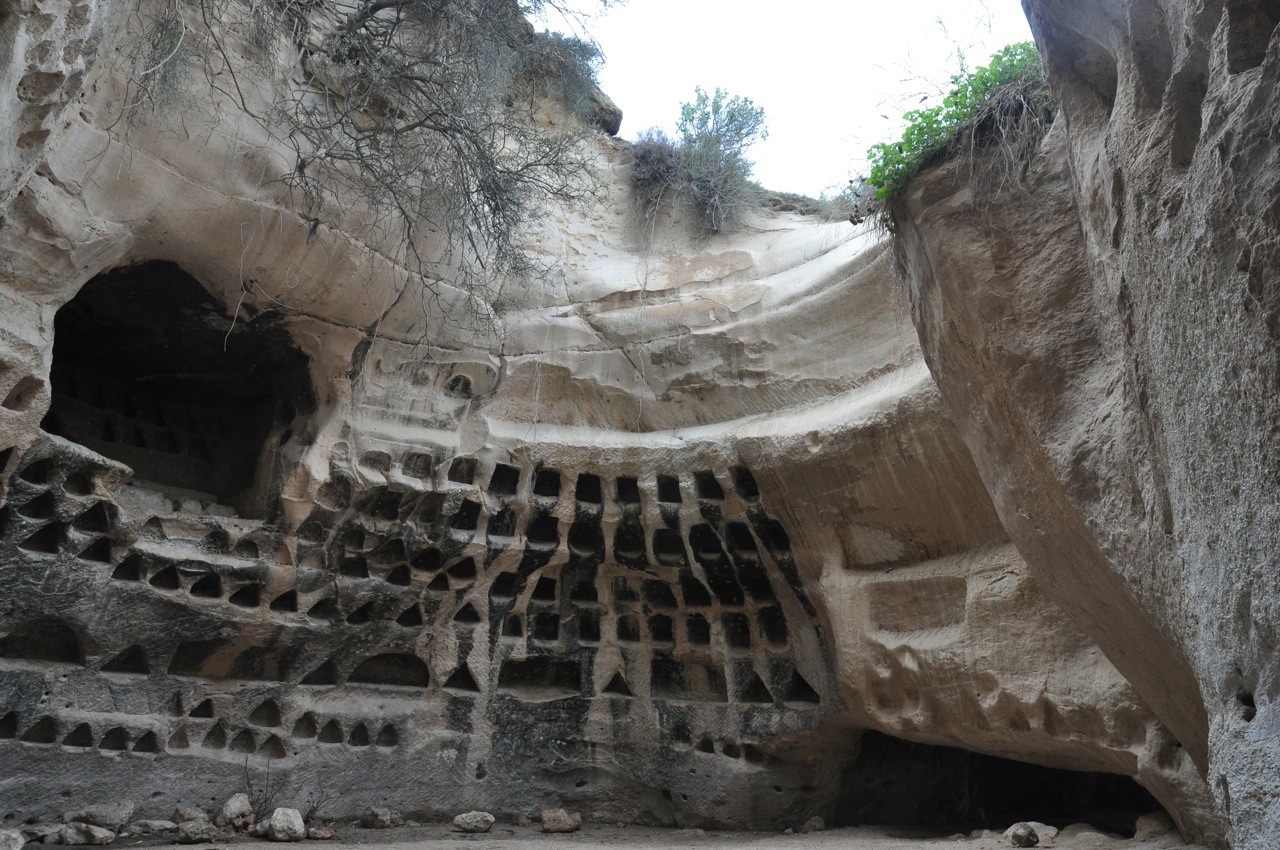
Cut out of the soft limestone is a bell cave with square and triangular niches carved in the walls that was used as a columbarium (dovecote). The pigeons were raised for food and the dung used as fertilizer. Other bell caves were used for storage and hiding during the Bar Kokhba revolt – a collection of chambers were quarried and connected to each other by tunnels. For those who like spelunking you can walk and crawl (about 20 minutes and you’ll need a flashlight and a map) from the bell cave through a circular maze of tunnels through some dozen chambers that takes you back to where you started.

At the top of the hill with a great view of the coastal plain is a stepped, pyramid-shaped structure of dressed stone, the only one of its kind in Israel. The base is about 10 meters and the present height is 3.5 meters but 3 rows of stones are missing bringing the original height to 5 meters. This structure is a nefesh or monument marking a Jewish burial cave.

There is a wall of dressed stones up the hill near the stepped pyramid and nearby part of a niche which leads scholars to identify the building as a 4th century synagogue.

On the way back down you will pass a system of subterranean burial chambers cut in the limestone. The original opening of the cave was from a square patio, the tomb opening was sealed by a large stone disc that rolled on a track in the rock.

Nearby on the western side of highway 38 is a site with Roman milestones from the third century CE, from the days of Marcus Aurelius, with inscriptions of one of the caesars names (Septimius Severus) and his achievements.


*According to Jewish and some Christian traditions the burial place of Zechariah, along with Hagai and Malachi, the last three Hebrew prophets who are believed to have lived during the 5th-6th centuries BCE is in a large catacomb on the Mount of Olives (31.783333°N 35.250833°E). Archaeological research shows that the complex dates from the 1st century BCE, when this style of tombs came into use for Jewish burial. Some Greek inscriptions discovered at the site suggest the cave was re-used to bury Christians during the 4th and 5th centuries CE.

Mosaics at Hirbet Midras

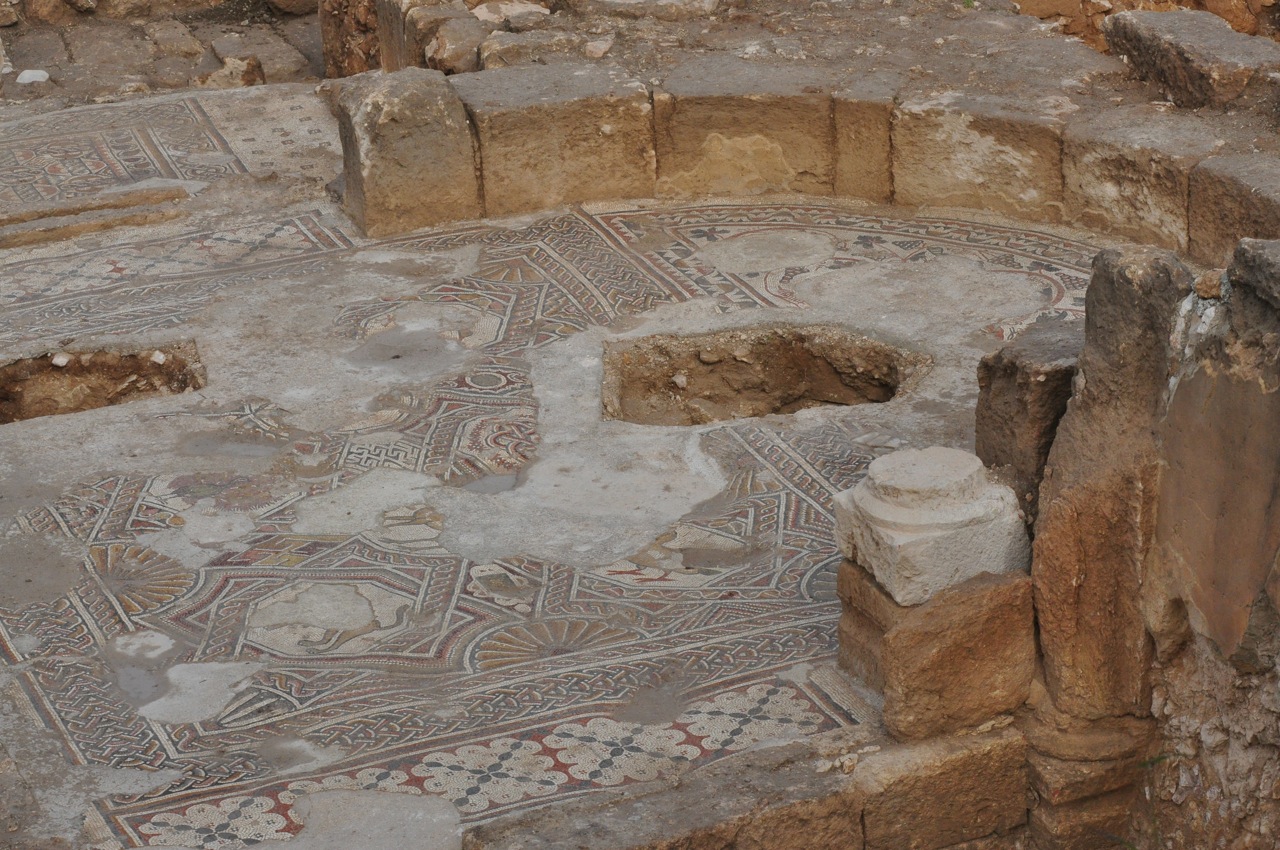
All of the floors recently uncovered in the church at Hirbet Midras have incredible mosaics, that are extraordinarily well preserved. The mosaics include both intricate geometric designs and floral, fauna, fish, birds and fruit. The tesserae are fine, 7mm cubes in an assortment of colors enabling the artists to create realistic images. You can click on any of the images to see it in higher resolution.

The apse of the church with a geometric rectangular carpet; the curved part has an image of a rooster and duck in a design of grapevine tendrils and bunches of grapes.

Display of mosaics in the aisle, geometric patterns on either side of a panel with chukar birds.

Close up of the chukar bird panel.

Panel that combines birds, fish and lotus.

Image of a lion attacking what looks like an ibex among grapevines. Interesting to compare it with the image of the lion attacking the deer under the tree from Hisham’s Palace (Khirbet El-Mafjar, 7th century) near Jericho.