Author Archives: Shmuel Browns

Unknown's avatar

About Shmuel Browns

I am a tour guide, licensed by the Israel Ministry of Tourism. I do tours throughout Israel, personalized to your interests, time and budget.

Aqueduct at Caesarea

The first aqueduct (one closest to water) was built by Herod at the time the city of Caesarea-Maritima was founded and brought water from the Shuni spring, south of Mount Carmel, about 10KM to the northeast of the city. The water flowed on a single raised channel supported on kurkar arches.

When this was not sufficient, a second “lower” aqueduct was built by the Legions of the Emperor Hadrian (2nd C CE). It brought water from Tanninim (Crocodiles) river. This section, with a tunnel of about 6KM long, was tapped into the older aqueduct, and doubled its capacity and its width. The builders used the same building materials and style, so it may be difficult to see that the pair of channels were built at different times. The aqueduct continued to supply water to Caesarea for 1200 years.

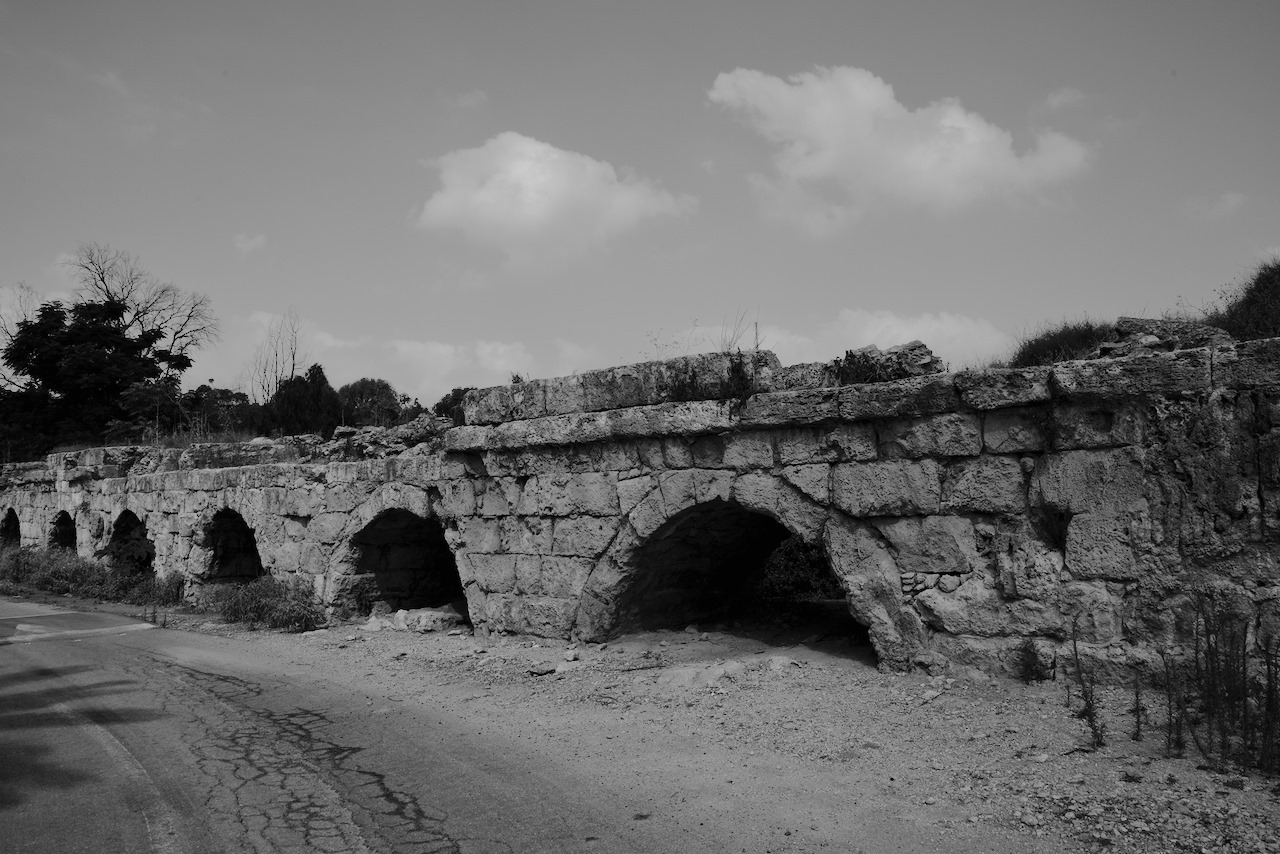
To find the start of the second aqueduct drive just past the entrance to Beit Hanania you will find the northern section of the aqueduct and the second aqueduct (Hadrian) connecting to the older one (Herod).

Aqueduct at Beit Hanania

In this section there are two stone tablets that were placed into the wall by its builders, the legion of the Emperor Hadrian. The right tablet clearly shows: “IMP CAES(ar) TRIAN HADR(ianus)”. The other tablet is of the Tenth Legion (the Imperial eagle without its head standing on a wreath).

IMG_5984

The Israel Trail winds its way beside the aquaduct, through the Arab town of Jizr a-Zarka and then south along the coast to Caesarea.

DSC_0195

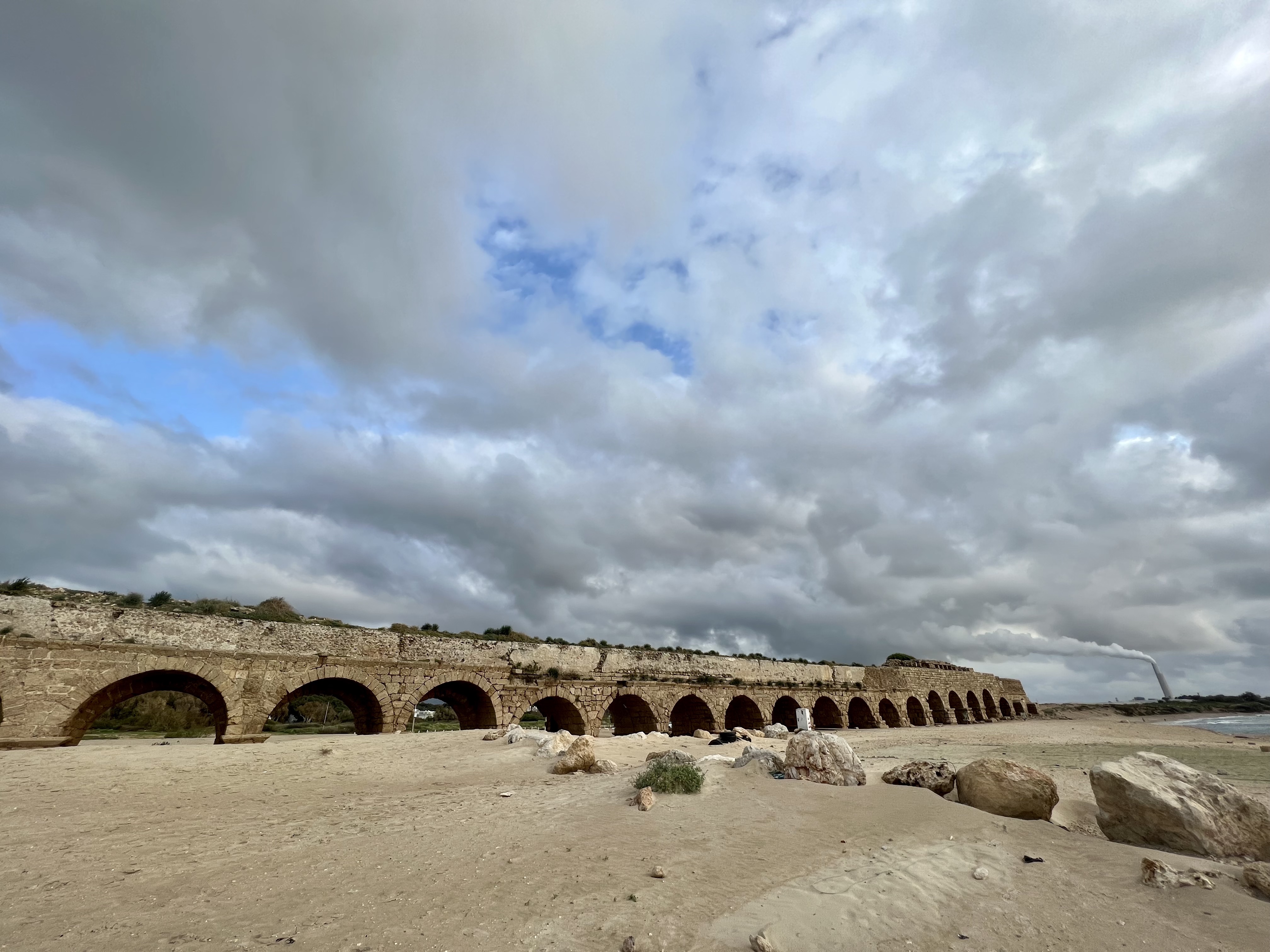
On the beach closer to the Caesarea archaeological park there is another section of the aqueduct.

Aqueduct just north of Caesarea

In fact it makes a great hike with the whole family following the aqueduct at Caesarea north along the beach to Dor (where you can visit the Mizgaga museum) or continue a little further to Hof Habonim.

Related articles

Bird Mosaic at Caesarea

Caesarea Maritima was a city and harbor built on the ruins of Strato’s Tower by Herod the Great about 25–13 BCE. It’s a very popular site, the archaeological park lies on the Mediterranean coast of Israel about halfway between the cities of Tel Aviv and Haifa. The city of Caesarea was described in detail by the 1st century Roman Jewish historian Josephus.

The city became the seat of the Roman praefecti soon after its founding. In 1961 Italian archaeologists excavating the theater found a stone inscription with the name of Pontius Pilate, according to the New Testament the Roman Governor responsible for ordering that Jesus be put to death, the first archaeological evidence that Pilate existed.

While visiting the Herodian, Roman, Byzantine and Crusader ruins of Caesarea make sure to see the Bird mosaic, a large rectangular mosaic ‘carpet’ on the floor of an extravagant mansion first uncovered in 1950 but only conserved and viewable by the public in 2004. It’s a tapestry of the land of Israel and includes fruit trees and animals native to Israel (lion, tiger, bear, wild boar, ibex, dog, elephant, deer and bull) bordering 120 round medallions, each of which contains a different bird.

Bird Mosaic Caesarea

Bird Mosaic


The owner of the mansion is unknown but was obviously extremely wealthy. Built in the sixth century on a hill overlooking the sea, the mansion included a hall with the mosaic floor, columns, an open roofed yard and a second floor. The findings indicate an exceptionally developed water and drainage system that included inclined floors, water canals and recessed wells.

When walking through the hippodrome don’t miss the mosaic floor from a 6th century public building near the public baths with images of birds, animals and people. Interesting to compare it with the Bird mosaic above.

Nymphaeum at Herodium?

I’m a tour guide who often does tours at Herodium, the palace complex built by King Herod about 15 km south of Jerusalem and where, according to Josephus, Herod was buried. Ehud Netzer, in excavating Lower Herodium, described a building that he called the Monumental building at the end of of an elongated course. He suggested that the building could have been Herod’s burial place. Since then Netzer has discovered the base of a mausoleum with finely carved decorations and 2 sarcophagi on the north-western side of the hill.

On p. 38 of his booklet entitled Herodium (published 1999) Netzer writes

“Present-day visitors are always puzzled by a series of grooves cut into all of the half-columns. These grooves were apparently carved to accommodate a piping system which was probably added later during the period of the Roman pro curators, who may have converted the hall into a nymphaeum.”

Interesting. The nymphaeum that comes to mind in Israel is the one in Bet Shean. So I looked up nymphaeum and came across a very interesting article about Hadrian’s Villa near Tivoli:

http://www.dartmouth.edu/~classics/rome2005/updates/week9_10/nov14.html

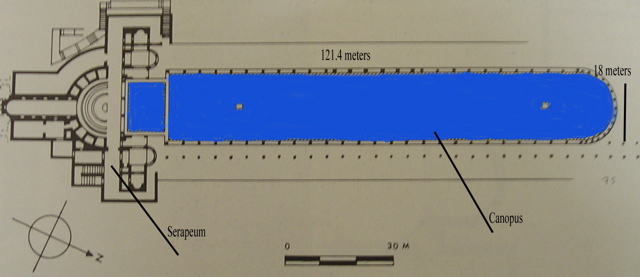
There’s a diagram of the Canopus/Serapeum complex, an open air triclinium/nymphaeum and water course. This is very reminiscent of the Monumental building and course that Netzer describes (course at Lower Herodium is ~300m in length and ~25m wide).

A plan of the Canopus/Serapeum complex (original image from Sear, p. 180.)

There is another nymphaeum in the plan, in the area called the Piazza d’Oro (based on Figure 103 on p. 177 of Sear’s Roman Architecture; the central dark grey area comes from Figure 114 on p. 96 of Macdonald and Pinto’s Hadrian’s Villa and its Legacy).

(A) A large colonaded pool with garden.  (B) The octagonal entrance vestibule.  (C) The eight-sided space on the southeastern side of the courtyard.  (D) The nymphaeum with five niches for fountains of flowing water.

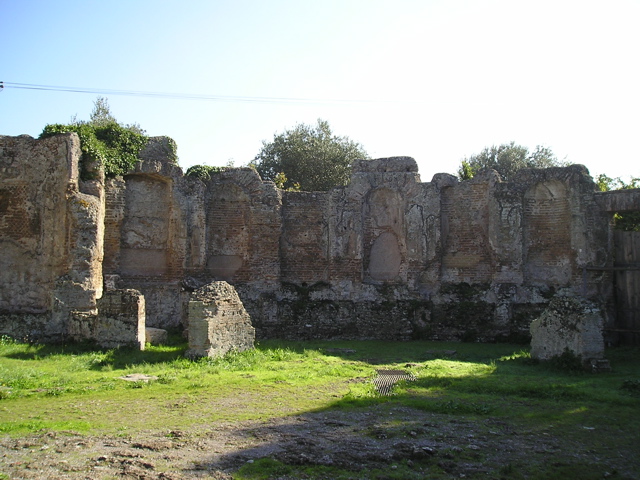
The article includes a photo of the remains of this nymphaeum, made up of 6 niches (which would have held the fountains) separated by pilasters. There is a channel that would have allowed water to run from the nymphaeum to the pool in the courtyard.

I was struck by how similar this is to the Monumental building, so I have included a photo of it here.

In guiding, I’ve had a number of tourists ask me what the curved cuts in the stone in the lower part of the pilasters (between the niches along the walls, 2 in the end, 3 on each side) were used for. If this was designed as a nymphaeum (either in the time of Herod or by later Roman governors) perhaps the channels were used for water. The course and building are just south of the large pool.

Roman Theater Box at Herodium

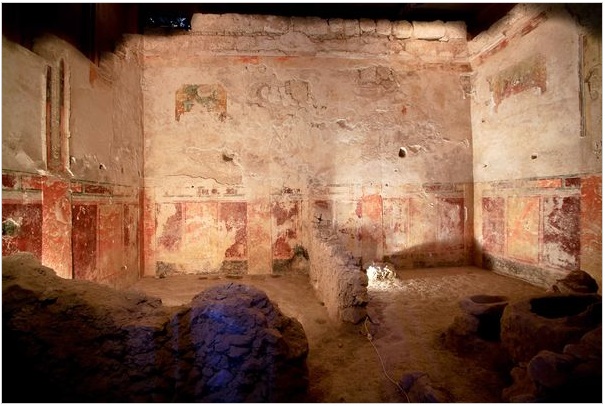
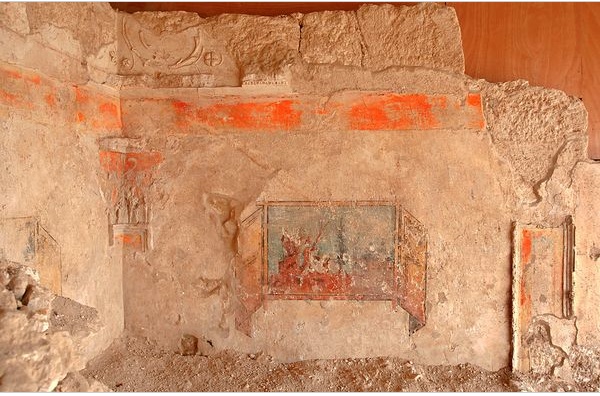
First discovered in 2008, the Royal loggia (theater box) above the regular rows of seats at Herod’s private theater has now been fully excavated.

Herod’s theater box, loggia; photo courtesy of Hebrew University

While ruling over Judea Herod wanted “to put Herodium on the map. In order to attract people, there were gardens and waterworks, and the place became famous.” said archaeologist Ehud Netzer, professor emeritus of archaeology at Hebrew University. “The theater indicates that the experiment worked: there was lots of life there. Hundreds, if not thousands, of guests would visit the place and there was justification to provide them with entertainment.”

On your next visit to Israel make sure that Herodium is on your itinerary. I can take you there and give you a comprehensive and fascinating guided tour.

“There is nothing like this in any other location” in Israel, Netzer said of the paintings and intricate moldings in Herod’s theater box. But the style was fairly common across the Mediterranean and reflects the Roman origins of Herod’s power.

Herod’s theater box, loggia, Herodium; photo courtesy of Hebrew University

“Our art history expert said, ‘Hang on, this is something very familiar from Italy,'” in terms of both style and method, Netzer said. “The technique used here was not particularly accepted in this region; it was secco rather than fresco“—painted on dry, rather than moist, plaster.

Depicting natural landscapes, nautical scenes, animals, and the Nile River, the paintings most closely resemble others in the roughly contemporary Villa Imperiale at Pompeii.

According to Netzer, the pictures are not only Roman style but Roman made, perhaps executed in advance of the visit of Marcus Agrippa to Judea in 15BCE. Agrippa was Augustus’ deputy and the man responsible for many of the building projects in his empire.  “It was a one-time mission. The artists came, they painted, and they returned to Italy.” says Netzer. There are other examples from the same period where Roman techniques and presumably builders and architects were sent to Judea for a specified period of time to assist in building projects. Archaeological excavation have uncovered walls at three sites built using the Roman opus reticulatum and opus quadratum techniques. These sites are Herod’s winter palace at Jericho, a temple at Banias and a round structure north of Damascus Gate in Jerusalem, apparently the mausoleum to members of Herod’s family, all mentioned in Josephus’ writings.

What to see in Jerusalem

What to see in Jerusalem and Not Hire a Guide

I’m often asked by people who are planning a trip to Israel what they should do if they have a couple of days to see and experience Jerusalem. Of course, there are many answers, it really depends on what you are interested in. Assuming that this is your first visit, you’ll probably want to start in the Old City so here are my recommendations – note some sites charge an entrance fee.

First, drop by the Tourist Information Center at Jaffa Gate, in the Old City and get a free map and a list of sites to see; say hi to Jennifer, she’ll help by marking sites on the map for you and answering your questions. Then walk around, exploring the 4 Quarters, Armenian, Jewish, Muslim and Christian.

Another possibility is to take the Ramparts Walk starting at Jaffa Gate where you actually walk on the walls built in 1537 by the Ottoman Turkish sultan, Suleiman the Magnificent – looking in gives you a birds-eye view of the Old City, looking out gives you a view of the new city.

In terms of churches, I would visit the Church of the Agony/All Nations and the Garden of Gethsemane outside of the city walls, re-enter the Old City at Lions Gate, visit the Church of Santa Anna, a Crusader church with incredible acoustics (try singing Amazing Grace or other liturgical melody). Continue and you will come to Station I of the Via Dolorosa, follow the Via Dolorosa counting 8 stations to the Church of the Holy Sepulcher, the holiest site to Christianity, where Jesus was crucified and buried and according to Christian tradition rose again, stations IX to XIV are at the Church.

Walk through the Arab shuq and take a right at the Cardo to get to the Jewish Quarter. Visit the Wohl archaeological museum to get a feeling for Jerusalem in the Second Temple Period, in the time of Herod and Jesus. If you are interested in more archaeology, then visit the southern wall excavations at the Davidson Center; there is also a movie that describes life at that time.

Visit the Western Wall, the holiest site to Judaism, write your prayer on a paper and tuck it into a crack in the stones of the wall. Try to reserve a Western Wall Tunnel tour in advance, either on their website (if you know some Hebrew) at http://english.thekotel.org/VisitorInfo.asp?id=1 or you can call them at (02) 627-1333 between 8:30-17:00.

It’s worth taking a guided group tour of the City of David – exit the Old City through Dung gate, take a left and then right and the entrance is on your left. If you have “water” shoes and aren’t claustrophobic, you can even walk 45 minutes through Hezekiah’s Tunnel with water up to your knees (you’ll need a flashlight which you can buy at the site or use your cell phone), which is quite an experience.

You might want to walk up onto the Haram el Sharif to see the Dome of the Rock and al Aqsa mosque (the third holiest site to Islam) close up (the Muslim Waqf won’t allowed you to enter them unfortunately) but if so you’ll have to do it in the morning and it takes between 1/2 and 1 hour to pass through security at the entrance to the Western Wall Plaza. Make sure you have no religious articles, prayer books or Bibles and no Swiss Army knife, etc. with you – they will be confiscated.

The new Israel Museum is open after extensive renovations and it is now much easier to find your way (for more information check out my blog entry) – the Archaeology wing has been completely redone, the Ethnography section has been expanded and called Jewish Life and the Art gallery includes a new section on Israeli art. The museum includes the Shrine of the Book, where the Dead Sea Scrolls and other artifacts from Qumran are on display. From the same period, the Holyland model of Jerusalem is now housed on the museum campus. If the weather is cooperative, walk around and enjoy the sculpture garden. If you’re interested in archaeology, you can also visit the Rockefeller museum (on the same admission, there’s even a shuttle bus) which will get you back to the Old City.

For an overview of Jerusalem, there’s a red double-decker bus that takes you for a 2 hour audio tour (explanations in 8 languages) of the whole city:
http://city-tour.co.il/ntext.asp?psn=8375

The Arab shuq/market and the Mahane Yehuda market are great places to get a feel for Jerusalem. There’s the Ben Yehuda Street pedestrian mall, called the Midrahov, and at the bottom Zion Square and the pubs, restaurants and boutique galleries in Nahalat Shiva. There’s live music at the Yellow Submarine in Talpiot.

Explore the German Colony: for a local movie theater from the British Mandate period with restaurant/pub check out the Smadar; for artistic films, check Cinemateque. For music, dance and theater try the Mabada. There are plenty of places to eat in this neighborhood (including my house 8-))

All this without hiring a guide, but to be fair how about reading my post, Why hire a guide?