Author Archives: Shmuel Browns

Unknown's avatar

About Shmuel Browns

I am a tour guide, licensed by the Israel Ministry of Tourism. I do tours throughout Israel, personalized to your interests, time and budget.

Meze Appetizers

While in Israel try meze (also spelled mezze), a selection of small dishes served in the Mediterranean and Middle East as appetizers, think of Spanish tapas.

The word meze was probably borrowed from the Greek mezés (μεζές), which was borrowed from Turkish meze, which was in turn borrowed from Persian maze ‘taste, flavour, snack, relish’, and is found in all the cuisines of the former Ottoman Empire.

The meze served depends on the chef and the restaurant but could include some or all of the following:

  • Labne – strained yoghurt cheese
  • Babaghanoush – eggplant (aubergine) mashed and mixed with various seasonings
  • Muhammara – a hot pepper dip with ground walnuts, breadcrumbs, garlic, salt, lemon juice, and olive oil
  • Pastirma – seasoned, air-dried cured beef
  • Tabbouleh – bulgur, finely chopped parsley, mint, tomato, scallion, with lemon juice, olive oil and various seasonings

Walking along the promenade from Jaffa to Tel Aviv, you’ll find Etzel Pini BaChatzer, a restaurant that offers typical Mediterranean dining by the sea (not kosher) with a good selection of mezes. One of their specialties is chopped beef and lamb salad with Swiss chard and pine nuts.

As you walk along the promenade there is a fun wall mural on a building facing the beach that shows some famous people enjoying the restaurant/bar scene in Tel Aviv. The mural was painted by Israeli artist Anna Kogan (http://tziur-kir.co.il).
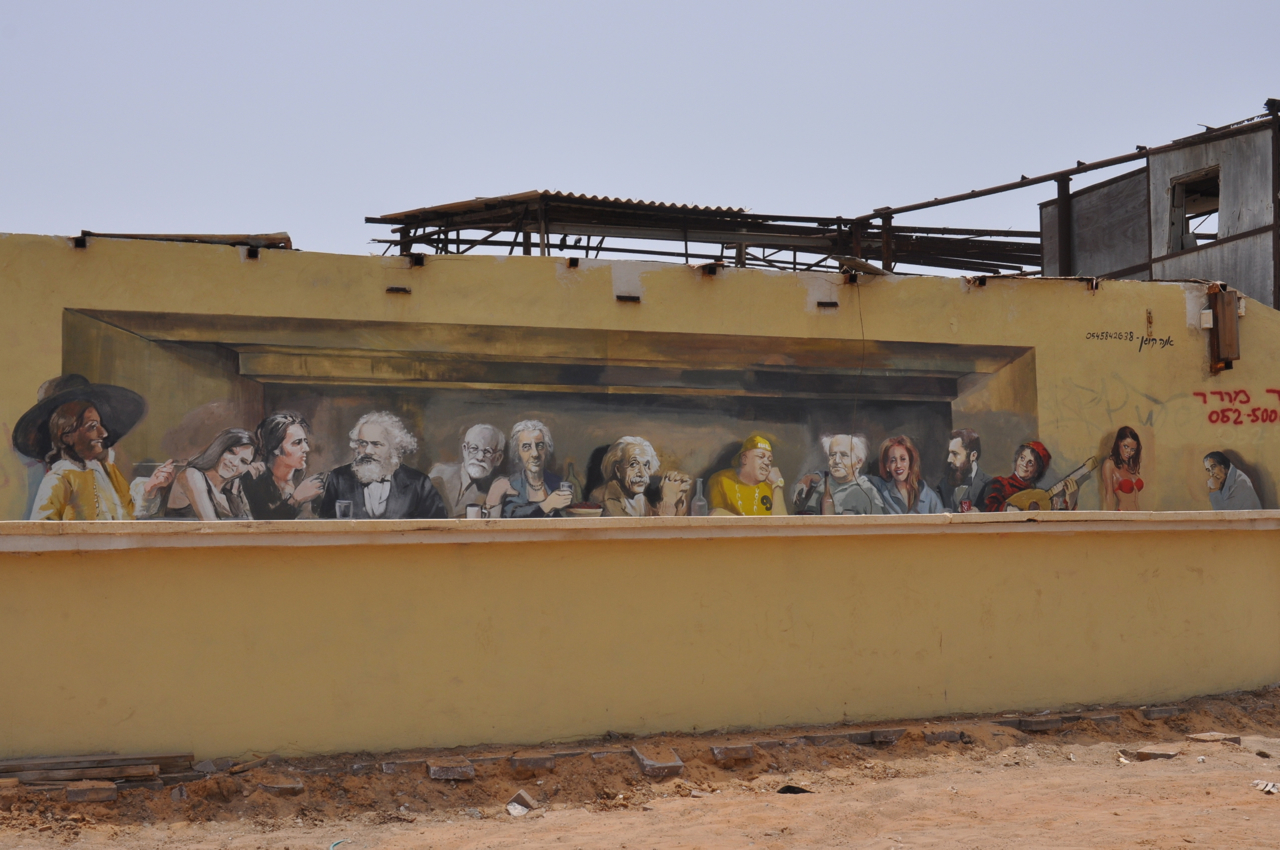
Wall mural-Anna KoganTwo of the people are from Renaissance paintings – the gentleman in the large-brimmed black hat and yellow jacket is from a painting, La Buveuse (Woman Drinking, 1658) by Pieter de Hooche and the fellow with the red outfit and hat playing the lute is from a painting, Jester with a Lute, by the Dutch Frans Hals about 1625. The two young women (in positions 2 and 10) are both named Orit and lived in a building nearby. Position 3 is based on George Harrison from this photo of the Beatles. Position 8 is based on rapper, Master P.

So the people from left to right are :

de Hooche painting, Orit, George Harrison,  Marx,  Freud, Golda Meir, Einstein, Master P., Ben Gurion, Orit, Herzl, Jester with a Lute, model, Golda Meir
Archaeological Artifacts with Names

Of the myriad names of people that are familiar from the Bible and I’ll expand it to include the New Testament, Josephus and the Talmud, we have very little confirmation from archaeological evidence, inscriptions, papyrus or parchment, that these figures actually existed. I am excluding, for the moment, the names of rulers who appear on coins minted during their reign or names on bullae or seals.

Here are some of the names that have been found on archaeological artifacts:

  • The name Nicanor, from Alexandria who brought 2 large bronze gates to the Herodian Temple in Jerusalem, recounted in the Talmud Yoma 38a, was found on an ossuary in a burial cave on Mt. Scopus.
  • The name of the priestly family of Hezir, mentioned in the Bible (Nehemiah 10:20; 1 Chronicles 24:15), was found in an epitaph in the family mausoleum in the Kidron Valley.
  • The name of the priestly family Qatros, mentioned in the Babylonian Talmud, was inscribed on a stone weight, found in the basement of the Burnt House, a private dwelling on the Western Hill in Jerusalem.
  • The name of the priestly family Caiaphas, mentioned in the New Testament, Josephus and the Talmud was found on two ossuaries found in Jerusalem.
  • The name Yehohanah, a granddaughter of the high priest Theophilus nominated high priest in 37CE the year Herod became king mentioned in Josephus was found inscribed on an ossuary.
  • The name “tzaddan malka” and “tzadda malkata,” the Aramaic equivalent of the Greek “Queen Helena”,  spoken of in Josephus and the Tosefta for her giving of charity to the poor of Jerusalem during a period of famine (Peah 4:1) was found inscribed on a sarcophagus from the Tomb of the Kings in Jerusalem.
  • The name Simon bar Kosiba or Bar Kokhba, the leader of the Second Jewish Revolt (132–135CE) against the Roman was found on letters in caves at Wadi Murabba’at and Nahal Hever and 4 lead weights. You can see images of these weights at this site: http://www.archaeological-center.com/en/monographs/
  • The name David was found in the excavations at Tel Dan when a piece of basalt, part of a victory stele (on display at the Israel Museum in Jerusalem) describing how the Aramaean King Hazael was victorious over the House of David was found in the southern end of the wall by the outer gate.
  • The name Pontius Pilate was found on a stone inscription, part of a larger dedication to Tiberius Caesar in Caesarea. In 2018 a thin, all copper-alloy signet ring found at Herodium in 1969 was deciphered to read PILATO (“for Pilate” in Greek), conceivably some administrator pushing papyrus for Pilate would have worn a ring like this at a southern administrative center like Herodium.
  • The name James (brother of Jesus) was found on an ossuary with the Aramaic inscription Ya’akov bar-Yosef akhui diYeshua, “James, son of Joseph, brother of Jesus” as recorded in the New Testament and Josephus; the authenticity of the inscription has been contested and is the subject of ongoing scholarly debate.

Caiaphas Family Tomb and Ossuary

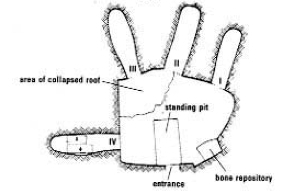
Tomb layout from IAA via Biblical Archaeology Review article

In the winter of 1990 while doing some work in the Peace Forest just below the Haas promenade (in Hebrew known as the tayelet) workers discovered a burial cave made up of 4 recesses (called loculi), rectangular spaces about 6 feet deep and 1.5 feet wide, cut in the limestone bedrock. The promenade, a dream of Teddy Kollek and designed by the Israeli landscape architect, Shlomo Aronson, is built on the ridge with an impressive view of the Old City walls and ancient city of David; I often take people there to begin a tour.

Since many tombs have been found in the Kidron and Ben Hinnom valleys around the Old City it was not a surprise to find this burial cave. Inside were found 12 ossuaries, 6 scattered about indicating that the cave had been robbed in antiquity but 6 in their original places.  Zvi Greenhut, the IAA archaeologist called to the site, identified it as a Jewish burial cave from the Second Temple period. At this time, burial for those who could afford a family tomb, the body was laid out in a recess carved in the wall of the cave and closed off. A year later, after the flesh had decomposed, the family returned, opened the loculus and gathered up the bones and deposited them in a cavern with earlier bones. That’s the explanation of the expression in the Bible “to be gathered up with his forefathers” and why it is a custom to revisit the grave after a year. Later it became customary to put the bones in a special limestone box and to write the name of the deceased on the outside – this coincided with the rise in belief of a physical resurrection at the End of Days.

Of the five ossuaries with inscriptions we find the names of two women: Miryam berat Shimon and Shlom… the full version would be Shlomzion.

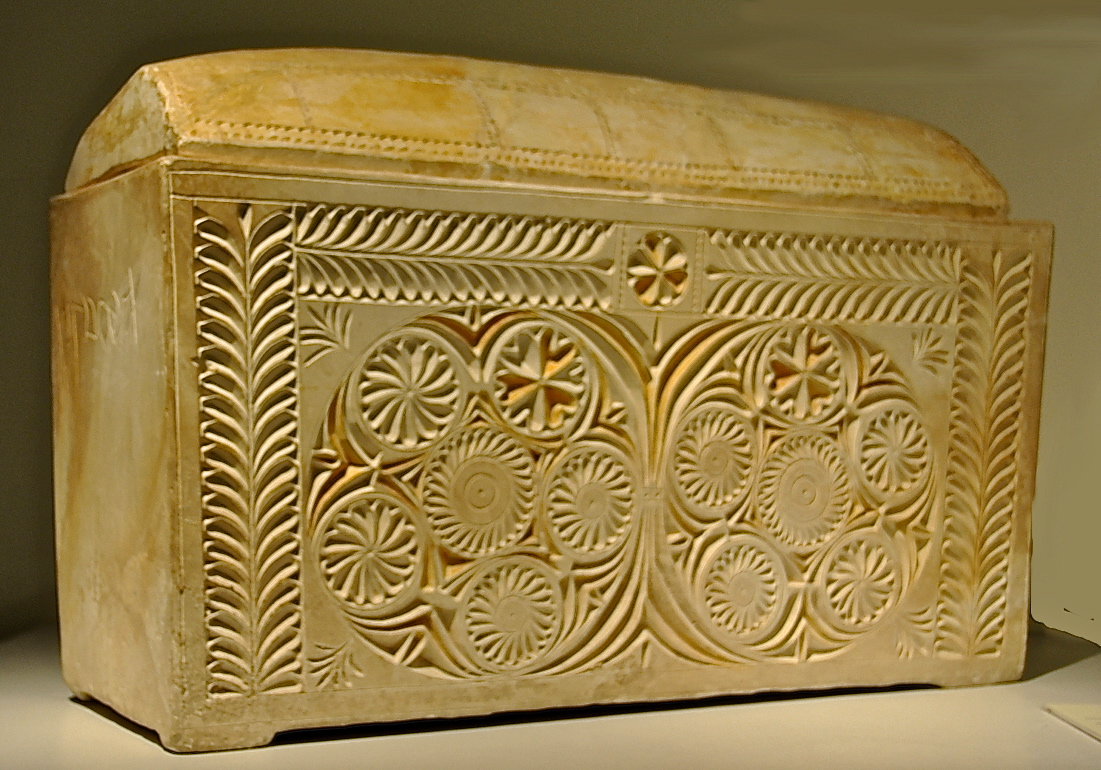
Caiaphas ossuaryFrom the name written on two of the ossuaries the cave seems to be the family tomb of Qafa, in Greek Caiaphas, a name known to us from the New Testament and writings of Josephus, one of whom was the high priest who presided at the trial of Jesus. One of these ossuaries is decorated beautifully in a rare and intricate pattern of two circles, each made up of six whorl rosettes, bordered by a pattern of palm branches. Inside were found bones from six different people, two infants, a child between 2 and 5, a young boy between 13 and 18, an adult woman and a male of about 60.

On the undecorated end is inscribed “Joseph bar Caiaphas” not necessarily “the son of” – here Caiaphas is a nickname which became a sort of family name. A fascinating statistic from the Second Temple period based on personal names mentioned in literary sources and inscriptions is that 28% of men had one of 4 names (Joseph and Shimon being the two most popular), 9 names account for 44% of men (so a family nickname would help identify people); for women it was even more extreme, 50% of women had 2 names, Miryam, which later became Mary and Shlomzion the equivalent of Salome in Greek.

A coin found in one of the ossuaries was minted by Herod Agrippa (37–44 C.E.). This would help us date the two Caiaphas ossuaries perhaps as early as the beginning of the century. The evidence suggests that we may have recovered the burial box (ossuary) and even the bones of the high priest Caiaphas who handed Jesus over to the Romans.

Columbarium for doves

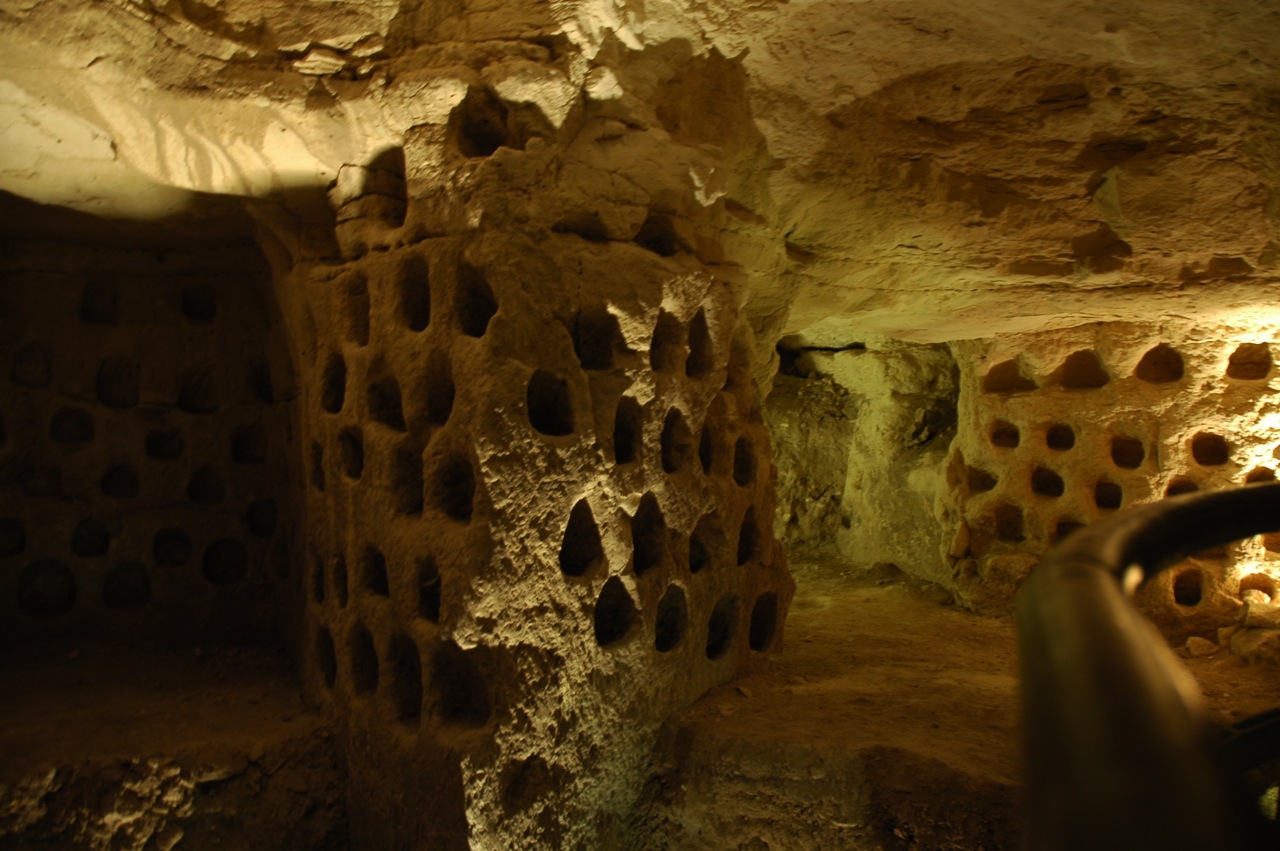
On one of the first trips on the guides course, we were driving along the southern coast with its sand dunes, from Gaza to Ashkelon. Haim Karel, the course coordinator, stopped the bus, we all got out and crossed the road to look at a large pit with rows of niches arranged in the walls built of kurkar blocks. The site is completely unmarked and not visible from the road – as the guide, you have to know where it is. Kurkar, is a kind of rock found along the Mediterranean coast, formed when the ocean spray carrying limestone glues the sand together to form rock. Haim explained that the structure is a columbarium, from the Latin columba meaning dove.

If you look up columbarium on the Internet you’ll find that a lot of the references are to cemeteries and crematorium. In his book on Masada Yadin describes  a circular “columbarium” southwest of the Western Palace from the time of Herod that they uncovered:

It is our conviction that this building, like similar though larger buildings discovered in Italy, was designed to receive the remains of cremations. It is probable that Herod built it for the burial of his servants, ministers or other members of his court who were not Jewish.

Two buildings, square not circular, but with similar niches in their walls, were found in the north-western part of the wall; it is possible that they fulfilled the same function.

Yadin even describes how Moshe Yoffe who worked on the excavation team  and raised pigeons at home brought in a very small pigeon but couldn’t cajole or force it into one of the niches.

In Jewish tradition where burial is outside the city and cremation is against Halacha (Jewish law) it seems unlikely; also, there were no human remains found here nor pottery shards, from the urns which may have held human ashes.

Another suggestion is that these caves were filled with water and used to raise fish. The consensus though is that they were used to raise doves or pigeons. The name columbarium comes from the Latin columba meaning dove. Doves/pigeons were used as a source of food and for sacrifice. My mother tells how in Israel in the 1950s when food was scarce and rationed, our neighbor kept pigeons and I was fed pigeon as a baby. The excrement makes excellent fertilizer for growing vegetables. The birds could be used for communication as they would fly back to their home.

But you don’t have to go as far as Masada, there are columbaria in other parts of Israel, for example, at Maresha/Bet Guvrin. After Alexander the Great’s conquest of Judea in 332 BCE, Maresha developed as a diverse town with Sidonians, Greeks, Jews and Egyptians arriving and settling there. Residents of Maresha took advantage of the naturally soft limestone to quarry water cisterns, olive presses and columbaria beneath their homes.

Don’t miss the columbarium at Tel Maresha where you descend into a tremendous cross-shaped cave with niches for more than 2,000 pigeons; so far more than 60 columbaria have been found in the Maresha region.

Near Nes Harim there is a nice hike through the natural oak, pistachio and carob trees in the Judean hills that takes us to the spring at Hurvat Itab among olive, fig and almond trees. In a large cave nearby is a columbarium for keeping pigeons.

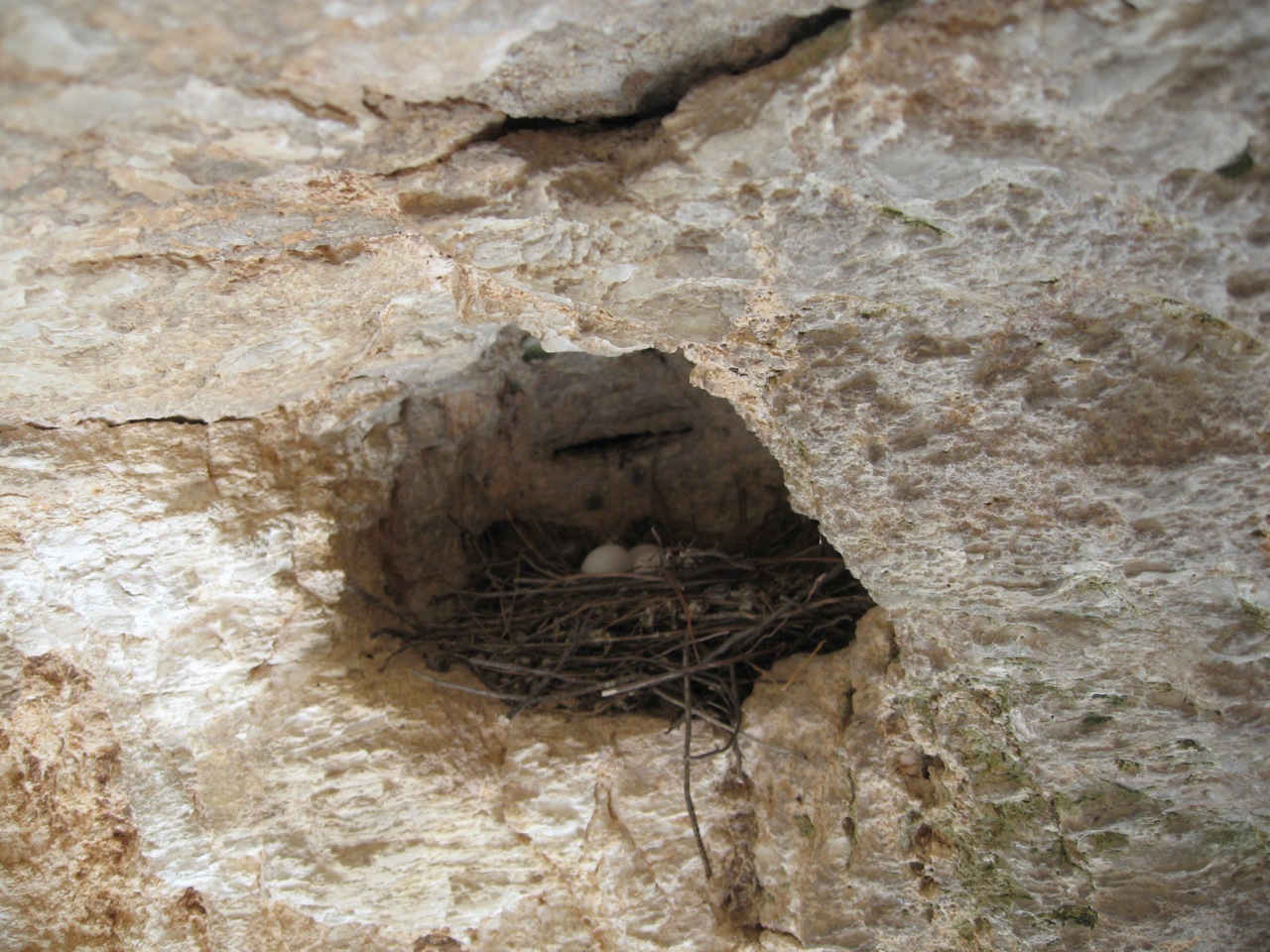
At Ramat Rahel, a burial cave, columbarium and ritual baths characteristic of the Second Temple period were uncovered by Aharoni (1962). The caves and columbarium were hewn into soft nari bedrock. On one of my visits to the archaeological site, I had climbed down into the columbarium to look around and was able to take this photo of one of the niches.

Madaba map

A few weeks ago I was guiding in the Old City and was explaining about the Madaba map, a graphical representation based on the Bishop Eusebius’ Onomasticon that lists cities and towns in the Holy Land during the Byzantine period. It is the oldest map we have of the area and includes a detailed map of Jerusalem. It was one of the first things that Haim Karel, who taught us in the guides course, impressed on us. It’s like having a map for buried treasure, the Madaba map shows archaeologists where to dig and guides what to guide.

Two summers ago while flying back from Nepal via Jordan we stopped in the sleepy Jordanian town of Madaba and got to see the original map in mosaic on the floor in St. Georges Church, a very special treat. I took this photo in the church.

Because Jerusalem is so important in Christianity the map includes a large and detailed depiction of Jerusalem. Note that in the Byzantine period it was customary to show north on the left (just as we show north up today). Hence, from left to right you can clearly see the Cardo running north-south from Damascus gate. In Arabic, this gate is called Bab el Amud which means the “gate of the column” because inside the gate was a plaza and a column with the statue of the emperor (today the column is gone but you can walk on the Roman flagstones of the plaza). The Madaba map shows that the Cardo joins the Church of the Holy Sepulcher, the holiest site to Christianity,  to the 5th C Nea Church of Justinian and there were religious processions along the Cardo between the two churches. Other things to notice are the gates of the city and the myriad of churches, any building with a red roof is a church: Holy Zion, Saint Sophia, Santa Anna, Siloam church.

Unusual for a Roman city there is another main north-south road, a secondary Cardo that follows the route of the Tyropean valley, part of which runs along the back of the Western Wall plaza. When plans were being made to build a visitors center for the Tunnel tour they knew that they would be building right on the secondary Cardo. What began as a salvage dig has become an important archaeological excavation. Although not yet open to the public you can view the excavation from a lookout point in the Jewish quarter.

Eclectic Style Architecture

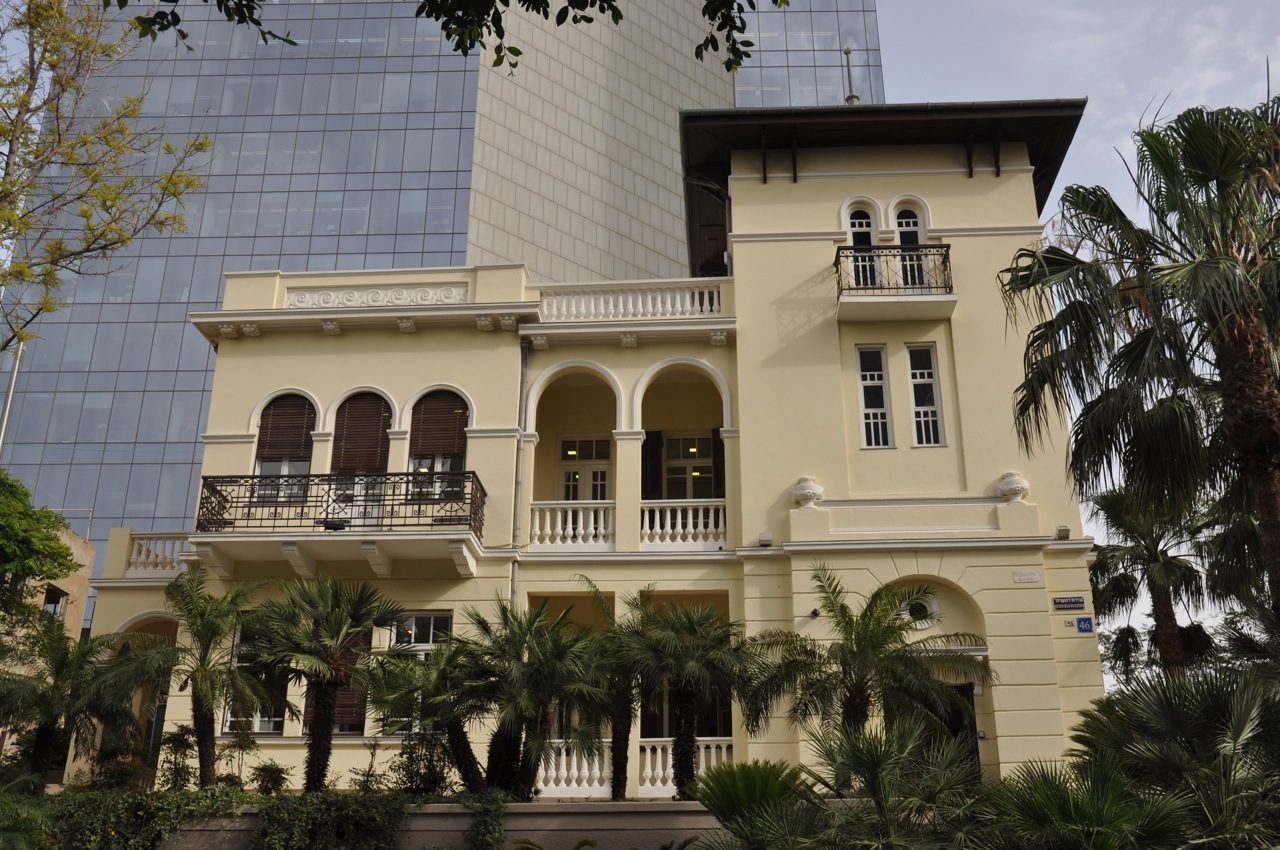
If you pay attention to the buildings while walking around Tel Aviv you may notice that you could divide them into two distinctly different styles. Those built in the 1930s are influenced by the International (Bauhaus) style, clean lines without much ornamentation whereas, the earlier buildings were designed in an eclectic style, a combination of neo-classic architecture with other styles, for example, romantic or oriental. With the establishment of the Bezalel School, Jewish artists created art and craft with Jewish symbols in various media, metalwork, ceramic tile, glass, stone that were used as architectural details. Buildings in the eclectic style tend to be uniquely interesting and are significant landmarks. There are many examples, it is worth taking a guided tour to find them, including the beautiful Pagoda House (Alexander Levy, 1924) on the corners of Melchett, Nachmani and Montifiori, the Levine House (Yehuda Megidovich, 1924) on 46 Rothschild Boulevard and the Palm House (Tabachnik, 1928) at 8 Nahalat Binyamin.

Pagoda House

The building was inspired by southern Asian pagodas, and is the first building in Tel Aviv to have an elevator. The building is composed of Doric pillars, Arabic style arches, and other elements that connect East and West, in a combination of styles. Impressively situated off King Albert Square.

Levine House

This magnificent urban villa was built on a 1700 sq m plot on a small hill on Rothschild Boulevard for Yakov Levine in 1924. The Levine family lived on the second floor and rented out the first. One of its special features is a turret with a mechanically operated roof that could be opened to create space for a sukka.

The architect was Yehuda Megidovich who was Tel Aviv’s first city engineer. Between 1919 and 1951 he designed more then 500 buildings in Tel Aviv, among them the House of Pillars (1925), Nordau Hotel, Ben Nahum Hotel (1921) and the Great Synagogue. Look at buildings he designed for one of his signature trademarks up at the roof line, a tower or dome.

The building was almost demolished in 1943 by a developer who wanted to build a six storey building in its place and was badly damaged by a bomb planted by members of Lehi protesting Jewish discrimination in the USSR in 1953 (when it was the Soviet embassy). In 1995 the developer Akirov bought the property and renovated the building in exchange for permission to build a 26 floor skyscraper, Elrov Tower, on the site.

Palm House

The architect Tabachnick wanted to create an architecture grounded in Israel that would emphasize Jewish motifs often blended with art-nouveau style. In the center section of the building is a window in the shape of a palm tree from which the building gets its name. Note the use of the Star of David, the grillwork of the railings in the shape of the menorah (Jewish candelabra) and the tops of the 3 towers in the shape of an altar.