Tag Archives: postaweek2011

Bahai Shrine of the Báb

This morning the golden dome above the Shrine of the Báb was unveiled to the delight of viewers and this tour guide and shone with a new splendor above the city of Haifa.

Photo credit: Baha’i World Centre photo. All rights reserved.

The Báb, the precursor to the Bahá’u’lláh, was executed in 1850 in Iran and his remains were later laid to rest on Mount Carmel. The precise location was designated by Bahá’u’lláh himself to his eldest son, `Abdu’l-Bahá, in 1891. `Abdu’l-Bahá planned the octagonal structure crowned by a dome set on an 18 windowed drum, which was designed and completed by his grandson, Shoghi Effendi.

The architect was William Sutherland Maxwell, a Canadian Bahá’í who was a Beaux-Arts architect and the father-in-law of Shoghi Effendi. Maxwell’s design of the Rose Baveno granite colonnade, Oriental-style Chiampo stone arches, and golden dome is meant to harmonize Eastern and Western proportions and style. Some remaining aspects of the dome’s structural engineering were designed by Professor H. Neumann of Haifa’s Technion University. The Bahai gardens and Shrine of the Báb is the second holiest site for Bahai, after Bahji, the Shrine of the Bahá’u’lláh just north of  Akko.

In 2008 an extensive project began to restore and conserve the interior and exterior stonework of the original 1909 structure, as well as measures to strengthen the Shrine against earthquakes. An entirely new retrofit design – combining concrete, steel and carbon fibre wrap technology – was applied to the building. More than 120 rock anchors were fixed into the mountain behind newly fortified retaining walls. Renovations were completed at a total cost of $6.7 million.

In the last stage, 12,000 gold tiles, of 120 different shapes and sizes, had to be fitted like a large puzzle onto the dome. When it was found that the old tiles could not be repaired a Portuguese firm was contracted to produce new tiles using leading-edge technology from pure porcelain, covered with layers of glazing and gold solution, and finished with a highly durable final coating. “The company had never done anything like this before,” said Mr. Samadi, project manager. “They are renowned for museum-quality porcelain artifacts. But the result is perfect. Not only are the tiles beautiful, they are five to six times more abrasion-resistant than the originals.”

An expert mason and tile setter from New Zealand, Bruce Hancock, was flown in to supervise the tile work. “We had to learn as we went,” Mr. Hancock said. “Ordinarily, you lay tiles that are square. These tiles are all shapes and sizes. Every row is curved. Initially, I was concerned how we were going to create that curve, but these tiles were designed and detailed in such a way that they just did it themselves. They seemed to have a life of their own. If we did the right thing – getting the two corners right – they did the right thing. It was just amazing.”

The Bahai Universal House of Justice released a statement that the dome of the Shrine of the Bab “now shines in the plenitude of its splendour.” Bahá’ís consider the Shrine of the Báb and the surrounding gardens to be a “gift to humanity.”

For the complete press release and additional photos see http://news.bahai.org/story/816

Moshe Castel and Israel Art

In Maale Adumim facing the panoramic view of the hills of Jerusalem sits a building that houses the art of Israeli artist Moshe Castel. Castel himself chose the site located between Jerusalem and the Judean desert symbolizing Israel’s past and future and his own connection to Jerusalem and the land of Israel and its history. (http://www.castelmuseum.com) The Israeli architect David Resnick designed the building with input from Castel. Resnick is well known for other architectural landmarks, Yad Kennedy, the “Mushroom” synagogue at Hebrew University, Givat Ram and the Mormon university in Jerusalem.

Moshe Castel (1909-1991) was born in Jerusalem to a Sephardi family from Castile with roots that go back to the expulsion from Spain in 1492. At the age of 13 he began to study at the recently opened Bezalel Art School where he learned the rudiments of painting and painted locally inspired landscapes and images. In 1927 at age 17 he traveled to Paris to study at the Academie Julian. Quickly he exchanged his hat and black tie for vagabond clothing and hung out with his fellow artists in the cafes. He rented a small apartment above the sculptor Giacomettti and joined the circle of great artists, Picasso, Matisse, Miro, Soutine and Chagall.

At the Louvre, he sat before the works of the Old Masters and copied their paintings, paying attention to the technique of layering the paint on the canvas. There Castel learned “That art is not symbolic, but rather material, the material is the main thing, the way the paint is placed, the way the layers are placed on the picture, this is the most essential thing.”

In the 1940s he returned to Israel, settled in the Artist Colony of Tzfat and established the New Horizons group of artists that broke way from the established Artists’ Union to focus on universal artistic elements and a more abstract European style. You can visit the house he lived in, newly renovated as a gallery.

He found basalt rocks on his hikes through the Galilee, in the area of Korazim, and began to use them as raw material – the stones were crushed, mixed with a bonding agent and pigment and applied in a thick coat with a palate knife. This material was applied as the textured background for scrolls, letters, figures that became his signature and unique artwork.

There are three other museums in Israel that are dedicated to the works of a single artist. The former residence of the Israeli painter Reuven Rubin at 14 Bialik Street in the heart of Tel Aviv has been made into a museum that displays his paintings from the different periods in his artistic development and preserves the artist’s studio. There is also an audio-visual slide show on Rubin’s life and work. (http://www.rubinmuseum.org.il/home.asp)

The Nahum Gutman Museum was opened to the public at the reconstructed Writers’ House at 21 Rokach Street in Neve Zedek in 1998 and encompasses works in oil, gouache and watercolor, as well as several thousand drawings and illustrations. (http://www.gutmanmuseum.co.il/Default.aspx)

The Janco Dada Museum in the center of the Ein Hod Artists’ Village south of Haifa exhibits the prolific work of Marcel Janco chronologically from his early works as a boy of fifteen. (http://www.jancodada.co.il/en/ar_01.php)

For other museums in Israel check out http://ilmuseums.com/

“Top Ten” Biblical Archaeological Discoveries

Several months ago Tim Kimberley of the Parchment and Pen posted his “Top Ten” list of biblical discoveries in archaeology. I found the link via Todd Bolen’s Bibleplaces blog who wrote that the list corresponds closely to what he would have suggested. So drumroll please, here is the list in reverse order of importance:

10. Sennacherib’s Siege Reliefs of Lachish

9. Black Obelisk of Jehu’s Tribute to Shalmaneser III

8. Caiaphas Ossuary

7. Hezekiah’s Tunnel

6. Pontius Pilate Inscription

5. The Crucified Man (nail through heel)

4. Ketef Hinnom Silver Amulet Scroll (Priestly Blessing)

3. Jericho (Tel es-Sultan)

2. Tel Dan Stele with House of David

1. Dead Sea Scrolls

To see most of these finds, specifically #1, 2, 4, 5, 6, and 8 only requires a visit to the Israel Museum in Jerusalem. The British Museum holds #9 and 10 but there is an excellent replica of #10, Sennacherib’s Siege Reliefs at the Israel Museum. You can experience #7 Hezekiah’s Tunnel by visiting the City of David archaeological park. Just last week I took a family, we started at the sifting project at Emeq Tsurim, walked along the Jerusalem trail to the Kidron to the City of David and walked Hezekiah’s Tunnel – everyone had a great time. Site #3 Jericho is off limits for a lot of Israeli guides but I am authorized to take tourists to Jericho – there is a lot of discussion about whether the archaeology supports the Biblical account.

One of the things Tim talks about is provenance, where the artifact was found. Besides seeing the objects at the museum, this is where you would have to go to see where they were discovered:

#1 Qumran, 2 Tel Dan, 3 Jericho, 4 Ketef Hinnom, 5 Givat haMivtar, a suburb north of Jerusalem, 6 Caesarea, 7 City of David, 8 Peace Forest at tayelet/promenade, 9 and 10 you’d have to go to Iraq; you can visit Tel Lachish off of highway 3415 between Jerusalem and Tel Aviv.

You might want to add these places to your itinerary on your next trip to Israel, you’ll learn a lot. I can take you to and guide these sites except for Iraq.

Hirbet Midras Vandalized!

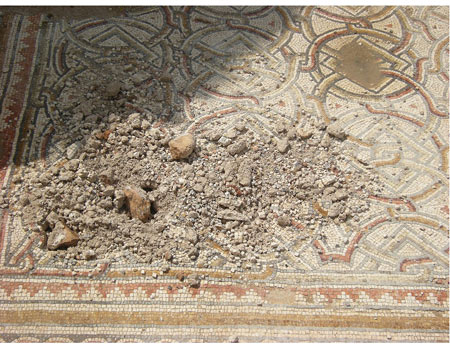
Just reported by Ynet (in Hebrew), Hirbet Midras, the site of the Byzantine church in the Ella Valley with the incredible mosaic floors, uncovered just two months ago and visited by tens of thousands of people was deliberately and brutally vandalized Wednesday night. The Antiquities Authority had made considerable effort to prepare the site and had decided to leave the mosaics uncovered so that people could visit and see them. The supervisor and archaeologist in charge, Alon Klein of the Israel Antiquities Authority’s Crime Prevention unit was shocked to find the destruction this morning when he arrived at the site.

Photo courtesy of the Israel Antiquities Authority

“Someone took a hammer and attacked the mosaic, digging them up in a large number of spots. A person hiking in the park had reported the damage. The mosaic looks like it has been hit by mortar shelling. It’s a sad sight, heart breaking. The mosaics suffered serious damage as a result of brutal vandalism. ” said Klein.

Photo courtesy of Israel Antiquities Authority

The Antiquities Authority has filed a criminal complaint with the police who are investigating. The mosaics will now be covered to protect them. When asked about whether the damage could be repaired the response was that it would be time-consuming and require a significant outlay of money but hopefully it could be done (at least to a certain degree).

This on the heels of the explosion yesterday near the entrance to Jerusalem and the escalation of rockets and mortar being fired on Beersheva and the coastal cities of Israel from Gaza. Sigh.

House of David Stele

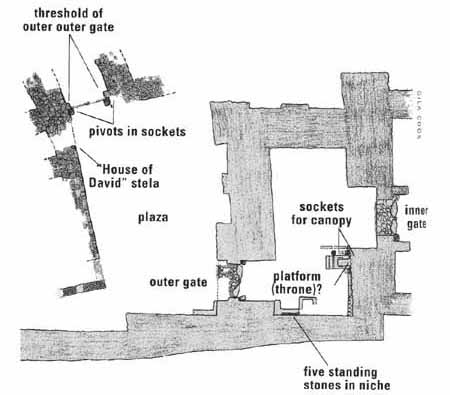
On a hot summer day in July 1993, Gila Cook who was the surveyor of the Tel Dan excavations in northern Israel noticed a basalt stone in the southern end of the wall by the outer gate as she was packing up her equipment. Here is the account, in her own words:

… I began to dismantle the level from the tripod. In this brief interval, my mind registered what I had seen. I looked again and said to myself, “Oh! These are Hebrew or Phoenician letters! It’s an inscription…with rows of characters”….

Professor Avraham Biran (1909-2008), the director of the excavations was impatient to begin the drive back to Jerusalem when Gila walked up to him. She was thinking about how to say in Hebrew “I’m going to make your day” but all she could muster was “Come”. Biran probably thought she’d been affected by the hot sun but followed her to the wall, knelt down and said “not in Hebrew, but in impeccable English, very quietly, “oh my God”. ”

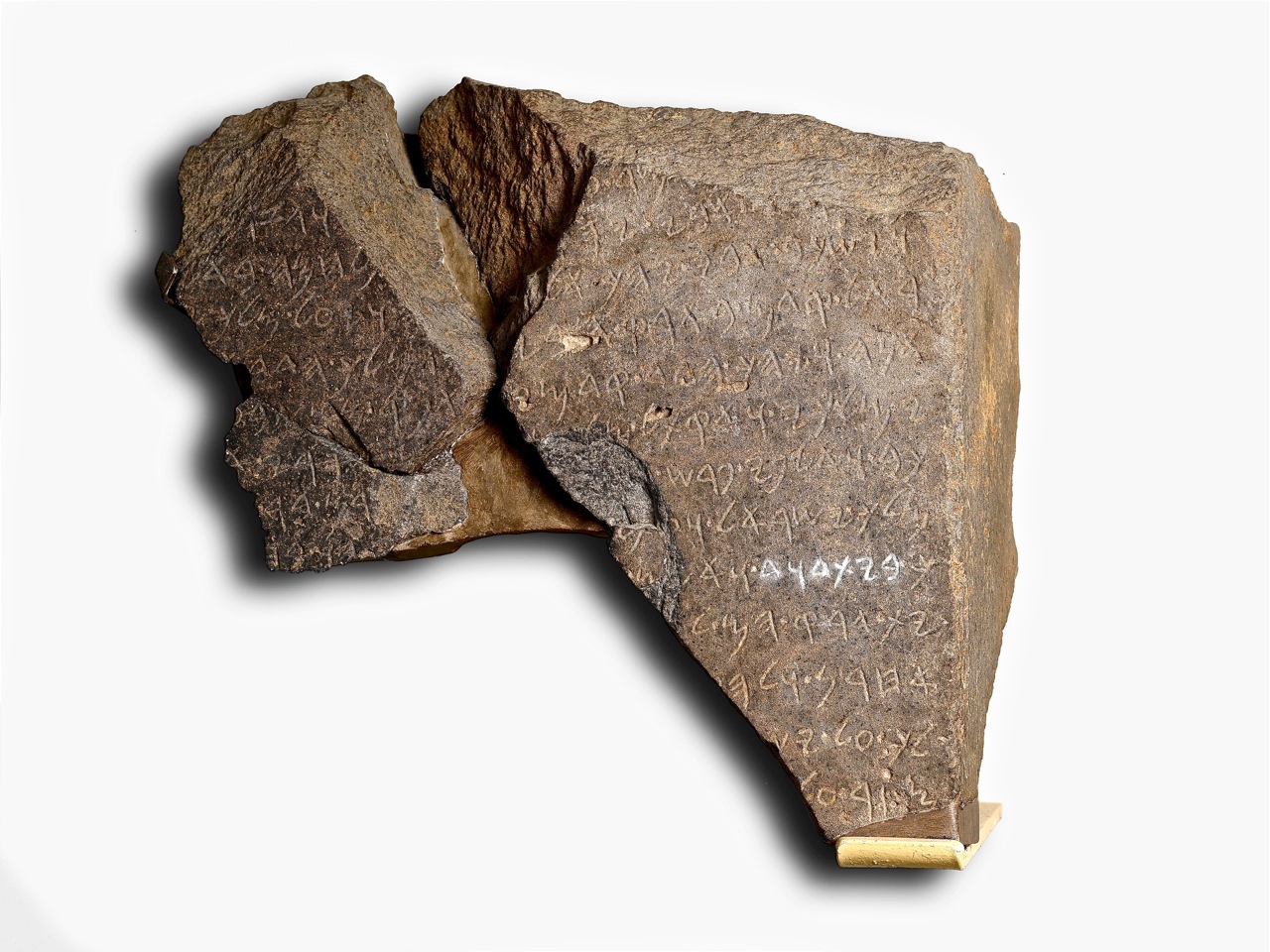
Two other fragments, B1 and B2, which fit together, were discovered later in 1994. In the broken part of the stone below the smooth writing surface, there is a possible “internal” fit between fragment A and the assembled fragments B1/B2, but it is uncertain and disputed.

House of David Stele, Tel Dan, photo courtesy of Israel Museum

The text is 13 incomplete lines written in Early Aramaic, in paleo-Hebrew script commemorating victories over local ancient people including “king of Israel” and the “House of David”. The victor/author is not mentioned in the fragments discovered but would be a king of Damascus, Hazael or one of his descendants, Bar Hadad II or III. The pertinent lines translate as follows:

7′. riots and thousands of horsemen (or: horses). [I killed Jeho]ram son of [Ahab]
8′. king of Israel, and I killed [Ahaz]iahu son of [Jehoram kin]g
9′. of the House of David. And I set [their towns into ruins and turned]

The stele is dated to the 9th or 8th centuries BCE. The 8th-century limit is determined by a destruction layer identified with a later, well-documented Assyrian conquest in 733/732 BCE by Tiglath-Pileser III.

In the text, the Aramaean king claims to have killed the kings of both Israel (Jehoram) and Judah (Ahaziahu) in the course of his southern conquests. Interestingly, there is a parallel account of the murders of Jehoram and Ahaziahu in 2 Kings 9, but it is Jehu who kills the two kings in a bloody coup and seizes the throne of Israel for himself.

The inscription generated excitement among biblical scholars and archaeologists because the letters ‘בית דוד’ (Beit David/House of David) refer to the kingdom of Judah by its dynastic name, a name frequently used in the Hebrew Bible. This not only indicates that the family of David still sat on the throne of Jerusalem, but this inscription is the first and oldest textual reference to the historical King David ever discovered!

Ketef Hinnom Silver Amulet

I wrote this post about First Temple Period tombs found in Jerusalem in 2011 and over the years the post got 1 Like, a few hundred views a year which is an average of less than 1 view a day, until this year! Since 2021 the post has 1672 views or 30 views on average per day and I can’t figure out why. If you’re reading this post could you please leave a comment about how you found it and why it is of interest. Thanks so much.

In 1979 Prof. Gabriel Barkay decided to do some archaeological research outside the walls of Jerusalem’s Old City and chose a ridge above the Hinnom valley by the Scottish Church of St. Andrew.

He called the area Ketef Hinnom (ketef means shoulder in Hebrew) and did a survey that uncovered the remains of a Byzantine church with mosaic floor and some tombs hewn in the rock whose roofs had collapsed. With the help of 12-13 year olds from a youth group from Tel Aviv run by the Society for the Protection of Nature he began excavating. They found one bead – it was clear that the tombs had been looted in antiquity.

A boy by the name of Nathan was assigned to clean a nook underneath one of the burial benches. By chance he also had a hammer and after cleaning, he got bored and started banging on the floor of the nook. To his surprise the stone bottom broke revealing an entryway to another room full of treasure. The burial chamber with its objects has been faithfully recreated at the Israel Museum.

As Prof. Barkay explained:

“In [that] one chamber more than a thousand objects were found.  They included 125 objects of silver, 40 iron arrowheads, gold, ivory, glass, [ceramics, oil lamps,] bone and 150 semi-precious stones.  There was 60 centimeters (two feet) of accumulation filled with objects and skeletal remains…

Judy Hadley, a girl from Toledo Ohio, now a professor of Bible at Villanova University in Philadelphia, showed me a purplish-colored object looking like a cigarette butt.  It took us three years to unroll it properly.  It was 2.5 cm wide, about 1 inch.  When unrolled, it was 10 cm in length.  It was made of pure silver, 99% silver. Very delicately scratched on the silver were ancient Hebrew characters.  I saw it at the Israel Museum lab and immediately recognized the four letters of the Divine Name, YHVH.”

Courtesy of the Israel Museum

All the dirt removed from the tombs was stored in large plastic boxes donated by Tnuva [Israel’s largest dairy and today a billion dollar food conglomerate] and sifted under lab conditions. In the sifting, a second, smaller silver object, 4 cm in length, was also found. Both objects have the Priestly Blessings from Numbers 6:24-26 engraved on the silver in proto-Hebrew script.

The Lord bless you and protect you.
The Lord make His face to shine upon you and be gracious to you.
The Lord lift up His countenance upon you and grant you peace.

Because of the pottery and the script, the objects are dated to the 7th century BCE (while the First Temple was still standing), to the time of the prophet Jeremiah. These are the oldest examples that we have found of a Biblical text on an archaeological artifact, about 400 years older than the Dead Sea Scrolls.

The discovery of the silver amulets received very wide public interest.  In the 1990s Dr. Bruce Zuckerman from the University of Southern California, an expert who specializes in photographing ancient texts (various Dead Sea Scrolls and the Leningrad Codex) arranged to photograph the amulets using the latest photographic and computer imaging techniques.  This made it possible to zoom in on every letter and even superimpose complete letters on broken letters, reconstructing broken letters in the scribe’s own peculiar style to better decipher those that were unclear. The result was that they were able to identify another biblical verse on the larger scroll, from Deuteronomy 7:9.

Know, therefore, that only the Lord your God is God, the steadfast God, who keeps His covenant faithfully to the thousandth generation of those who love Him and keep His commandments.

Read the Life and Land blog for a first-hand report from Gordon Franz who as a 25-year old was at Ketef Hinnom working with Prof. Gaby Barkai. The two amulets are on display in the Archaeology wing of the Israel Museum. I can take you to Ketef Hinnom to see the First Temple period tombs where the amulets were found.