Tag Archives: postaweek2011

Hiking Wadi Qelt – St George Monastery

Hiking Wadi Qelt is best in the early morning on the way down to the Dead Sea, a great place to experience the Judean desert and for photographs of the desert landscape.

From Jerusalem on highway <1> take the left at Mizpe Yericho, left again and left at the T. Park the car here for a great view of Wadi Qelt/Nahal Prat. Follow the black trail down to the stream bed. Here you will see the remains of the stone arches of the bridge of the aquaduct.

Continuing another 450 meters you’ll come to a wooden bridge that crosses Nahal Prat and to your left is the Ein Qelt pool. There are two possibilities from here: hike west along the streambed to a string of pools in Lower Nahal Prat or east along the red trail which will take you after about 2 kilometers to the monastery of St George of Koziba perched on the northern cliff.

From the monastery you can climb up to the road where you drive back to the highway or continue to the ruins of Herod’s fortress at Cypros.

Christian monks began to settle in the Judean Desert in the early 4th century identifying with Moses, Elijah, Jesus and others who spent time in the desert, as a respite from the secular world. By the fifth to seventh centuries, there were some 65 monasteries in the area: St. George, Martyrius, Euthymius, Deir Hijla, Mar Saba can be visited to this day.

Originally founded as a laura, a cluster of cells or caves for hermits about 420 CE, a small chapel was added later and about 480CE St. John of Thebes transformed the site into a monastery. In the 6th century it became known as St. George under the leadership of Gorgias of Koziba, born in Cyprus about 550 CE. The Persians destroyed it in 614 and it was rebuilt during the Crusader period but abandoned when the Crusaders were defeated and was reported in ruins by a pilgrim who visited in 1483. In 1878 a Greek monk, Kalinikos, settled here and restored the monastery, completing it in 1901.
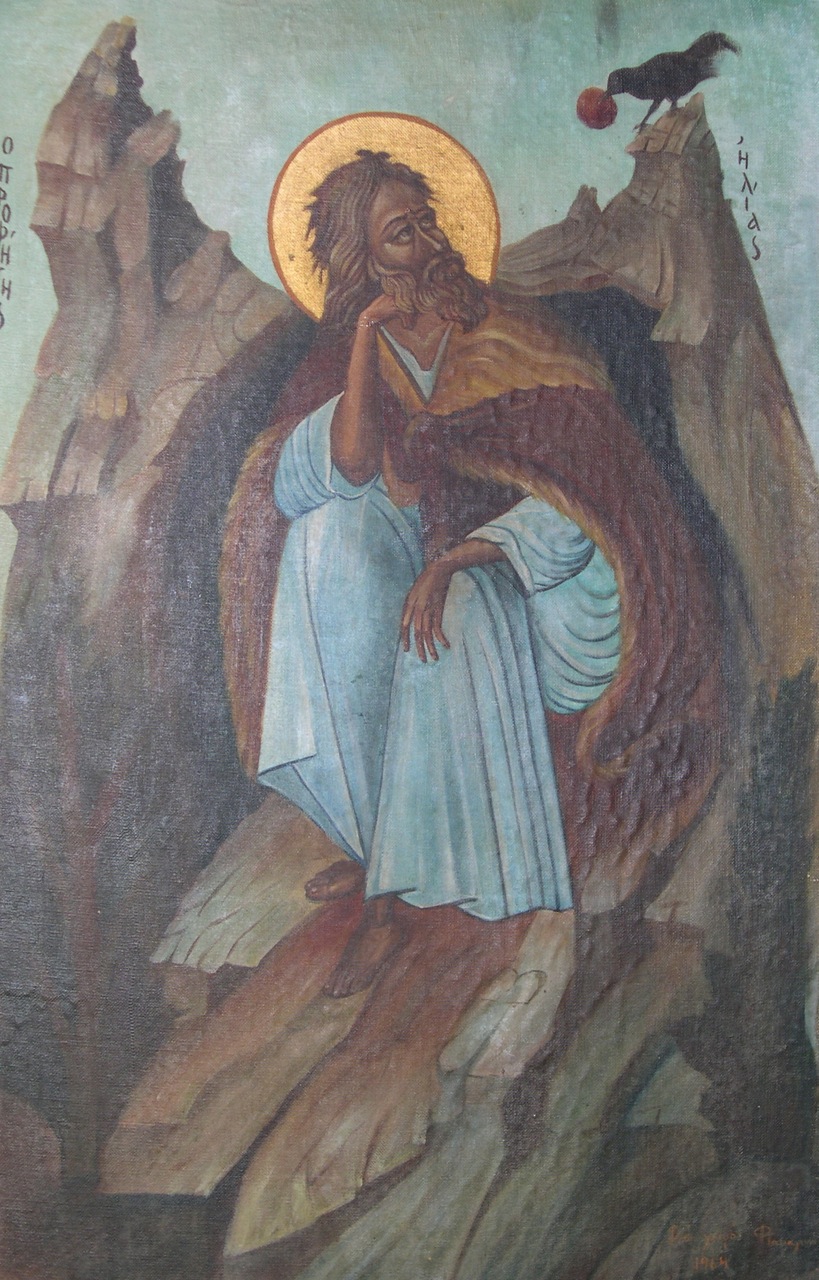
According to tradition this is the place where Elijah stayed when God commanded him to leave King Ahab during the drought and was fed by ravens:

5 So he went and did according unto the word of the LORD; for he went and dwelt by the brook Cherith, that is before the Jordan.

6 And the ravens brought him bread and flesh in the morning, and bread and flesh in the evening; and he drank of the brook.

I Kings 17

There is also the story that Joachim, father of the Virgin Mary, hid here for forty days bewailing the barrenness of his wife Anne, whereupon an angel came to him to announce that Anne was pregnant with a daughter.
Four sites in Old City

Most archaeological sites in Israel are part of the Israel Nature and Parks Authority but in the Old City there are a few interesting sites that are run by the East Jerusalem Development Company:

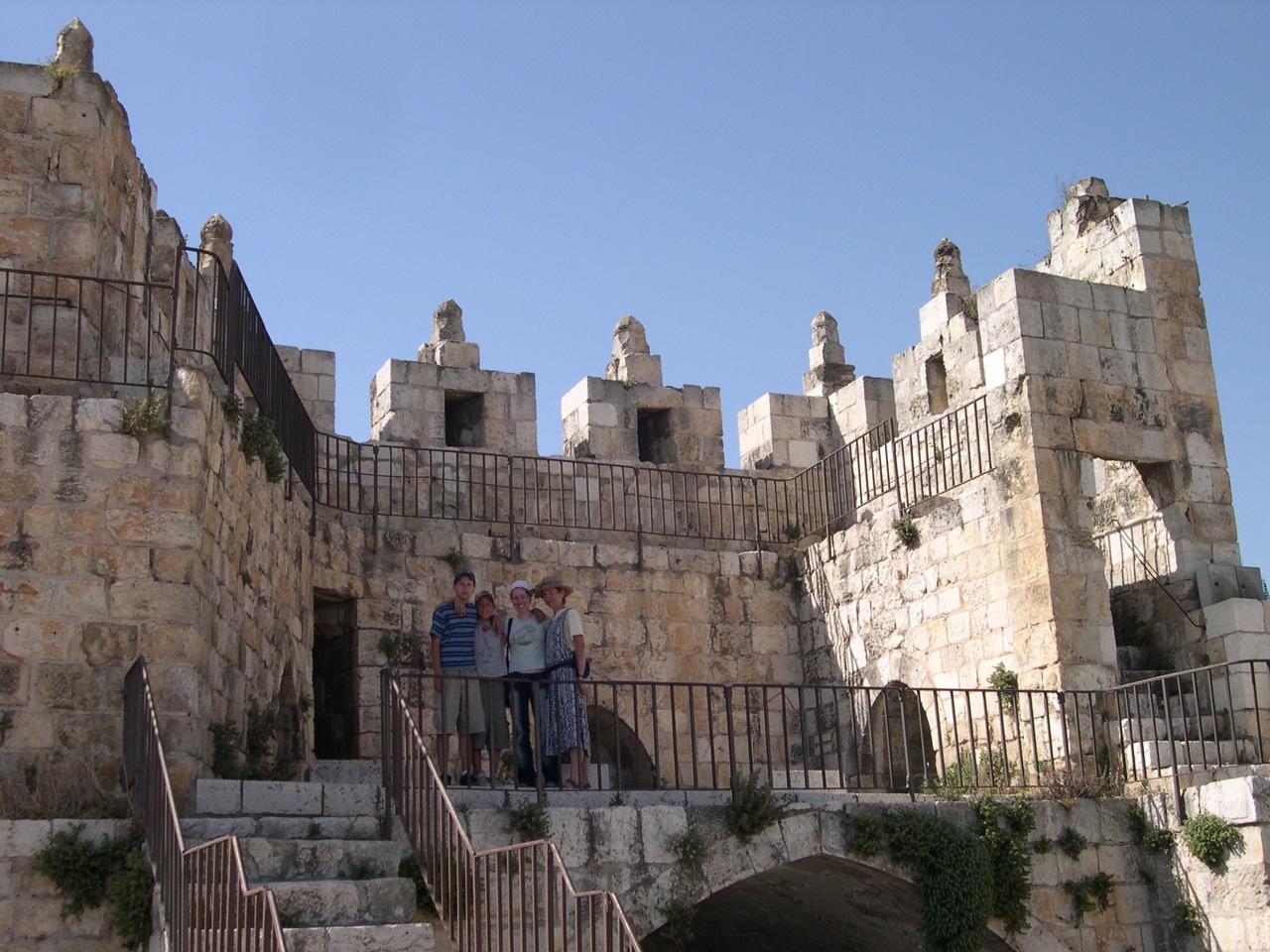
  • Ramparts Walk
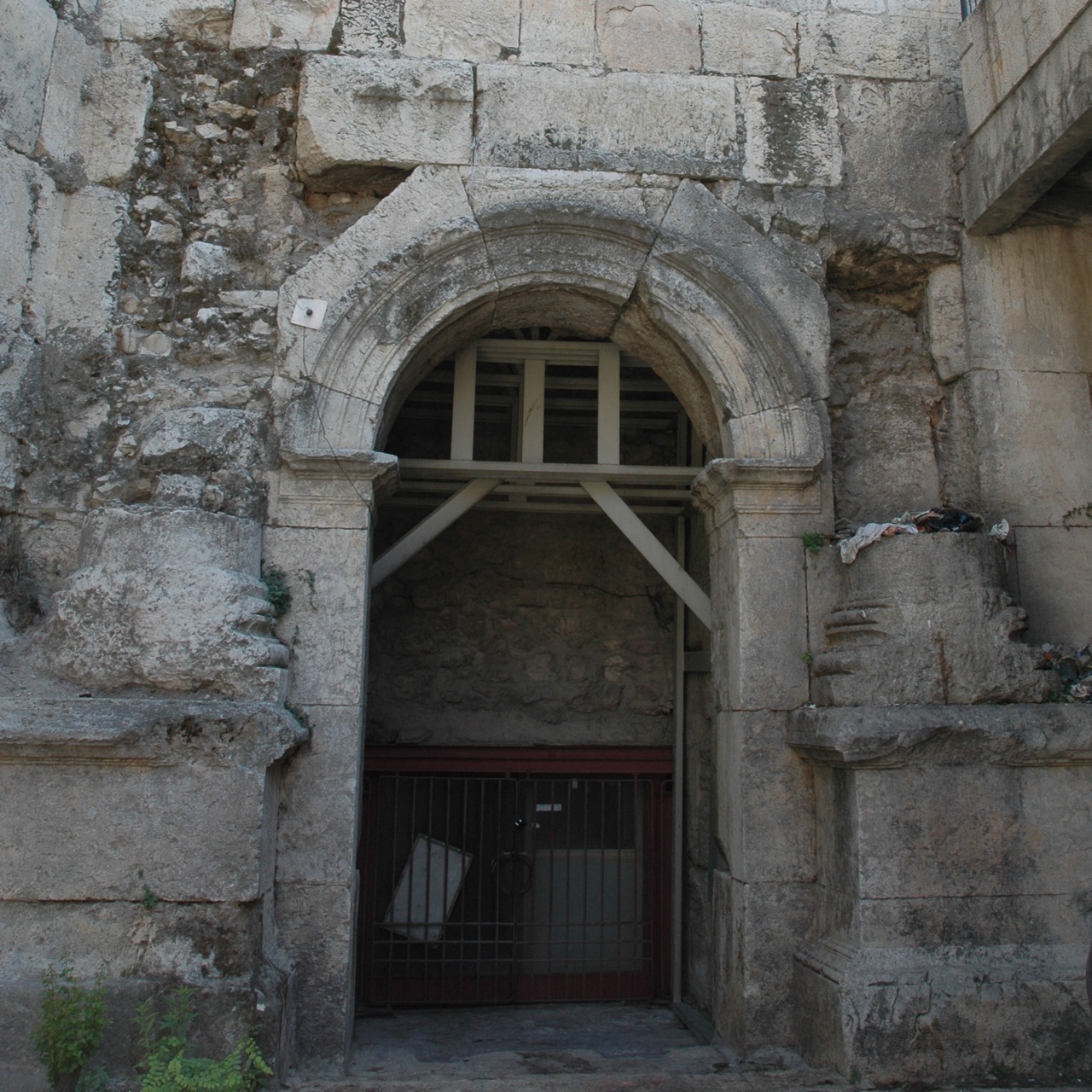
  • Roman Plaza
  • Zedekiah’s Cave
  • Davidson Archaeological Park

Together these 4 sites can be the skeleton for a tour of the Old City. Because these sites are under one authority there is a combination ticket that gives you entry to all 4 sites. The current price is 55NIS whereas it would cost 72NIS if you bought  them individually (a saving of 24%) and the ticket is valid for 3 days.

The walls around the Old City were built in 1540 by the Turkish Sultan Suleiman and it is possible to walk on the top of two sections of these walls: 1) from Jaffa Gate around the Christian and Muslim Quarters all the way to Lions Gate (though I would recommend descending at Damascus Gate) and 2) across from Jaffa Gate by the Tower of David Museum around the Armenian and Jewish quarters to Dung Gate.

It’s important when exploring the Old City to go up onto the walls or roofs to get an overview of the city, something you can’t do from the ground. Looking outside the walls lets you see the institutions that were built in the late 1800s by the various European powers as the Ottoman Empire became the sick man on the Bosphorus.

At Damascus Gate you descend back in time to 135CE to the Roman Emperor Hadrian who crushed the Bar Kochba Revolt, destroyed Jerusalem and exiled its Jewish inhabitants. Hadrian rebuilt the city as a Roman city that he called Aelia Capitolina, of which remnants of the city plan exist to this day. The base of the Roman wall and the leftmost arch of three Roman arches can be seen below Damascus Gate. From Damascus Gate going south is El Zeit Street which runs along the route of the Roman Cardo and  El Wad Street that follows the Tyropean valley, above the secondary Cardo. Remains of both Cardos as well as other remains from the time of Hadrian can be visited on your tour.

Not far from Damascus Gate is another site that is called Zedekiah’s Cave or Solomon’s Quarry. This cave was discovered by chance by Dr James Turner Barclay, a physician and missionary who lived in Jerusalem for some years and was interested in biblical scholarship. On a sunny Sunday during the winter of 1854 Dr. Barclay was out walking along the city walls with his son and his faithful dog as he ususally did every Sunday when suddenly the dog vanished as if the earth had swallowed him up. While searching for the dog near the bedrock at the base of the city wall they noticed a deep hole from which they could hear the sound of barking. Excitedly they went home, gathered lanterns, ropes, measuring instruments and other equipment and under cover of darkness returned to the hole – the opening to a man-made cavern that had been created by quarrying stone. This is the largest quarry in the Holy Land, the cave begins at the city’s northern wall and extends under the Muslim Quarter for 230 meters, reaching the Sisters of Zion convent. Barclay is the one who discovered the gate to the Temple Mount that bears his name today (that you can see in the Western wall in the Women’s section of the Kotel plaza).

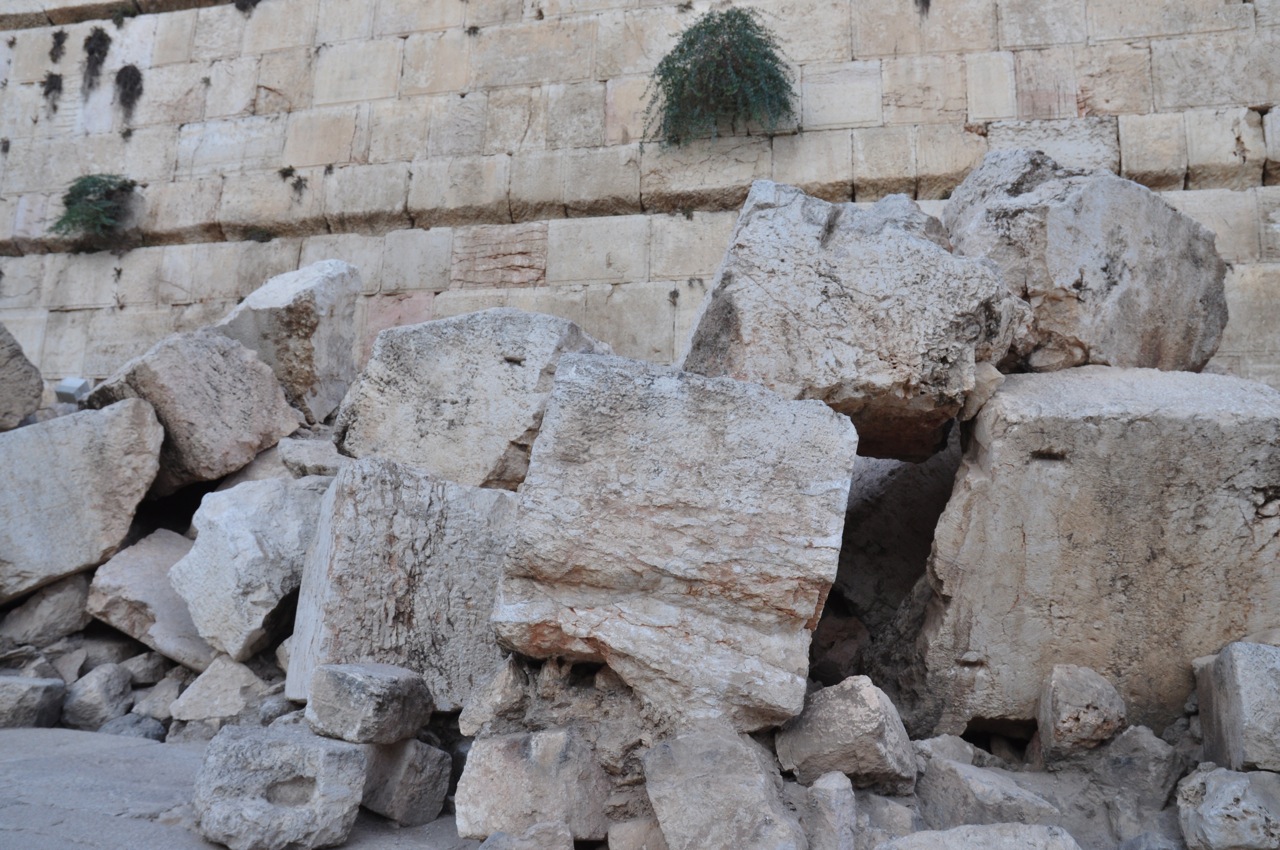
Following the secondary Cardo to the south of the city will bring you to the Davidson Archaeological Park excavated by Benjamin Mazar and Meir Ben Dov from 1968 to 1978 and later in the mid 90s by Ronnie Reich. Perhaps the most impressive sight in Jerusalem is the main Second Temple street, littered with large Herodian stones that the Romans hurled off the top of the wall 15 meters above when they destroyed the Temple and Jerusalem in 70CE. Where the stones under Robinson’s Arch have been cleared away, you can see that the large paving stones are broken and have buckled under the tremendous impact of the arch’s collapse.

In the visitor’s center is a movie of a Jewish pilgrim’s experience coming to the Temple in Jerusalem. The movie uses 3D modelling of the Temple complex based on the archaeological evidence.

Under the street is the main drainage channel for ancient Jerusalem that has been recently opened and that goes as far as the Siloam Pool. Walking through the park you come to the southern steps that lead up to the double and triple gates. Below the steps is Eilat Mazar’s recent excavation of part of a citadel, a 4 chamber entrance gate whose dimensions are almost identical to the palace gate in Megiddo and a building of “royal character” dated to the 9th century BCE.

Photo Walk

I spent 3 hours yesterday afternoon on a photowalk, in this case, walking through the Old City taking photos, one of about 30 photographers. We started at Kikar Tzahal, walked through the Mamilla mall, entered Jaffa gate, followed the main road through the Armenian quarter to the Jewish quarter, down the steps to the Western Wall plaza and back to Jaffa gate via the Arab shuq. The route was chosen by a photographer – I think a guide could have taken people to some places that would have been more interesting to shoot. I was hoping for some photos with a background sky with a pink and blue sunset but the weather just didn’t cooperate yesterday.

In this post I’m sharing what I think are my best 7 photos. It gives you one particular view of Jerusalem on a particular day. A photowalk is an interesting photographic exercise.

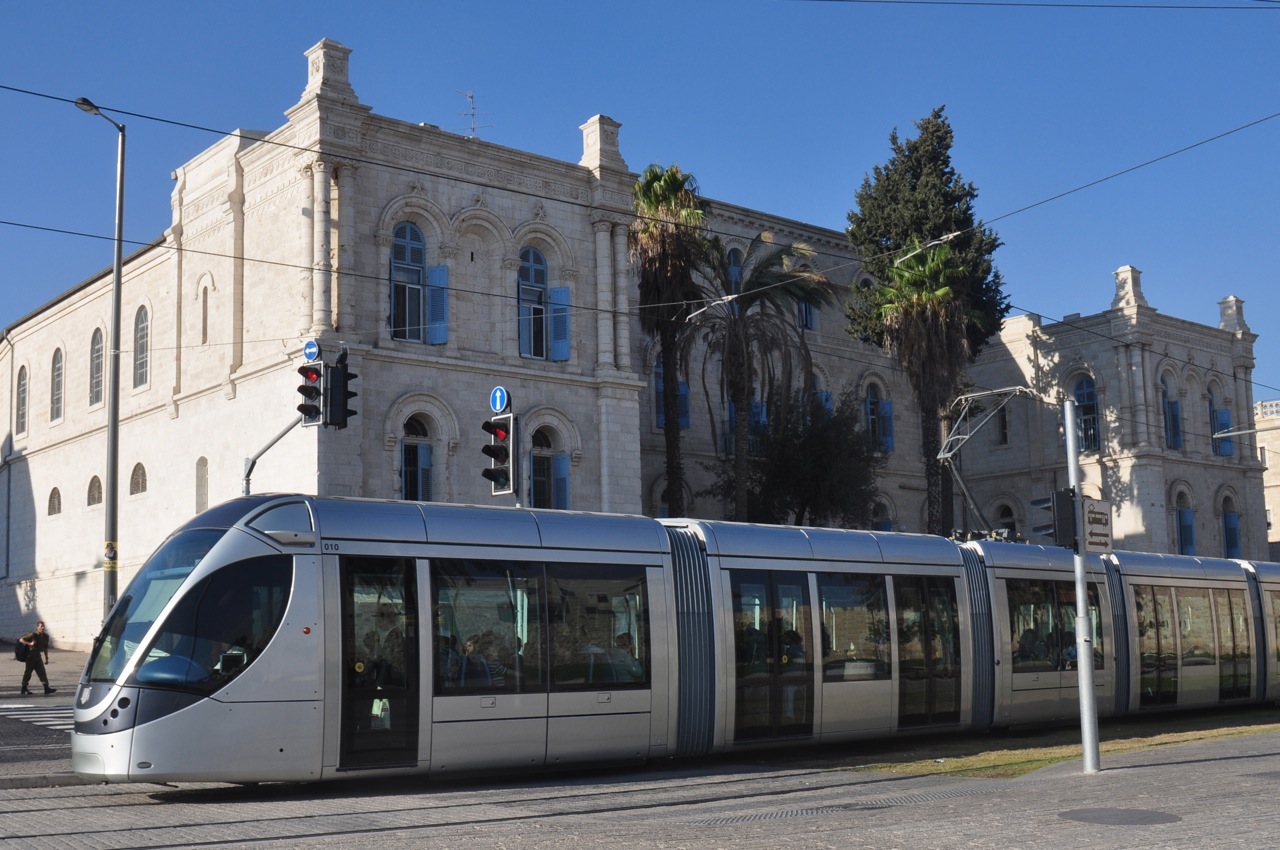
The first day that you could ride Jerusalem’s new Light Rail was August 19. I rode it for the first time last week with clients. For the time being it’s free.

One of Jerusalem’s newest and fanciest hotels designed by Israeli architect, Moshe Safdie, as part of the Mamilla project. Across the street is the David Citadel Hotel also designed by Safdie. On the opposite corner the new Waldorf-Astoria is being built which incorporates the original Palace Hotel.

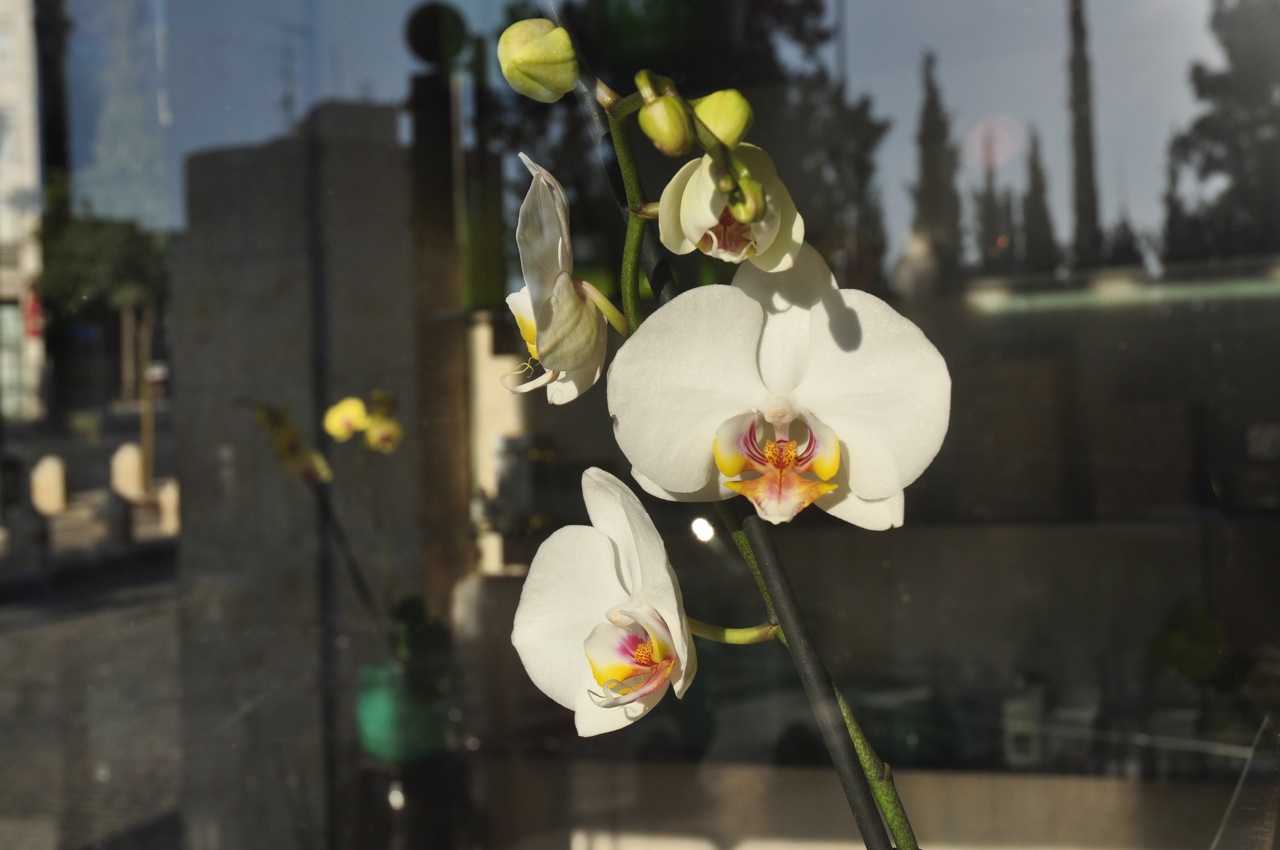
A really incredible flower shop, Aleh Koteret, with Jerusalem being reflected in the window.

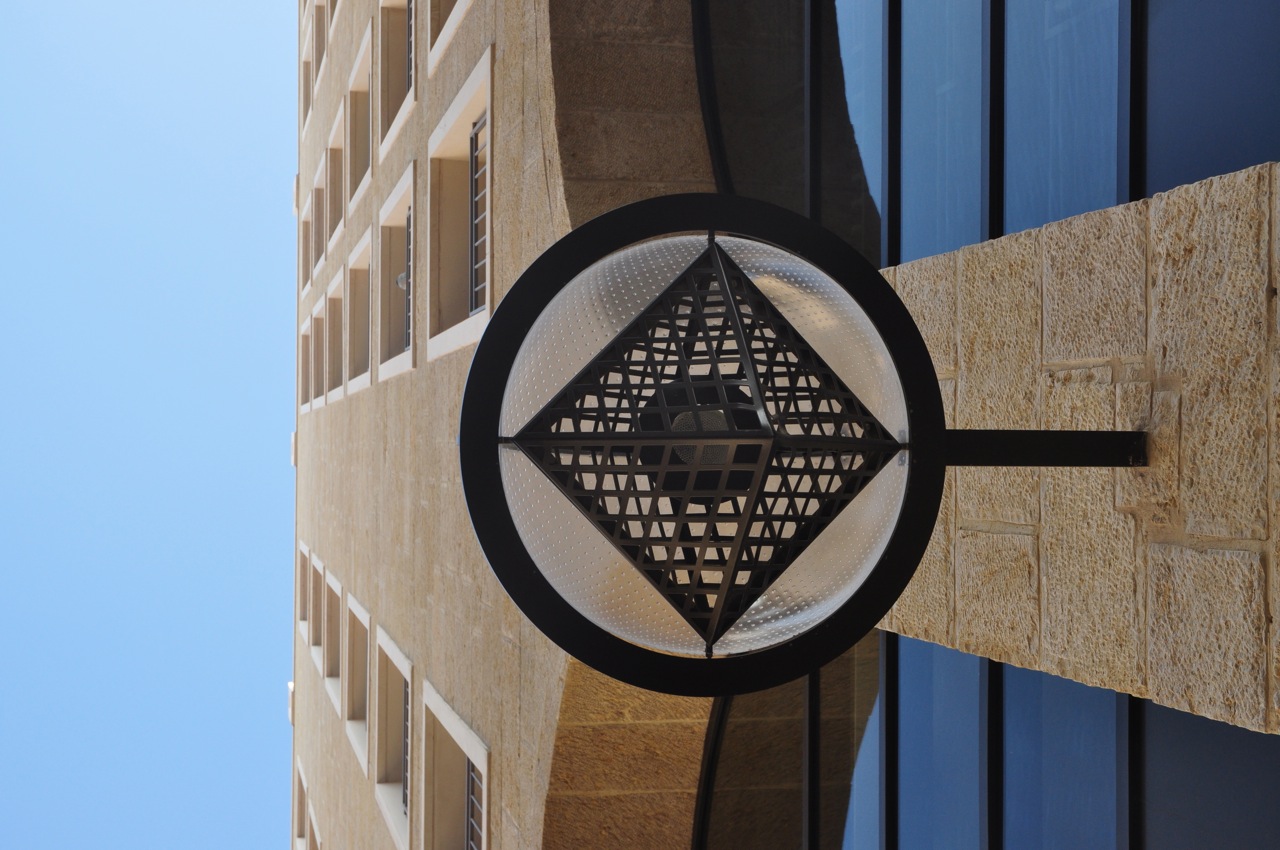
The juxtaposition of metal and Jerusalem limestone, old and new.

Crossing through the Armenian quarter, you take an alleyway that turns left and under an arch is a view north to the Christian quarter and the Church of the Holy Sepulcher and the Mosque of Omar (Ibn Khattab). But Jerusalem, even the Old City, is not a living museum, so there are also water tanks, dude shemesh (sun heated water panels) and satellite dishes.

I can only submit one of these photos to the competition. Comment to make your choice.

Khirbet Qeiyafa

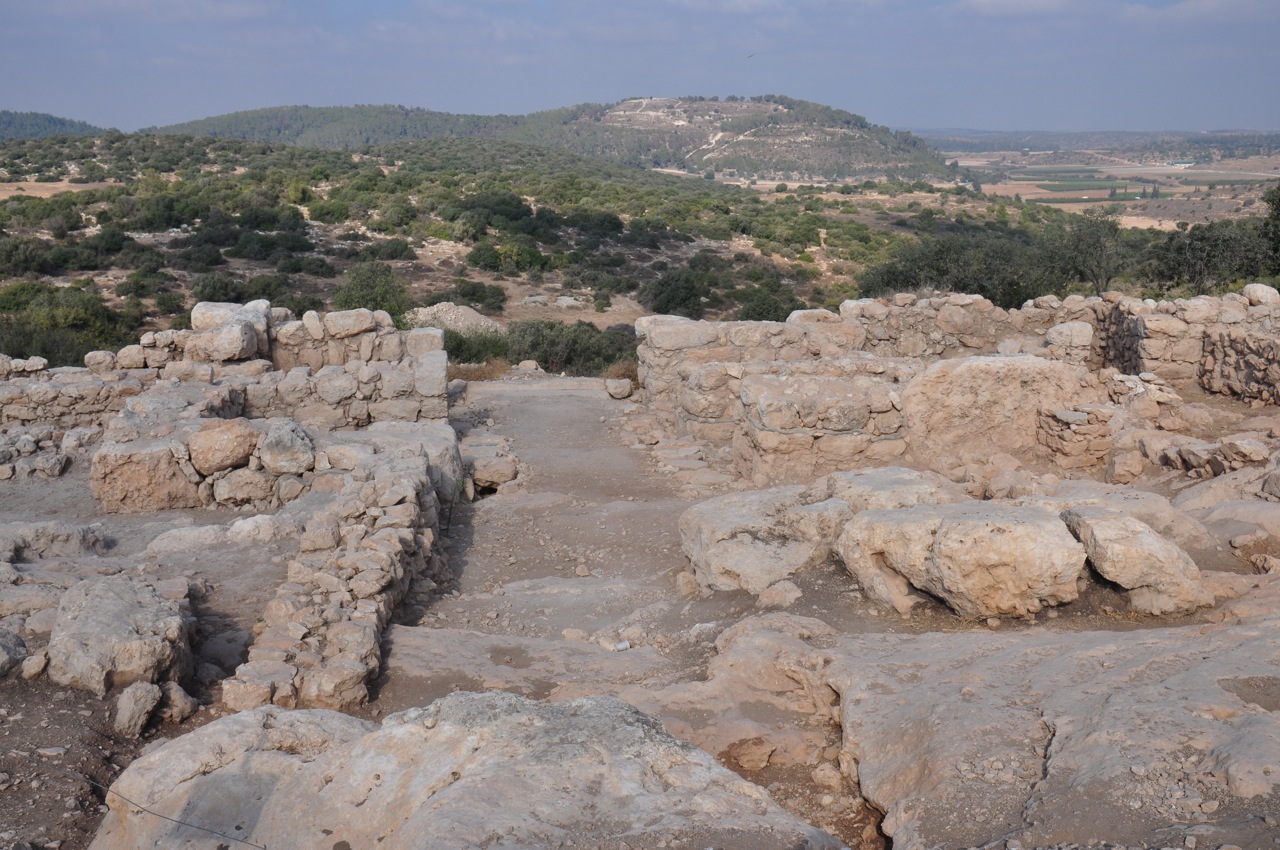
The traditional view based on the Biblical account is that in the 10th century King David ruled over a United Monarchy consisting of Judea in the south and Israel in the north. By the 9th century it had split into two kingdoms, Israel that continued to exist until the Assyrian conquest in 722BCE and Judea that continued until the Babylonian destruction in 586BCE. In contrast the Minimalist school refuted the idea of a United Monarchy and saw David as a mythical figure. The kingdom of Israel established itself first, in the 9th century (low chronology) and a monarchy developed in Judea only after the destruction of the kingdom of Israel in the late 8th century. With the discovery of the House of David stele at Dan the Minimalists had to grudgingly concede that David could exist but was a minor chieftain who ruled over a limited area, not an extensive kingdom ruled from a centralized location. With the discoveries at Khirbet Qeiyafa, a site in the Elah valley Prof. Yosef Garfinkel of Hebrew University is convinced that he has uncovered a Judean town that is dated to the 10th C. To build fortifications like those at Khirbet Qeiyafa, requiring moving 200,000 tons of stone, could not have been a local initiative but would have required a centralized government.

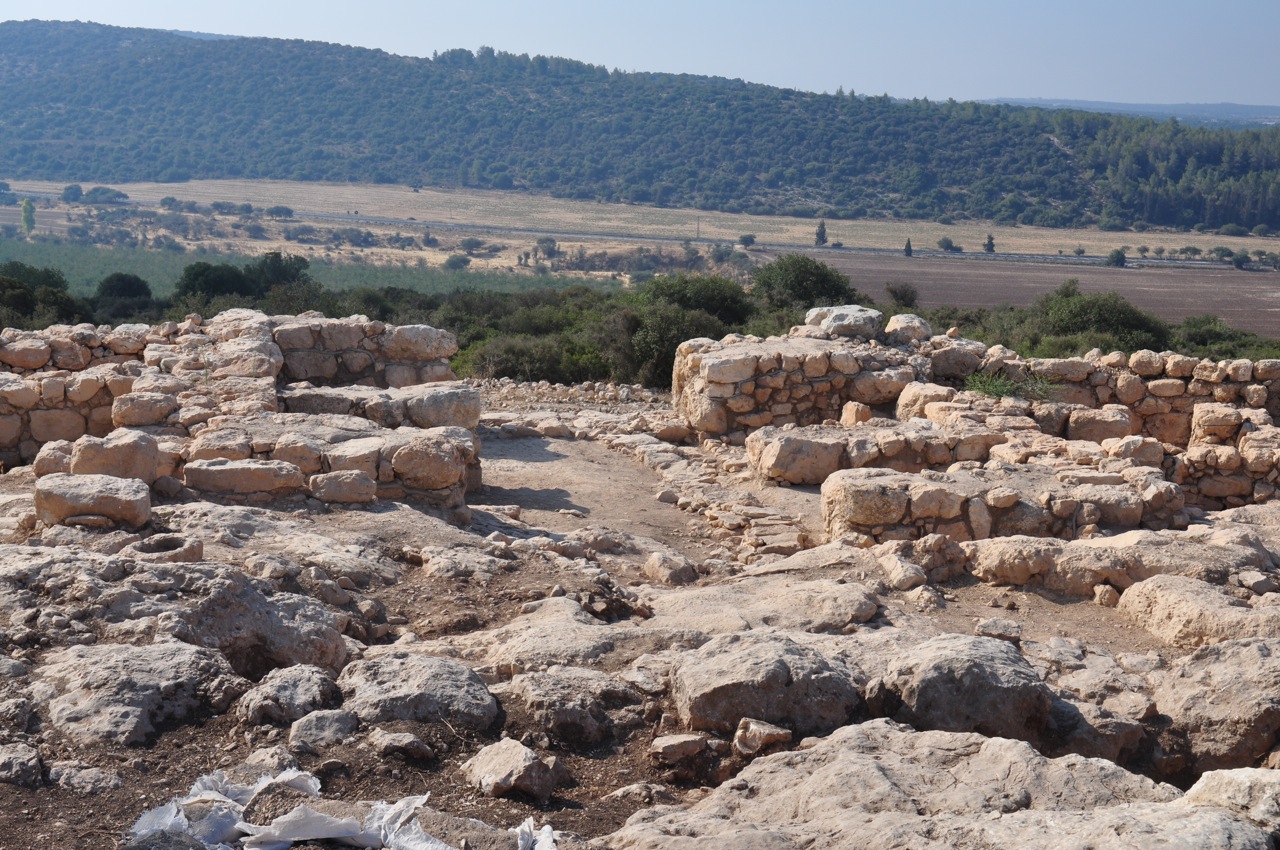
The site is small, 23 dunam enclosed with a casement wall situated on a hill overlooking the Elah valley with human occupation for about 20 years. Garfinkel suggests that the site was destroyed by Phillistine Gath/Tel Safi a larger town only 12 km to the west (Prof. Aren Maier who heads the excavations at Safi concurs); the Bible describes numerous border disputes in the Elah Valley region during the 11th-10th century BCE. There are only 3 building strata layers: 1) the late Roman/Byzantine period, 4th to 6th century when it included a fortress or caravansery at the center of the site, 2) late Persian or early Hellenstic period (ca. 350-270BCE) and 3) the lowest stratum directly on the bedrock dated to Iron Age IIA, existing in the late 11th to early 10th century. The dating is based on pottery and artifacts correlated with the results of radiometric (Carbon 14) dating of 4 burnt olive pits that yield a calibrated date of 1051 to 969BCE with 77.8% probablity which supports the ‘high chronology” of the biblical traditionalists.

Features and artifacts unearthed at the site suggest that it was a Judean settlement.

  • The structural style of the casemate walls was classically Judean, matching similar construction at the ancient excavated sites of Beersheva, Tell en-Nasbeh, and Tell Beit Mirsim.
  • Thousands of animal bones were found (goats, sheep and cattle) but no pig bones, found commonly at nearby Phillistine sites like Ekron and Gath/Tell Safi.
  • Pottery found is different than that at nearby Gath. Fragments of an almost complete pottery baking tray hinted at a culture that was unlike that of the nearby Phillistine sites.

Khirbet Qeiyafa is the only archaeological site discovered in Israel so far that has two gates. Garfinkel says, “Even cities three or four times its size, such as Lachish and Megiddo, have only a single gate.” Based on location, dating and the two gates Garfinkel identifies it as Shaarayim (Hebrew for two gates) mentioned 3 times in the Bible.

  • In the city list of the tribe of Judah it appears after Socoh and Azekah (Josh 15:36). Socoh is located 2.5 km to the southeast of Khirbet Qeiyafa and Azekah 2 km to the west.
  • After David killed Goliath the Philistines escaped through the ““road of Sha’’arayim”” (1 Sam 17:52).
  • In the city list of the tribe of Simeon, Sha’’arayim is mentioned as one of the cities ““until the reign of David”” (1 Ch 4:31––32).

It’s exciting to have the opportunity to attend an annual archaeology conference reporting on the latest research about Israel 3000 years ago. But more than that it’s possible to visit and explore the actual sites. After hearing Garfinkel’s interpretations I drove to the site to see for myself (I do guided tours of Khirbet Qeiyafa). Notice the drainage channel in the Southern gate (and our golden retriever, Sumsum, who likes to go on tours).

Prof. Israel Finkelstein of Tel Aviv University, a proponent of the Minimalist school, also gave a paper at the conference but disappointingly, he didn’t comment at all about Garfinkel’s claim. Instead, he presented a critique of Eilat Mazar’s conclusions about the Large Stone Structure and her dating of the building to the 10th C. Finkelstein argues that

  • the remains of what is called the Large Stone Structure are not one building.
  • Similarly, the Stepped Structure is not monolitic but contains segments from Iron age IIA and Hellenistic periods. There is no connection today between some of the Iron Age IIA components of the Large Stone Structure and the Stepped Structure. The only physical connection is between the walls and the top section of the Stepped Structure which is from the Hellenistic period.
  • Some of the massive walls may be from Iron Age IIA, (he uses low chronology, 9th century) but others are from the Hellenistic period.

Finkelstein concludes that no experienced archaeologist would claim to have uncovered a monumental building from the 10C BCE based on the archaeological evidence.

Walking underground to Robinson’s Arch

The 12th annual City of David Archaeological conference marked the official opening to the public of Jerusalem’s central drainage channel in the Tyropean valley from the Second Temple period. Thanks to the excavations by Reich and Shukron it is now possible to begin on the Herodian street beside the Siloam Pool, walk underground up the hill on the western stairs and then take a left to the drainage channel and continue, exiting on the Herodian street by the western wall below Robinson’s Arch, a distance of 650m. This is an incredible experience or in Hebrew, a havaya. You are walking on 2000 year old paving stones and in the drainage channel where Josephus writes that Jerusalem residents hid from the Romans until either they succeeded to flee the city or were discovered; you can see paving stones smashed so Roman soldiers could enter the channel.

It was Bliss and Dickie who in 1898 first discovered and documented the stepped street with a stone pavement and an underlying large drainage channel when they excavated a line of 9 shafts sunk across the width of the Tyropean 425m to the south of where Warren had excavated. In this southern section the channel is built of ashlars (large square cut stones) on bedrock and is covered with heavy stone slabs that are actually the paving stones of the street above.

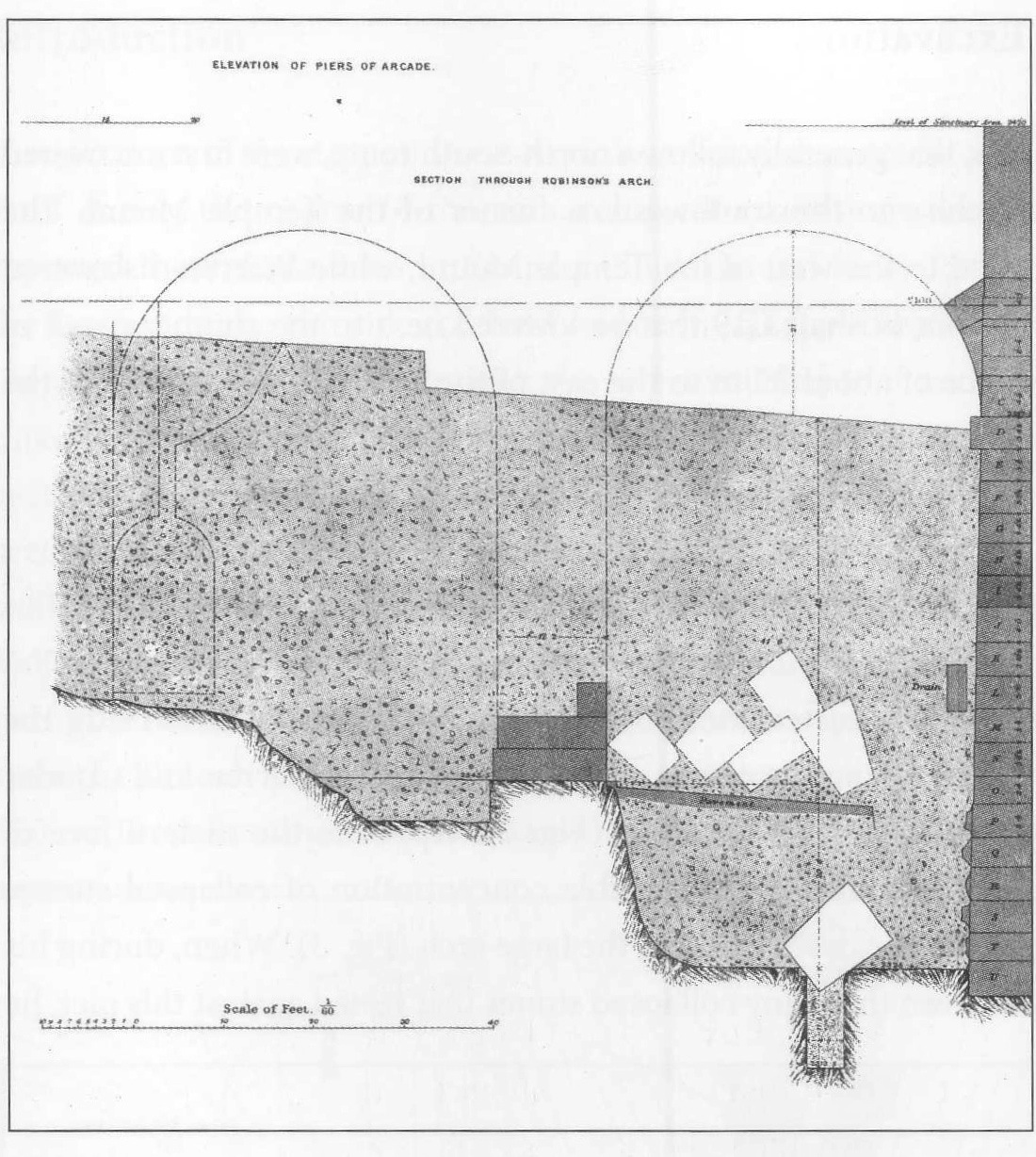
Earlier Warren had sunk 7 shafts across the Tyropean at Robinson’s Arch. In a report for the Palestinian Exploration Fund (PEF) in 1867 he described two drainage channels, running generally north south, the western channel was unearthed about 4m from  the western wall and the eastern channel about 37m east of the southwestern corner. The western channel is quarried into the bedrock, about 4m deep and 1.2 m wide and roofed with an elongated vault. In two places, a large voussoir (a wedge-shaped stone used to construct an arch) fell during the building of Robinson’s arch and wedged itself  in the top of the channel; the vaulted roof was built around these stones. According to Mazaar and Ben-Dov who excavated this area in the 1970s, these stones fell before the street pavement was installed. They concluded from this that the channel was built earlier, in the time of Herod, while the street was paved afterward. Excavations by Reich and Billig in 1990s discovered 15 coins in the earth fill between the street and the vault, the latest of which was from the time of Pontius Pilate (23-26CE), implying a late dating of the middle of the first century for the street paving (time of Agrippa II).

In 1869, William “Crimea” Simpson (widely known for his firsthand coverage of the British campaign in the Crimean War) was sent by his employer the Illustrated London News to sketch the opening ceremony and scenes of the Suez Canal. On his way, he took the opportunity to visit Jerusalem on behalf of the PEF and made sketches of the excavations which Warren had undertaken of some ancient water tunnels. To provide sufficient light for him to sketch, they had to burn magnesium wire (Edison only invented the incadescent light bulb in 1879). This sketch was made into a watercolor painting – Henry Birtles, Warren’s assistant, leaning against the wall of the drainage channel with the large voussoir in the foreground. Interesting that we have illustrations and paintings from Warren but no photographs although the process was known from 1839. The daguerreotype, with its silver surface and minute detail, was very popular in both Europe and the US. At virtually the same time, Talbot published working methods for his photogenic drawing and the negative-positive calotype process in 1840. These provided the basis for photography until the digital age. Today you can stand where Birtles stood and take your photograph under the same stone still lodged in the channel.

Jerusalem Tombs

With a history that goes back 4000 years, you can find a lot of tombs in and around Jerusalem. I’ve already blogged about Nicanor’s tomb, tombs at Ketef Hinnom, Caiaphas tomb, Mary’s tomb – you can see all the articles by clicking on Tombs in the right hand column under Categories. Todd Bolen posted a link to a Jerusalem Post article about some significant Jerusalem tombs, King David’s tomb, a Mamluk tomb, Herod’s so-called family tomb (Herod himself chose to be buried at Herodium – one of my favorite sites to guide) and Jason’s tomb and suggested that a couple of photos would enhance the article. I’m happy to oblige and I even mapped out the sites on Google Maps to make them easier to find.