Tag Archives: Herod

Aqueduct at Caesarea

The first aqueduct (one closest to water) was built by Herod at the time the city of Caesarea-Maritima was founded and brought water from the Shuni spring, south of Mount Carmel, about 10KM to the northeast of the city. The water flowed on a single raised channel supported on kurkar arches.

When this was not sufficient, a second “lower” aqueduct was built by the Legions of the Emperor Hadrian (2nd C CE). It brought water from Tanninim (Crocodiles) river. This section, with a tunnel of about 6KM long, was tapped into the older aqueduct, and doubled its capacity and its width. The builders used the same building materials and style, so it may be difficult to see that the pair of channels were built at different times. The aqueduct continued to supply water to Caesarea for 1200 years.

To find the start of the second aqueduct drive just past the entrance to Beit Hanania you will find the northern section of the aqueduct and the second aqueduct (Hadrian) connecting to the older one (Herod).
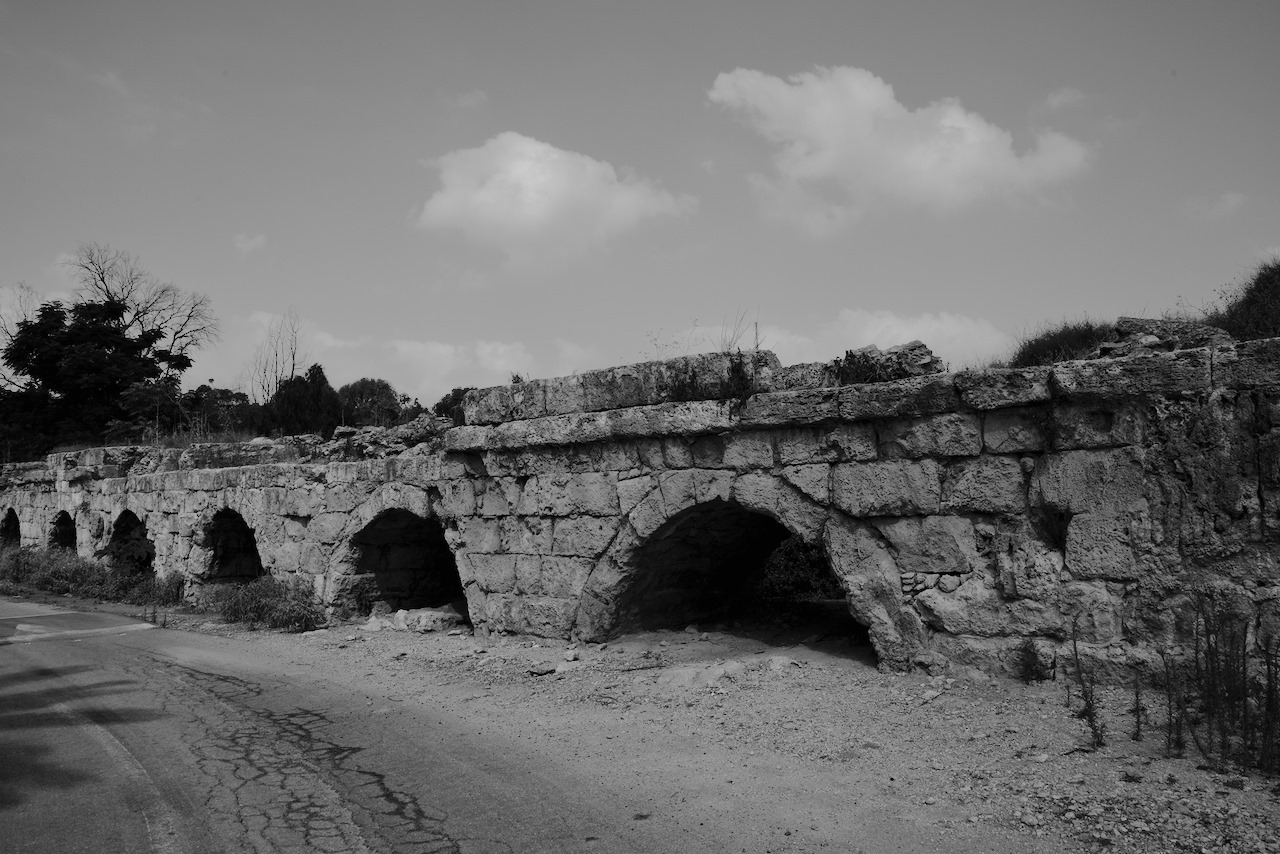
Aqueduct at Beit Hanania

In this section there are two stone tablets that were placed into the wall by its builders, the legion of the Emperor Hadrian. The right tablet clearly shows: “IMP CAES(ar) TRIAN HADR(ianus)”. The other tablet is of the Tenth Legion (the Imperial eagle without its head standing on a wreath).
IMG_5984

The Israel Trail winds its way beside the aquaduct, through the Arab town of Jizr a-Zarka and then south along the coast to Caesarea.

DSC_0195

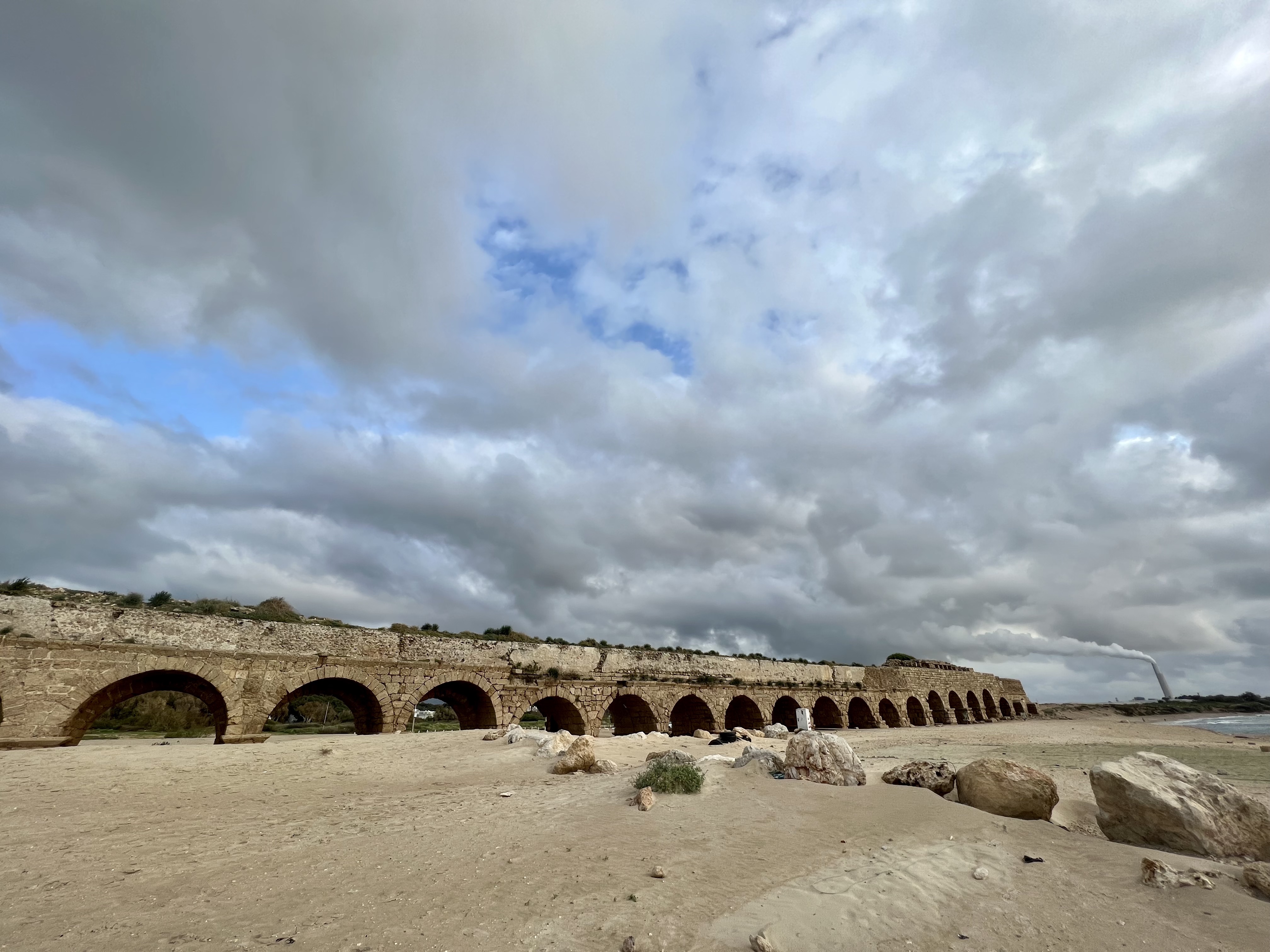
On the beach closer to the Caesarea archaeological park there is another section of the aqueduct.

Aqueduct just north of Caesarea

In fact it makes a great hike with the whole family following the aqueduct at Caesarea north along the beach to Dor (where you can visit the Mizgaga museum) or continue a little further to Hof Habonim.

Related articles

Nymphaeum at Herodium?

I’m a tour guide who often does tours at Herodium, the palace complex built by King Herod about 15 km south of Jerusalem and where, according to Josephus, Herod was buried. Ehud Netzer, in excavating Lower Herodium, described a building that he called the Monumental building at the end of of an elongated course. He suggested that the building could have been Herod’s burial place. Since then Netzer has discovered the base of a mausoleum with finely carved decorations and 2 sarcophagi on the north-western side of the hill.

On p. 38 of his booklet entitled Herodium (published 1999) Netzer writes

“Present-day visitors are always puzzled by a series of grooves cut into all of the half-columns. These grooves were apparently carved to accommodate a piping system which was probably added later during the period of the Roman pro curators, who may have converted the hall into a nymphaeum.”

Interesting. The nymphaeum that comes to mind in Israel is the one in Bet Shean. So I looked up nymphaeum and came across a very interesting article about Hadrian’s Villa near Tivoli:

http://www.dartmouth.edu/~classics/rome2005/updates/week9_10/nov14.html

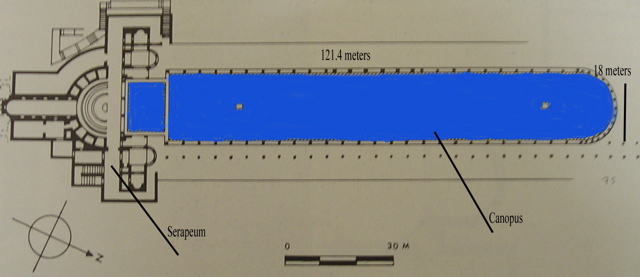
There’s a diagram of the Canopus/Serapeum complex, an open air triclinium/nymphaeum and water course. This is very reminiscent of the Monumental building and course that Netzer describes (course at Lower Herodium is ~300m in length and ~25m wide).

A plan of the Canopus/Serapeum complex (original image from Sear, p. 180.)

There is another nymphaeum in the plan, in the area called the Piazza d’Oro (based on Figure 103 on p. 177 of Sear’s Roman Architecture; the central dark grey area comes from Figure 114 on p. 96 of Macdonald and Pinto’s Hadrian’s Villa and its Legacy).

(A) A large colonaded pool with garden.  (B) The octagonal entrance vestibule.  (C) The eight-sided space on the southeastern side of the courtyard.  (D) The nymphaeum with five niches for fountains of flowing water.

The article includes a photo of the remains of this nymphaeum, made up of 6 niches (which would have held the fountains) separated by pilasters. There is a channel that would have allowed water to run from the nymphaeum to the pool in the courtyard.

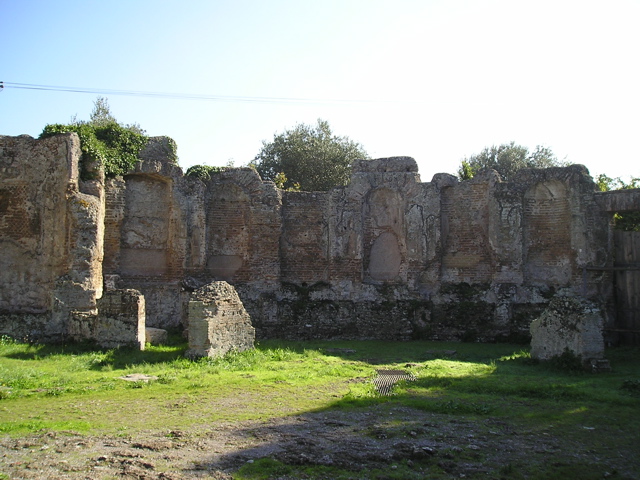
I was struck by how similar this is to the Monumental building, so I have included a photo of it here.

In guiding, I’ve had a number of tourists ask me what the curved cuts in the stone in the lower part of the pilasters (between the niches along the walls, 2 in the end, 3 on each side) were used for. If this was designed as a nymphaeum (either in the time of Herod or by later Roman governors) perhaps the channels were used for water. The course and building are just south of the large pool.

Roman Theater Box at Herodium

First discovered in 2008, the Royal loggia (theater box) above the regular rows of seats at Herod’s private theater has now been fully excavated.

Herod’s theater box, loggia; photo courtesy of Hebrew University

While ruling over Judea Herod wanted “to put Herodium on the map. In order to attract people, there were gardens and waterworks, and the place became famous.” said archaeologist Ehud Netzer, professor emeritus of archaeology at Hebrew University. “The theater indicates that the experiment worked: there was lots of life there. Hundreds, if not thousands, of guests would visit the place and there was justification to provide them with entertainment.”

On your next visit to Israel make sure that Herodium is on your itinerary. I can take you there and give you a comprehensive and fascinating guided tour.

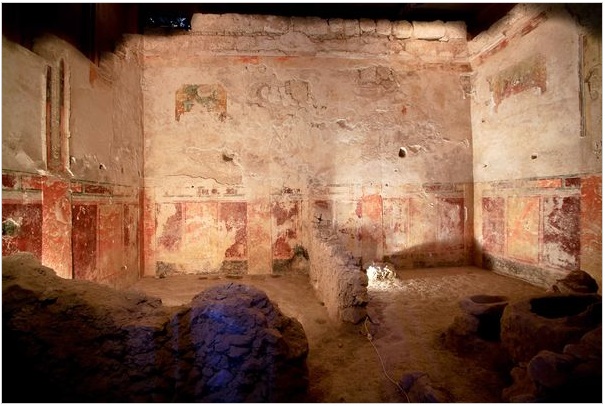
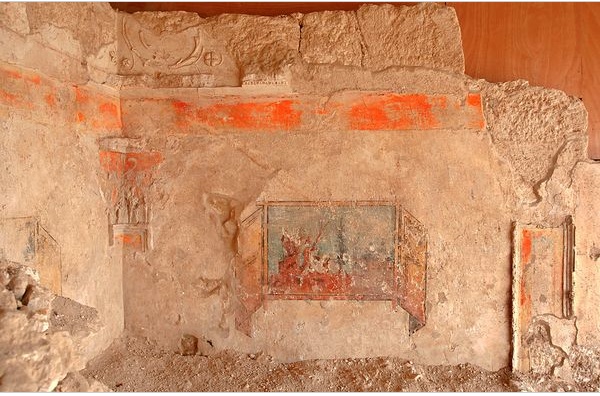
“There is nothing like this in any other location” in Israel, Netzer said of the paintings and intricate moldings in Herod’s theater box. But the style was fairly common across the Mediterranean and reflects the Roman origins of Herod’s power.

Herod’s theater box, loggia, Herodium; photo courtesy of Hebrew University

“Our art history expert said, ‘Hang on, this is something very familiar from Italy,'” in terms of both style and method, Netzer said. “The technique used here was not particularly accepted in this region; it was secco rather than fresco“—painted on dry, rather than moist, plaster.

Depicting natural landscapes, nautical scenes, animals, and the Nile River, the paintings most closely resemble others in the roughly contemporary Villa Imperiale at Pompeii.

According to Netzer, the pictures are not only Roman style but Roman made, perhaps executed in advance of the visit of Marcus Agrippa to Judea in 15BCE. Agrippa was Augustus’ deputy and the man responsible for many of the building projects in his empire.  “It was a one-time mission. The artists came, they painted, and they returned to Italy.” says Netzer. There are other examples from the same period where Roman techniques and presumably builders and architects were sent to Judea for a specified period of time to assist in building projects. Archaeological excavation have uncovered walls at three sites built using the Roman opus reticulatum and opus quadratum techniques. These sites are Herod’s winter palace at Jericho, a temple at Banias and a round structure north of Damascus Gate in Jerusalem, apparently the mausoleum to members of Herod’s family, all mentioned in Josephus’ writings.

4–Day Itinerary

I’m happy when people contact me looking for a multi-day itinerary based from Jerusalem. It’s definitely worth a few days if you have the time. I’d like to share one itinerary that I guided for clients a couple of weeks ago. Of course, this itinerary is just to give you the idea – when you hire me as your guide you get a personalized itinerary that matches your interests.

Day 1

  • We started with an overview of Jerusalem from the promenade at Armon HaNatziv, learned about the aquaduct that brought water to the city from Hasmonean times (100 BCE). From there we drove to Herodium for a comprehensive tour: the lower city (pool, Roman bath, monumental building, Byzantine church) outside the park and the palace/fortress on the manmade mountain top built by King Herod including the latest excavation by Netzer of the tomb and Roman theater discovered on the north-east side of the mountain.
  • Visit to Gush Etzion (Etzion Bloc) to learn about the history of the Gush and memorial to the defenders of Kibbutz Kfar Etzion in 1948. Lunch at a lovely restaurant called Gavna in the forest of Kibbutz Massuot Yitzhak with a view all the way to the coastal plain.
  • Visit to Hebron and the Cave of Machpela, that Abraham purchased to bury Sarah in which our forefathers and 3/4 mothers are buried. The building over the cave was built by Herod. Walk around the city to try to understand the current political reality.

Day 2

  • Walking tour of the Old City covering the 4 quarters, the 3 religions and 3000 years of history, including Herodian, Roman, Byzantine, Arab, Crusader periods. Views of the city from above and exploring underground. Tastes of the city for lunch.

Day 3

  • Visit the Israel museum to see the 2nd Temple model of Jerusalem. Tour of the Shrine of the Book, the unique architecture, the exhibits of artifacts from Qumran and the Dead Sea Scrolls.
  • Opportunity to stroll through the Sculpture garden.
  • Visit the City of David, the walled Jebusite city captured by King David in 1004BCE and made the capital of his kingdom. Learn about the extensive archaeology going on there and the politics. Possibility of walking through Hezekiah’s tunnel.

Day 4

  • Drive from Jerusalem to the Dead Sea and Judean desert, the lowest point on earth, only 42 km away but 1170 meters lower. Learn about the African Rift valley, water, shrinking of Dead Sea, sink-holes, flora and fauna.
  • Qumran where the Dead Sea Scrolls were discovered in passing.
  • At Ein Gedi, hike Nahal David to waterfalls and natural pools (it’s delightful to take a dip even in the winter months). Visit the ruins of the Jewish synagogue with mosaic floor.
  • Continue south to Masada, Hasmonean fortress in the desert extensively renovated by Herod, used by the Jewish rebels against the Roman and later by some Byzantine monks. Visit the new museum at Masada.

Masada at Sunrise

Masada is one of the most visited historical/archaeological sites in Israel, an isolated rock cliff in the Judean desert overlooking the Dead Sea.

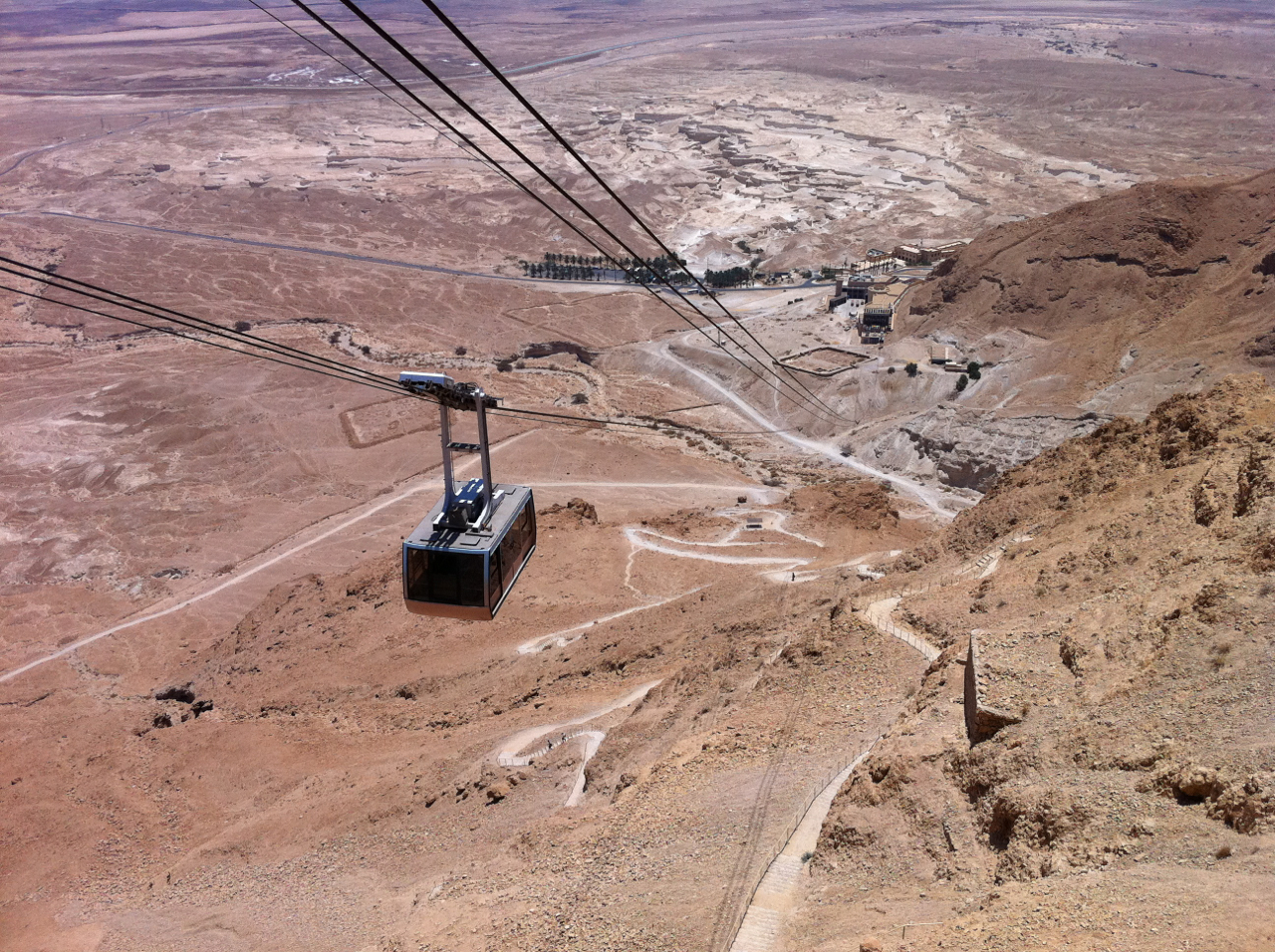
Masada cable carAlthough there is a cable car that will take you to the top of the mountain, a tradition has grown up to climb the Snake Path, a zig-zag trail, early in the morning in order to reach the summit in time to watch the sunrise – that’s what we did. The top is only 59 meters above sea level but remember that you’re starting at about 400 meters below sea level. You should be able to climb it in 45 minutes to 1 hour. If you want to do this the best place to stay the night before is the youth hostel at the base of Masada.

I recently read an article on the Israelity website about a group of 7 seniors from the Cedar Village retirement community near Cincinnati who came to Israel to celebrate their bar/bat mitzvahs and tour Israel including climbing Masada – their average age was 85 years old, the oldest was 97!

I guided two families traveling together, a group of four adults and five children, during their time in Israel. When we reached Masada and saw the mountain some were interested in climbing the Snake path. We didn’t really have enough time so one of the Dads suggested running it. At first no one took him seriously, so Chris said he’d do it. I showed him where the path started and he was off. The rest of us took the cable car and on our way up looked for Chris. I finally saw him on the last turn of the path before the summit – his time 17 minutes! For Bernie’s description of their experience check out their blog at http://keepingupwiththemounts.blogspot.co.il/2011/11/masada.html

Masada (from Arad)

Another option is a nice hike that starts at the same but splits from the Snake Path, you walk north on the red trail following the circumvallation wall built by the Romans around the mountain. You pass the 4th siege camp (northernmost) and follow the trail west and then south. As you climb there’s a great view of the Northern Palace hanging on the cliff and the water cisterns on the western side. You can go to see the cisterns and/or climb the Roman ramp to the summit.

Tour of Herodium and Herod’s Tomb

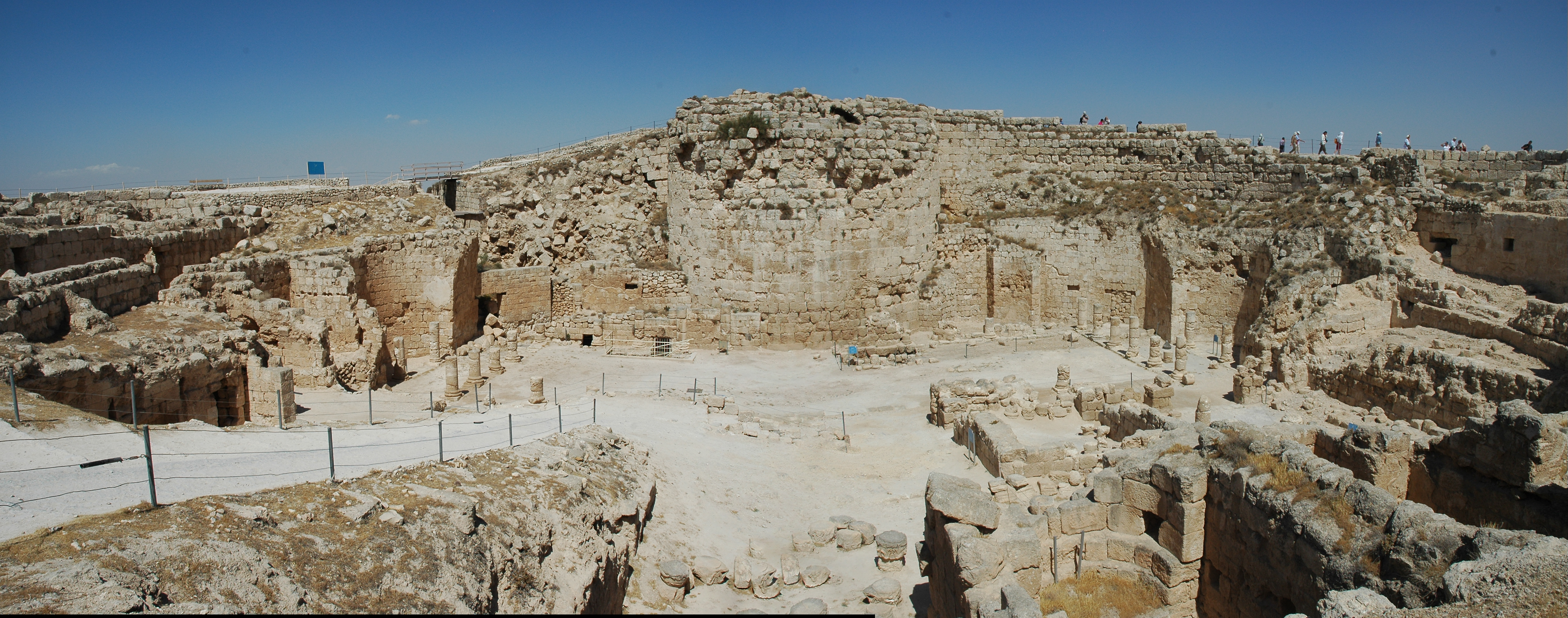
herodium mountain top palace fortress panorama

Panoramic view looking down into Herod’s palace-fortress

A guided tour of an archaeological site like Herodium can be a unique birthday present for a friend or family member. It was a hot and sunny day but there was a cool breeze on the mountaintop and you could understand one reason why Herod would have chosen this site.

When I guide Herodium I often start in the Old City to show people the remains of the buildings at the Wohl museum and the stones of the walls and streets from the Herodion period along the western wall below Robinson’s Arch. Also, the Herodion stones forming the base of the tower at the Roman Gate are impressive. Seeing examples of Herod’s architecture help people know what to look for when we get to Herodium.

Last summer, I participated for a few days in the latest excavations that Ehud Netzer is leading on the eastern side of the mountain, excavating the tomb area. We were working on the pool and besides many pottery shards we found some catapult stones (size of snowballs, not to be confused with the larger ones rolled down from the walls by the Jewish rebels) and some coins from the Great Revolt.

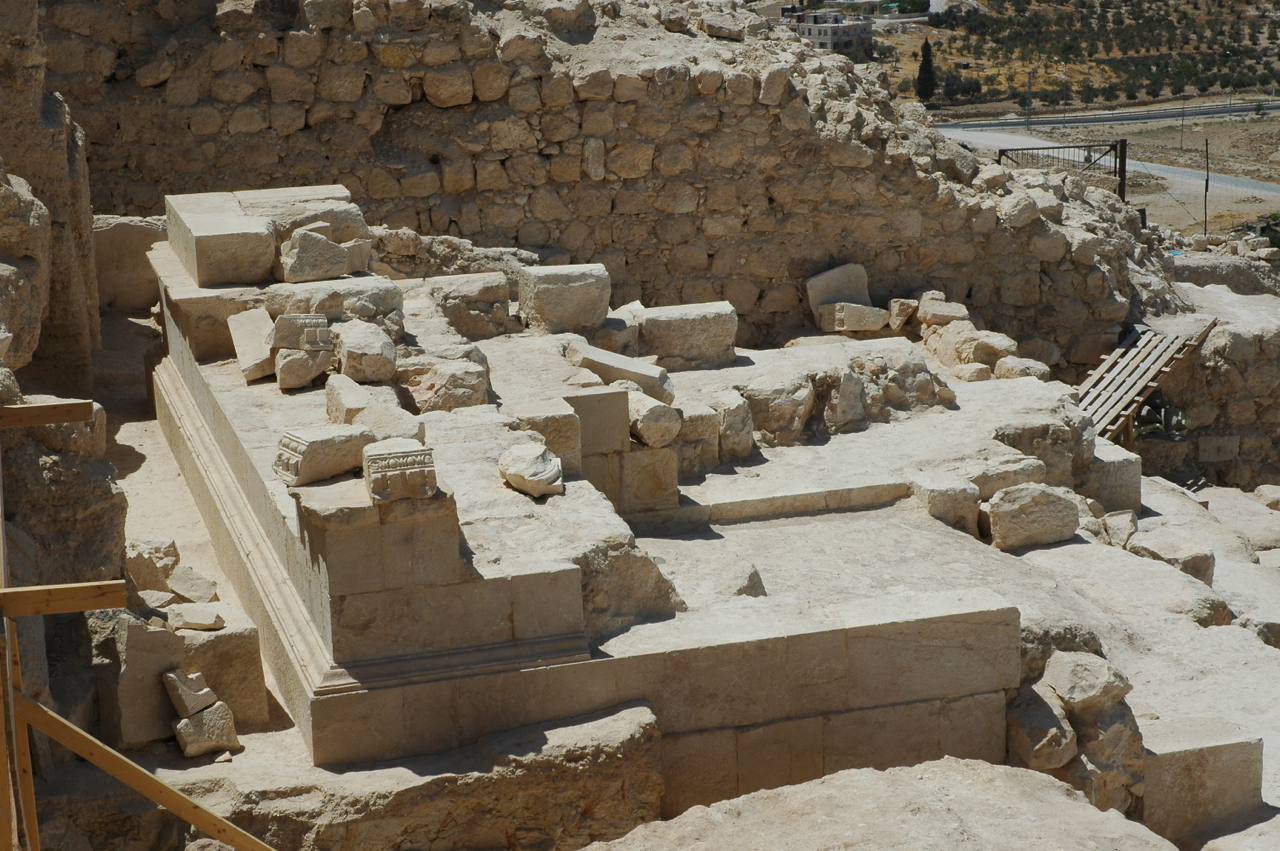
Excavations are continuing and they’ve excavated a much larger area now. More of the base of the mausoleum is now exposed. Additional stone architectural details of a very high quality can be seen. These are not of the local soft limestone but a more royal stone, called meleke, that would have been quarried some distance away and brought here. Netzer thinks that the base supported a nefesh or monument, cylindrical in shape, something like Yad Avshalom in the Kidron Valley.

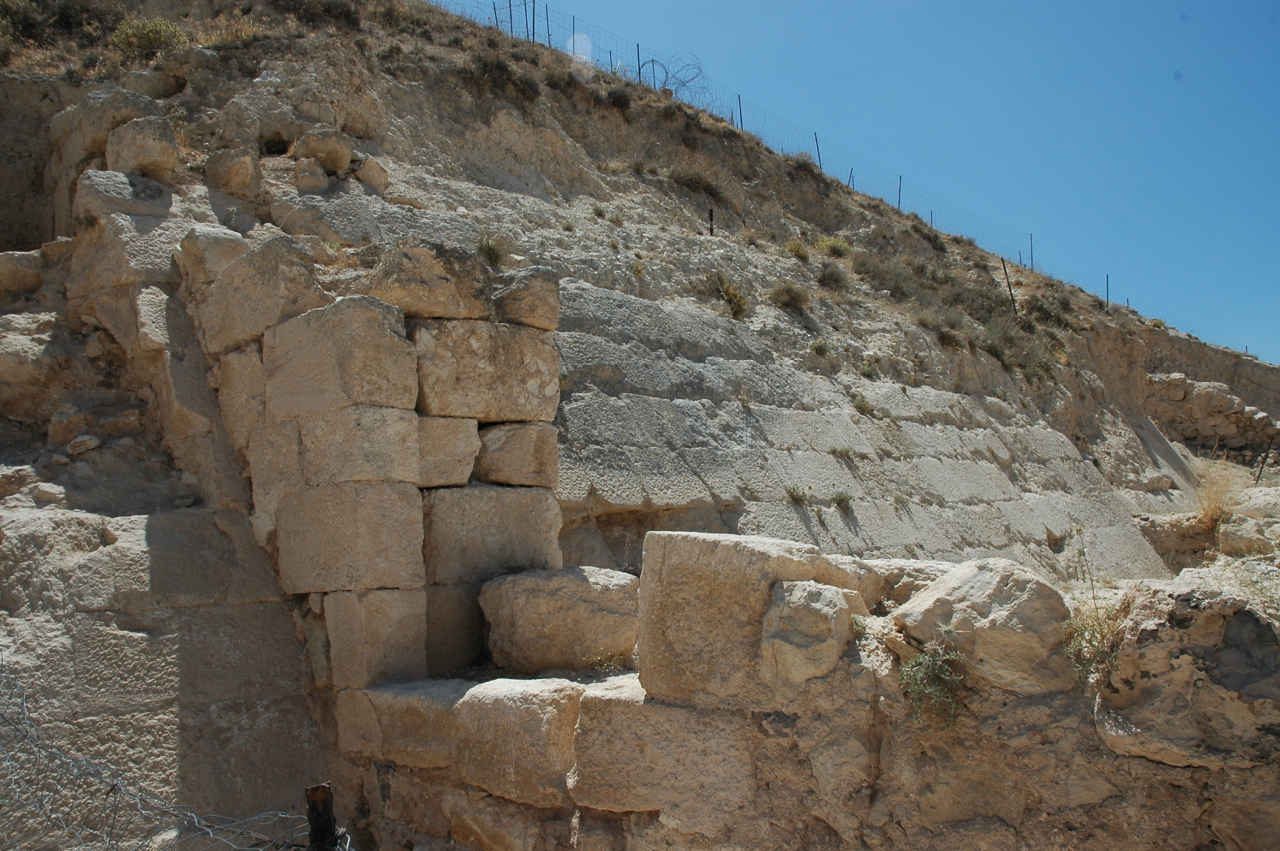
Tomb area at HerodiumThe latest findings are changing our understanding of Herodium. For example, it seems that the earth that was piled up around the mountain palace/fortress is not from the time of Herod but later. Originally, there was a glacis, a sloping wall, that circumvented the mountain.

Glacis at Herodium

Also, the archaeological evidence suggests that the staircase that is described by Josephus “and provided an easy ascent by two hundred steps of the purest white marble” was built later, that originally there was a “snake path” like at Masada. Archaeologists are left with some interesting unanswered questions: When was it done, why and by whom?

I’ve uploaded additional photographs of Herodium to Flickr at http://www.flickr.com/photos/27944012@N06/sets/72157615671440473/