Category Archives: Photography

The Dead Sea

Driving on highway 90 from Jerusalem down to the Dead Sea takes half an hour as you descend from more than 700 meters above sea level to 400 meters below sea level. The Dead Sea is situated at the lowest point on earth, in the Great Rift valley that runs from Turkey in the north to Mozambique in the south, in the crack in the earth’s crust created when Asia and Africa were torn apart five million years ago. Originally it was an ancient larger sea connected to the Mediterranean when water flowed across the Jezreel valley and Jordan River to fill the rift. Although it has no outlet, evaporation in the hot Judean desert reaches 25 mm per day in the summer so in four days it loses the equivalent of the annual rainfall. When the amount of water flowing into the Dead Sea from the Jordan River was equal to the amount lost to evaporation, 1.2 billion cubic meters, the level stayed in equilibrium. Today the Dead Sea is receding at the alarming rate of one meter a year as Israel and Jordan divert the waters flowing into it. The sea is still 1100 meters deep at the northern end so it isn’t going to disappear tomorrow but it is a serious problem that needs to be addressed.
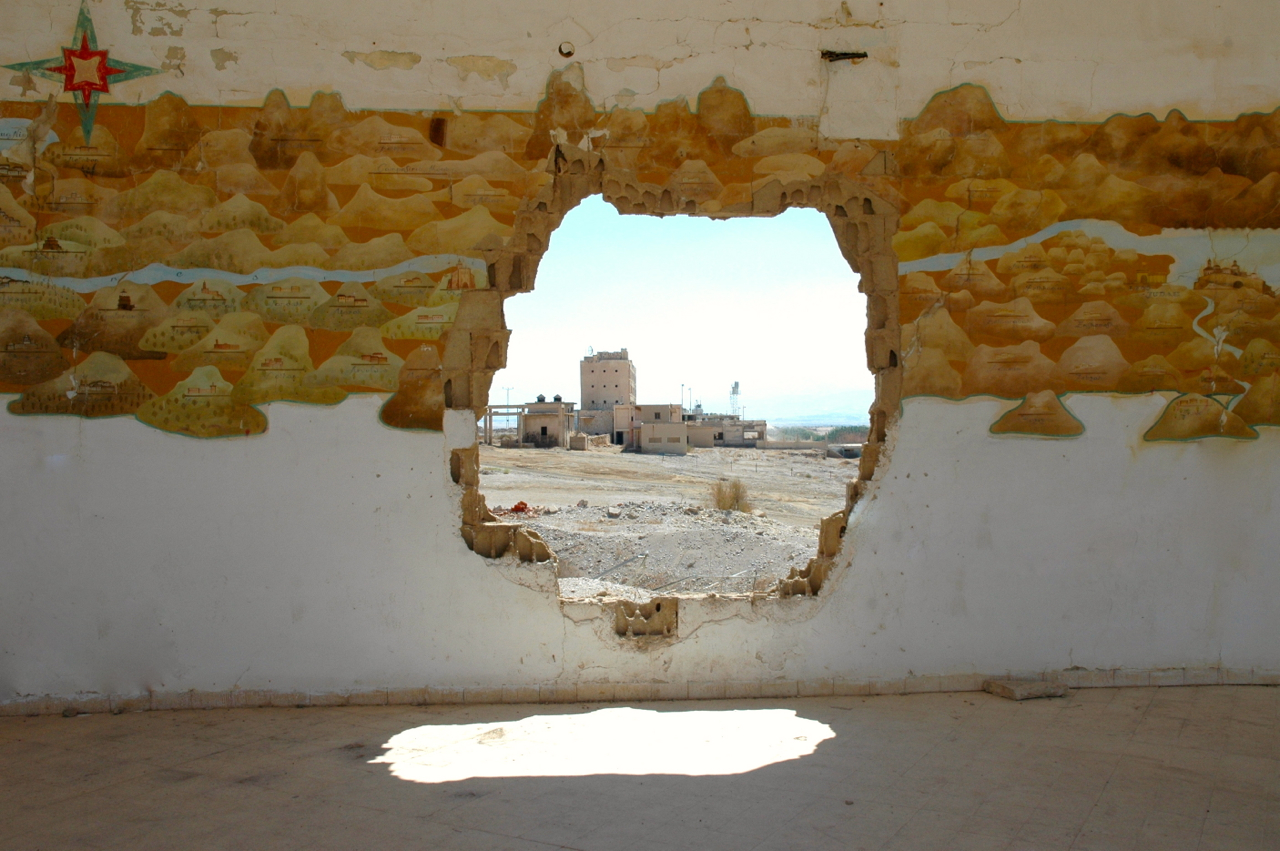
Hilton, Dead Sea

At Lido junction at the northern end of the Dead Sea I often stop to show people the replica of a Crusader map painted on the curved walls of what was a fancy Jordanian restaurant on the shores of the Dead Sea. The artwork was done in March 1973 by Kohavi, who served like me as a reserve soldier at the nearby “Hilton” hotel, now an Israeli army base. Here you can see the trickle that is the Jordan River today flowing into the Dead Sea.Jordan River flowing into Dead Sea

Continuing south along highway 90 we’ll pass some private beaches on your left where you can float in the salty water of the Dead Sea and cover yourself in mineral rich mud. The mud contains magnesium, potassium, sodium, bromide and calcium, all beneficial to our skin; in fact, as the mud dries it even draws out toxins from your skin.

On your right we’ll pass Qumran where the Dead Sea scrolls were discovered in the nearby caves. At that time, Qumran was a land terminal, you couldn’t continue southward except by boat. The Dead Sea was an important transportation route because even heavily-laden barges would float easily (the Madaba mosaic map shows 2 such boats carrying salt and grain). On your left is En Feshka (also called Einot Tsukim). Excavations were carried out here in 1958 by de Vaux (when he was excavating Qumran) and in 2001 by Hirshfeld. The concensus is that this was a farm that prepared balsam perfume. Today it is a nature reserve, 1500 dunam of which has restricted access and can only be visited with an authorized guide like me.

Just before we reach En Feshka look up on the cliffs to your right for the PEF markings, 2 black horizontal lines drawn in 1900 and 1927 by members of the Palestine Exploration Fund and the letters PEF in red. To help you understand how much the Dead Sea has receded these lines were painted from a boat floating on the Dead Sea in the 1900s.

East of the main highway (on your left) we’ll see a few sinkholes and more across from Ein Gedi. As the Dead Sea recedes fresh water from runoff dissolves the salt in the newly uncovered salt-laden earth creating an empty cavern. When the top crust of earth collapses a sinkhole is formed. More than a 1000 sinkholes have appeared on the Israeli and Jordanian coasts of the Dead Sea in the past 15 years. The holes fill up with water and the naturally occurring minerals create pools of orange, yellow, green and indigo with borders of encrusted salt, incredible to see. I’ve taken a series of photographs of sinkholes that you can see on my Flickr site http://www.flickr.com/photos/27944012@N06/sets/72157621040678204/

Sinkholes at Dead Sea © Shmuel Browns

Ein Gedi

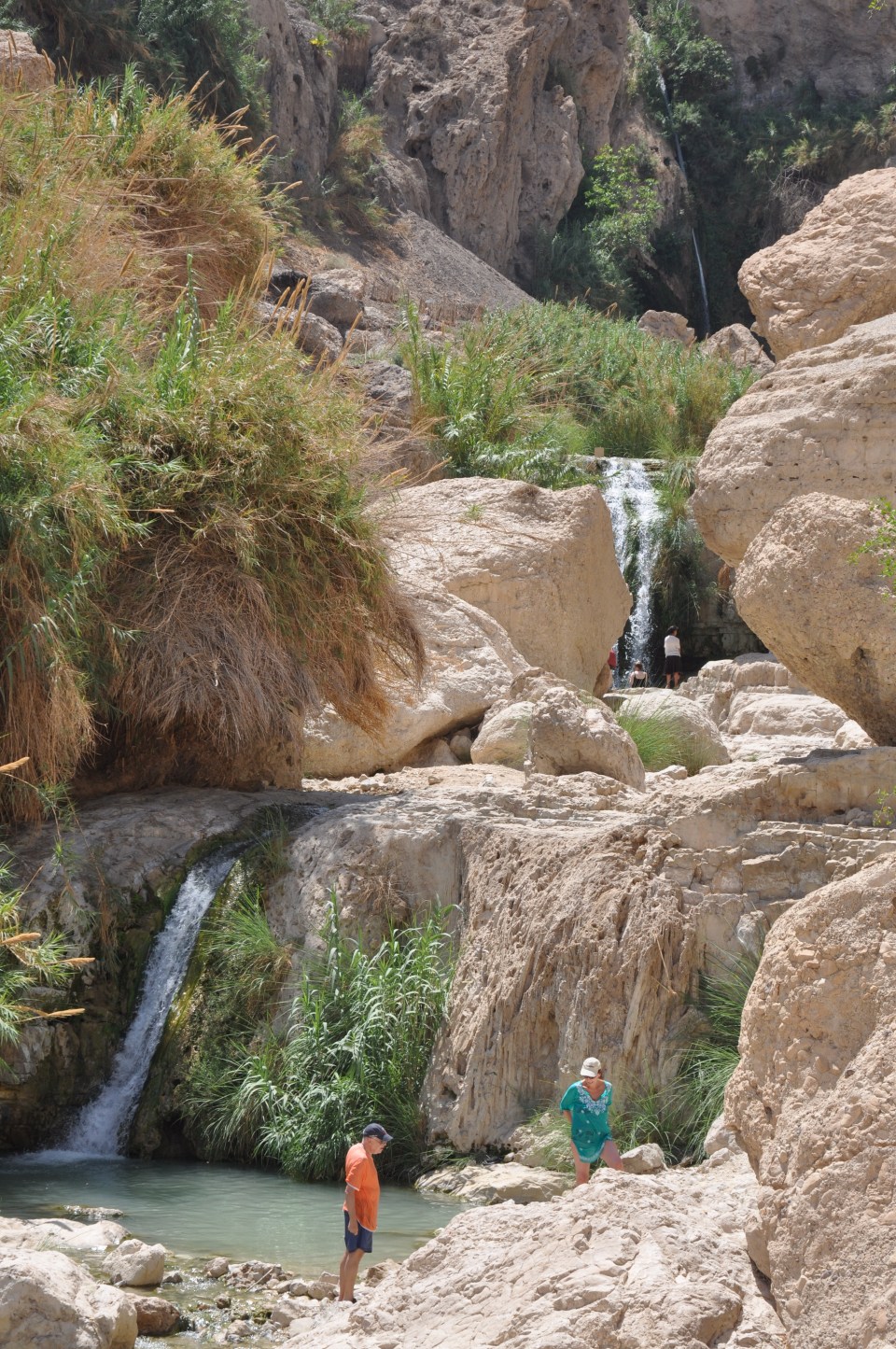
Ein Gedi-waterfalls and pools

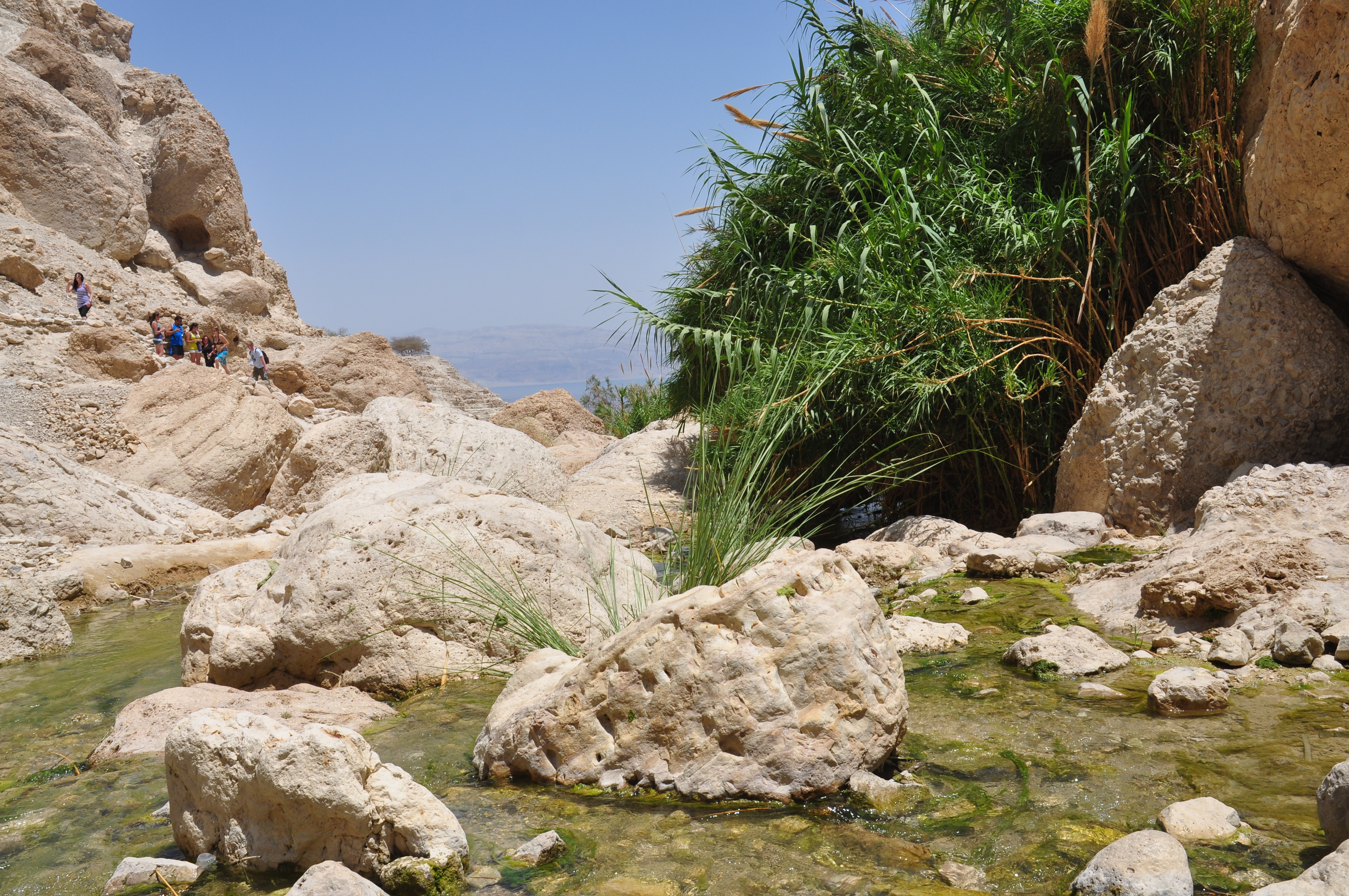
Ein Gedi (literally Spring of the Goats, refers to Nubian Ibex that come to the spring to drink) is an oasis in the Judean desert along the western shore of the Dead Sea. Here are two hikes (each about 5 km) in the Ein Gedi reserve that are perfect for families, Nahal David and Nahal Arugot.
On entering the reserve follow the marked the path and after about 15 minutes of easy walking we’ll reach the first waterfall, Mapal Shulamit that cascades 30 meters down the rock to a pool below. After a refreshing dip we’ll continue to a fork in the trail, we’ll take the steeper one on the right (the other path would take us back to the entrance) to the Shulamit spring and from there above the wadi to the Dudim cave. Retracing our steps we’ll continue to the Ein Gedi spring and beside it the flour mill. From there we can walk to the ruins of the Chalcolithic temple (3500 BCE), one of the oldest remains of human settlement in the Judean desert. We’ll descend through a cranny along a dry canyon to discover a 50 meter high waterfall and a great view of Nahal David and the Dead Sea beyond.

Ein Gedi-Nahal DavidAccording to the Roman historian Pliny the Elder the area of Ein Gedi was settled during the Second Temple period by a Jewish ascetic sect called the Essenes. The archaeological evidence uncovered by Hirschfeld suggests that they lived   near the spring where he found more than 20 tiny stone cells and two pools, one for irrigation and one a miqve or ritual bath. Pottery shards date it to the first century BCE.

The second hike starts from Tel Goren along the Nahal Arugot river bed past acacia trees and salvadora to a large pool used for irrigation of crops like balsam; the pool was filled by a channel that brought runoff from the wadi. Continuing we will pass reeds, maidenhead ferns, willow and poplar; we may see a rare orchid called Ben Horesh. A little farther the wadi narrows to a steep walled canyon at whose end is a waterfall and pool.
Excavations at Tel Goren by Mazar of the Hebrew University in  the 1960s show that the site was settled in the Israelite period and functioned as a royal estate for growing dates of the now extinct Judean palm Phoenix dactylifera, considered uniquely medicinal. Balsam was grown for the production of perfume (in Hebrew, afarsimon).
The Romans were interested in the production of balsam perfume; Mark Anthony confiscated the groves from Herod and gave them to Cleopatra. After their deaths, Herod was able to lease them back. During the Great Revolt, the Jews uprooted the groves so they would not fall into the hands of the Romans.
Excavations have revealed a small Jewish village and a synagogue from the 4th century with a beautiful mosaic floor. Written in Hebrew and Aramaic,  inscriptions list the signs of the zodaic and months of the year (later displayed graphically in mosaic floors in synagogues in Bet Alpha and Tiberius) and the expression “Peace unto Israel” (also found in the ancient synagogue in Jericho) and a dire warning at the end: “whoever reveals the secret of the town to the Gentiles – He whose eyes range through the whole earth and who sees hiddens things, He will set his face on that man and on his seed and will uproot him from under the heavens.” The secret seems to be the production of perfume from balsam.

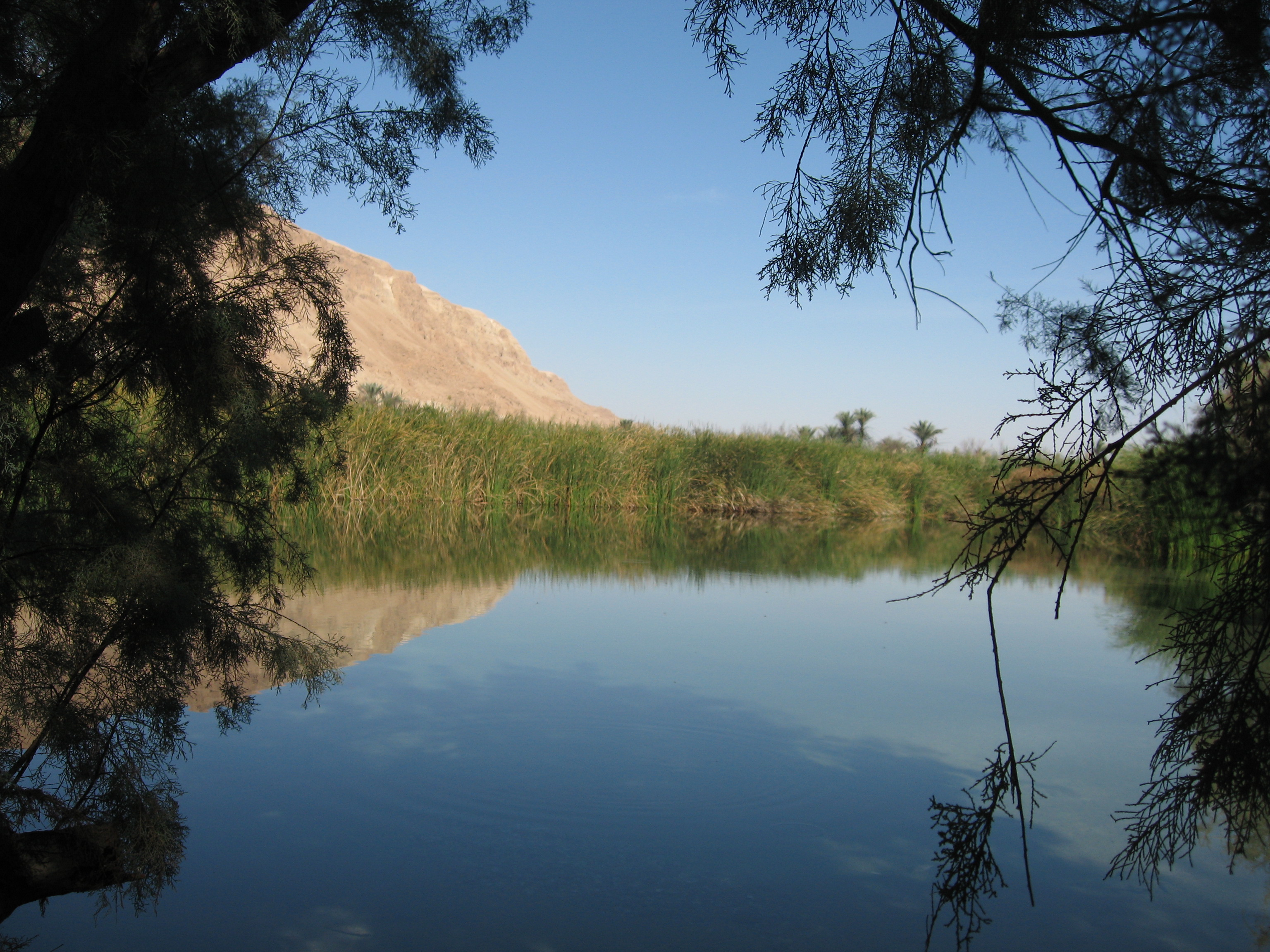
En Feshka pondThe other natural source of fresh water in the Judean desert is Ein Feshka 30 km to the north of Ein Gedi. The lowest nature reserve in the world consists of 3 parts of which one is closed to visitors except research scientists who are studying the desert. The public part includes a small archaeological site from the Second Temple period and pools of fresh water, picnic tables and facilities for the enjoyment of visitors. The closed reserve is 1500 dunams (370 acres) that can only be visited with an authorized guide like me. It’s incredible to find a large freshwater pond with fish, shaded by trees in the middle of the desert next to the Dead Sea.

Herzl and Kaiser Wilhelm II

Herzl and German Kaiser

Herzl and Kaiser Wilhelm II, 1898

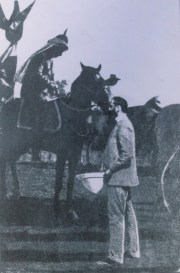
This photograph was taken on October 28, 1898 outside of the agricultural school at Mikve Israel when Kaiser Wilhelm II of Germany, astride a white stallion, with helmet of gold stopped for a moment on his way to Jerusalem. By the roadside, stood a solemn figure with a black beard: Theodor Herzl, founder of modern Zionism. Herzl considered the Kaiser’s recognition crucial for international approval of his plan to resettle the Jews in the land of Israel. All the Kaiser could muster was the observation: “The land needs water, very much water.”

What’s wrong with the photo? First, the Kaiser is on a dark horse. The original unusable photo can be viewed by clicking here.

On the right edge of the original photo you can just make out Herzl holding his safari hat. The Kaiser’s horse has its head completely out of the frame. Can you imagine taking such a poor photo? Have you ever had one of those days, when nothing seems to go right?

To salvage the situation a photo of Herzl was taken on the roof of the school and superimposed onto the photo after seating Kaiser Wilhelm II on the dark horse and cropping the photo on the right.

Surprised? Actually there are quite a few examples. See the Time magazine website http://www.time.com/time/photogallery/0,29307,1924226,00.html on “Doctored Photos” with the warning “photographers have been manipulating imagery since the medium was invented”.

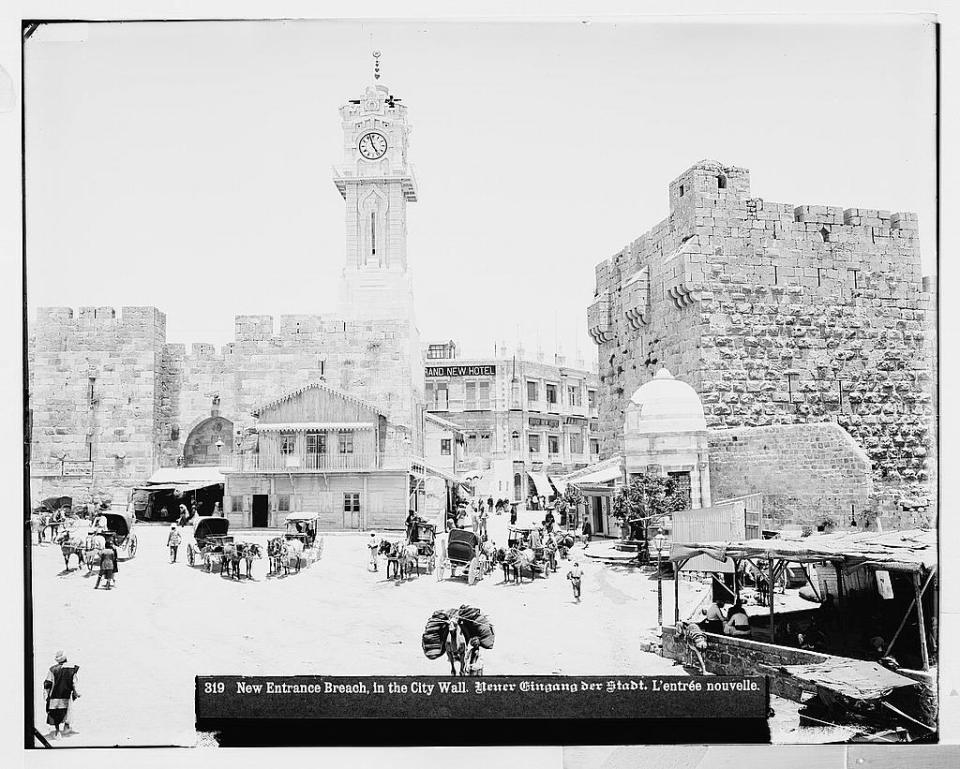
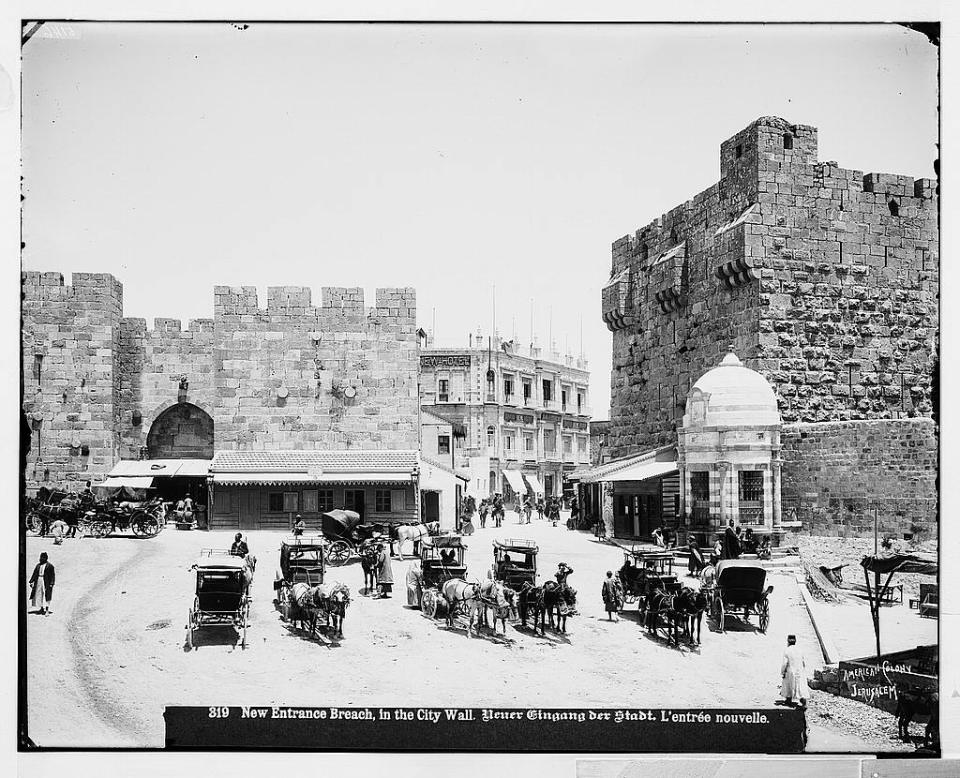
Here are another two photographs from the early 1900s of Jaffa Gate, after the Kaiser’s visit (the wall has been breached and the moat filled in so that the Empress Augusta Victoria’s carriage can enter). These photos were taken by one of the photographers of the American Colony, probably Lars Larsson. Which one is the earlier one? Do you think the image in either one of them has been manipulated?

Jaffa Gate, Old City, ~1900

Jaffa Gate, Old City, ~1900 (American Colony Photo Department)

Jaffa Gate, Old City, ~1900 (photographer: Eric Matson)

Jaffa Gate, Old City, ~1900 (American Colony Photo Department)

The clock tower at Jaffa Gate was one of seven built by the Ottoman Turks in 1908 on the occasion of the silver jubilee of the reign of the Sultan abd al-Hamid II (there are still clock towers in Jaffa, Safed, Nablus, Haifa, Nazareth and Akko) but was taken down by the British about 1920.

The entire American Colony/Matson collection of photographs, some 22,000 negatives were donated by Eric Matson’s heirs to the American Library of Congress who have digitized the collection and made it available for viewing at http://memory.loc.gov/pp/matpchtml/matpcac.html

Wildflowers, before the rain

One of the things about taking a tour of Israel is that you get to see a lot in a small amount of space. Because Israel is located on the land bridge that connects Europe, Asia and Africa it has some of the best features of each. Although it only extends from the Mediterranean Sea to the Jordan River in the Great African Rift Valley and from the Red Sea to mountains in the north it has a diversity of climates and habitats. These unique conditions are the main cause for the rich diversity of Israeli flora, more than 2500 species (compared to 1500 in the British Isles for example which is 10 times the size).

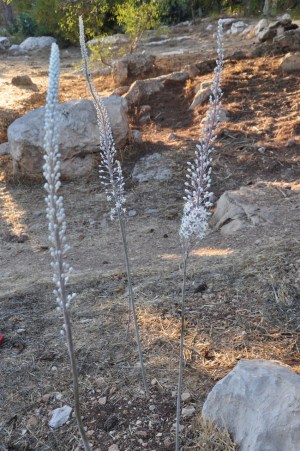
The Sea Squill (Urginea maritima, חצב מצוי) is a perennial of the lily family with a large poisonous bulb. The squill is one of ten species of plants called geophytes which bloom before the rains in Israel, in the driest part of the year and are a harbinger of winter. You’ll probably find the tall spikes of squill flowering by mid September. I saw some in Jerusalem while running along the tayelet, at the Museum HaTeva (Nature museum) and while hiking in the cliffs above Qumran.


You also won’t see the bright yellow Sternbergia (Sternbergia clusiana, חלמונית, from the same root as yolk of an egg) until just before the first autumn rains – don’t confuse them with the saffron and crocus that come after the first rains. Sternbergia belong to the daffodil family. This image was captured in November in the Yatir forest near Arad. On a hike we found Sternbergia growing in the wadi below Maale Rehavam near Herodium. I was touring in Ramat HaNegev and learned that there are Sternbergia in bloom in the wadi behind the Nahal Boker family farm. Moshe Zohar who lives there told me that this is the southern most point that they grow. I learned from a colleague who did a tour in the Golan that there are Sternbergia blooming below Har Hozek (conceivably the most northern point). If you are interested in touring Israel including hikes to see and/or photograph wildflowers please contact me.

You can check out these two excellent websites, that give you a lot of information about wildflowers in Israel:

http://www.wildflowers.co.il/english/

http://www.flowersinisrael.com/

Dead Sea – Lowest Place on Earth

From Jerusalem (elevation of 750 meters above sea level) it is about a half hour drive, on routes <1> and <90> down to the northernmost end of the Dead Sea (elevation 420 meters below sea level), the lowest place on earth. As the highway continues along the western shore of the Dead Sea you will pass Qumran, Ein Gedi, Masada, Ein Boqeq and the Dead Sea Works. There are numerous places along the route to take photos of the Dead Sea and the mountains that rise above it. In one day I took almost 150 photographs, filling all 3 of the CompactFlash cards (digital film) that I had with me, more photos than I have ever taken in one day.

It is very hot in the Judean desert so a stop for a dip at the springs at Ein Gedi is delightful. While enjoying the cool water pool in Nahal David, a family asked if I would take a photo of them under the falls – little did they know that they were getting someone who was so practised. With a little patience you will be able to observe the wildlife that lives in the reserve: hyrax, ibex, tristram grackle and red dragonfly.

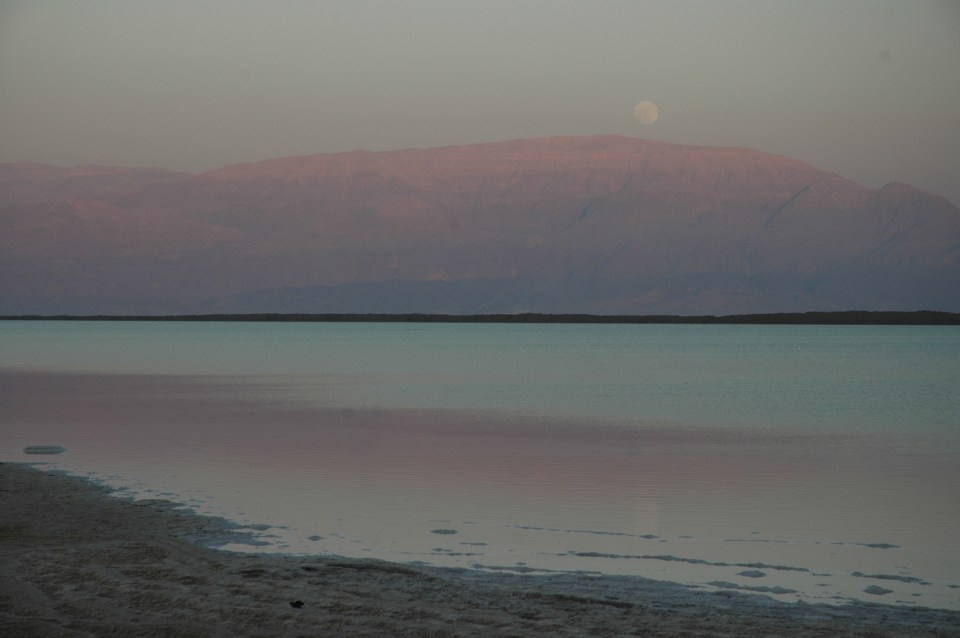
If you drive along the Dead Sea in the late afternoon you will be able to watch the setting sun as it paints the blue-green sea different colors of pink and purple. This photo is at Ein Boqeq – only as I was focussing on my composition in the viewfinder did I notice the full moon rising over the mountains of Moab.
Moonrise over Dead Sea at sunset
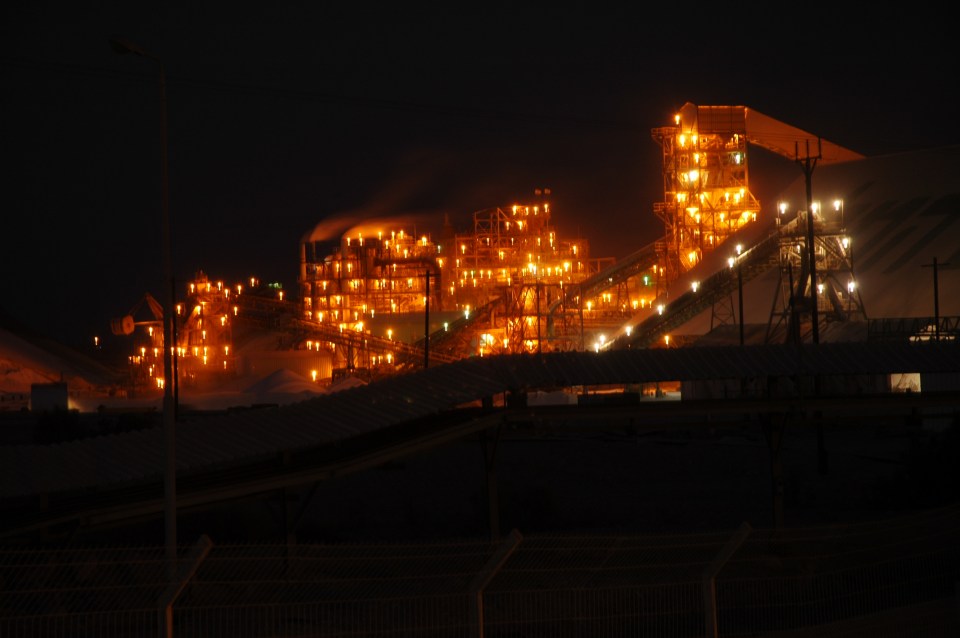
From there it is a short drive south to the Dead Sea Works, these are a series of photos of the industrial complex as night fell.
Full moon over Dead Sea Works
Nightfall at Dead Sea Works
Dead Sea Works lit up at night

I would be happy to arrange a tour and guide you if you want to focus on Israel through a camera lens.

In the last 3 years I’ve taken more than 4000 photographs in Israel. In July I am going to Kathmandu, in the foothills of the Himalayas, the highest place on earth–I am looking forward to an exhibit of my photos “From the Lowest Place on Earth” that will be on show there in August. To view the photos click here.