Category Archives: Jerusalem

Ardon Windows

photo, Mordecai ArdonMordecai Ardon (1896-1992) was born into an Orthodox Jewish family in Tuchów, Galicia (then Austria-Hungary, now Poland) but lived a secular life. From 1921 to 1924 Ardon studied at the Bauhaus under Klee, Kandinsky, Feininger and Itten. The influence of the Bauhaus and especially Paul Klee on his artistic development was profound. After graduating from the Bauhaus he studied the painting techniques of the Old Masters, especially Rembrandt and El Greco under Max Doerner in Munich. Combining these seemingly contradictory techniques gives Ardon’s colors their depth and richness.

In 1933 he immigrated to Palestine under the British Mandate. He joined the faculty of the newly formed Bezalel Arts and Crafts School in 1935, five years later he was elected director. Through the fifties he lectured at the Hebrew University on art appreciation and was artistic advisor to the Israel Ministry of Education and Culture.

Professor Ronen, of Tel Aviv University in speaking of Ardon said:

Ardon conceived colour as possessing an absolute aesthetic and spiritual value. He therefore always strove to create the most beautiful colours possible, the deepest blue, the warmest red, the most shining yellow, the most saturated green.

Ardon believed in pure art devoid of any political or social message. He believed that a painting should be appreciated and judged solely by its inherent artistic elements, such as colour, composition and their interplay. He rejected literary, symbolic or, indeed, any other additional meaning attributed to a work of art.

Ardon loved colors and ‘pure art’ but filled his works nevertheless with mystical connotations, Jewish symbolism and enigmatic scenery. He was appalled by the horrors of war and injustice and these themes too seeped into his art. Ardon was an artist who chose to use modern, expressionistic and abstract styles, combined with a classic painting technique which created distinctly unique paintings.

As Ardon expressed in a letter he wrote to Willem Sandberg, Director of the Stedelijk Museum, Amsterdam in 1960:

… an odd thing happened on my palette: something foreign sneaked into the group of cadmiums, ultramarines and viridiums – it was Jerusalem – ascetic, with a sack over its head.

What is Jerusalem doing amongst the bright cadmiums? How can one scratch it off the palette? Sometimes it can be scared away and hidden behind the ivory black. But in vain – the next morning it settles down again in the midst of the cadmiums…

One cannot get away from it. The alien Jerusalem always gives orders: “Thou shalt”, “Thou shalt not”, like a black woodpecker Jerusalem keeps knocking on your bark – Thou, Thou, Thou. Thou and the orphan, Thou and the widow…

In 1963 Ardon retired and finally was able to focus solely on his artwork. During these years, moving between Paris and Jerusalem, he created eight monumental triptychs – the last ‘Hiroshima‘ when he was 92. One of these was executed in stained glass by Charles Marq (who had collaborated with Chagall 20 years earlier) at Atelier Simon in Rheims, France between 1982 and 1984. A set of three large stained-glass windows (measuring (6.5×17 meters) cover one wall in the Jewish National and University Library in Jerusalem, dedicated to Isaiah’s vision of eternal peace with visual elements from the Kabbalah.

And many people shall come and say, “Come let us go up to the Mountain of the Lord, to the house of the God of Jacob, that he may teach us his ways and that we may walk in his paths. For out of Zion shall go forth the Law and the word of the Lord from Jerusalem. He shall judge among the nations and decide for many peoples and they shall beat their swords into plowshares and their spears into pruning hooks. Nation shall not lift up sword against nation, neither shall they learn war any more.   Isaiah 2:3-4

Click on the thumbnail above to display a larger image (these are quite incredible stained glass images).

The left panel depicts the winding roads taken by the nations on their way up to Jerusalem, up to the Mountain of the Lord, each road marked with its own language and alphabet (Latin, Greek, English, French, Arabic).

In the central panel Ardon represents Jerusalem, where the city’s stone walls are represented by the Isaiah Scroll (one of the Dead Sea Scrolls), a spiritual wall combined with the Kabbalistic tree of the sefirot, a symbol of the mystical divine presence, a merging of the earthly and heavenly Jerusalems.

The right panel is the vision come true, guns and shells beaten and transformed into spades which hover above.


Ardon was considered by many to be Israel’s greatest painter.
For images of Ardon’s paintings check out the website http://www.ardon.com/
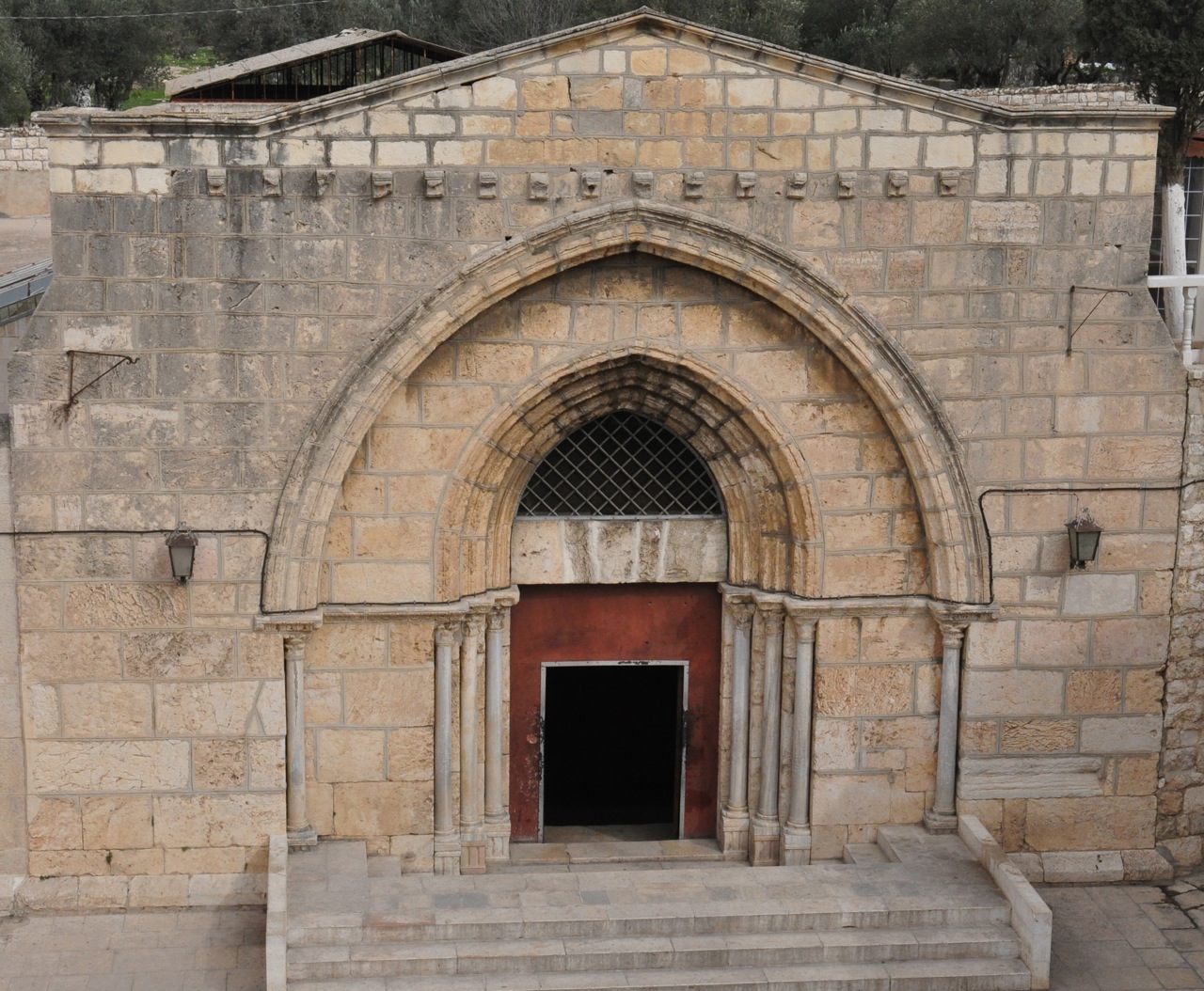
Two Churches: Mary and Jesus

Two Churches: Old and New

In the Kidron valley is a church built on a rock cut cave that is the tomb of Mary, mother of Jesus. Through the centuries the cruciform (in the shape of a cross) church was destroyed many times but the facade and wide staircase descending to the tomb is from the Crusader period. On the left side of the staircase a chapel to Joseph, Mary’s husband, on the right a chapel to Mary’s parents, Joachim and Anne; Queen Melisende is also buried there. Today the Greek Orthodox Church is in possession of the shrine, sharing it with the Armenian Apostolic Church (the Syriacs, the Copts, and the Abyssinians have minor rights). A niche on the southern wall is a mihrab indicating the direction of Mecca, installed when Muslims had joint rights to the church.

In a courtyard off the Via Dolorosa in the Old City is a small church that reminds me of the Crusader church. The Church of the Flagellation, marks the Second Station of the Cross, where according to tradition, Roman soldiers flogged Jesus and placed a crown of thorns on his head after he was brought to Pontius Pilate. The architect, Antonio Barluzzi, rebuilt this church in 1929, in medieval style over ancient ruins. Barluzzi designs churches so that the style and decoration preserve the history and recall the events that happened at the site. The facade has one central opening with a Crusader style pillow-shaped arch that incorporates a crown of thorns. There are 10 icons under the roof, a crown of thorns, two representations of a cat of nine tails (see if you can recognize the others, for example there is an image of a rooster and 3 stars*). The floor is made of small, inlaid colored stones in geometric patterns.

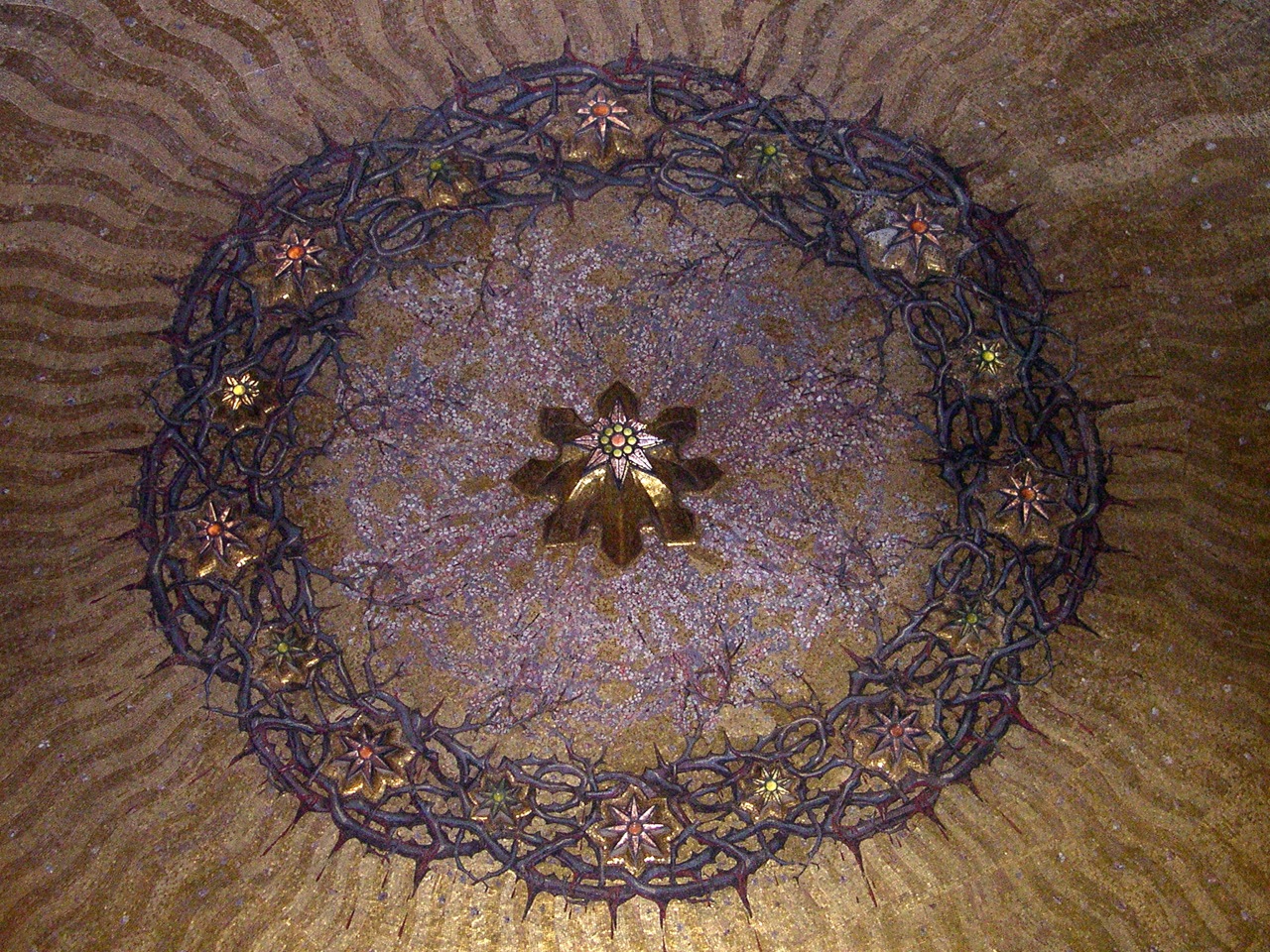
Probably the most impressive part of the church are three large stained glass windows: on the left, Pilate washing his hands of the affair, on the right, the victory cry of Barabbas, in front, the flogging of Jesus wearing the crown of thorns amidst the soldiers. Above is a dome in gold mosaic and decorated with a crown of thorns intertwined with flowers.

Click on the thumbnails above to display a larger image (these are quite incredible stained glass images). Included below is a closeup of the dome.

Near the church of the Tomb of Mary are two other Barluzzi churches, the Church of the Agony at Gethsemane, also known as All Nations and the Franciscan chapel farther up the Mount of Olives, Dominus Flevit. You can contact me about arranging a tour to visit Barluzzi churches including:

  1. St Veronica Church, VI Station of Via Dolorosa
  2. Chapel, XI Station in Church of Holy Sepulcher
  3. Church of Visitation, Ein Kerem
  4. Church of Bethpage
  5. Mount of Beatitudes, Galilee
  6. Church of Transfiguration, Mount Tabor
  7. Chapel of the Shepherd’s Field, Beit Sahour
  8. Church of St Lazarus, El-Azariya

* Rooster and 3 stars refer to Jesus’ prophecy at Gethsemane that Peter will deny him 3 times before the cock crows

Hurva Synagogue

In the winter of 1700, charismatic rabbi Judah he-Hasid Segal arrived in Jerusalem from Poland with about 500 followers (some say as many as 1000). You can imagine the reaction, at a time when the entire Jewish population of Jerusalem was about 500 people. They were mystics who were intent on bringing the Messiah and some say believers in the false messiah, Shabbetai Zvi. Within a few days of their arrival the rabbi died, some say he was poisoned. His followers struggled without a leader but managed to build forty dwellings and a small synagogue in the Ashkenazic Compound. Then they began to build a larger synagogue, but between bribes to Ottoman authorities, unexpected construction costs and other financial burdens they exhausted their funds. They took loans from local Arabs to complete the project. When the loans were still outstanding in late 1720, the Arab lenders lost patience and the synagogue was burned down, some say that 40 Torah scrolls were destroyed in the fire. The Ashkenazi Jews were banished from the city and the synagogue was left in ruins and became known as the Hurva, the “Ruin of Rabbi Judah he-Hasid”.

It took almost 100 years, in 1815, when Rabbi Menachem Mendel of Shklov, leader of the Tzfat Perushim, moved to Jerusalem with a group of followers, disciples of the Vilna Gaon. They wanted to reclaim the Ashkenazic Compound and to rebuild the Hurva synagogue, which had symbolized the expulsion of Ashkenazi Jews from Jerusalem. They believed that the “repairing” of an earlier destruction would have kabbalistic significance and be a prerequisite for bringing the Messiah.

There were a lot of difficulties in getting a firman, permission from the Turkish authorities to rebuild the Hurva. In 1829 Shlomo Zalman Zoref, a Lithuanian-born silversmith tried unsuccessfully but in 1836 he finally got a firman. Some say that it did not include permission for a synagogue in the Ashkenazic Compound but only for dwellings in the area. They managed to build two small synagogues. Although there was an injunction which absolved the Ashkenazim from repaying the debt and the Turkish Statute of Limitations cancelled out the debts of Judah he-Hasid’s followers Arab creditors interfered with the work and Zoref had to appease them with annual bribes. In 1851, Zoref was struck on the head with a sword and three months later died of his wounds.

Only in the early 1850s were the Perushim ready to attempt the building of a larger synagogue on the Hurva’s original site. With the help of the British they finally received a firman from the Ottoman sultan Abdulmejid I in 1854 to rebuild the synagogue according to a plan by his official architect, Assad Effendi. Built in neo-Byzantine style, it was supported by four massive pilasters at each corner over which soared a large dome that stood 24 meters high. The inside of the dome was painted sky-blue and strewn with golden stars. Numerous crystal chandeliers hung from the dome. Frescoes with religious motifs, such as the Star of David, the menorah, Mount Sinai and the Ten Commandments, adorned every wall. In the four corners were drawings of four animals in accordance with the verse in Pirkei Avot:

Be strong as the leopard and swift as the eagle, fleet as the deer and brave as the lion to do the will of your Father in Heaven.

The Holy Ark had the capacity to house 50 Torah scrolls and was built on two levels. It was flanked by four Corinthian columns surrounded by Baroque woodcuts depicting flowers and birds. The Ark together with its ornamental gates were taken from the Nikolaijewsky Synagogue in Kherson, Russia, which had been used by Russian Jewish conscripts, forced to spend twenty-five years in the Czar’s army. The synagogue was dedicated in 1864 and called Beis Yaakov, in memory of Jacob Mayer de Rothschild but it continued to be referred to as the Hurva. It stood as a beacon above the walls of the Old City along with the dome of the Tiferet Israel synagogue.

On May 25, 1948, during the fighting in the Old City Major Abdullah el Tell, commander of the Jordanian Legion, wrote to Otto Lehner of the Red Cross that unless the Haganah abandoned its positions in the Hurva synagogue and its adjoining courtyard, he would be forced to attack it. Moshe Russnak, commander of the Haganah in the Old City, ignored his request, knowing that if the Hurva fell, the Jewish Quarter would be lost. On May 27, el Tell, after receiving no reply, told his men to “Get the Hurva Synagogue by noon.” Fawzi el-Kutub executed the mission by placing a 200-litre barrel filled with explosives against the synagogue’s northern wall. The explosion resulted in a gaping hole through which the Legionnaires burst through. A short while later, after the Arabs had captured the area, another huge explosion reduced the 84 year old synagogue together with the Etz Chaim Yeshiva to ruins. The Tiferet Israel synagogue was also destroyed.

Following the Six-Day War, plans were sought for a new synagogue to be built on the site, part of the overall rehabilitation of the Jewish Quarter. Leading the campaign to rebuild the Hurva was Zoref’s great-great-grandson, Ya’acov Salomon. He consulted Ram Karmi, one of Israel’s leading young architects, who magnanimously recommended Louis Kahn, a world-renowned architectֿ for the job. Kahn came to Israel to tour the site in the Jewish quarter and made a trip to the nearby Judean desert to visit two isolated Greek Orthodox monasteries, St George’s in Wadi Qelt and Mar Saba in the Kidron. Kahn was deeply moved by the experience and inspired to design a synagogue that he felt expressed the spirit of Jerusalem, its history and religion.


Kahn model Hurva Synagogue, from Kent Larson

Kahn model Hurva Synagogue, from Kent Larson

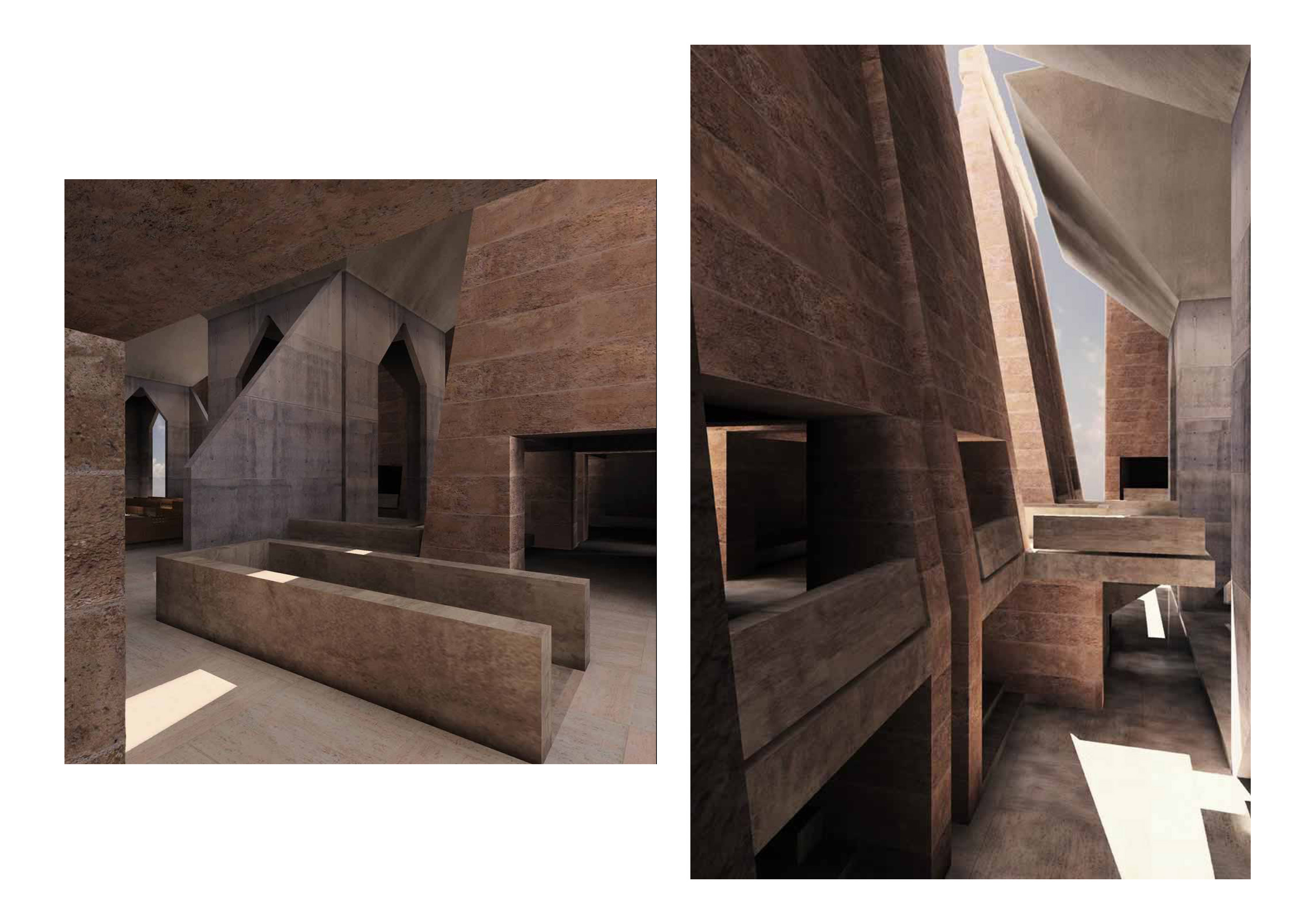
Between 1968 and 1973, Kahn presented three plans for the reconstruction. Each left the ruins of the Hurva in place as a memorial garden, with a new structure on an adjacent lot and a promenade, the “Route of the Prophets”, leading to the Western Wall. Kahn proposed a structure within a structure, the outer one composed of 16 piers covered in Jerusalem stone cut in blocks of the same proportions as the Herodian stones of the Western Wall. In the bases of the four corners of the two-story, 12 meter high structure would be small alcoves for meditation or individual prayer. The inner chamber, made of four inverted concrete pyramids supporting the building’s roof, would be used for larger communal prayer services.

Model of Kahn's Hurva synagogue, from Kent Larson

Model of Kahn’s Hurva synagogue, from Kent Larson

Unfortunately, Kahn died of a heart attack in the men’s washroom at Penn train station in New York City in 1974, a few weeks before he was to return to Jerusalem for consultations on what many regard as his greatest unrealized plan, the reconstruction of the Hurva synagogue. With Kahn’s passing his plans, through a combination of bureaucratic inaction and aesthetic timidity, died with him. Instead, in 2000 it was decided to rebuild the Hurva in its original 19th century Ottoman style.

But Kahn’s plans haven’t been totally forgotten. In the mid-1990s, MIT architecture professor Kent Larson used Kahn’s plans and new modeling software to create dramatic color images of what the Hurva might have looked like, both from inside and out, complete with lighting and shadow. If such tools had existed when Kahn was living, it would have been clearer what a masterpiece we were being offered.

Model of Kahn's Hurva synagogue, from Kent Larson

Model of Kahn’s Hurva synagogue, from Kent Larson

Like the redevelopment of the World Trade Center site it raises broader questions about how to rebuild on a site defined in large part by a history of destruction. For most of its history the site housed a ruin and encapsulates not only the long conflict between Arabs and Jews in the Holy Land but also how we, Jews living in Israel, commemorate our past and envision our future.


Contact me about a guided tour like Kahn’s starting with a visit to St George and Mar Saba monasteries in the Judean desert and then an overview of the Old City and the story of the fall of the Jewish quarter, its destruction in 1948 and rebirth after the Six Day War.

Ohel Yitzchak Synagogue

In 1867 a courtyard between Cotton Merchants’ Gate (Bab al-Qattanin) and the Gate of the Chain (Bab al-Silsileh) and less than 80 meters from the Western Wall was purchased from the Muslim Khaladi family* by the Hungarian Jewish community. They founded a kollel, called Shomrei Ha’Chomot (Guardians of the Walls) and a yeshiva known as Or Ha’Meir and studied Torah around the clock in 3 shifts. After a visit by Rabbi Yitzhak Ratsdorfer, a Belz Hassid and diamond merchant in 1891, they built two synagogues, Beit Yitzchak and Ohel Yitzchak, financed by and named for him.

The magnificent synagogue was completed in 1904 and was on a par with the more famous Tiferet Israel and Hurva synagogues in the Jewish quarter. In 1938 because of the Arab riots the site had to be abandoned and the community relocated to Mea She’arim. During the 19 years of Jordanian Legion, the synagogue was looted and vandalized until it was a ruin, the story of more than 50 Jewish religious institutions in the Old City.

The site lay deserted until about 15 years ago, when Moskowitz bought it and financed the synagogue’s reconstruction and a comprehensive archaeological dig. In cooperation with the Israel Antiquities Authority who did the research to find old photographs and drawings of the site (I saw similar detailed documentation prepared by the IAA for the renovation of a building in Akko that will become the new Effendi Hotel) they reconstructed the building over a 10 year period using remnants of the destroyed building found at the site whenever possible. In the excavation begun in 2004 they found three steps dating back to the Second Temple period going east towards the Western Wall suggesting a monumental staircase leading to Warren’s Gate, the closest entrance to the Holy of Holies (I’ve heard that the synagogue and staircase have been connected to the Western Wall tunnels). Every historical period was represented but a major discovery was a giant public bathhouse from the Mameluke period (14th C), which lies below the entire site. According to IAA archaeologist Yuval Baruch, this is the most complete relic of the Mameluke period ever discovered in Jerusalem.


* Not far from the synagogue, along Bab al-Silsileh street in a 13th C Mameluke building is the Khalidi Library, the largest and finest private Palestinian library, and one of the largest private collections of Islamic manuscripts in the Arab world. Some of these are handwritten, one of a kind manuscripts and even autograph works written by hand by the original author (umm in Arabic). One such umm dated 1201 is a very richly decorated makrumah, or presentation copy, gilded with floral and geometric motives, a personal horoscope and family tree prepared for Salah al-Din Yusuf ibn Ayyub sultan of Egypt and Syria who defeated the Crusaders.

The library reading room is housed in the turbah, or burial place, of Amir Husam al-Din Barkah Khan and his two sons. Barkah Khan, who died in 1246, was a military chieftain of Khwarizmian origin who fought in Syria and Palestine in the 1230’s and 1240’s. His daughter was married to the formidable Mameluke sultan Baybars (1260-1277), who relentlessly fought the Crusaders. The two pairs of lions at Lion’s Gate are the symbol of Baybars.

Phoenician Glass-blowing to Chihuly

Glassblowing is a glass forming technique which was invented by the Phoenicians in about 50BCE along the Syro-Palestinian coast. The earliest evidence of glassblowing comes from waste from a glass workshop, including fragments of glass tubes, glass rods and tiny blown bottles, that was dumped in a mikveh (ritual bath) in the Jewish Quarter dated to the time of King Herod, from 37 to 4BCE.

During excavations in the Jewish Quarter by Avigad and Geva in the 1970s they discovered in the eastern wall of the Fresco room (F3) in the Palatial Mansion a niche in which was standing a glass jug by the 1st C artist Ennion of Sidon with his name in Greek on the vessel. This rare piece can be seen as part of the glass collection in the Israel museum’s archaeology wing. The buildings, with mosaic floors and frescoes, have been preserved in the Wohl museum and are worth a visit.

If you are interested in glass-making it is also worth checking out the Glass Pavilion at the Eretz Israel museum in Tel Aviv which exhibits ancient glass vessels, representing 3 chapters in the history of glass production:

  1. Pre-blown glass
  2. Blown glass from Roman/Byzantine period (they also have one of Ennion’s works, Blue Jug)
  3. Blown glass of Islamic period

Currently (January 2011) there is a gold-glass panel (table top) with mosaic-glass tiles found in the Byzantine “Birds Mosaic” mansion in Caesarea on display in Israel for the first time. Both museums collect and exhibit contemporary glass art.

Some of the earliest pieces of blown glass have been discovered in Israel and the tradition of glass blowing developed in this area but since then there has been little activity in glass art. Only in the the mid 1970s with Marvin Lipofsky’s visit to Israel was there an opportuity to try glass making. Lipovsky built the first glass furnace for the Ceramics department at the Bezalel Academy of Art in Jerusalem, the first courses were taught in the late 70s but a formal department with a full curriculum was established only in 1997. The glass furnace built by Lipofsky over 35 years ago is the same furnace in use today and to date Bezalel remains the only university where students can study glass making in Israel.

In 1962 Dale Chihuly, a 21 year old American, came to Israel and volunteered on Kibbutz Lehav north west of Beersheva in the Negev.

I discovered there was more to life than having a good time,” he has said of his kibbutz service. “It’s difficult to explain how this change came about, but it had a lot to do with going out on border patrol during the night with guys my own age who had more responsibility and maturity than adults twice their age in the States.

Chihuly credits this Israel experience as the turning point in his life. He recalls that he began to think of how he could make a contribution to society. He became dedicated to the hard work and long hours necessary to realize his goals. Conceivably, the collective nature of kibbutz life also inspired him to work with a close-knit group of artisans for a common purpose, the creation of art.

Chihuly’s choice of a millennium project was his famous installation at the Tower of David Museum inside Jaffa Gate in 2000, a project that proved to be “history-making in its ambition, its difficulty and its enormous popular success”. The Light of Jerusalem 2000 installation was composed of 10,000 pieces of individually hand-blown glass weighing a total of 42 tons, the various elements of the work were shipped to Israel in 12 40-foot containers from five different countries. I was one of more than a million people who saw his work.

The installation was the fruit of Chihuly’s relationship to Israel and to the history of blown glass. Chihuly was aware that two thousand years ago, some of the oldest glass in the world had been made in Jerusalem and that just before the birth of Jesus, glassblowing was invented. Israeli artists say that Chihuly’s exhibit was an eye-opening experience and defining moment for them so like Israel affected Chihuly, he affected Israel.

Chihuly at Tower of DavidIf you’re interested in glass art check out the Litvak Gallery in Tel Aviv near the Gallery of Art for their current exhibition. They have works by Chihuly as well as other contemporary glass artists. There was a special Chihuly exhibit in January 2011.

Earthquakes in History and Archaeology

Israel and Jordan lie along the African Rift, that runs from the heart of Africa through the Red Sea, Dead Sea and Jordan River valley, the deepest known break in the earth’s crust. The rift was formed by adjacent continental plates. As the plates move, stress accumulates gradually which is relieved periodically through sudden jolts, experienced as an earthquake. There are many events in the Bible that can be explained by major earthquakes. The destruction of Sodom and Gomorrah on the eastern shore of the Dead Sea in the time of Abraham about 1900BCE is vividly described (Genesis 19). Archaeological research suggests that a great earthquake opened the earth’s crust releasing “brimstone” (sulfur) and volatile petroleum gases which caused a horrific firestorm. The fall of Jericho in 1400BCE was probably associated with a double earthquake. As Joshua and the children of Israel crossed the Jordan River to enter the land, an earthquake-produced landslide at the town of Adam (15 miles to the north) dammed the Jordan.  Historically known quakes have dammed the Jordan River repeatedly, sometimes for several days, in 1160CE, 1267, 1534, 1834, 1906 and 1927. Then God arranged a second tremor, or aftershock, to topple Jericho’s walls (Josh. 6). A major earthquake is reported “in the days of Uzziah king of Judah, and in the days of Jeroboam son of Joash king of Israel” (Amos 1:1), sometime between 760BCE to 749BCE. Geologists believe they have found evidence of this major earthquake in sites throughout Israel and Jordan:

“Masonry walls best display the earthquake, especially walls with broken ashlars, walls with displaced rows of stones, walls still standing but leaning or bowed, and walls collapsed with large sections still lying course-on-course. Debris at six sites (Hazor, Deir ‘Alla, Gezer, Lachish, Tell Judeideh, and ‘En Haseva) is tightly confined stratigraphically to the middle of the eighth century BCE, with dating errors of ~30 years.…The earthquake was at least magnitude 7.8, but likely was 8.2…This severe geologic disaster has been linked historically to a speech delivered at the city of Bethel by a shepherd-farmer named Amos of Tekoa.”

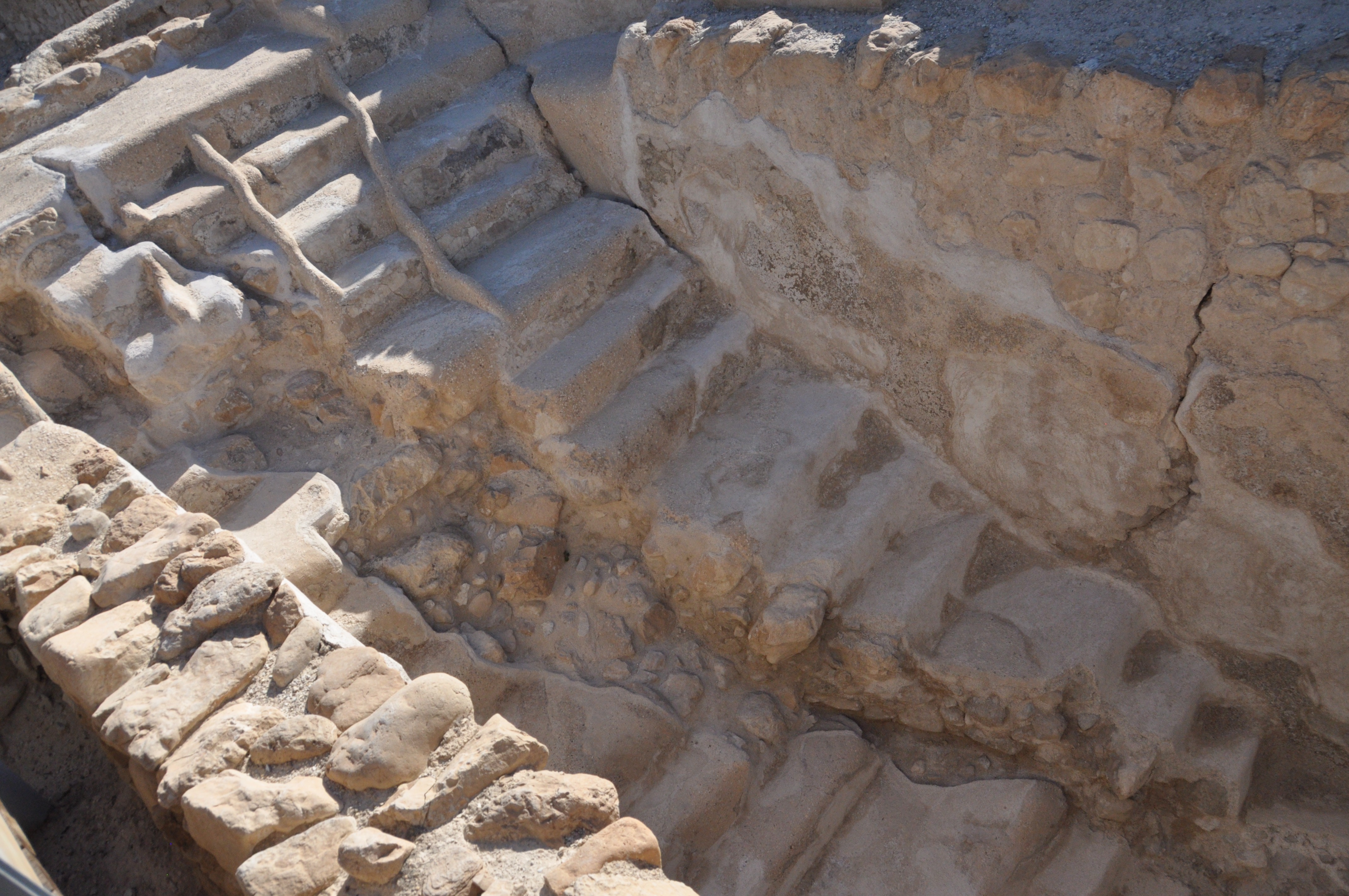
QumranQumran, where the Dead Sea scrolls were found, bears unmistakable evidence of major earthquake destruction in 31BC during the reign of Herod the Great where 10,000 people lost their lives (Josephus). Photo shows staircase to mikve (ritual bath) damaged by seismic activity.

When Jesus died on the cross, the end of his life was punctuated by a severe earthquake, following a strange three-hour darkness covering the land (Matt. 27:50-54) and a second great earthquake occurred on Easter morning at the time of the resurrection (Matt. 28:2). Researchers know that there was an earthquake on April 11, 33CE making it a possible date for the crucifixion. The prevalence of earthquakes during the Second Temple period caused the High Priest when he went into the Holy of Holies on Yom Kippur to include in his prayer a special intention (kavana) that the people who lived on the Sharon plain (a populated area to this day) should be spared the fate of “having their houses become their graves” (Yoma 5b).

A powerful earthquake (7.0 on Richter scale) in 363CE, which caused widespread havoc throughout ancient Israel, destroyed Antipatris (Tel Afek) and Tzippori.

Bet Shean, one of the major Roman cities known from Hellenistic times as Scythopolis, suffered major damage in 363CE and was devastated in the Golan earthquake (6.6 on Richter scale) on January 18, 749CE and never recovered. Photo from the archaeological site at Bet Shean shows toppled columns in a row along the Decumanus, think of a tablecloth jerked under wine bottles. Also on the northeastern side of the Sea of Galilee the other Decapolis city of Sussita and the nearby monastery at Kursi were destroyed and abandoned.

Jerusalem suffered a severe earthquake (6.7 on Richter scale) January 15, 1546: the dome on the Church of the Holy Sepulcher was completely destroyed as were many other buildings. The Dome of the Rock was seriously damaged; the Al-Aqsa Mosque was damaged or destroyed in 749CE, 1033CE, 1546CE and in the 1927 earthquake. The three most destructive earthquakes in Israel since the 18th century happened in 1759, 1837 and 1927. Check out my article about the Nimrod fortress to see a photo of the result of earthquake activity. On January 1, 1837 at 2pm an earthquake “obliterated” Safed, Tiberias and damaged neighboring Arab villages causing more than 5,000 fatalities. Another major quake (6.4 on Richter) occurred on July 11, 1927 at about 16:00 local time. The epicenter of the earthquake was on the western shore of the Dead Sea (31.6, 35.4) just north of Metsoke Dragot. Besides Jerusalem, the cities of Ramle, Tiberias and Nablus were heavily damaged and at least 500 people died. In Jericho, a number of houses collapsed, including several relatively new hotels. In addition, the Allenby Bridge collapsed and the Jordan river was blocked for about 21 hours following the collapse of the marl cliffs on its banks.

Earthquake in Jericho, 1927.  Photo: Matson collection.
Jericho, 1927 earthquake, by American Colony photographer

The last major earthquake to hit Israel was 1927 and on average, there is an earthquake approximately every 80 years. That and the large amount of unrelieved stress (~10 meters) along the African Rift today tells scientists that we are overdue for a major earthquake.