Category Archives: Art

Chagall Windows

Using the medium of stained glass enables the painter to create intense and fresh colors. “When Matisse dies”, Pablo Picasso remarked in the 1950s, “Chagall will be the only painter left who understands what colour really is.” It was not until 1956, when Chagall was nearly 70 years of age, that he began to design stained-glass windows, first for the church at Assy and then for the Metz Cathedral. One of Chagall’s major contributions to art has been his work with stained glass.

Chagall collaborated with Charles Marq of Atelier Simon in Rheims, France; together they worked on the project, during which time Marq developed a special process for applying color to the glass. This allowed Chagall to use as many as three colors on a single pane, rather than being confined to the traditional technique of separating each colored pane by a lead strip.

French art historian Leymarie writes that in order to illuminate the synagogue at Hebrew University’s Hadassah Medical Center in Jerusalem both spiritually and physically Chagall decided that the twelve windows, representing the twelve tribes of Israel as blessed by Jacob and Moses in the verses which conclude Genesis and Deuteronomy, were to be filled with stained glass. This is very traditional, the Hurva synagogue had 12 windows with stained glass for the twelve tribes around the dome and the ceiling of the Chabad synagogue was decorated with illustrations of the twelve tribes. Chagall envisaged the windows as “jewels of translucent fire”. Each of the twelve windows is approximately 3.35×2.4 meters, much larger than anything he had done before. They are probably Chagall’s greatest work in the field of stained glass.

Leymarie goes on to describe the spiritual and physical significance of the windows:

The essence of the Jerusalem Windows lies in color, in Chagall’s magical ability to animate material and transform it into light. Words do not have the power to describe Chagall’s color, its spirituality, its singing quality, its dazzling luminosity…

At the dedication ceremony in 1962, Chagall described his personal feelings about the windows:

For me a stained glass window is a transparent partition between my heart and the heart of the world. Stained glass has to be serious and passionate. It is something elevating and exhilarating. It has to live through the perception of light. To read the Bible is to perceive a certain light, and the window has to make this obvious through its simplicity and grace… The thoughts have nested in me for many years, since the time when my feet walked on the Holy Land…

You probably notice that there are no photographs of the Chagall Windows accompanying this post. I contacted Hadassah for permission to photograph and was told that I would have to contact an agency in Paris, Société des Auteurs dans les Arts Graphiques et Plastiques, that handles such requests. The ADAGP wants me to pay €7 per image per month, which comes to €84 per year royalties to display one of my photographs on my website. In a quick search for “Chagall Windows” on Google I found 42,700 images that are already online (either ADAGP is bringing in more than €3.5 million per year or these images are not authorized, I’ll let you guess). I suggest that you check some of these images to get some appreciation for Chagall’s stained glass work.

What do Hadassah Ein Karem and Hebrew University Givat Ram have in common? In 1948 the Hadassah medical center and campus of Hebrew University on Mount Scopus built in 1925 were cut off from Israeli held western Jerusalem. For 19 years, a convoy travelled up to Scopus every 2 weeks under Red Cross auspices to exchange people and bring supplies. Consequently, these two institutions are a second hospital and university campus.
Mary Magdalene

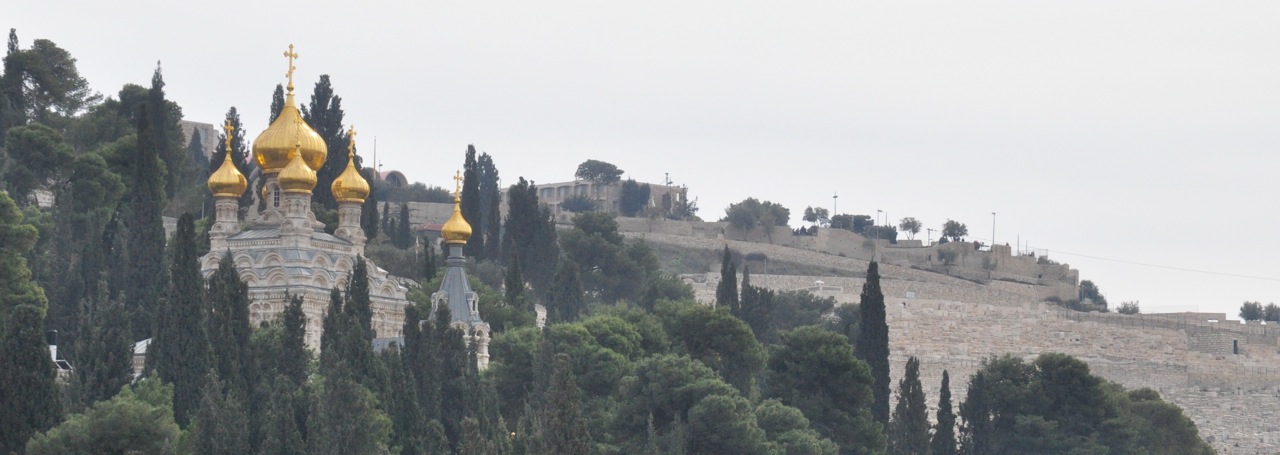
You can’t miss the church on the slope of the Mount of Olives, its seven gilded, onion-shaped domes sparkling in the sunlight. This is the Church of Mary Magdalene built by Czar Alexander III of Russia in 1886. Dedicated to Alexander’s mother Maria Alexandrovna, it was called the Church of Mary Magdalene after her name-saint from the town of Magdala on the western shore of the Sea of Galilee.

Mary Magdalene is mentioned as one of the women who “ministered to him [Christ] of their substance”. The New Testament also tells the story of an exorcism on Mary that cast out seven demons (Luke 8:3). One of the best-known women in the New Testament, Mary accompanied Jesus on his last journey to Jerusalem, was present at the crucifixion and was the first person to see Jesus after the resurrection (Mark 16:9). Though she was very close to Jesus, she was never recognized by Christianity as one of the Apostles.

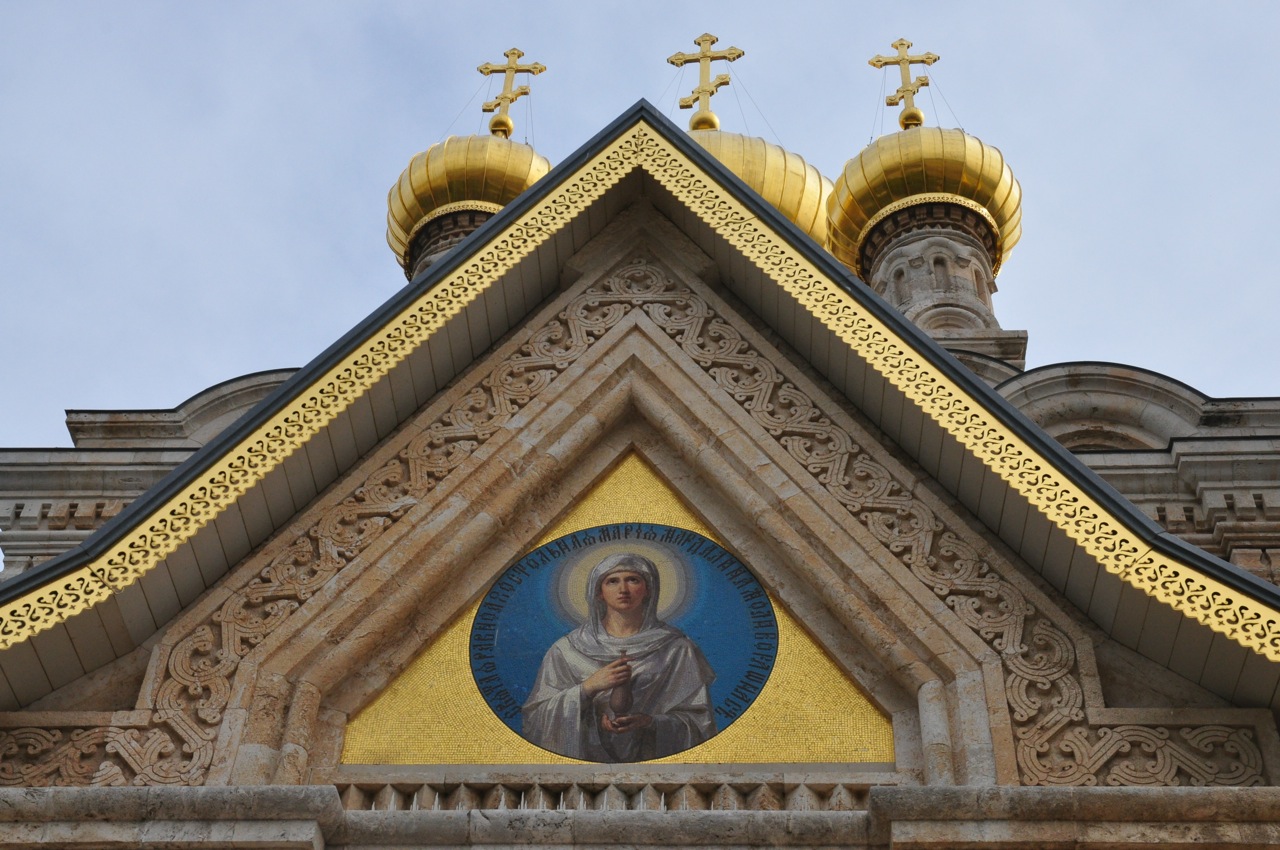
Above the main entrance to the church, located on the second level, is a gabled roof trimmed with a lace pattern in gold. A circular blue mosaic depicting Mary Magdalene piously robed in white is superimposed on a gold triangle in the gable,which is bordered with an intricately carved stone pattern. On the left side of the building is a bell tower ringed with squat squarish pillars topped by a large grey cone with several dormer like windows, a gold onion dome perched on top.

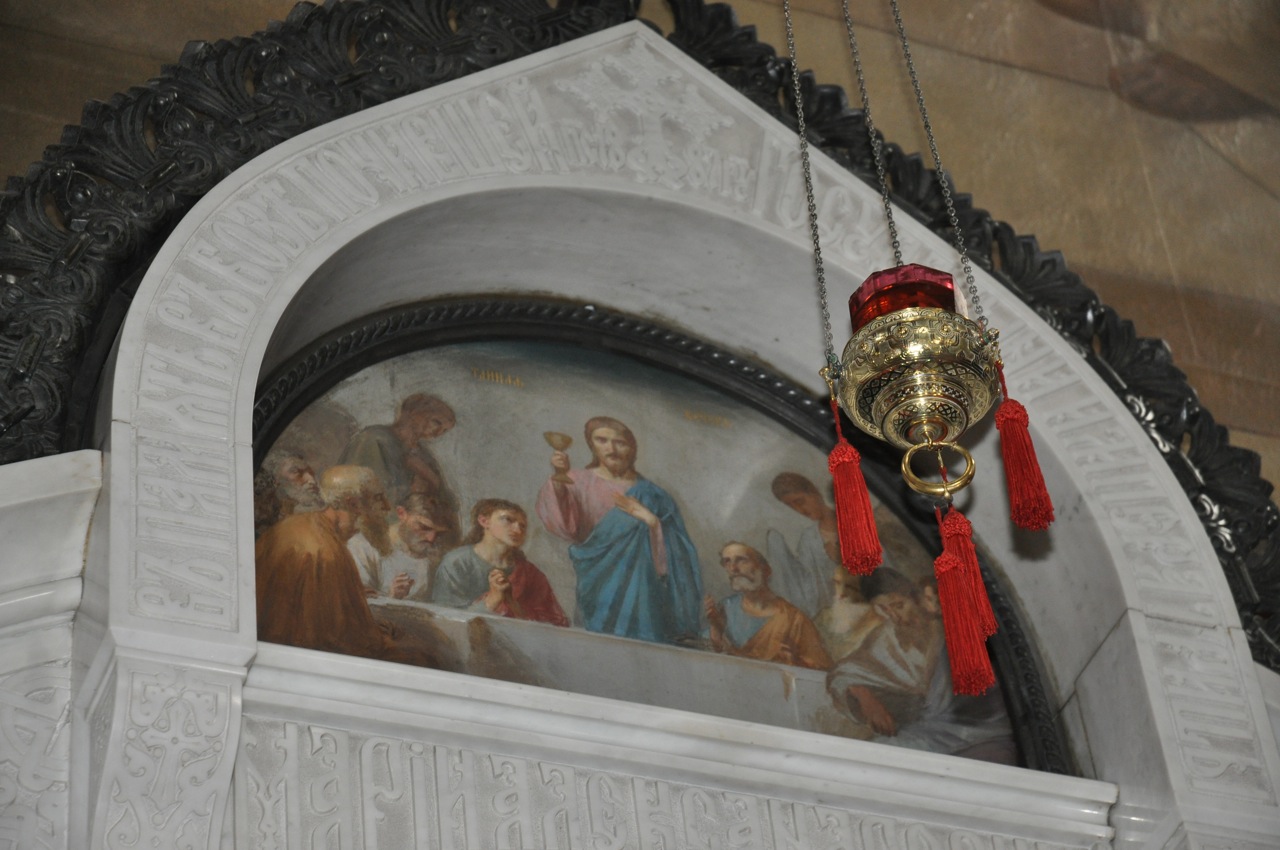
Inside the church decorated in shades of burnt orange in various patterns hangs a large metal chandelier which has small oil lamps for light. The iconostasis, a wall separating the nave from the sanctuary and altar in an Eastern church, consists of a series of arches of beautifully carved white marble, with paintings by Vereshoguine, one of Mary Magdalene. In the middle in an arch above the Holy Doors is the traditional scene of the Last Supper (click on the image to see it larger).

Six tiny paintings on the doors depict the four evangelists, the Virgin Mary, and the angel Gabriel. Over the arches of the iconostasis and high up on the other three walls are scenes with Mary Magdalene painted by Ivanov.

One of Russia’s most extraordinary saints lies in state within the church. She was Russian Grand Duchess Elizabeth Fyodorovna put to death by the Boshevists in 1917, wife of the Czar’s brother Sergei (assasinated in 1905) and sister to the Czar’s wife Alexandra. She was the creative force behind the church and supervised the artwork.

Visiting the church takes planning due to the limited hours it is open (Saturday, Tuesday and Thursday from 10am to noon) so until then check out this virtual tour at http://www.3disrael.com/jerusalem/church_magdalene2.cfm

If you are on the trail of Mary Magdalene search out the church of Saint Etienne, outside of the Old City walls just north of Damascus gate. Named for Saint Stephen, the first Christian martyr, this is a Catholic church of the Dominican order. You can’t help but notice the painting of Mary Magdalene on your right as you enter the church.

For another Russian Orthodox church with gold onions visit the Gorney monastery compound in the village of Ein Kerem southwest of the city where Mary came to visit her sister Elizabeth and where John the Baptist was born (Luke 1:39).

Mosaics at Hirbet Midras

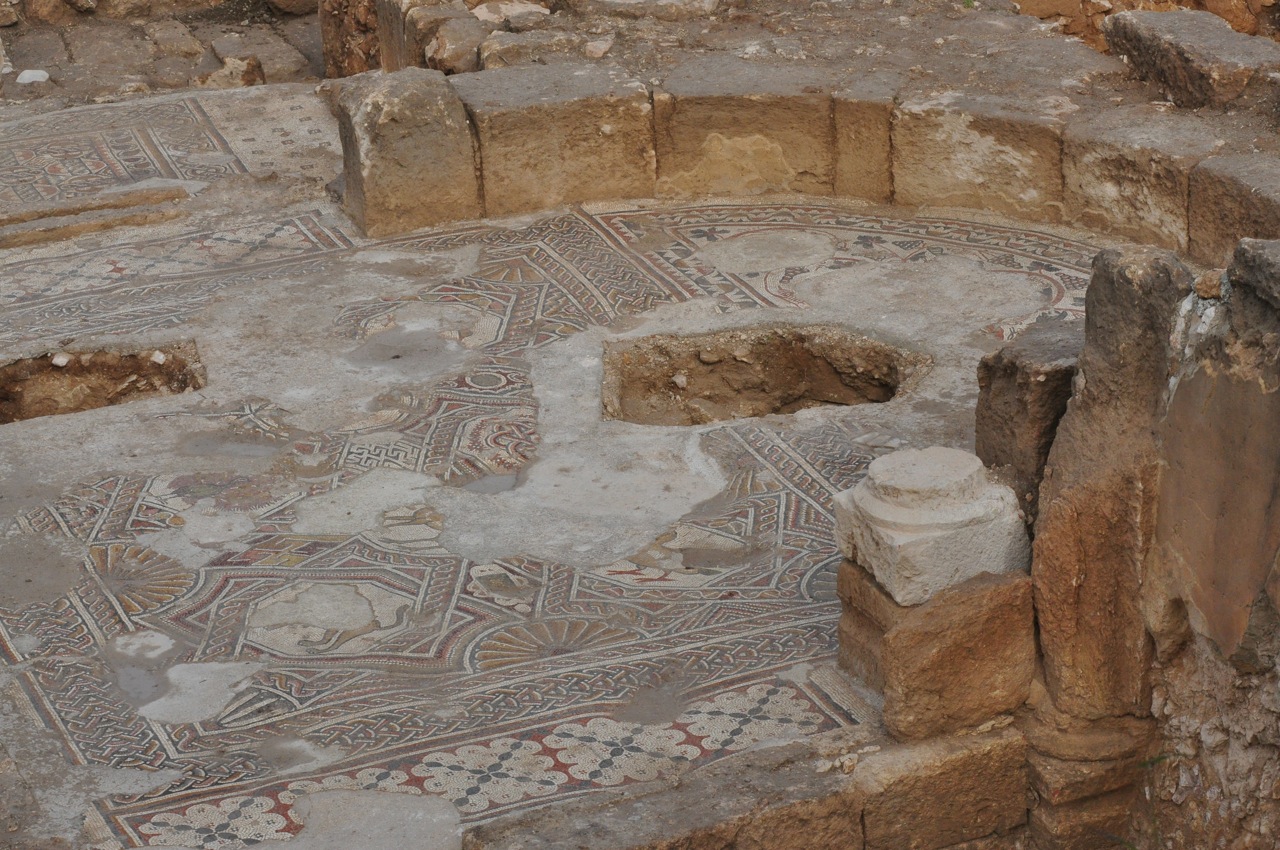
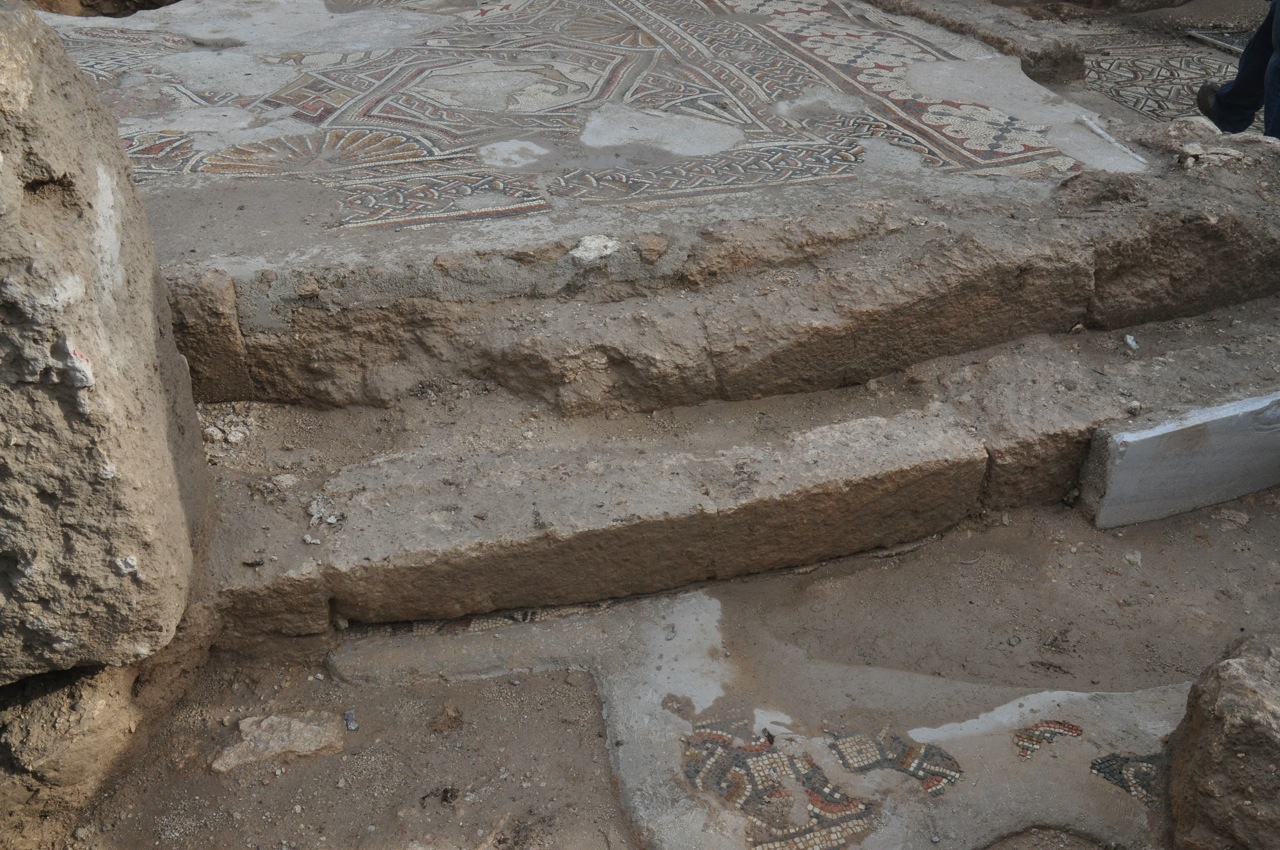
All of the floors recently uncovered in the church at Hirbet Midras have incredible mosaics, that are extraordinarily well preserved. The mosaics include both intricate geometric designs and floral, fauna, fish, birds and fruit. The tesserae are fine, 7mm cubes in an assortment of colors enabling the artists to create realistic images. You can click on any of the images to see it in higher resolution.

The apse of the church with a geometric rectangular carpet; the curved part has an image of a rooster and duck in a design of grapevine tendrils and bunches of grapes.

Display of mosaics in the aisle, geometric patterns on either side of a panel with chukar birds.

Close up of the chukar bird panel.

Panel that combines birds, fish and lotus.

Image of a lion attacking what looks like an ibex among grapevines. Interesting to compare it with the image of the lion attacking the deer under the tree from Hisham’s Palace (Khirbet El-Mafjar, 7th century) near Jericho.

Byzantine Church, Hirbet Midras

Amir Ganor is not your usual archaeologist. Although he works for the Israel Antiquities Authority he packs a handgun because his primary responsibility is apprehending thieves who plunder sites for valuable artifacts to sell on the antiquities market. In this case a group of Palestinians were breaking into the complex of tunnels and caves in the Judean Coastal Plain or shefela in the area of Beit Guvrin, specifically Hirbet Midras, looking for coins and other treasure. This led Ganor to the site where a large stone lintel was uncovered.

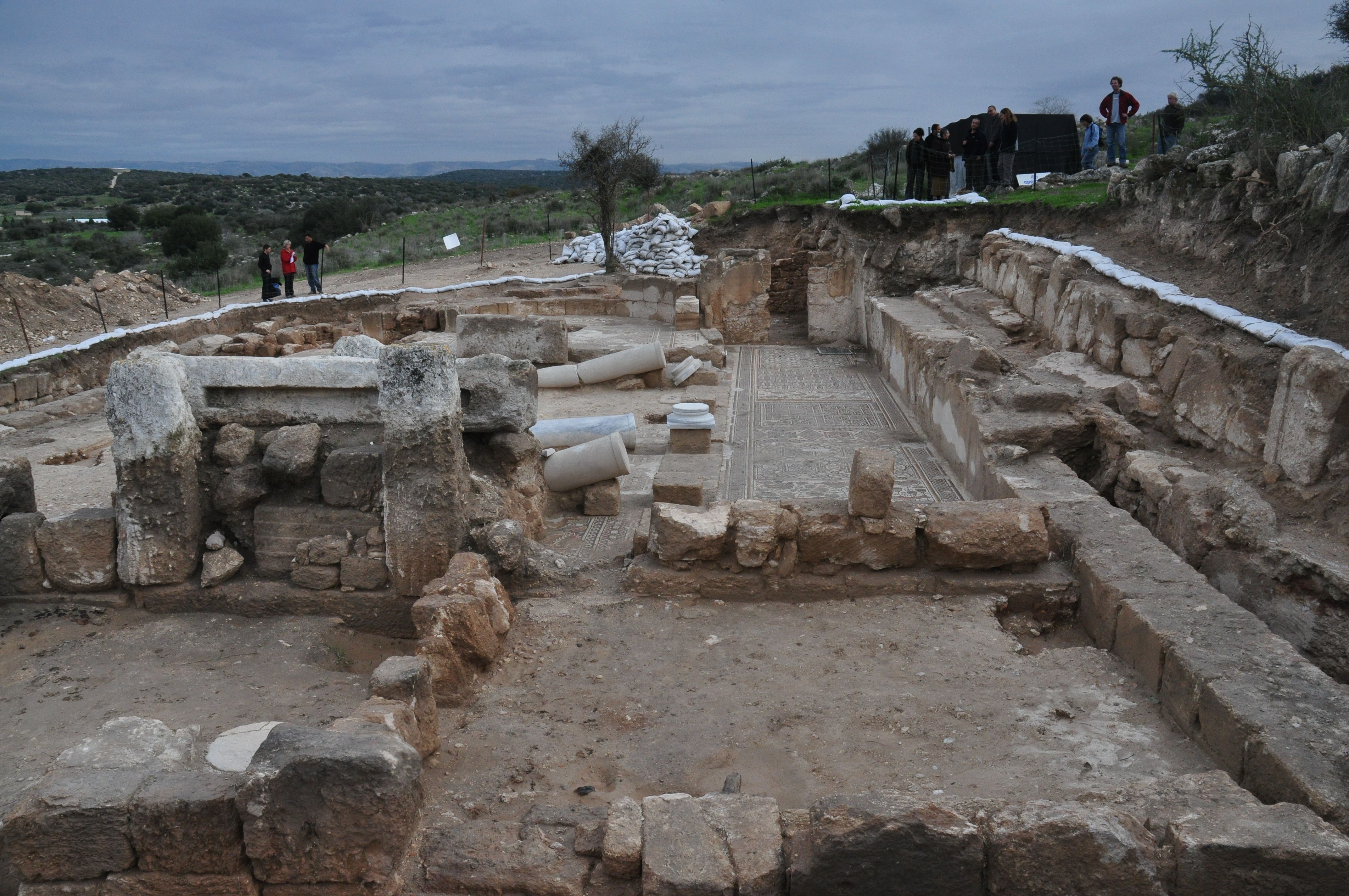
The same lintel was first uncovered in the 1980s and based on the expert opinion of Prof. Amos Kloner was thought to be from a synagogue since it was almost identical to one found in the north at Hirbet Nevoraya. Ganor requested approval and support from the Antiquities Authority to excavate the area to discover more about the public building. Within a short time very impressive and beautiful floor mosaics were uncovered. Large dressed stones with what look like Byzantine crosses were discovered when the plaster covering them fell off. Combined with the architectural details, an apse, a crypt, mosaic floors, it seems that the building was a church. The church was destroyed by an earthquake some 1,300 years ago and lay mostly covered until the 19th century. The columns and capitals are displayed exactly as they were found, lying parallel on the ground and the northern wall is angled out from the movement of the earthquake.

There are several construction phases, in the last two the building was used as a splendid church. However, in the first phase the excavation shows that the later church was built inside a large public compound from the Second Temple period. The church, in its last phases, was built as a basilica, a central nave and two wide aisles that are delineated by eight marble columns with magnificent capitals which were specially imported (the eight bases can be seen but only 3 capitals and columns remain). The front of the church had a large flagstone courtyard, a narthex, and at the end of the nave is a raised bema or platform (that was added later – you can see that the mosaic floor continues under the bema).

All of the floors in the building were adorned with incredible mosaics, that are extraordinarily well preserved; these include both geometric designs and floral, fauna, fish, birds and fruit. Today I went out to the site to photograph the mosaics (before they are covered to protect them until the site can be readied for visitors). You can view them at https://israeltours.wordpress.com/2011/02/04/mosaics-hirbet-midras/

Located behind the bema are two rooms, one paved with a marble floor and the other that led to an underground tomb that was empty.

Beneath the entire building is a subterranean complex in which there are rooms, water installations, traps and store rooms for hiding. Among the artifacts discovered are coins from the time of the Great Revolt (66-70 CE) and the Bar Kokhba uprising (132-135 CE), stone vessels, lamps and various pottery vessels that are characteristic of the Jewish population from the settlement at that time.

Scholars who visited the site during the excavation proposed identifying the crypt as the tomb of the prophet Zechariah. Early Christian sources identified his burial place in the village of Zechariah which was discovered in 415CE. In light of these sources, including the Madaba Map (the building with the apse with the Greek, ΒΕθΖΑΧΑΡ to its left is Bet Zechariah), scholars think the church at Hirbet Midras is a memorial church meant to mark the tomb of the prophet Zechariah.

Jerusalem Armenian Ceramics

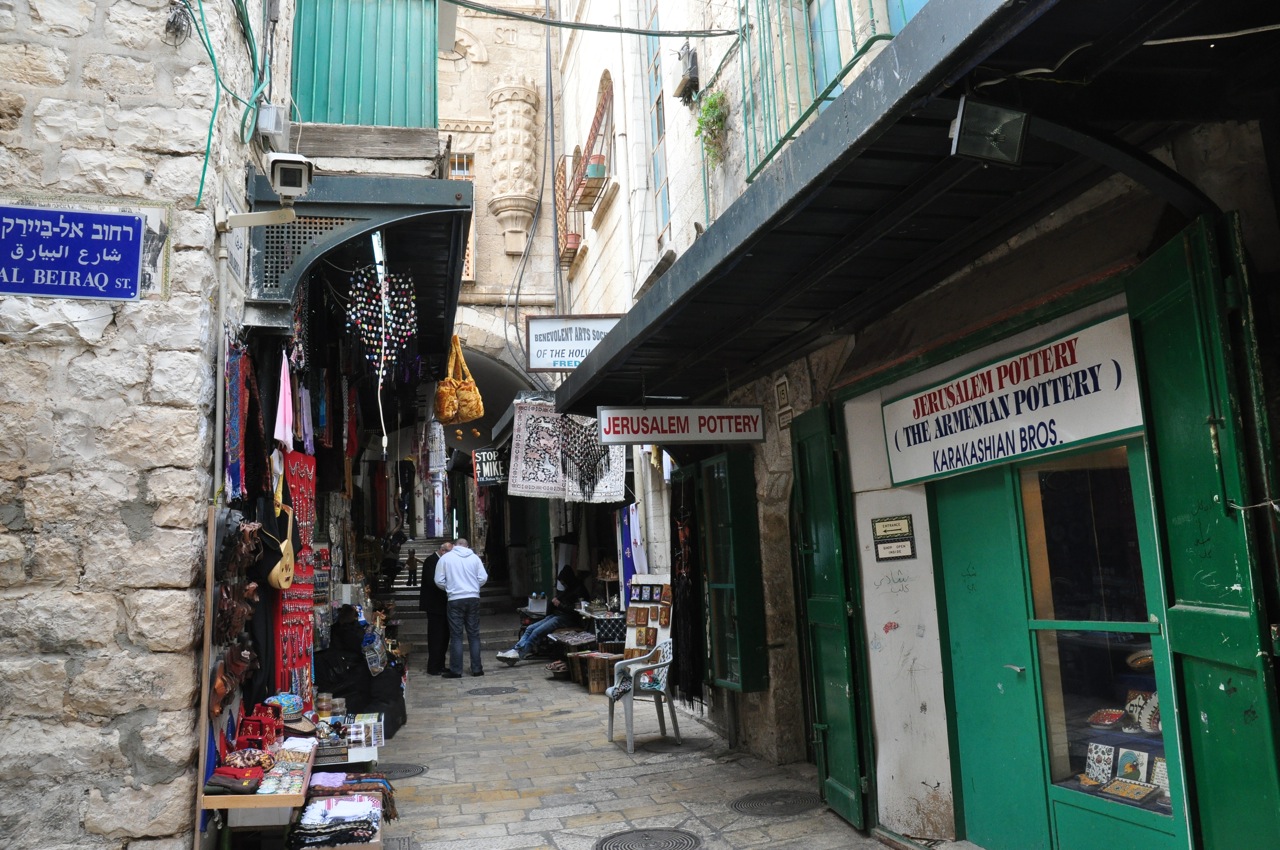
Walking the streets of the Old City your first introduction to Armenian ceramics may be the tiles designed by Mr. Karakashian that display the names of streets in Hebrew, Arabic and English. Please note that much of the painted pottery that you see in the souvenir shops in the Arab market is done in Palestinian workshops in Hebron.

The Armenian community in Jerusalem goes back to the 5th century and in the Old City they live primarily in one of the 4 quarters, a walled neighborhood within the walls to the right from Jaffa gate called the Armenian quarter. Their religious center is the Cathedral of St. James that goes back to the 12th century. The Crusader King Baldwin II married the Armenian princess Morphia who bore him 4 daughters, the eldest, Melisende was married to Fulk, Count of Anjou who was King of Jerusalem and ruled in her own right from 1129-1161. She is buried in the Tomb of Mary in the Kidron valley. From at least the 17th century numerous ceramic tiles by Armenian artists from Kutahya and Iznik were sent as gifts to the Cathedral and  the Church of the Holy Sepulcher.

After the British defeated the Turks, Ronald Storrs was the military governor of Jerusalem and one of the projects was to repair the 16th century ceramic tiles of the Dome of the Rock. David Ohannessian who had fled from the city of Kutahya, Turkey to Jerusalem and was known to Mark Sykes was recommended to Storrs. Ohannessian set up a workshop first on the Haram el Sharif and then later on the Via Dolorosa. Although the project fell through due to lack of funds he started producing ceramic wares and tiles to sell. An Armenian told me that the Muslims didn’t allow the Armenians who are Christian to work on the building.

Many recognize David Ohannessian as the founder of local Armenian ceramics based on the Iznik tradition and a bridge between the ceramic artistry of Turkey and what was to be developed later in Jerusalem. Ohannessian created tiles for buildings in Jerusalem until 1948 when he left for Beirut. You can see examples of these tiles at the Rockefeller museum and in my neighborhood, on the facade of originally Christian-Arab buildings, at 25 Emeq Refaim (I lead a tour of the German Colony that includes the Armenian story in the fascinating history of the German Templars) and next door to my house, at 24 Hazefira. Be on the lookout for other examples as you explore the city, buildings on Jaffa Road, in Talbiye, American Colony Hotel, St. John’s hospital (today the Mount Zion Hotel), Scottish Church of St. Andrew.

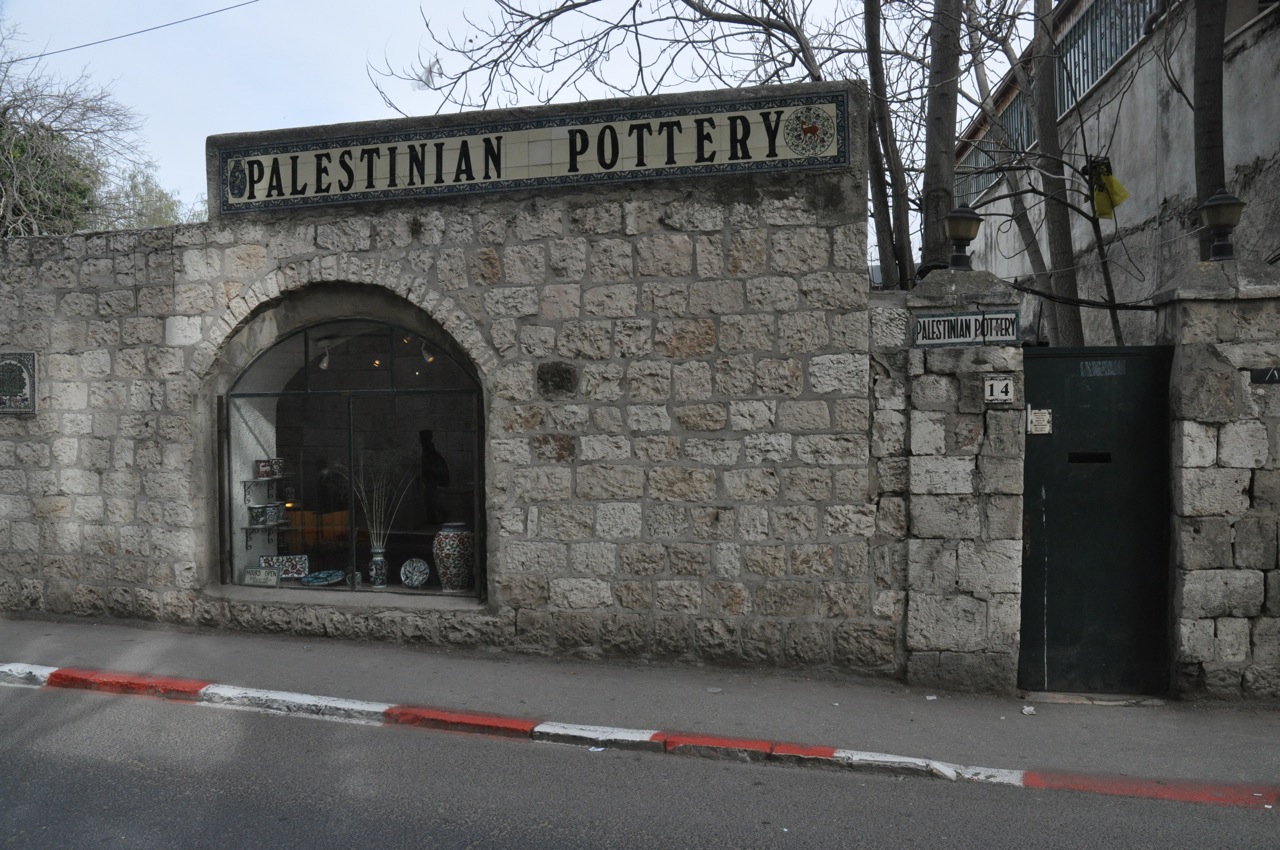
In 1922 Balian and Karakashian opened their own workshop at 14 Nablus Road where the families worked and lived for more than 40 years. Ballian was the master potter and Karakashian the painter artist and they passed on their skills and traditional craft to the next generation. It was here that the transformative process took traditional Kutahyan Armenian ceramics and created a uniquely Jerusalem pottery, the introduction of an art form that had not previously existed  in the city. It is a major contribution to decorative art, creating an artistic language that combines Eastern and local elements.

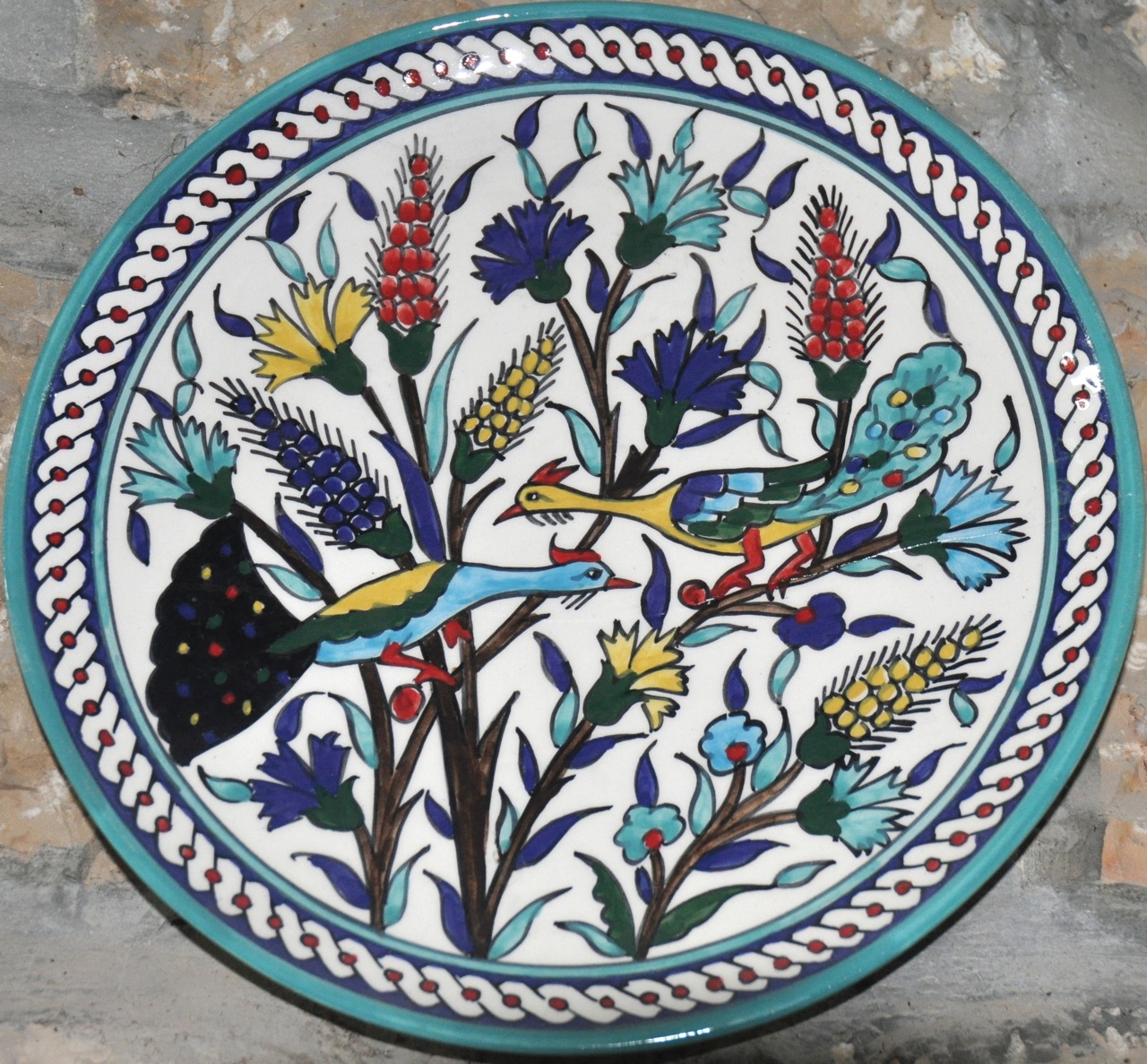
Their repertoire of forms was grounded in the traditional designs of Iznik (carnations, tulips, almond blossoms and saz leaves) and Kutahya (white or blue background with discretely outlines images) and included themes from the Bible. Two mosaic pavements in particular seems to have inspired them: the 6th century Bird Mosaic in the Armenian chapel and an Umayyad mosaic from the 8th century at Khirbat al-Mafjar (Hisham Palace) near Jericho. As they worked the two artists created new forms of their own inspired by local sources. Their first major project was a series of tile panels for the walls of the courtyard where the Patriarchs are buried in the Armenian Cemetery on Mount Zion. Their last work together done in 1963 were three rectangular tile pictures in the center of which are arched niches enclosed behind latticework doors for the facade of the Cathedral.

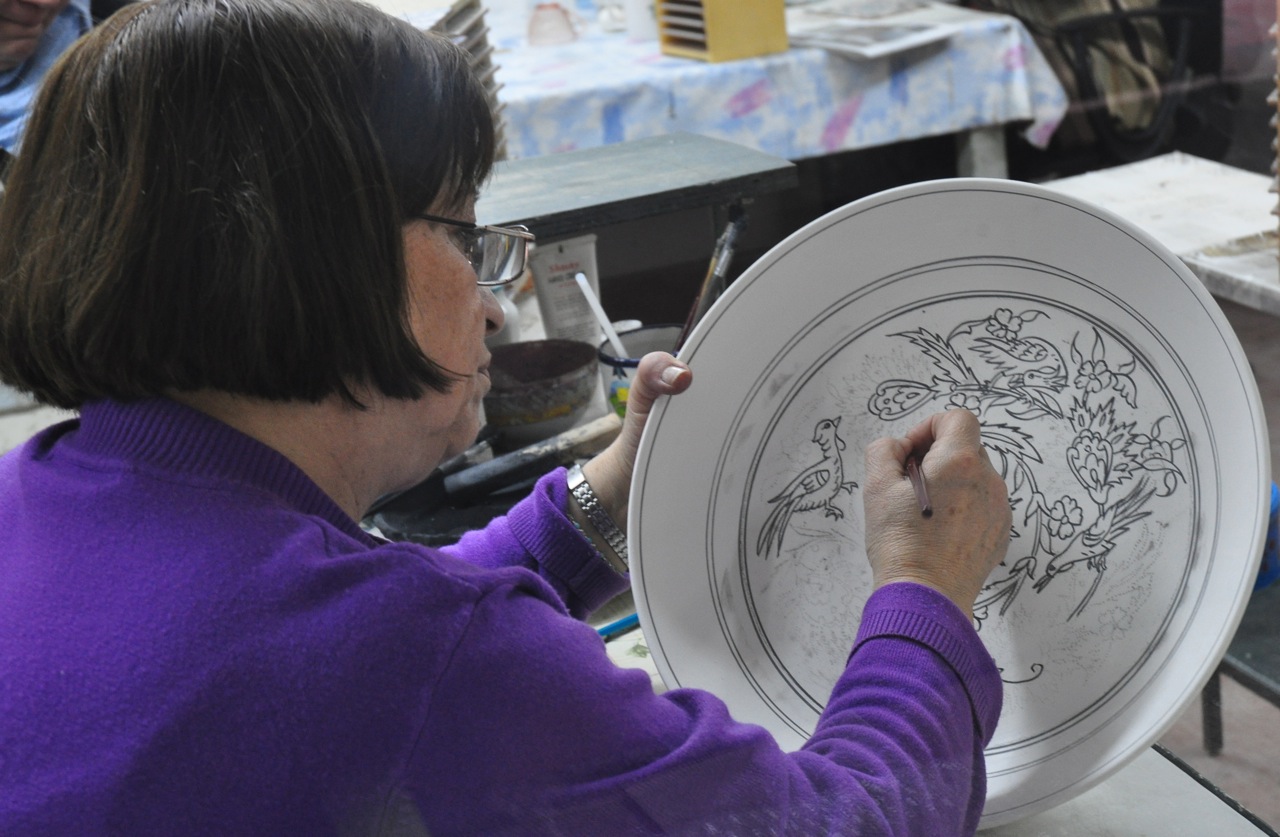
The designs were created by the master painter as drawings on paper. The paper design would be perforated along the lines so that the copyists could transfer them to the ceramics. The copyist-artisans would then paint the outlines in black and then colored glazes would be painted onto the ceramic. When the Balians and Karakashians separated in 1964, the traditional patterns, property of the joint workshop were divided between them.

In 1965 the Karakashian family moved to live and work in the Old City, where they created a studio, “Jerusalem Old City” on the Via Dolorosa between El Wad and Khan El Zeit (recently they moved to 3 Greek Orthodox Patriarchate Street in the Christian quarter). The main designs are those of arabesques, various bird designs, flowers, grapevines, a fawn, fish and biblical scenes on ceramic vessels and tiles.

http://www.jerusalempottery.biz/about_us/aboutus.htm

The Balian studio, called Palestinian Pottery, is still at the original 14 Nablus Rd location.

https://armenianceramics.com/about/

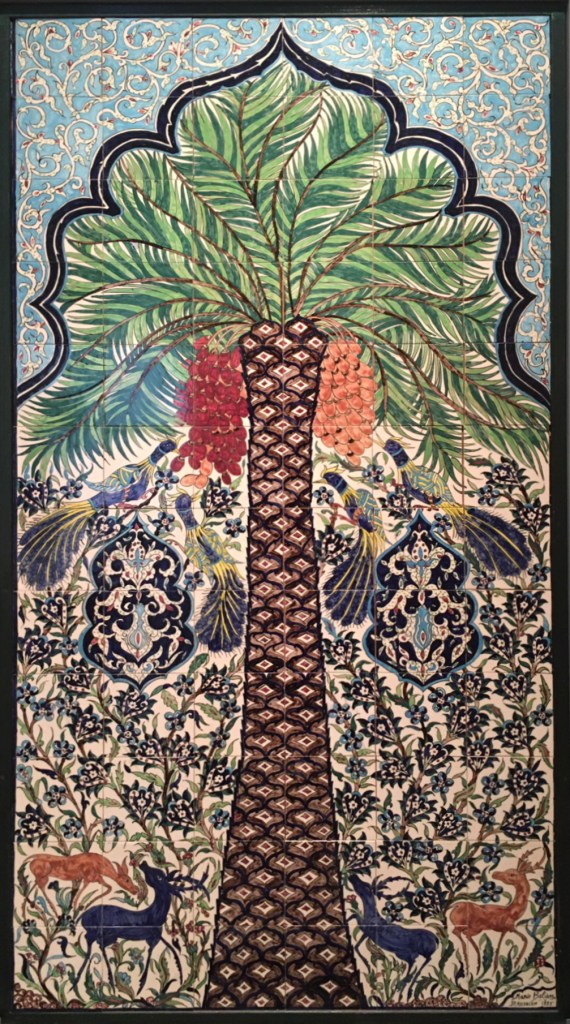
The creative force behind the Balian workshop was Marie Balian, who had studied painting in Lyon, France. One outstanding example is her dialogue with the images of the tree, gazelles and lion from the Hisham Palace painted in various combinations. By the early 1980s Marie Balian was working on larger compositions of many tiles, as if they were monumental canvases.


In 1986 she created a multi-tile triptych for the “Sukkoth patio” of the President of Israel’s residence which included pomegranates, date palms and grapevines (from the seven species that grow in the Land of Israel).

For an excellent book on the subject check out
Kenaan-Kedar, Nurith, The Armenian Ceramics of Jerusalem: Three Generations 1919-2003, Yad Izhak Ben-Zvi Jerusalem, Eretz Israel Museum, Tel Aviv, 2003.  ISBN 965-217-217-0

Sato Moughalian, the grand-daughter of David Ohannessian published a book in 2019 about his life and art, Feast of Ashes.

Two Churches: Mary and Jesus

Two Churches: Old and New

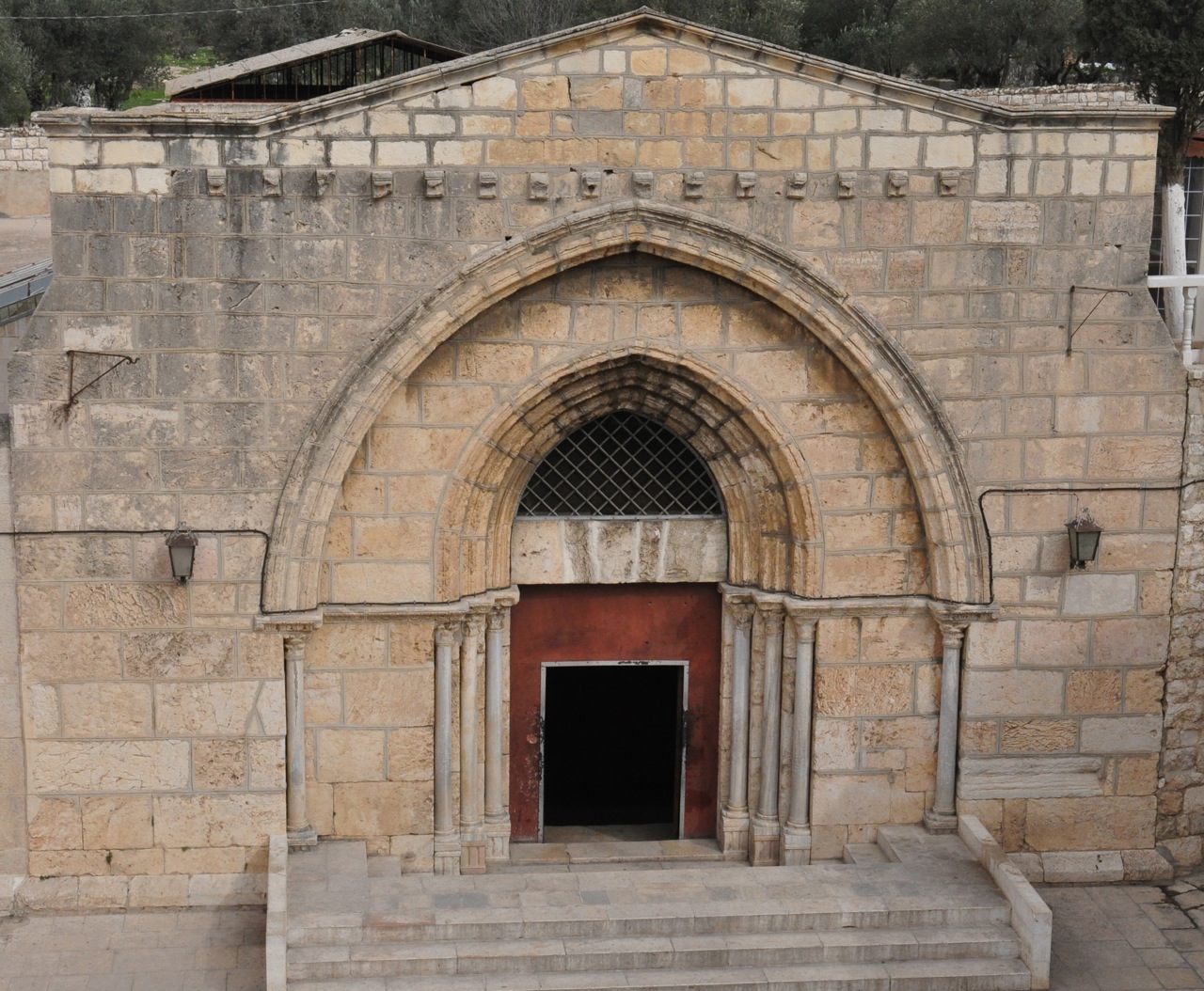
In the Kidron valley is a church built on a rock cut cave that is the tomb of Mary, mother of Jesus. Through the centuries the cruciform (in the shape of a cross) church was destroyed many times but the facade and wide staircase descending to the tomb is from the Crusader period. On the left side of the staircase a chapel to Joseph, Mary’s husband, on the right a chapel to Mary’s parents, Joachim and Anne; Queen Melisende is also buried there. Today the Greek Orthodox Church is in possession of the shrine, sharing it with the Armenian Apostolic Church (the Syriacs, the Copts, and the Abyssinians have minor rights). A niche on the southern wall is a mihrab indicating the direction of Mecca, installed when Muslims had joint rights to the church.

In a courtyard off the Via Dolorosa in the Old City is a small church that reminds me of the Crusader church. The Church of the Flagellation, marks the Second Station of the Cross, where according to tradition, Roman soldiers flogged Jesus and placed a crown of thorns on his head after he was brought to Pontius Pilate. The architect, Antonio Barluzzi, rebuilt this church in 1929, in medieval style over ancient ruins. Barluzzi designs churches so that the style and decoration preserve the history and recall the events that happened at the site. The facade has one central opening with a Crusader style pillow-shaped arch that incorporates a crown of thorns. There are 10 icons under the roof, a crown of thorns, two representations of a cat of nine tails (see if you can recognize the others, for example there is an image of a rooster and 3 stars*). The floor is made of small, inlaid colored stones in geometric patterns.

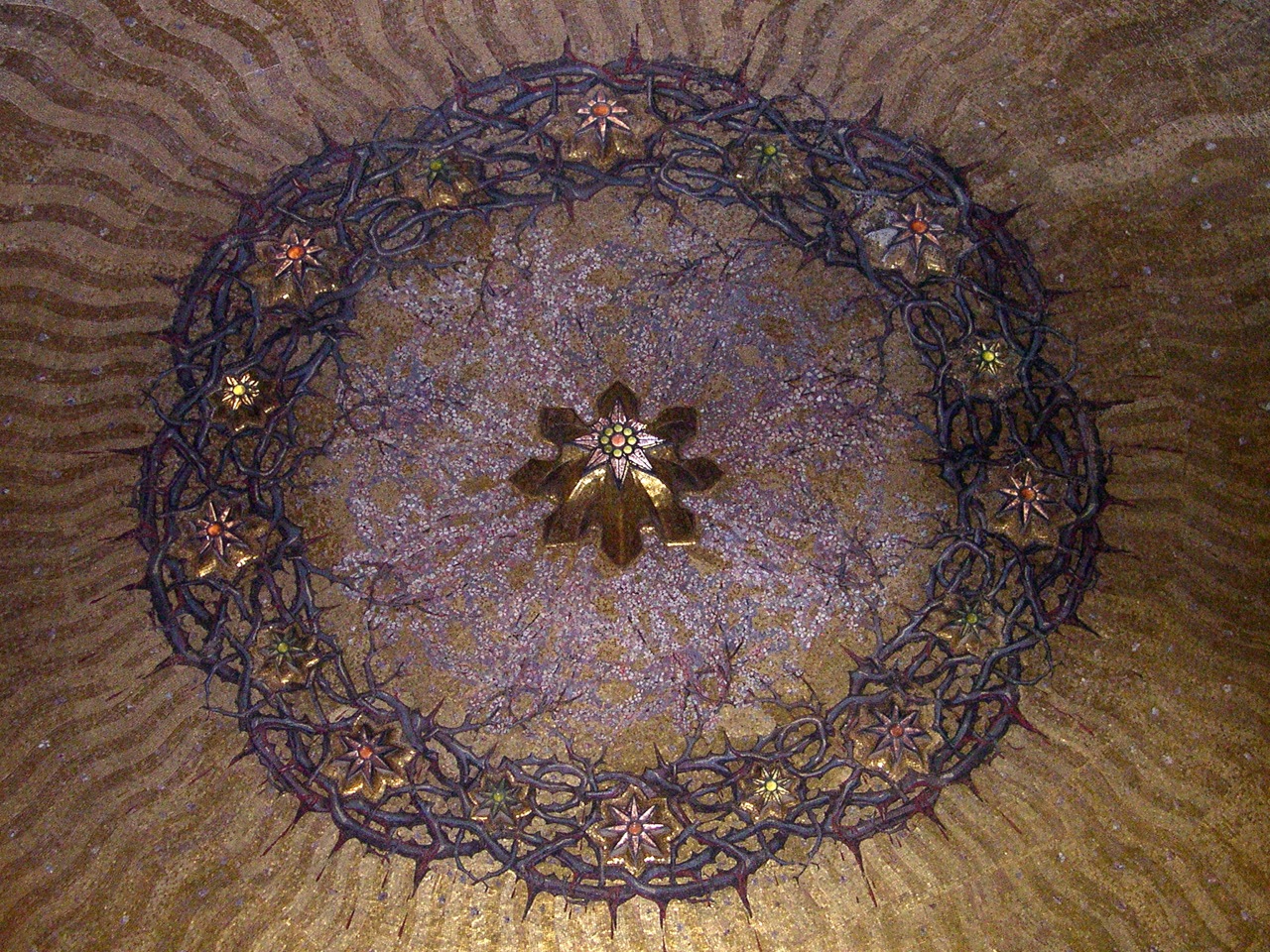
Probably the most impressive part of the church are three large stained glass windows: on the left, Pilate washing his hands of the affair, on the right, the victory cry of Barabbas, in front, the flogging of Jesus wearing the crown of thorns amidst the soldiers. Above is a dome in gold mosaic and decorated with a crown of thorns intertwined with flowers.

Click on the thumbnails above to display a larger image (these are quite incredible stained glass images). Included below is a closeup of the dome.

Near the church of the Tomb of Mary are two other Barluzzi churches, the Church of the Agony at Gethsemane, also known as All Nations and the Franciscan chapel farther up the Mount of Olives, Dominus Flevit. You can contact me about arranging a tour to visit Barluzzi churches including:

  1. St Veronica Church, VI Station of Via Dolorosa
  2. Chapel, XI Station in Church of Holy Sepulcher
  3. Church of Visitation, Ein Kerem
  4. Church of Bethpage
  5. Mount of Beatitudes, Galilee
  6. Church of Transfiguration, Mount Tabor
  7. Chapel of the Shepherd’s Field, Beit Sahour
  8. Church of St Lazarus, El-Azariya

* Rooster and 3 stars refer to Jesus’ prophecy at Gethsemane that Peter will deny him 3 times before the cock crows