Category Archives: Art

Dome of the Chain on Haram el-Sharif

The enigmatic building known as the Dome of the Chain was inaccessible and hidden for eight months by metal sheeting as the Waqf did some renovations on the structure. Just a few weeks ago the building was made accessible once again so I went and took these photographs.

Dome of ChainThe Dome of the Chain is not a mosque or a shrine and is one of the most ancient buildings on the Haram. It was probably built in 691 during the Umayyad period by Abd al-Malik who also built the Dome of the Rock. Some think the structure, because of its position in the precise center of the Haram, existed prior to Islamic rule in Jerusalem and refers back to the days of the Jewish temple or at least to the traditions that surrounded it. There is a tradition that the Dome of the Chain is the site where King David hung a chain that could not be grasped or touched by anyone deceitful, unjust or wicked and where his son King Solomon administered justice.

With the Crusader conquest it became a Christian chapel to St. James, restored as an Islamic prayer house by the Ayyubids and has been renovated by the Mamluks, Ottomans and the Palestinian-based waqf. It seems that the Mamluk sultan Baibars renovated it, refacing the mihrab with marble and reducing the number of outer columns. The ceramic tiles were added in the time of the Ottoman sultan, Suleiman the Magnificent.

Dome of Chain interiorOne of the most unusual things about the structure is that it combines an interior hexagon defined by marble columns with open arches supporting the dome surrounded by an eleven-sided polygon of columns with eleven open arches. Note that each of the column capitals is different. In the southern wall one arch has been closed as a mihrab. It is the third largest building on the Haram after the mosque of al-Aqsa and the Dome of the Rock with a diameter of 14 meters.

Dome interior

Closeup of Hanging lantern

Lantern hanging from the dome of Dome of the Chain


Shmuel Browns

December 2, 2012

Shmuel Browns's avatar

Hanukah, Christmas and Kwanza are celebrated  around the time of the winter solstice, the shortest day of the year. At this holiday season, I am pleased to announce the opening of my new online store, Designed in Israel, where you can buy products (like calendars and notecards) that include images of my photographs and artwork. As far as I know I am the only Israel guide that has an online store [update, as of 2017 the store no longer exists].

Other Church at Capernaum

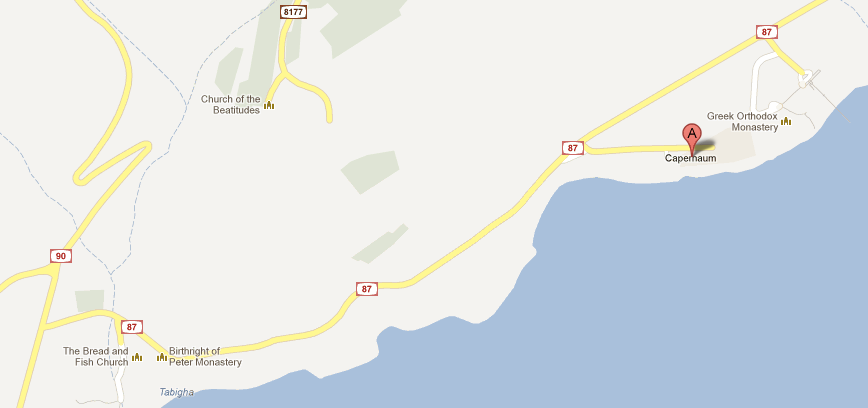
Capernaum is an important place to visit because not only is it an interesting archaeological site but it has historical importance in understanding Jewish life in the time of Jesus. According to the Gospels Jesus lived in Capernaum during much of his ministry in the Galilee.

The site was first discovered in 1838 by the American biblical geographer Dr. Edward Robinson. British explorer Captain Charles Wilson identified the ruins of the synagogue in his survey of 1866, and in 1894 a part of the ancient site was purchased by the Franciscan Custody of the Holy Land – this is the site most often visited.

Archeological evidence (from excavations by the Franciscans between 1968-84) indicates that the fishing village of Capernaum was established at the beginning of Hasmonean rule – the earliest coins found at the site date from the 2nd C BCE. The town, near the border of the province of Galilee, was on a branch of the Via Maris trade route. At the time of Jesus, Capernaum included a customs post and a small Roman garrison commanded by a centurion. Although the natural building material was black basalt, from the remains that we see today we know that the town had an impressive synagogue in white limestone (the floor plan is similar to the 4th C synagogue at Korazim and the 3rd C synagogue at Baram, a comparison would make an interesting subject for another post) and an octagonal church (5th C), a short distance from one another.

Since the town did not participate in either of the two major Jewish revolts against Rome village life continued quietly until a winter day in 749CE . On January 18th Capernaum was badly damaged by the Golan earthquake and was rebuilt a short distance to the northeast but little is known of its  history, decline and eventual abandonment sometime in the 11th century. Despite the importance of Capernaum in the life of Jesus, there is no evidence of any construction during the Crusader period.

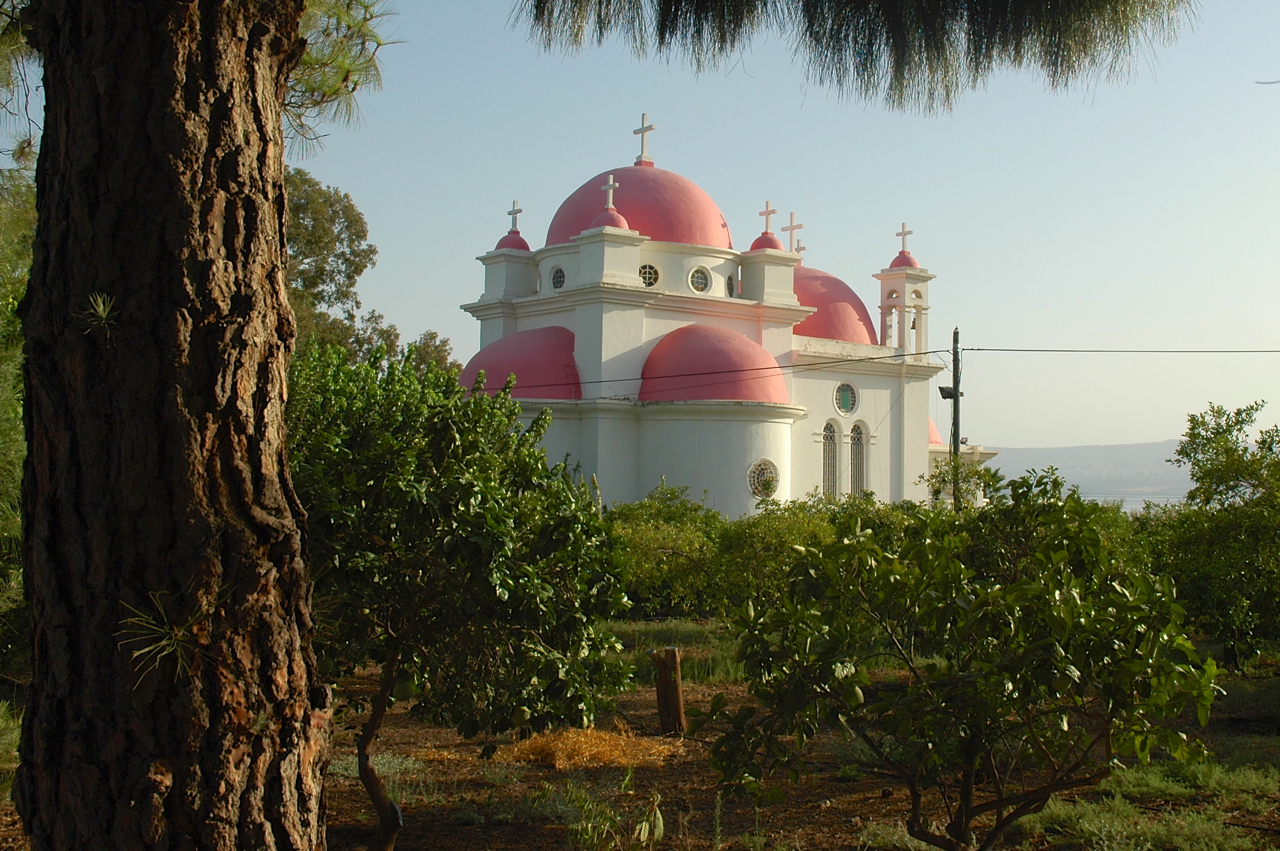
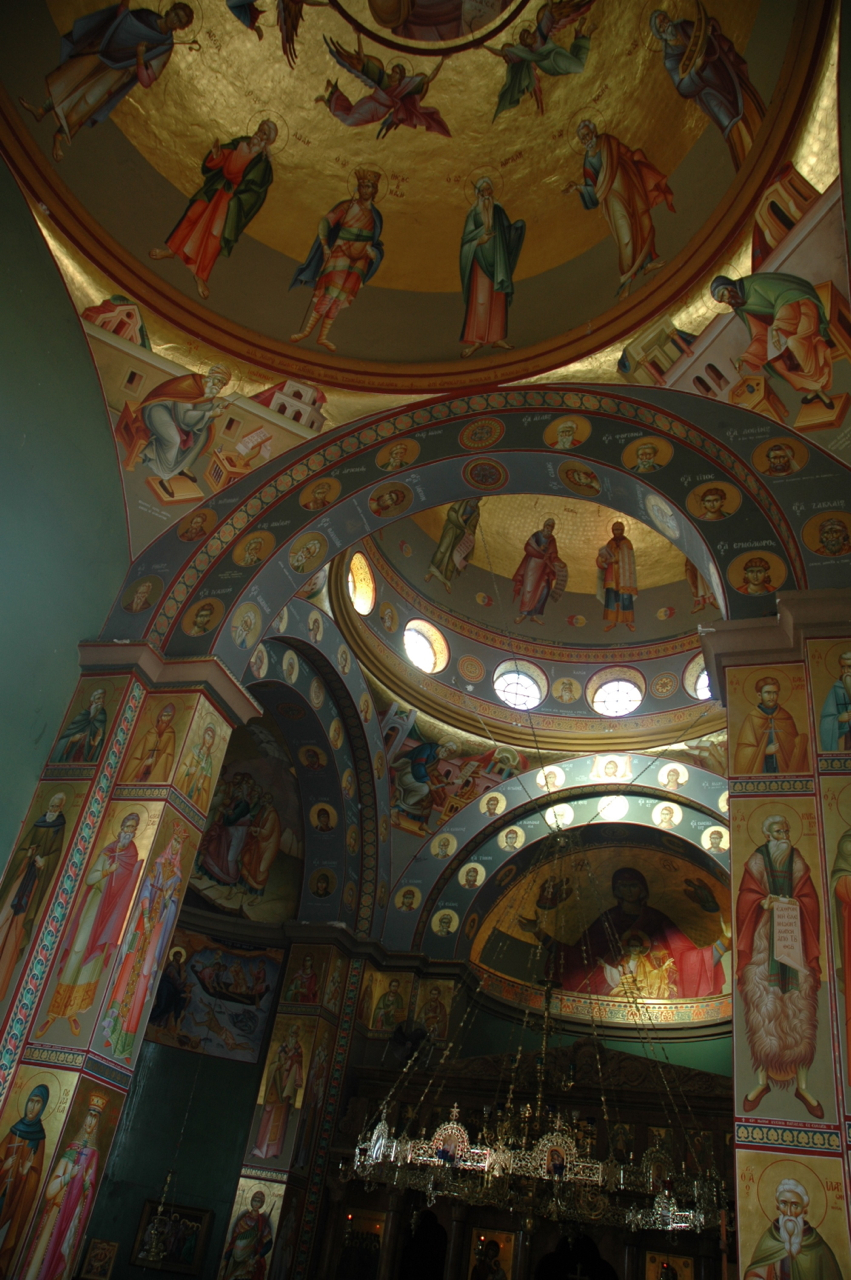
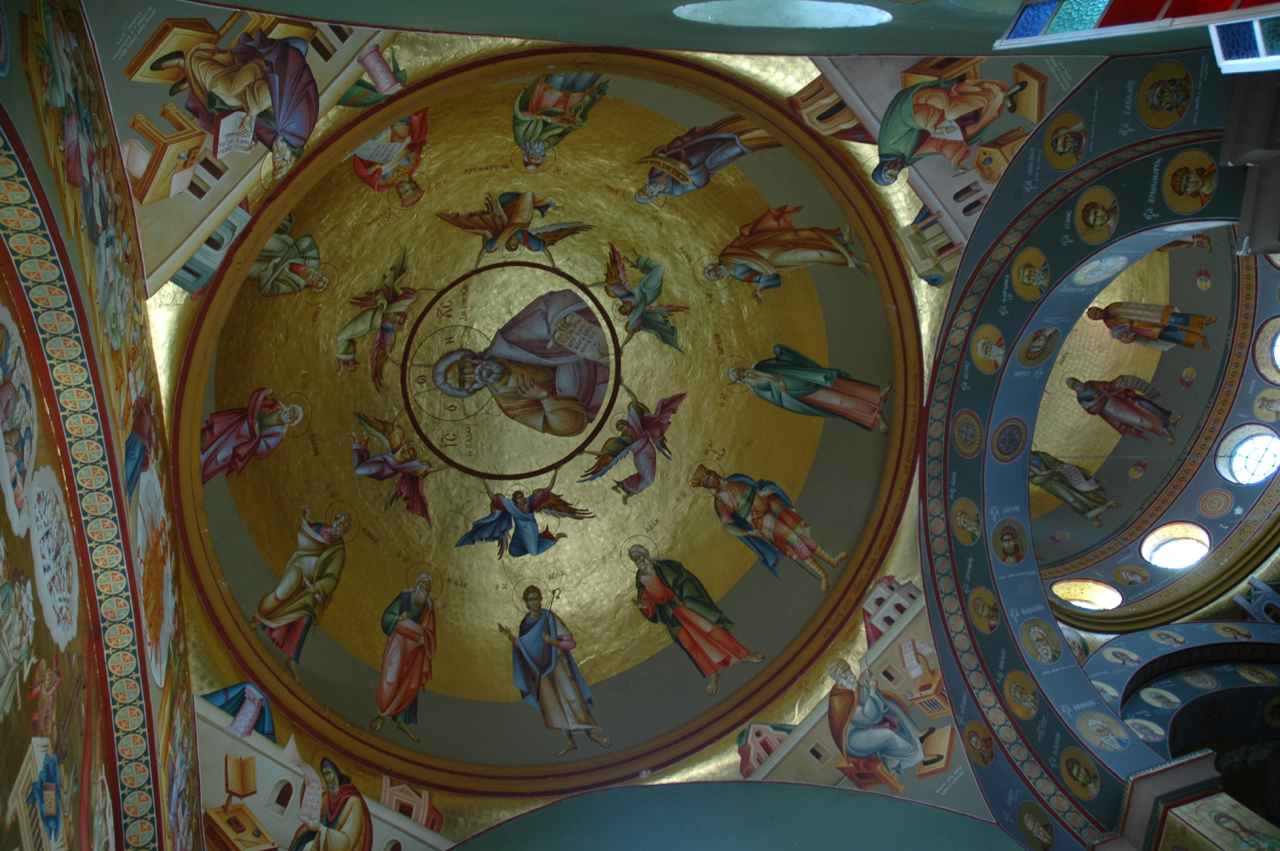
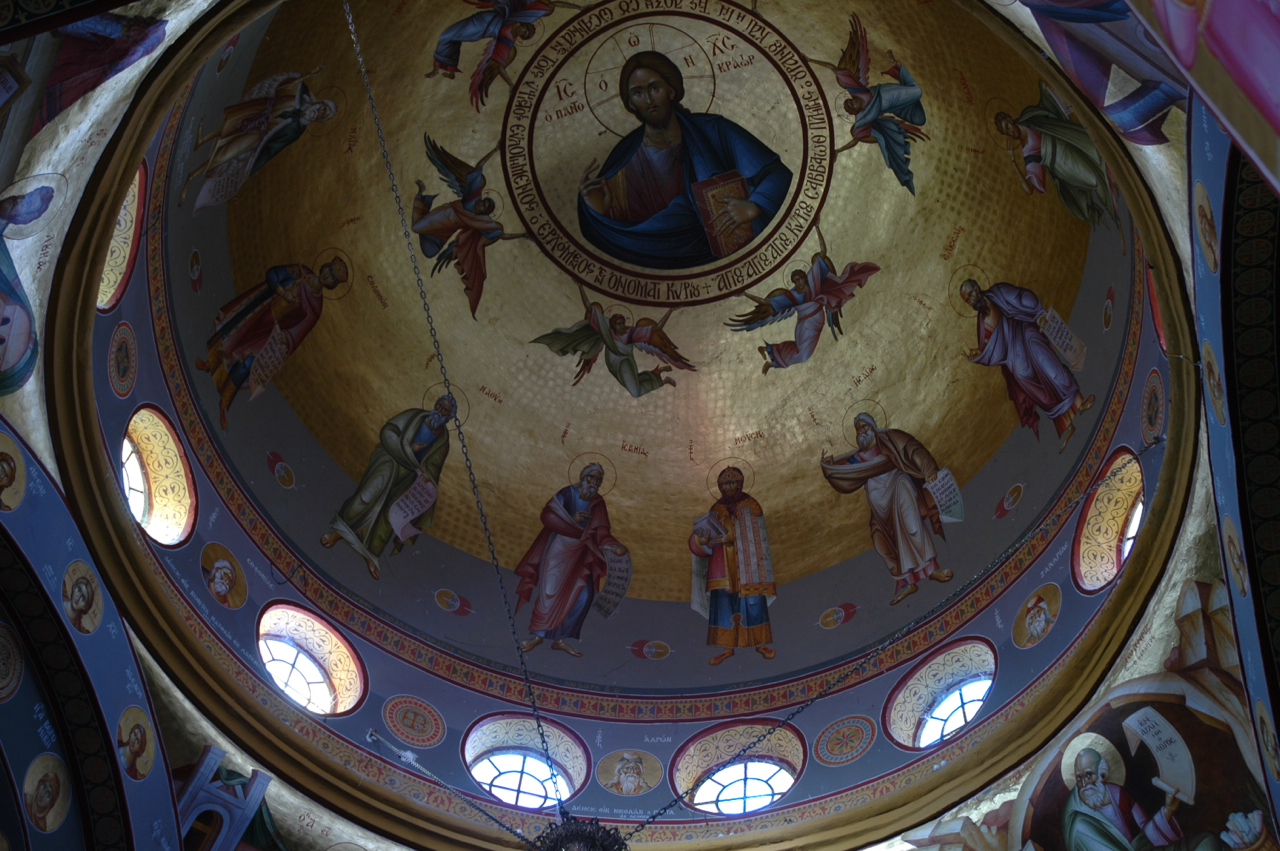
The small, pink-domed Greek Orthodox Church of the Seven Apostles (built in 1931) marks the site to which the village of Capernaum was relocated after the earthquake. A monk greeted us when we entered so we asked why the church had pink domes – he replied that it was the paint they had found at the local hardware store. The church is dedicated to the seven apostles (Simon Peter, Thomas called Didymus, Nathanael from Cana in Galilee, James and John, the sons of Zebedee, and two other disciples not recorded (John 21). Jesus appears for the third time, this time by the Sea of Galilee. The interior of the church is covered with paintings and I got some photographs of them.

Archeological excavations carried out at four locations on the site between 1978-82 revealed the foundations of residential dwellings with the same black basalt dry-stone walling as the earlier constructions in Capernaum. Of special note are the remnants of a two-meter-wide basalt wall along the shoreline that may have been part of a quay along the entire lakefront of the village and two stonework jetties extending at right angles into the lake. This would have provided both sheltered anchorage and a slip for hauling boats out of the water.


This post is especially for a friend, Alex Koch who is an art historian and guide who lives in Munich and loves Israel.

Gold Jewelry

A gold bell, 1 cm in diameter, with curved markings was discovered during wet-sifting of material from the drainage channel below the Herodian street near Robinson’s Arch. This is indeed a rare find. According to the press release “The bell looked as if it was sewn on the garment worn by a man of high authority in Jerusalem at the end of the Second Temple period.” Not a regular item of jewelry. The only reference to golden bells in the Bible are bells on the vestments of the high priest (Exodus 28:33-34; 39:25-26).

And beneath upon the hem of it you shall make pomegranates of tekhelet and argaman (purple) and of scarlet, round about its hem and bells of gold between them round about.

Now you can hear the gold bell “tinkle” in this short video.

Jim Davila of the PaleoJudaica blog suggests that the women of Jerusalem wore bangles on their ankles which “tinkled” and had lots of jewelry (based on Isaiah 3:16-23). It seems plausible that they might well have worn bells as jewelry and that some of those bells might have been made of gold.

I find it fascinating that people were able to make a bell out of gold 2000 years ago. So I asked my good friend Michael Parkin, a sculptor and jeweler, if he could explain how it might have been constructed. This is his response:

It appears to have a seam on the right hand side so this is my best guess or at least how I would do it using first century methods:  First the bell’s maker formed 2 hemispheres using a rounded bit of (cow?) horn or antler and a wooden mallet to drive the metal into a depression in a piece of wood.  Each hemisphere would then be filled with either pitch (conifer sap mixed with dried powdered clay or perhaps beeswax (to hold its shape).  The surface decoration was probably done with a bronze tool shaped like a very dull cold chisel and driven using a mallet similar to but smaller than the one used to hammer on the horn tool.  The completed parts and a bit of gold wire (drawn or more likely hammered) could then be welded together in a tiny charcoal forge with a blow pipe to raise the temperature locally at the seam.

Photo courtesy of IAA

This reminds me of another rare find discovered in the excavations in the Givati parking lot across from Ir David, south of the Old City Walls. One gold earring was found, made up of a large pearl inlaid at the top center and surrounded by a coiled gold hoop. Two pendants hang below the focal pearl, each one with an emerald in a gold frame and a strung pearl. The earring was discovered in the ruins of a building that dates to the Byzantine period (4th-5th Centuries AD), but archaeologists at the site believe it is much older and that it was created during the Roman period, about 2,000 years ago.

Moshe Castel and Israel Art

In Maale Adumim facing the panoramic view of the hills of Jerusalem sits a building that houses the art of Israeli artist Moshe Castel. Castel himself chose the site located between Jerusalem and the Judean desert symbolizing Israel’s past and future and his own connection to Jerusalem and the land of Israel and its history. (http://www.castelmuseum.com) The Israeli architect David Resnick designed the building with input from Castel. Resnick is well known for other architectural landmarks, Yad Kennedy, the “Mushroom” synagogue at Hebrew University, Givat Ram and the Mormon university in Jerusalem.

Moshe Castel (1909-1991) was born in Jerusalem to a Sephardi family from Castile with roots that go back to the expulsion from Spain in 1492. At the age of 13 he began to study at the recently opened Bezalel Art School where he learned the rudiments of painting and painted locally inspired landscapes and images. In 1927 at age 17 he traveled to Paris to study at the Academie Julian. Quickly he exchanged his hat and black tie for vagabond clothing and hung out with his fellow artists in the cafes. He rented a small apartment above the sculptor Giacomettti and joined the circle of great artists, Picasso, Matisse, Miro, Soutine and Chagall.

At the Louvre, he sat before the works of the Old Masters and copied their paintings, paying attention to the technique of layering the paint on the canvas. There Castel learned “That art is not symbolic, but rather material, the material is the main thing, the way the paint is placed, the way the layers are placed on the picture, this is the most essential thing.”

In the 1940s he returned to Israel, settled in the Artist Colony of Tzfat and established the New Horizons group of artists that broke way from the established Artists’ Union to focus on universal artistic elements and a more abstract European style. You can visit the house he lived in, newly renovated as a gallery.

He found basalt rocks on his hikes through the Galilee, in the area of Korazim, and began to use them as raw material – the stones were crushed, mixed with a bonding agent and pigment and applied in a thick coat with a palate knife. This material was applied as the textured background for scrolls, letters, figures that became his signature and unique artwork.

There are three other museums in Israel that are dedicated to the works of a single artist. The former residence of the Israeli painter Reuven Rubin at 14 Bialik Street in the heart of Tel Aviv has been made into a museum that displays his paintings from the different periods in his artistic development and preserves the artist’s studio. There is also an audio-visual slide show on Rubin’s life and work. (http://www.rubinmuseum.org.il/home.asp)

The Nahum Gutman Museum was opened to the public at the reconstructed Writers’ House at 21 Rokach Street in Neve Zedek in 1998 and encompasses works in oil, gouache and watercolor, as well as several thousand drawings and illustrations. (http://www.gutmanmuseum.co.il/Default.aspx)

The Janco Dada Museum in the center of the Ein Hod Artists’ Village south of Haifa exhibits the prolific work of Marcel Janco chronologically from his early works as a boy of fifteen. (http://www.jancodada.co.il/en/ar_01.php)

For other museums in Israel check out http://ilmuseums.com/

Hirbet Midras Vandalized!

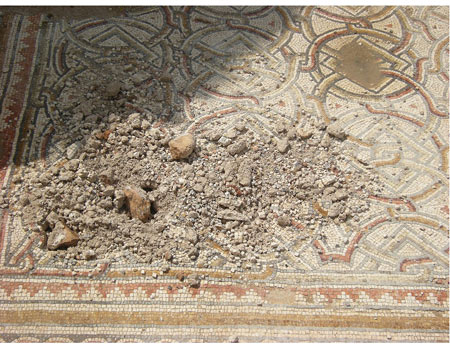
Just reported by Ynet (in Hebrew), Hirbet Midras, the site of the Byzantine church in the Ella Valley with the incredible mosaic floors, uncovered just two months ago and visited by tens of thousands of people was deliberately and brutally vandalized Wednesday night. The Antiquities Authority had made considerable effort to prepare the site and had decided to leave the mosaics uncovered so that people could visit and see them. The supervisor and archaeologist in charge, Alon Klein of the Israel Antiquities Authority’s Crime Prevention unit was shocked to find the destruction this morning when he arrived at the site.

Photo courtesy of the Israel Antiquities Authority

“Someone took a hammer and attacked the mosaic, digging them up in a large number of spots. A person hiking in the park had reported the damage. The mosaic looks like it has been hit by mortar shelling. It’s a sad sight, heart breaking. The mosaics suffered serious damage as a result of brutal vandalism. ” said Klein.

Photo courtesy of Israel Antiquities Authority

The Antiquities Authority has filed a criminal complaint with the police who are investigating. The mosaics will now be covered to protect them. When asked about whether the damage could be repaired the response was that it would be time-consuming and require a significant outlay of money but hopefully it could be done (at least to a certain degree).

This on the heels of the explosion yesterday near the entrance to Jerusalem and the escalation of rockets and mortar being fired on Beersheva and the coastal cities of Israel from Gaza. Sigh.