Category Archives: Archaeology

Technology at Israel Museums

The Google Art Project spent months mapping the Israel Museum with cameras mounted atop bicycles and photographing 520 objects, artifacts and artwork from the Museum’s collection. The outcome is an online compilation of high-resolution images accessible over the Internet and a virtual tour of the museum using Google’s Street technology. The Israel Museum was among 151 museums in 40 countries taking part in the second phase of the project. Currently more than 30,000 high-resolution objects from museums around the world are available for viewing and items can be found by various keywords, location, artist, collections, etc.

Archaeological items included are the only dedicatory inscription mentioning Pontius Pilate, the procurator of Judea in the time of Jesus found at Caesarea, the oldest Biblical text, Priestly Blessing from Numbers 6:23 on silver amulet found in tomb at Ketef Hinnom in Jerusalem (you can read my blog post at https://israeltours.wordpress.com/2011/03/16/ketef-hinnom-silver-amulet/ ) and Theodotus synagogue inscription in Greek found near the Temple Mount. There is also artwork, for example, the triptych Gates of Jerusalem by Mordecai Ardon (you can read my blog post on the Ardon Windows at https://israeltours.wordpress.com/2011/02/09/ardon-windows-isaiah-vision-peace/).

The Google Art Project creates images larger than 1 billion pixels in size, the zoom-in feature allows viewers to get inside cracks in the parchment and other details that are not visible to the naked eye – a really fascinating collection of treasures worth exploring. Kudos to the Israel Museum for making these images available.

The project follows last year’s collaboration with Google to make the famed Dead Sea Scrolls accessible in high resolution on the Internet. When announced the site drew a million viewers within the first few days. Five of the Scrolls, including the Great Isaiah Scroll 1QIsaone of the original seven Dead Sea Scrolls discovered in Qumran in 1947 are viewable at http://dss.collections.imj.org.il/isaiah.

Google has also partnered with Israel’s Holocaust memorial, Yad Vashem, to make its photographs and documents searchable on the Internet.

“Mendel takes out his camera. No more flowers, clouds, natures, stills or landscapes. Amid the horror all around him he has found his destiny: to photograph and leave behind a testimony for all generations about the great tragedy unfolding before his eyes.”

Mendel Grossman’s photos constitute a small portion of the historical photos in Yad Vashem’s collection. The project will facilitate preservation of and access to the world’s largest historical collection on the Holocaust. Google implemented experimental optical character recognition (OCR) technology to carry out this project, making previously difficult to locate documents now searchable and discoverable online. As of today, 130,000 photos from Yad Vashem’s archive, the largest of its kind in the world, are viewable in full resolution online. The collections are visible at http://collections.yadvashem.org/photosarchive/en-us/photos.html. This is a first step towards bringing the vast Yad Vashem archive online over time.

Yad Vashem has also launched a YouTube channel to showcase a series of videos of Holocaust survivor testimonials. The YouTube channel is available at www.youtube.com/yadvashem. There is also a YouTube channel with more than 400 hours of original video footage from the landmark 1961 Jerusalem trial of Nazi mastermind Adolf Eichmann at http://www.youtube.com/user/EichmannTrialEN.

If you know of other technology projects that are being developed in Israel please share by leaving a comment about them. If you peruse the images leave a comment here of your impression.
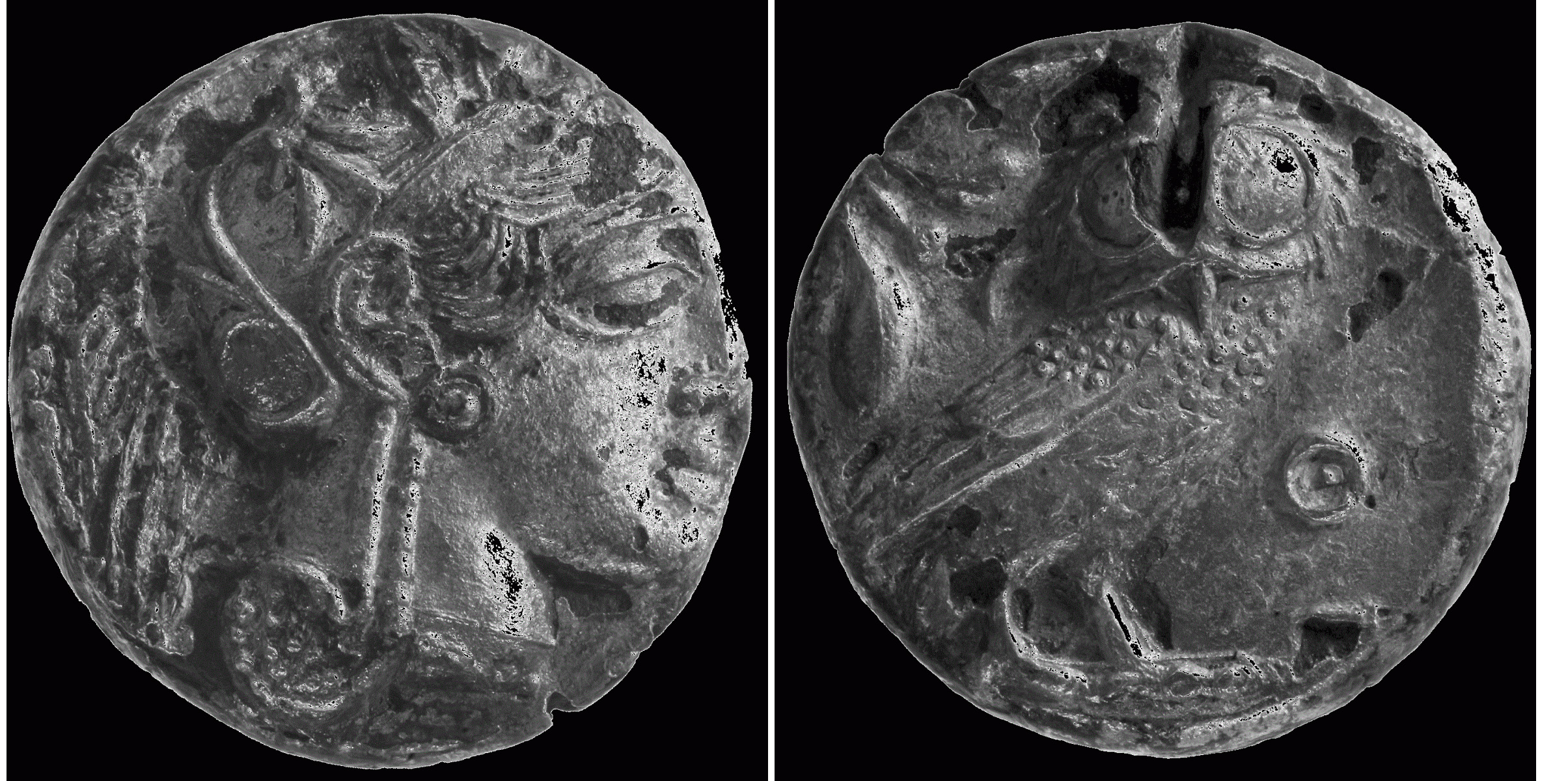
Early Counterfeit Silver Coin

An extensive survey was conducted in preparation for the upcoming Israel-Germany joint excavation at Tel Azekah in the Elah valley this summer. During the survey, among the many pottery shards, a silver Athenian Tetradrachmon coin which was used as universal currency in the 5th and 4th centuries BCE (very much like the dollar or the euro today) was found.

Athenian Tetra Drachma coin, courtesy of IAA

The diameter of the coin is 23 mm, and it is fairly heavy for its size. One side of the coin depicts the profile of Athena, the patron goddess of Athens, and the other depicts an owl, the goddess’ symbol. On closer examination it turns out that the core of the coin is made of bronze which has been covered with silver in order to give the illusion that it is pure silver, in other words what we have here is an early example of a counterfeit coin!

The excavation is an exciting development because digging Azekah, a site that was a major Judahite fortress in the late 8th century, will provide us with new data and help advance new theories about the rise and fall of the Levantine territorial kingdoms of the Biblical Period. This has been the  focus of hot debate. How much archaeological and historical evidence do we have that Judah was a full blown state before the 9th century, in the time of King David and Solomon? See my article on the House of David Stele uncovered in the excavations at Tel Dan. More recent excavations by Garfinkel at Khirbet Qeiyafa has shed some light on this question, demonstrating the slow and gradual process of the monarchy and its expansion from the hill country of Jerusalem to the much more fertile lowlands. BTW, I do a great tour of Khirbet Qeiyafa, a Judean walled town identified as Biblical Shaarayim.

Finding a coin in an archaeological strata enables us to date that layer. If you’re interested in coins check out my post on other coins found in archaeological excavations.

The excavation at Tel Azekah begins July 15th. I’m going to check out working at the dig. Do you want to join me?

First Temple period Seal

First Temple period Seal

Courtesy of Israel Antiquities Authority.

A small stone seal at least 2,600 years old in Paleo-Hebrew script has been found in the continuing excavations of the main drainage channel along the western side of the Temple Mount in Jerusalem the Israel Antiquities Authority announced. The name on the seal is Matanyahu, meaning ”gift of God”, son of but only two letters survived – “Ho”. The seal was found in a structure that dates to the First Temple period – between the end of the 8th century BCE and 586 BCE. No more than two dozen seals this old have been found since excavations began in Jerusalem in the 1800s, according to archaeologist Eli Shukron.

The drainage channel runs from the City of David (you reach it by climbing the stairs from the Siloam pool), under the excavations in the Givati parking lot, under the current street and under the walls of the Old City to the Davidson archaeological park where you exit near Robinson’s Arch. Work is continuing on clearing the drainage channel and   my guess is that they have already passed the Western Wall plaza.

Check out my article on walking the drainage channel. The City of David and Davidson archaeological parks are great sites (there’s a combination ticket) and I’m happy to guide you there.

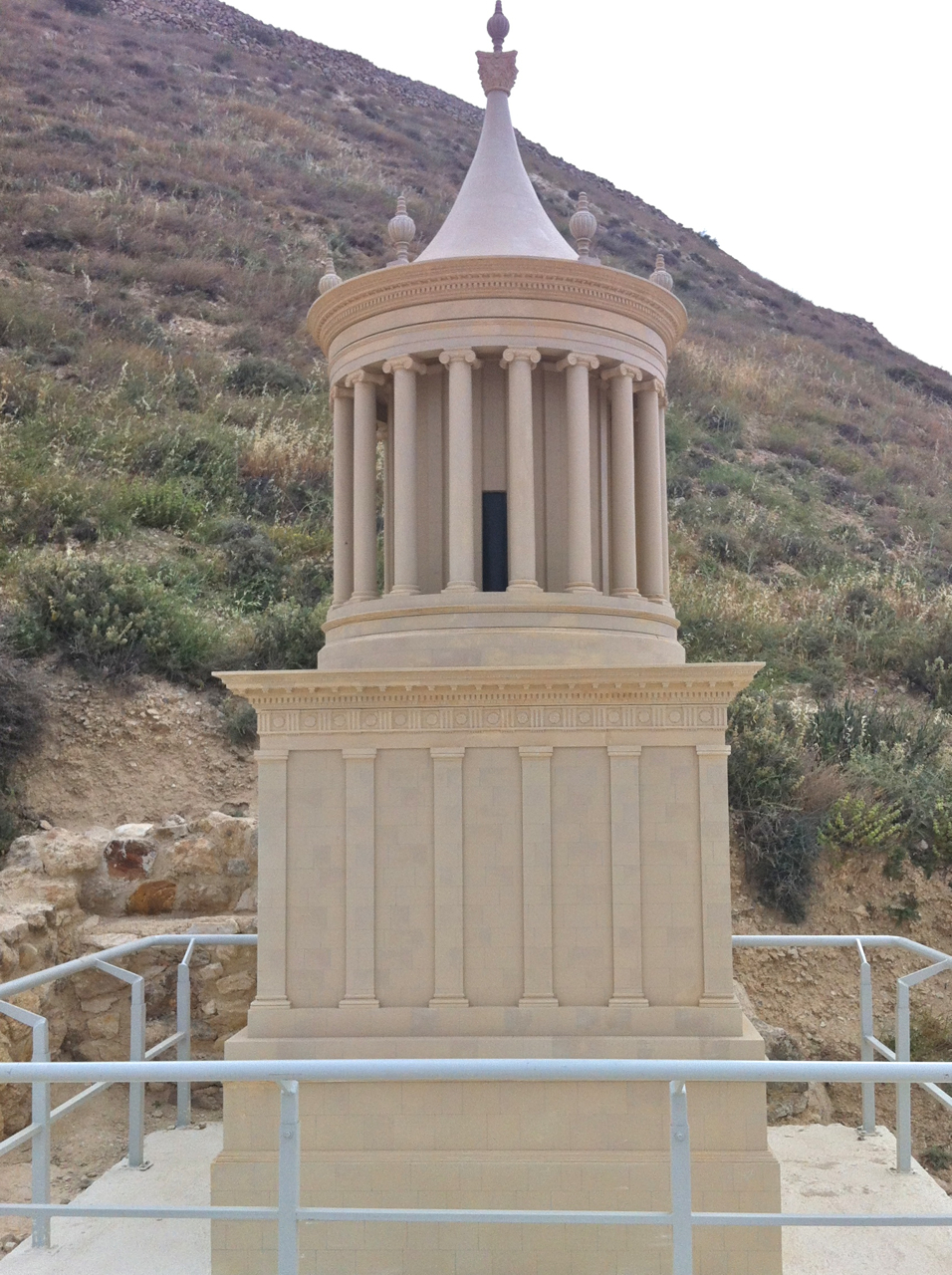
Model of Herod’s Tomb

I was at Herodium today and took the opportunity to photograph the new smaller than life-size model of Herod’s tomb which has been installed by the path that leads to the palace-fortress. The model was built from drawings by Prof. Ehud Netzer based on the base of the mausoleum uncovered and Netzer’s expertise as both an architect and archaeologist on the Herodian period. Netzer estimates the nefesh as 25 meters high, with a cube-shaped lower level with two rows of decorations below the roof line, a row of egg and dart pattern and below it a row of medallions and vertical bars. On top of this cube sits a cylindrical second level, a tholos with columns and a conical roof. The model shows Nabatean funerary urns in four places along the roof line and the peak of the cone. We found two pieces of stone carved in the egg and dart pattern a few years ago when I volunteered at the dig.

There is also a short video, currently only in Hebrew, that attempts to illustrate the account by Josephus of Herod’s death.

Archelaus omitted nothing of magnificence therein, but brought out all the royal ornaments to augment the pomp of the deceased. There was a bier all of gold, embroidered with precious stones, and a purple bed of various contexture, with the dead body upon it, covered with purple; and a diadem was put upon his head, and a crown of gold above it, and a secptre in his right hand; and near to the bier were Herod’s sons, and a multitude of his kindred; next to which came his guards, and the regiment of Thracians, the Germans. also and Gauls, all accounted as if they were going to war; but the rest of the army went foremost, armed, and following their captains and officers in a regular manner; after whom five hundred of his domestic servants and freed-men followed, with sweet spices in their hands: and the body was carried two hundred furlongs, to Herodium, where he had given order to be buried.

There were a half dozen people working at the tomb site. I noticed the remains of some additional structures that have been uncovered. Unfortunately, access to the tomb area is still closed.

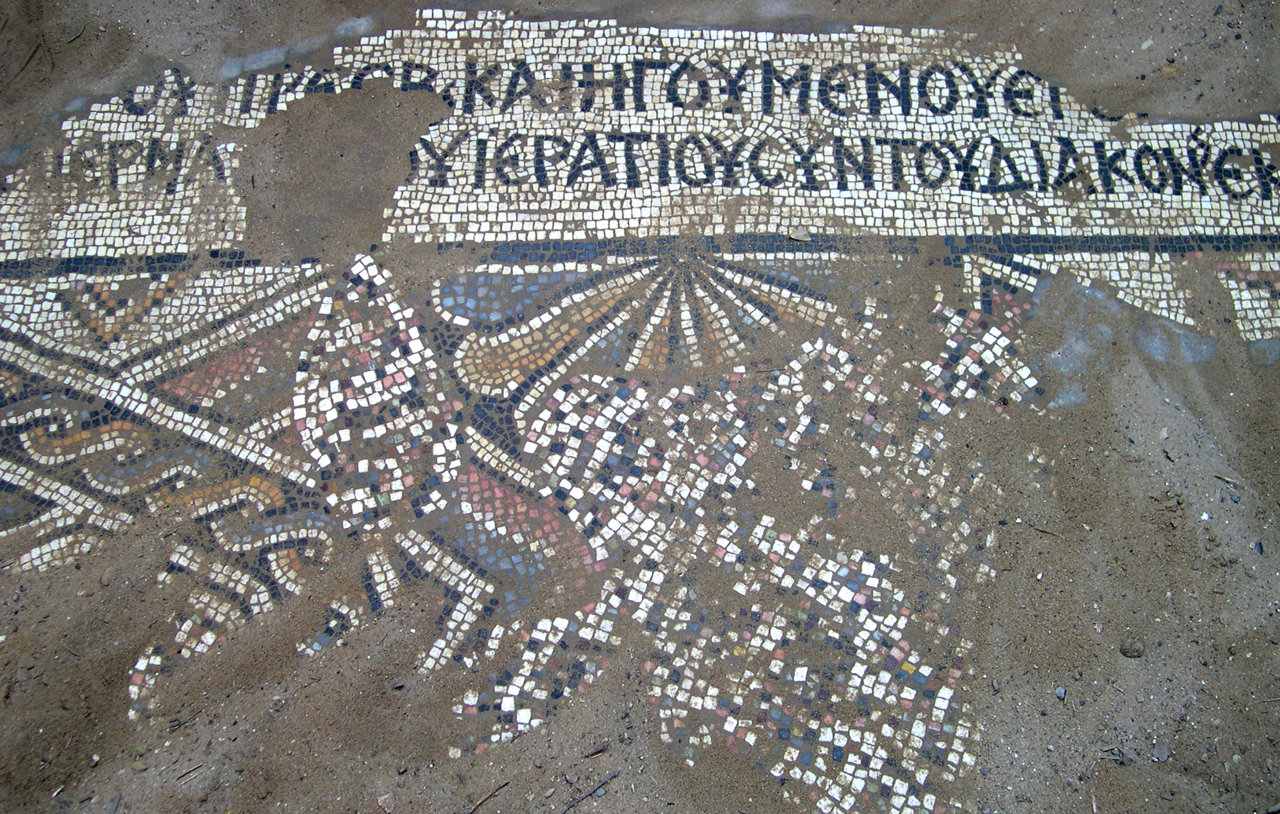
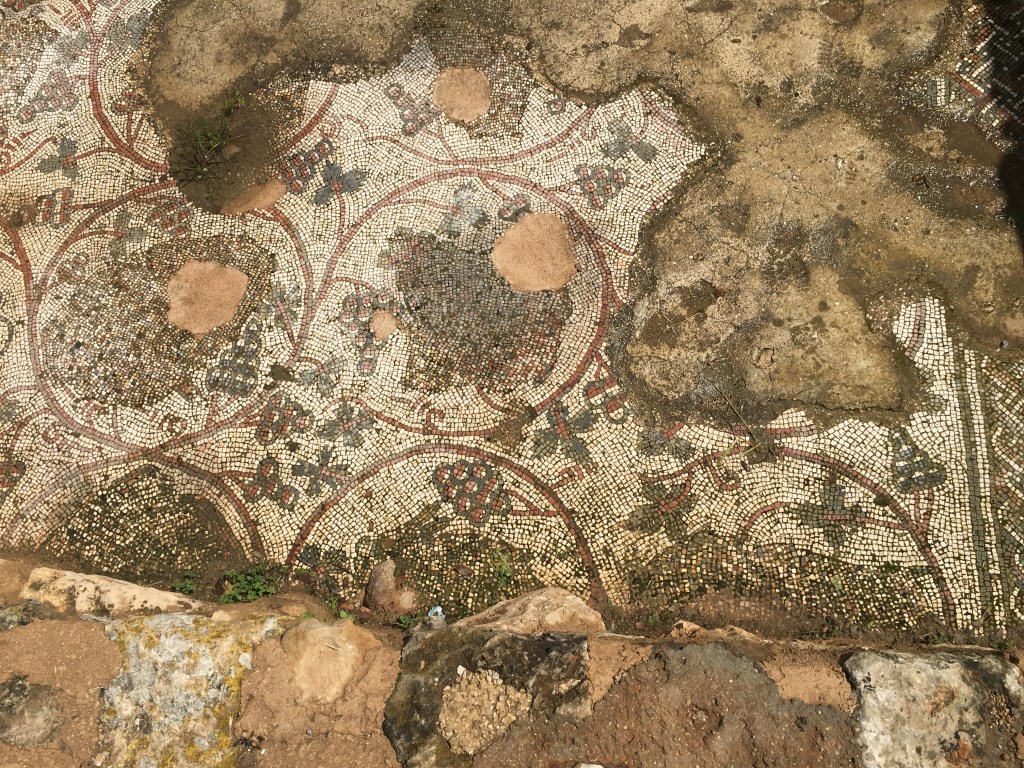
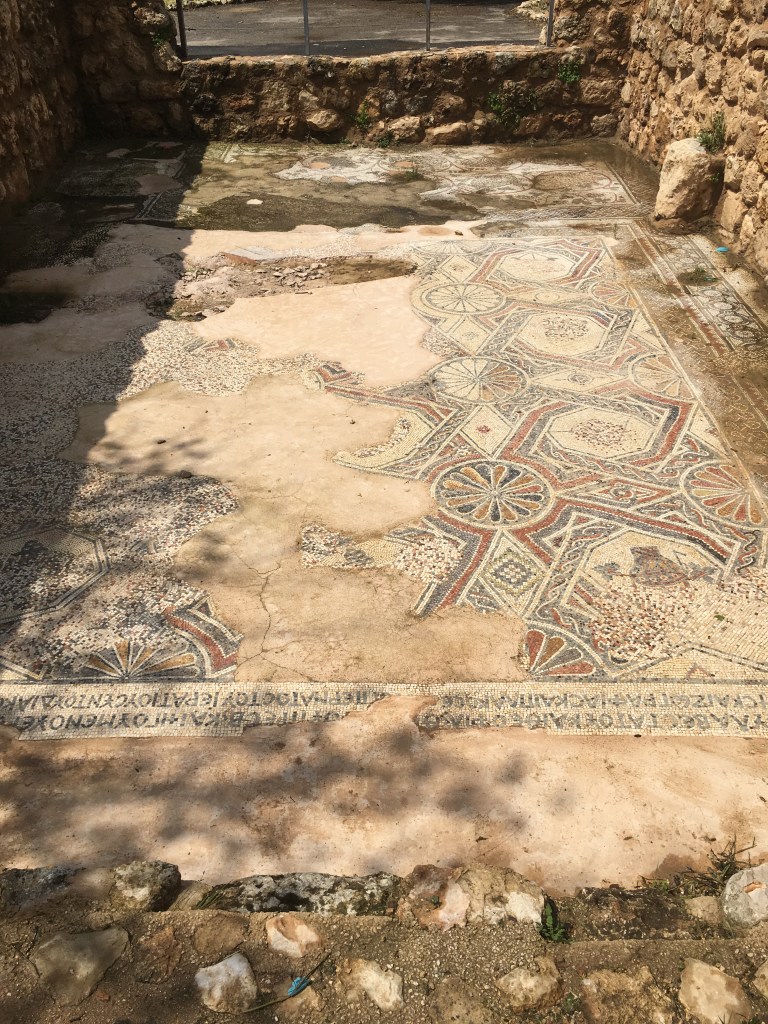
Khirbet Hanut Mosaic Vandalized

When you hire me as your guide I can take you places and show you things you probably won’t find on your own. Out of Jerusalem along highway 375 is the shell of a small stone building where the floor is covered with sand.

The site is from the Byzantine period, the ruins of a monastery with a mosaic floor including an inscription in Greek dated to 563CE. To see it, all you have to do is sweep aside the sand covering the mosaic – a simple way to protect it.

Image

Unfortunately, because the location is accessible somebody took advantage and two days ago badly damaged the mosaic. According to the report in YNet Israel Antiquities Authority staff collected 23 bags full of the scattered stone cubes (tesserae) from the mosaic. I had even driven by the site on two different days last week on my way to photograph a field covered with thousands of red poppies and had thought to stop and take photographs but didn’t.

So these photographs are from a few years ago and I post them here so there is a record and you can see parts of the mosaic. It is terrible when something like this happens.

Good news. The site has been repaired and here are some photographs.

Khirbet Hanut is not far from Khirbet Midras where the stunning mosaics uncovered in a Byzantine church were vandalized just over a year ago. I posted photographs of those mosaics in my article Khirbet Midras Mosaics.

Kathisma Church

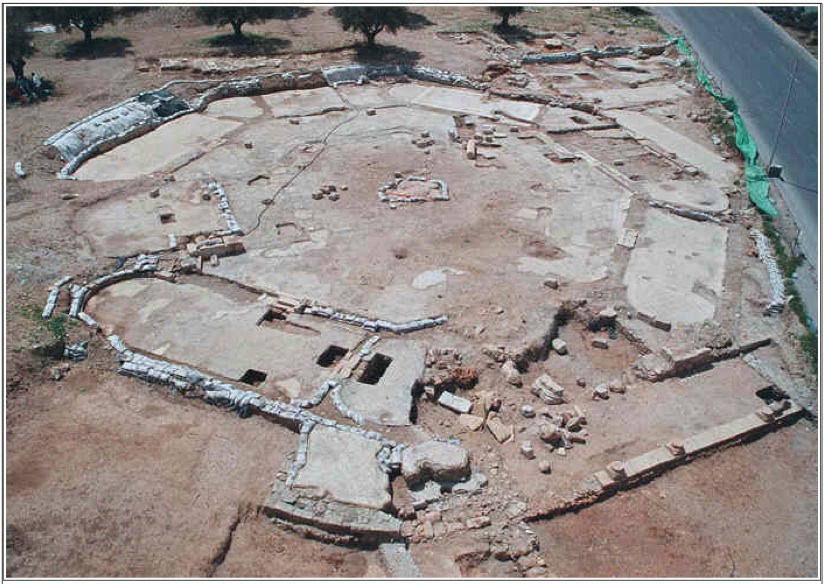
Aerial photo of Kathisma site, IAA

Despite the many people traveling along the main road to Bethlehem (or Gilo or Gush Etzion) before the turnoff to Har Homa and Herodium few notice the ruins of a 5th century Byzantine church and monastery. Discovered by chance in 1992 when the road was paved and excavated briefly in 1999 by Rina Avner, the site is worth exploring but lies abandoned due to lack of money, time and initiative. Called the Kathisma church, after the word in Greek for seat (καθισμα), according to Christian tradition it is where Mary rested on the way to Bethlehem just before giving birth to Jesus.

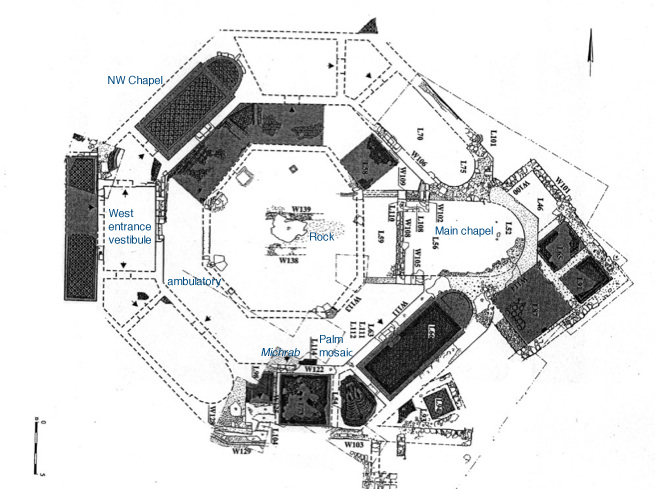
Most Byzantine churches are in the shape of a basilica, a rectangular plan with a central nave and two aisles, with a semicircular apse at the far end. Not exactly a church, the Kathisma is a martyrium, a special structure that functions as a church (or mosque) and marks the site of a holy event. Rather than a basilica, the church is octagonally shaped and built over a flat, protruding rock in the center. There are 3 concentric octagons, the innermost one around the rock, the second a walkway (ambulatoria) with one chapel and the outer one made up of 4 chapels and smaller rooms.

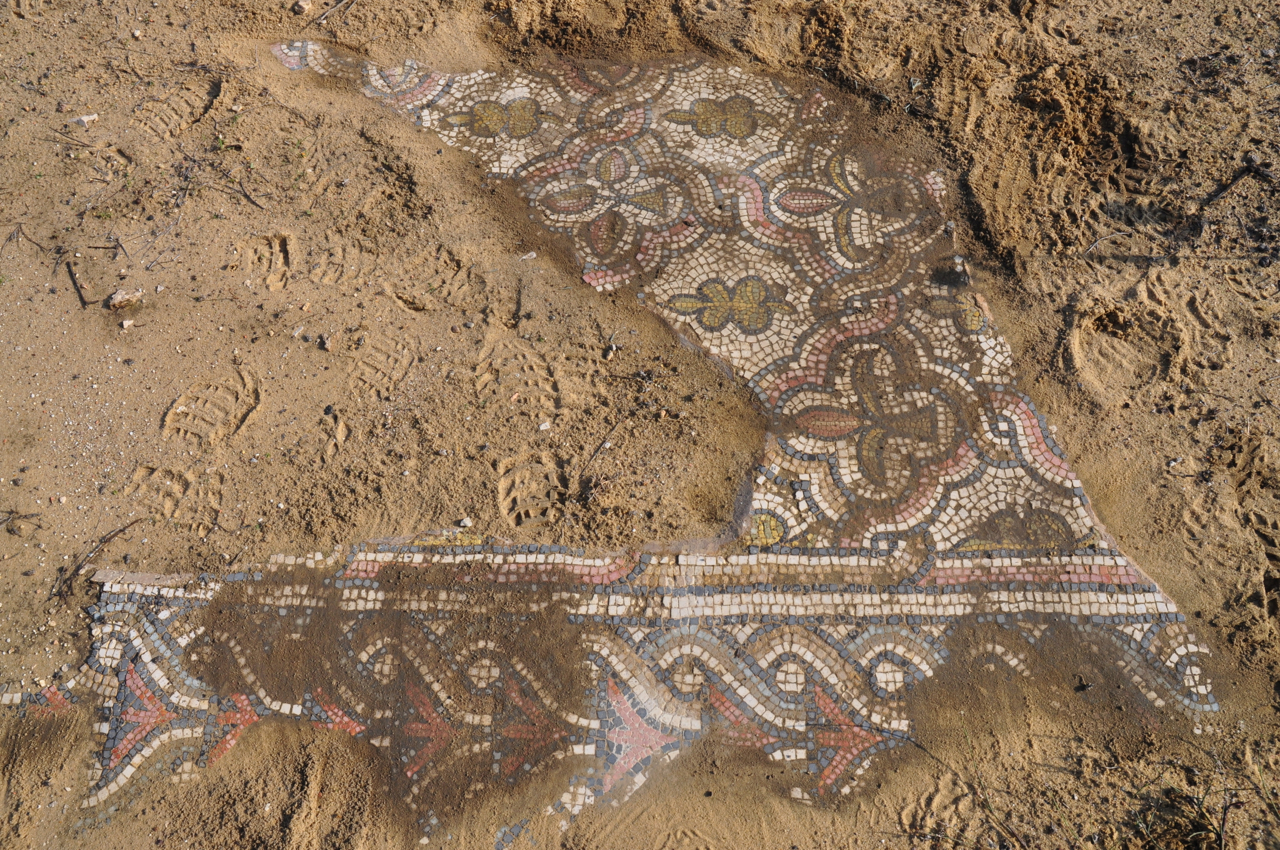
The floors are covered in mosaics in geometric and floral designs in white, black, yellow, green and red stone tesserae. The mosaics have been mostly covered with felt mats and sand to protect them.

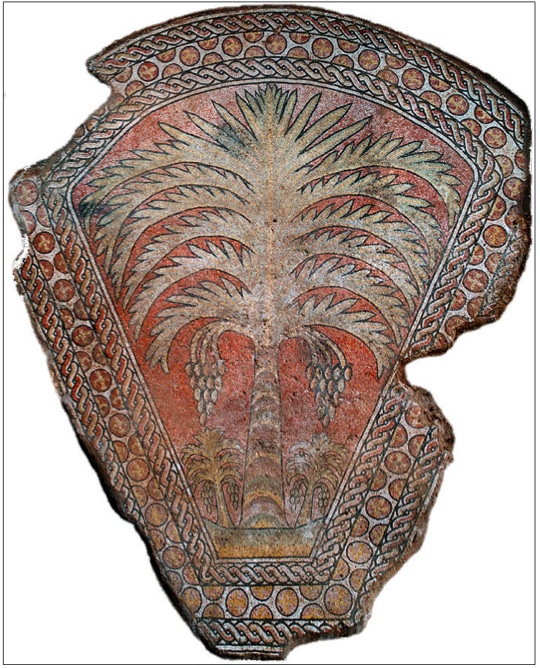
Kathisma palm mosaic from Arab period, IAA

One of the finest mosaics is from the Arab period, an ornate mosaic of a date palm in the southeastern corner. According to the Koran, Mary sat and rested under a palm during the onset of her labor.

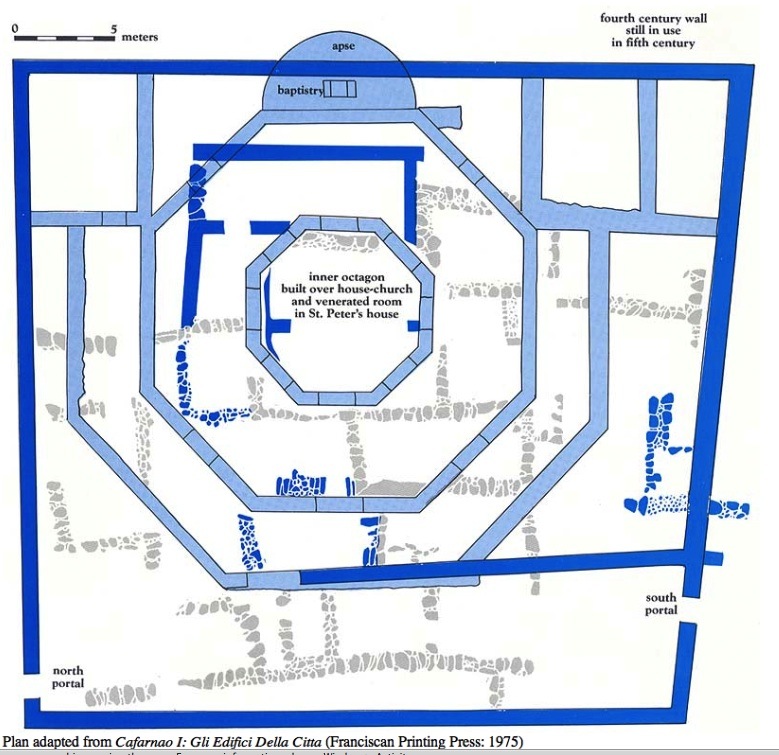
There are ruins of another octagonally shaped church at Capernaum. The remains of a 5thC church were uncovered that consist of a central octagon with eight pillars, an exterior octagon with thresholds still in situ, and a portico. Later an apse with a pool for baptism was constructed in the middle of the east wall. The central octagon was placed directly on top of the walls of Simon Peter’s house with the aim of preserving its exact location.

The floor of the portico is a geometric patterned mosaic. In the area of the external octagon, the mosaics represented plants and animals in a style similar to that found in the Basilica of the Heptapegon at Tabgha. In the central octagon, the mosaic was composed of a strip of flowers, a field of fish with small flowers and a circle with a peacock in the center.

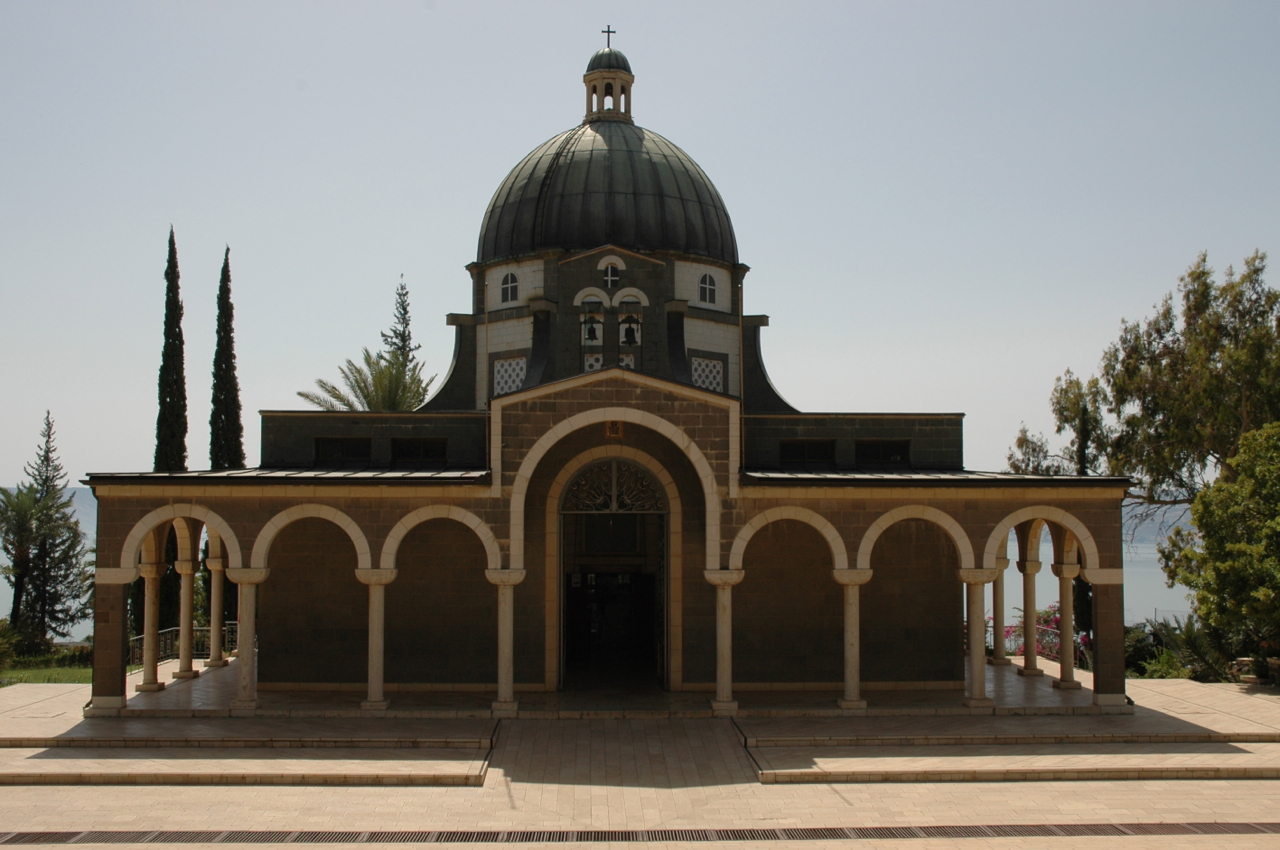
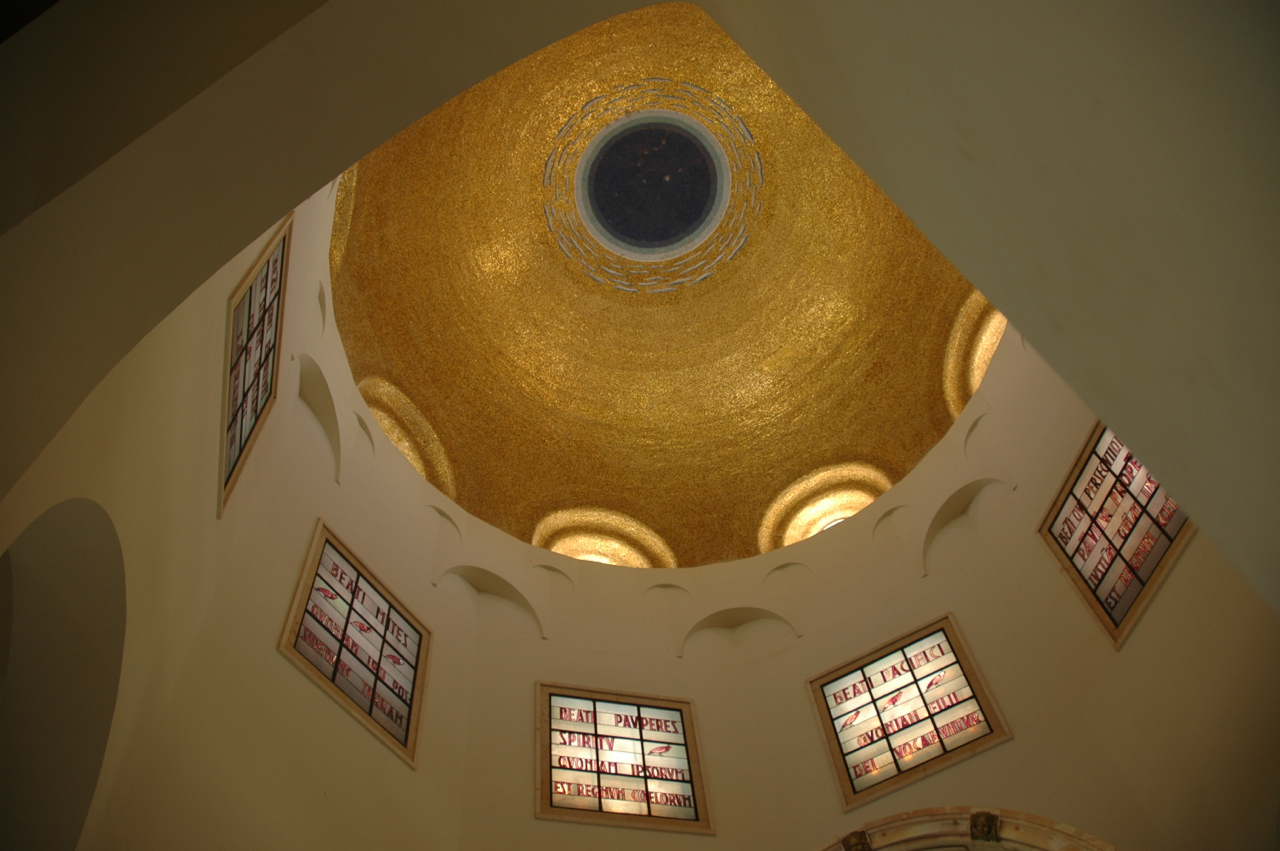
Another church that is octagon-shaped and crowned by a copper dome though enclosed in a rectangular envelope is the church on the Mount of Beatitudes. The church is from 1938 and was designed by the Italian architect Antonio Barluzzi in neo-Renaissance (Byzantine) style.

He chose the octagonal shape to match the eight beatitudes from the Sermon on the Mount (Matthew 5:1-5) and on the eight stained glass windows beneath the dome are verses from the Sermon.

There are only a couple of other churches that have been built over a rock, the Basilica of the Agony and the Basilica of the Heptapegon but neither is an octagon.

According to our understanding the Kathisma church was renovated in the 6thC and used as a mosque in the 8thC after which it was destroyed. A mihrab, or prayer niche facing Mecca was built into the southern wall of the outermost octagon. This means that the church was not destroyed during the Persian conquest and existed at the time of Abd el-Malik who commissioned the building of the Dome of the Rock, a martyrium in octagon shape over a rock – it may have been the inspiration for what has been called the earliest example of Islamic architecture.