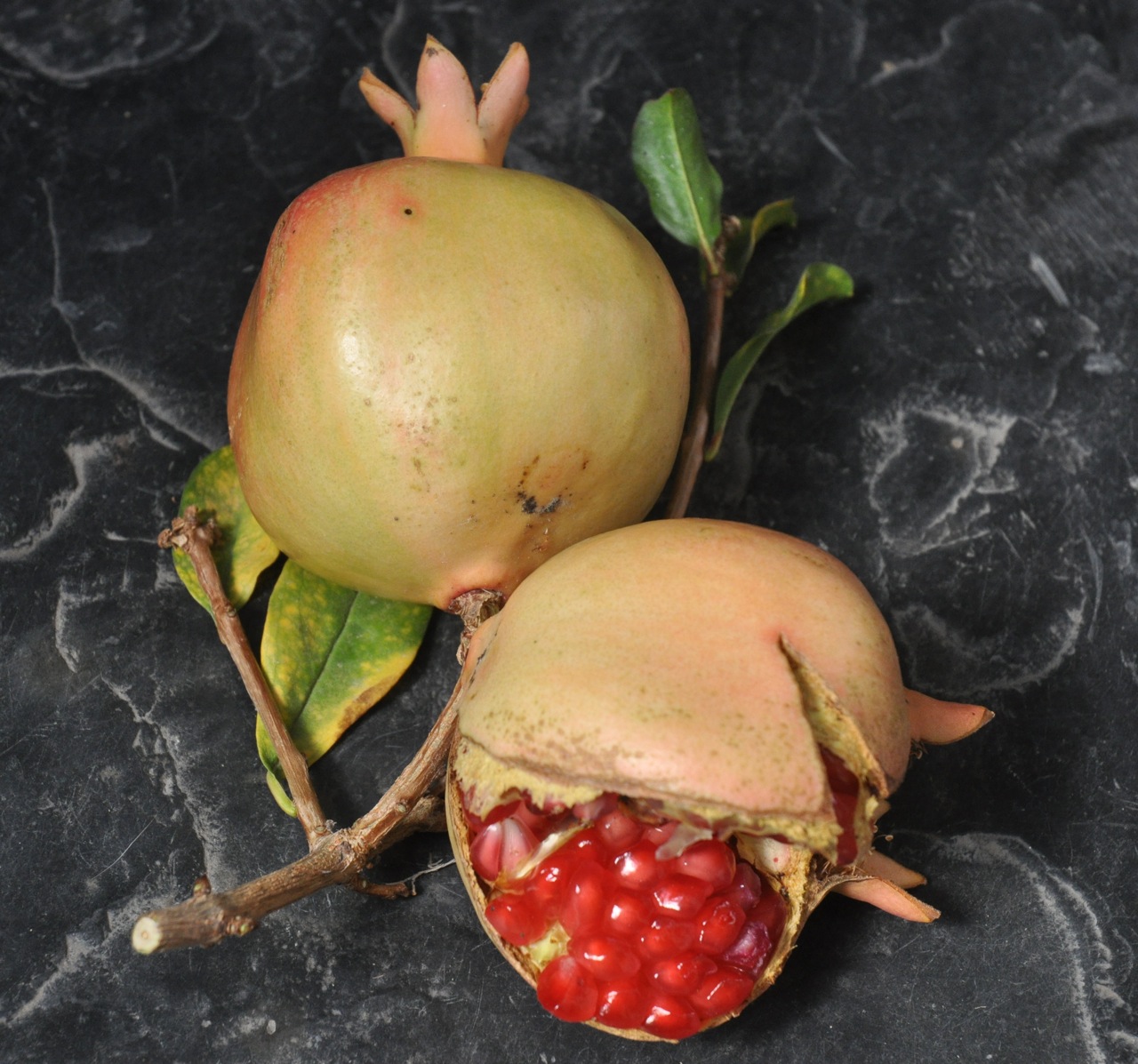
Pomegranates at Jewish New Year
2 Replies
I’m often asked by people who are planning a trip to Israel what they should do if they have a couple of days to see and experience Jerusalem. Of course, there are many answers, it really depends on what you are interested in. Assuming that this is your first visit, you’ll probably want to start in the Old City so here are my recommendations – note some sites charge an entrance fee.

First, drop by the Tourist Information Center at Jaffa Gate, in the Old City and get a free map and a list of sites to see; say hi to Jennifer, she’ll help by marking sites on the map for you and answering your questions. Then walk around, exploring the 4 Quarters, Armenian, Jewish, Muslim and Christian.
Another possibility is to take the Ramparts Walk starting at Jaffa Gate where you actually walk on the walls built in 1537 by the Ottoman Turkish sultan, Suleiman the Magnificent – looking in gives you a birds-eye view of the Old City, looking out gives you a view of the new city.
In terms of churches, I would visit the Church of the Agony/All Nations and the Garden of Gethsemane outside of the city walls, re-enter the Old City at Lions Gate, visit the Church of Santa Anna, a Crusader church with incredible acoustics (try singing Amazing Grace or other liturgical melody). Continue and you will come to Station I of the Via Dolorosa, follow the Via Dolorosa counting 8 stations to the Church of the Holy Sepulcher, the holiest site to Christianity, where Jesus was crucified and buried and according to Christian tradition rose again, stations IX to XIV are at the Church.
Walk through the Arab shuq and take a right at the Cardo to get to the Jewish Quarter. Visit the Wohl archaeological museum to get a feeling for Jerusalem in the Second Temple Period, in the time of Herod and Jesus. If you are interested in more archaeology, then visit the southern wall excavations at the Davidson Center; there is also a movie that describes life at that time.
Visit the Western Wall, the holiest site to Judaism, write your prayer on a paper and tuck it into a crack in the stones of the wall. Try to reserve a Western Wall Tunnel tour in advance, either on their website (if you know some Hebrew) at http://english.thekotel.org/VisitorInfo.asp?id=1 or you can call them at (02) 627-1333 between 8:30-17:00.
It’s worth taking a guided group tour of the City of David – exit the Old City through Dung gate, take a left and then right and the entrance is on your left. If you have “water” shoes and aren’t claustrophobic, you can even walk 45 minutes through Hezekiah’s Tunnel with water up to your knees (you’ll need a flashlight which you can buy at the site or use your cell phone), which is quite an experience.
You might want to walk up onto the Haram el Sharif to see the Dome of the Rock and al Aqsa mosque (the third holiest site to Islam) close up (the Muslim Waqf won’t allowed you to enter them unfortunately) but if so you’ll have to do it in the morning and it takes between 1/2 and 1 hour to pass through security at the entrance to the Western Wall Plaza. Make sure you have no religious articles, prayer books or Bibles and no Swiss Army knife, etc. with you – they will be confiscated.
The new Israel Museum is open after extensive renovations and it is now much easier to find your way (for more information check out my blog entry) – the Archaeology wing has been completely redone, the Ethnography section has been expanded and called Jewish Life and the Art gallery includes a new section on Israeli art. The museum includes the Shrine of the Book, where the Dead Sea Scrolls and other artifacts from Qumran are on display. From the same period, the Holyland model of Jerusalem is now housed on the museum campus. If the weather is cooperative, walk around and enjoy the sculpture garden. If you’re interested in archaeology, you can also visit the Rockefeller museum (on the same admission, there’s even a shuttle bus) which will get you back to the Old City.
For an overview of Jerusalem, there’s a red double-decker bus that takes you for a 2 hour audio tour (explanations in 8 languages) of the whole city:
http://city-tour.co.il/ntext.asp?psn=8375
The Arab shuq/market and the Mahane Yehuda market are great places to get a feel for Jerusalem. There’s the Ben Yehuda Street pedestrian mall, called the Midrahov, and at the bottom Zion Square and the pubs, restaurants and boutique galleries in Nahalat Shiva. There’s live music at the Yellow Submarine in Talpiot.
Explore the German Colony: for a local movie theater from the British Mandate period with restaurant/pub check out the Smadar; for artistic films, check Cinemateque. For music, dance and theater try the Mabada. There are plenty of places to eat in this neighborhood (including my house 8-))
All this without hiring a guide, but to be fair how about reading my post, Why hire a guide?
Driving along the shore of the Dead Sea on our way to Masada and Ein Gedi, I usually point out the cutoff to Nahal Dragot – there are some great hikes here if you are up to the challenge. In fact, Nahal Darga as it is also called, is a kind of test for Israelis.

From the center at Metzukei Dragot, there is an unpaved road (if you were to continue north you could go as far as Herodium), take the turn to a lookout point with a great view of the canyon, the deepest part of Nahal Darga and a hint of what awaits.

Returning to the main road and continuing westward we come to the start of the black trail. From there it is a short hike to the Murabat Caves, 3 caves, side by side on the northern cliff. It was here that letters signed Bar Kosiba were found, evidence that the mythical leader of the Bar Kochba Revolt against the Romans in 132-135CE did in fact exist.
Letter of Shimeon bar Kosiba to Yehonathan, son of Be’ayan:
Peace! My order is that whatever Elisha tells you, do to him and help him and those with him. Be well.
From here it’s about a 150 m. descent to the start of the canyon. It will take 4-6 hours (4 km) to hike this part of the narrow canyon with more than 50 meter high walls, dry waterfalls and pools of water in natural craters (note there are places you will have to swim across). At the end of the hike the wadi widens and crosses highway <90> about 1½ km from the Mezuke Dragot cutoff, estimate that to complete the hike will take a full day. There are metal D-shaped rings hammered into the rock in places to help you on the descents but it’s probably also worth having at least 20m. of rope. A guide is recommended.
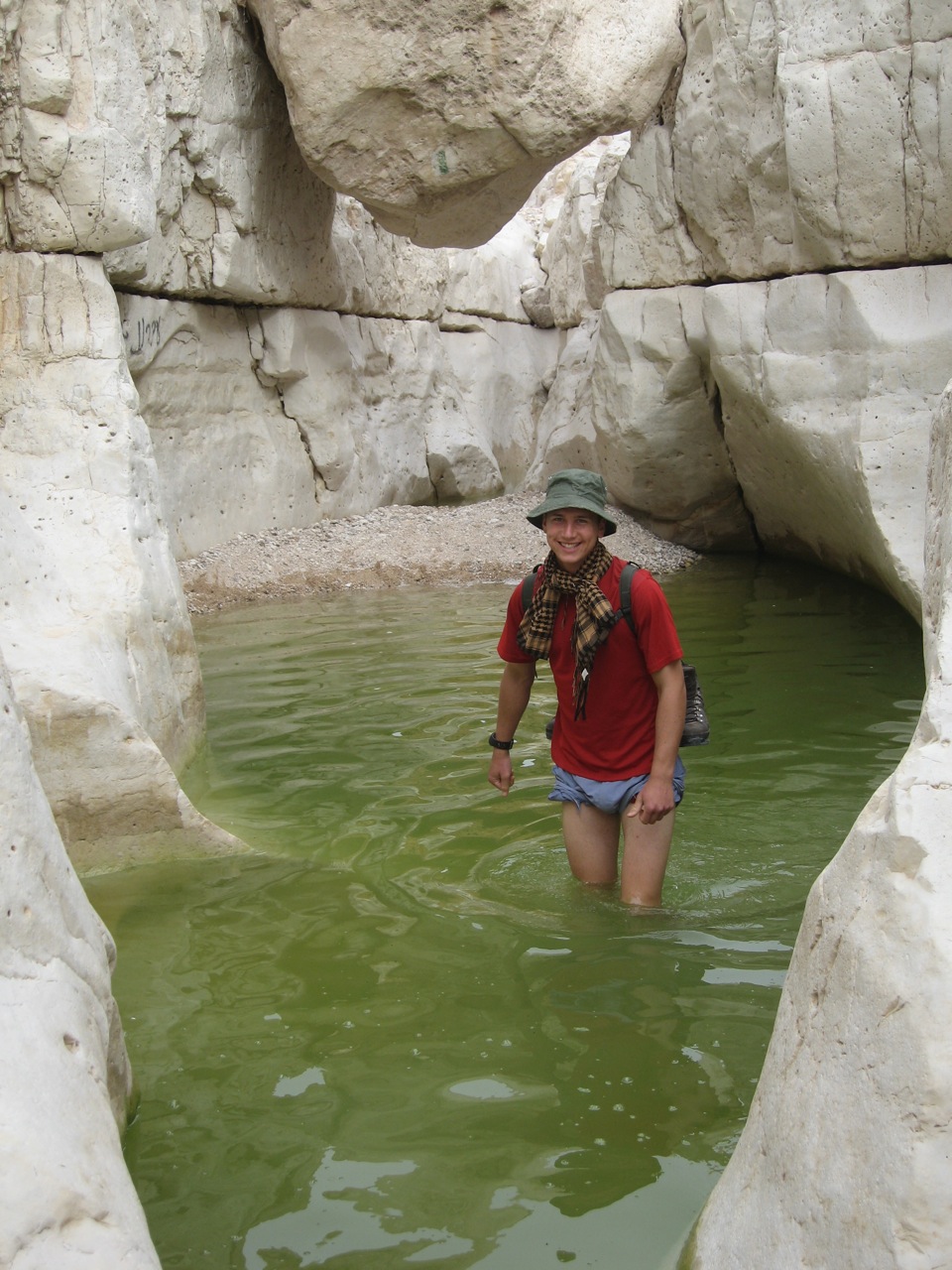
Amitai in Nahal Darga, photos AdirChai Haberman-Browns, used with permission.
You should also read this article http://www.jpost.com/Travel/AroundIsrael/Article.aspx?id=135713
One of the most exciting new installations that I saw in the Israel Museum’s renovated archaeology galleries was the display of a part of the laconicum (hot dry room) next to the calderium of the Roman bath house that was found at Lower Herodium. I arrived to see the museum staff putting the final touches to the installation that shows clearly all the components: the hypocaust, the underfloor heating system where the floor is supported by stone pillars (pilae stacks) and the clay tubes in the walls to let the heat pass through; the plasterwork and fresco paintings on the wall; the mosaic floor.
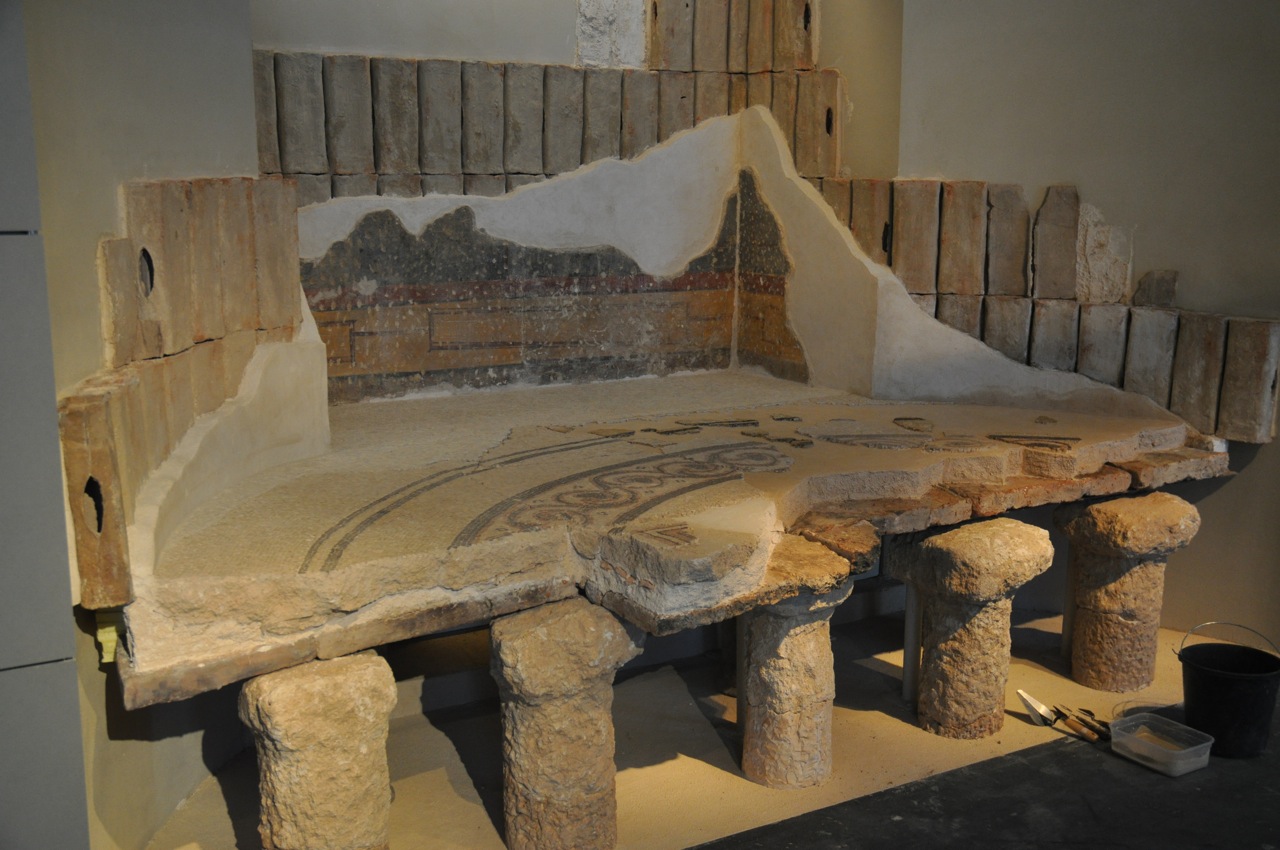
 Nearby is another square mosaic floor with a geometric, intertwined circle and pomegranates (one of the 7 species that grows in the land of Israel and characteristic Jewish motif of this period) in each of the corners. You can see this mosaic on site at Lower Herodium in the main tepidarium if you climb onto the roof of the bath house (though I learned that the one in the museum is the original and on site is a copy). If you look to the right, there is another mosaic in the small tepidarium designed as an opus sectile pattern of tiles.
I didn’t see any other artifacts from Herodium being readied for display – I was hoping to see the 3 sarcophagi that were discovered.

A newly acquired piece of art, a polished stainless steel hourglass 5 meters tall stands in the plaza at the highest point of the Israel Museum campus. Commissioned by the museum from the London-based Indian sculptor Anish Kapoor it is called “Turning the World Upside Down, Jerusalem”. Kapoor is known for creating visually striking works that inspire interaction. Depending on where you stand you can frame the museum’s buildings, the trees and the sky in the polished surface and the effect is to invert the images, a play on the duality of the heavenly and earthly Jerusalem. And that’s what I did and captured in this photograph (note that the photo is upside down).

Today I had the opportunity to visit the Israel Museum before its official opening to the public on July 26th. There have been a lot of changes, to the tune of $100 million and these improve the visitor experience immensely.
James Carpenter Design Associates built new entry pavilions at the entrance to the museum that are connected by a covered “route of passage” to a new gallery entrance pavilion which acts as the central hub giving access to the Museum’s 3 collection gallery wings, Archaeology, Judaica and Art, from a main Cardo. Each of the new buildings is basically a glass cube shaded by cast terracotta louvered shade panels that diffuse the bright Mediterranean light and still allow the visitor a view of and interaction with the exterior. With this design the new pavilions resonate with Alfred Mansfeld and Dora Gad’s original modular and modernist design. I am pleased to offer an architecturally focussed tour of the new Israel Museum, including highlights like the Shrine of the Book, that has been called “a milestone in the history of world architecture”.

In the above photo, the view from the Carter Promenade looking back towards the entrance pavillions; below, looking up the hill to how the new gallery pavillion fits into the plan.

Light and glass comprise the firm’s signature architectural focus. The passageway has a wall of glass and is covered by a swatch of translucent glass panels that were designed and made especially for the project. Outside above the passageway a stream of water cascades down the hill over the glass panels. During the day the water and glass let light into the passage which animates the wall with a moving pattern and at night the light illuminating the passageway lights up the water stream above.
Efrat-Kowalsky Architects redesigned the interior gallery spaces of the existing buildings and the way the museum has organized the art and artifacts suggests some interesting connections among objects and between the particular and the universal. The emphasis is on what cultures have in common and there is an attempt to place Jewish history and practices in a broader context.
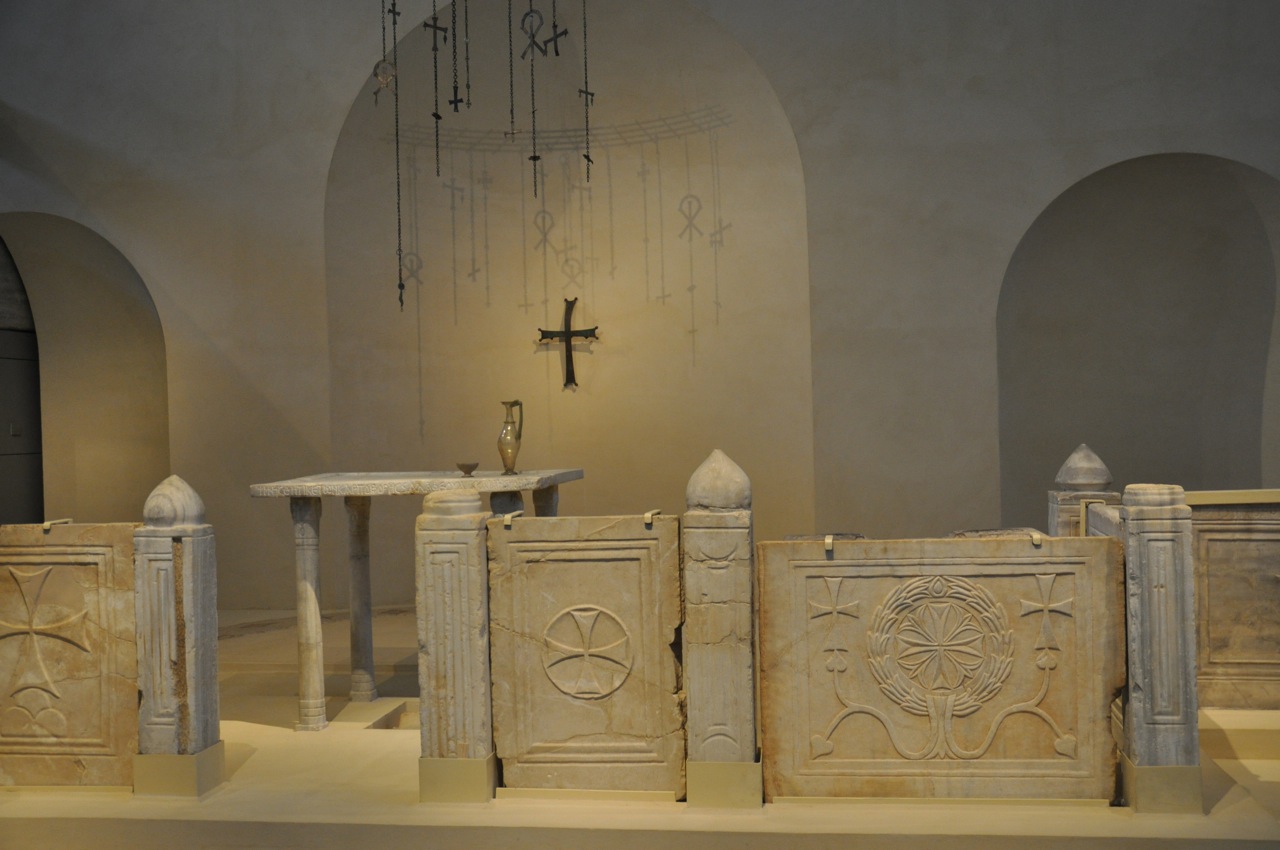
One example is a very impressive new installation in one large room that focuses on the 5th to 7th Century where part of a restored synagogue is displayed, the facade of the interior of the synagogue with its particular decorations and objects and a beautiful mosaic floor. Next to it a Byzantine church and across the room the michrab or prayer niche from a mosque. Roughly contemporary structures, they are placed in a way that highlights both their distinctiveness and their commonality.

The new galleries and displays are stunning. The museum is a wondrous place to explore.
 Israel Tours