Author Archives: Shmuel Browns

Unknown's avatar

About Shmuel Browns

I am a tour guide, licensed by the Israel Ministry of Tourism. I do tours throughout Israel, personalized to your interests, time and budget.

Photo of the Week – Dead Sea

Last week I posted a photograph of a natural sculpture on the cliffs above En Gedi. If you continue south along the Dead Sea you come to the area of Biblical Sodom and Gemorah, a rock salt mountain. A short hike up gives a great view of the Dead Sea. You can click on the image for a larger view (which may take some time to load depending on your Internet connection). Please share this post with your friends by clicking on the icons at the end of this message.

The technical details – the photo was taken with a Nikon D90 (digital SLR) camera with a Nikon 18-70mm lens on December 16 (ISO 200, 25mm, F9 at 1/320 sec).

For more information check out my post at https://israeltours.wordpress.com/2009/12/30/mount-sodom/

Photographs on this website are © Shmuel Browns (unless marked otherwise) – if you are interested in purchasing one of my photos or using one of my photos for your own project please contact me.

Roman Mausoleum

Because our son Amitai is training new recruits for the Border Police I attended the swearing-in ceremony at Tel Hadid. Hadid is mentioned in Nehemiah 7 in the list of cities to which Jews returned from the Babylonian exile. In excavations at Tel Hadid archaeologists found a typical four room house,  numerous potsherds from the Iron Age (9th-8th centuries BCE) and two complete tablets, written in cuneiform, Assyrian legal documents one recording the sale of land dating from 698BCE and the other a promissory note from 664BCE. The tablets are evidence that with the conquest of Judea by Sargon II foreigners from Babylonia were settled at Hadid.

Continuing north past Tel Hadid along highway 444 (which follows the route of the Via Maris) is a small stone building, a Roman mausoleum, amazingly intact and graced with a magnificent temple-like façade in classical style, two columns with Corinthian capitals framing a single entrance (closed originally with a stone door, note the recesses on the doorposts for a mezuza).

According to the style of the building and the remnants of two sarcophagi (stone coffins) in the floor of the main chamber, archaeologists conclude that it was built in the beginning of the 4th century CE for a wealthy landowner and his wife, although their identities remain a mystery.

A second chamber to the left is a columbarium with about 60 “pigeonholes” where doves were raised for sacrifice to Aphrodite. Of interest is a cantilevered stone staircase leading up to the opening at ceiling level.

Later the Muslims added a michrab, a niche in the southern wall signifying the direction of Mecca, and dedicated the site to Nebi Yihya, associated by local tradition with John the Baptist. In this way, the building was preserved through the ages.


Photo of the Week – Ein Gedi

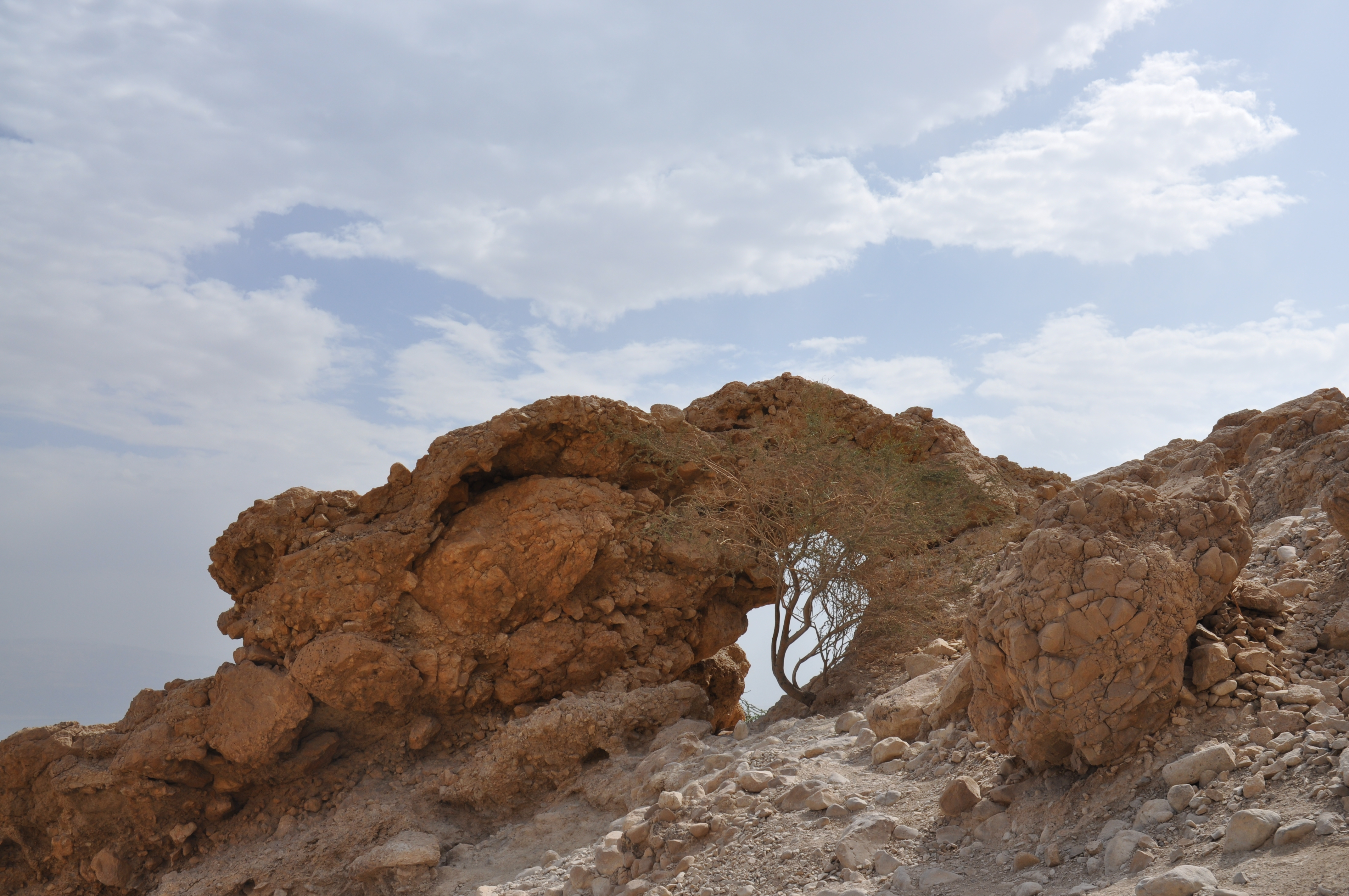
Last week a shot of sinkholes on the shore of the Dead Sea with the cliffs above En Gedi in the background, this week a shot of a hole in the rock, a natural sculpture on the cliffs. You can click on the image for a larger view (which may take some time to load depending on your Internet connection). Please share this post with your friends by clicking on the icons at the end of this message.

The technical details – the photo was taken with a Nikon D90 (digital SLR) camera with a Nikon 18-70mm lens on October 27 (ISO 200, 25mm, F10 at 1/400 sec).

For more ideas on other hikes in the area check out my post at https://israeltours.wordpress.com/hiking-israel/.

Photographs on this website are © Shmuel Browns (unless marked otherwise) – if you are interested in purchasing one of my photos or using one of my photos for your own project please contact me.

Stone Age Figurines discovered near Jerusalem

Here in Israel you can feel the seasons changing and the focus is directed towards Rosh Hashana, the Jewish New Year when we read the story of the Sacrifice of Isaac. God commands Abraham to take his son, his only son, the one he loves and sacrifice him as a test of Abraham’s faith. At the last moment an angel stops Abraham, who looks up and sees a ram caught in a thicket by its horns and sacrifices it instead.

Road work continues in Israel to widen the highway just outside Jerusalem on the way to Tel Aviv. Whenever there is new construction archaeologists have to do a salvage dig. The excavations at Tel Moza uncover stone figurines in the shape of animals estimated to be 9500 years old (pre-Pottery Neolithic period).

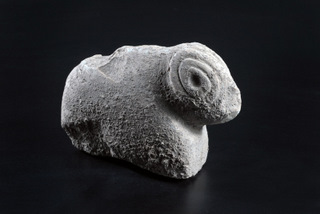
According to Anna Eirikh and Dr. Hamoudi Khalaily, directors of the excavation at the site on behalf of the Israel Antiquities Authority, “The figurines, which are 9,000-9,500 years old, were found near a large round building whose foundations were built of fieldstones and upper parts of the walls were apparently made of mud brick. The first figurine, in the shape of a ram with twisted horns, was fashioned from limestone and is c. 15 cm in size. The sculpting is extraordinary and precisely depicts details of the animal’s image; the head and the horns protrude in front of the body and their proportions are extremely accurate. The body was made smooth and the legs of the figurine were incised in order to distinguish them from the rest of the body. The second figurine, which was fashioned on hard smoothed dolomite, is an abstract design; yet it too seems to depict a large animal with prominent horns that separate the elongated body from the head. The horns emerge from the middle of the head sideward and resemble those of a wild bovine or buffalo”.

   Photo credit: Yael Yolovitch, courtesy of the Israel Antiquities Authority

The Pre-Pottery Neolithic B period (the eighth millennium BCE) is considered one of the most fascinating chapters in the history of humankind. There were many changes that shaped human society for thousands of years – the transition began from nomadism, based on hunting and gathering, to a life based on permanent settlement, farming, domestication of animals, even preliminary architectural planning. These figurines are a connection to our past as we work to create a better future. May this new year be a year of blessing and peace for all the people in this region.

Shmuel Browns

September 12, 2012

Shmuel Browns's avatar

In line with the tradition to contemplate what things can be improved and remake oneself for Rosh Hashana (Jewish New Year) I have decided to change the theme of my blog. I am writing this short post to alert you. When you next go to my website/blog, Israel Tour Guide | Israel Tours, you will see that it has a very different look, appropriately called Twenty Twelve (the current year in the Gregorian calendar). This theme is brand new and provides some powerful new capabilities which I will be able to take advantage of in the coming weeks. I like that it is a modern-looking, clean design. Leave a comment to let me know what you think and/or click Like (if you do).

What Tree is the Sycamine?

This blog post is based on an email conversation with Revd Stephen Williams of Harlington church in England.

Dear Shmuel,

I know you are interested in plants, and take great care to label photos of them in your blog. In Luke 17:6 Jesus speaks of a sycamine tree:

“If you had faith the size of a mustard seed, you could say to this sycamine tree, ‘Be pulled out by the roots and planted in the sea,’ and it would obey you.“

Might you have a photo (or know where you can take one) I can show my congregation here in UK?
It seems to be different from the Sycomore and the Mulberry. What do you think?


Hello Revd Williams.

Fascinating. I’m familiar with the Mulberry tree (Morus Nigra or Alba), in fact, we have one growing in our backyard here in Jerusalem. I have photos of a large, old Sycomore tree (Ficus Sycomorus) that I shot in a park at the southern entrance to Netanya. This is the tree described in Luke 19:4, συκομορέαν (sukomoraya) which is translated as sycamore-fig and this seems to be the tree that Zacchaeus, the tax collector climbs into.

Sycamore figHere is a closeup shot showing the fruit.

Your question intrigued me so I contacted the Jerusalem Botanical Garden and their head scientist, Dr. Ori Fragman-Sapir. He replied that he is not familiar with a sycamine tree – we don’t know what tree Luke was referring to.

So I looked up sycomore in the dictionary, http://en.wiktionary.org/wiki/sycomore:

Etymology

Circa 1350, from Old French sicamor, from Latin sycomorus, from Ancient Greek συκόμορος (sukomoros, “fig-mulberry”), from σῦκον (sukon, “fig”) + μόρον (moron, “mulberry”). Possibly influenced by Hebrew שִׁקמָה (shiqmah, “mulberry”).

I think the translation above that shiqmah is mulberry is a mistake. The translation of shiqmah is sycamore(-fig), mulberry is tut in Hebrew.

Noun

sycomore (plural sycomores)

1.    a type of figFicus sycomorus, native to the Middle East; the sycamore tree of the Bible.

Usage notes

Sycomore is an obsolete spelling of sycamore that hearkens closer to the word’s Greek roots. Some writers have used the more Hellenic sycomore when referring to the Biblical tree to distinguish it from other trees now called sycamore.

The Ficus sycomorus, the mulberry (Morus nigra and alba) and the fig (Ficus carica) are related, they belong to the same family Moraceae.

In the Hebrew Bible there are many references to shiqmah which seem to refer to the same sycamores, see

Psa 78:47 He destroyed their vines with hail, and their sycamore-fig trees with driving rain.

Amo 7:14 Amos replied to Amaziah, “I was not a prophet by profession. No, I was a herdsman who also took care of sycamore fig trees.

1Ki 10:27 The king made silver as plentiful in Jerusalem as stones; cedar was as plentiful as sycamore fig trees are in the lowlands. See also 2Ch 1:15 and 2Ch 9:27

1Ch 27:28 Baal-Hanan the Gederite was in charge of the olive and sycamore trees in the lowlands; Joash was in charge of the storehouses of olive oil.

Isa 9:10 “The bricks have fallen, but we will rebuild with chiseled stone; the sycamore fig trees have been cut down, but we will replace them with cedars.”


Dear Shmuel,

You are a star. You have addressed the problem better than I could have hoped, thinking in the same analytical way I like. And the advice of Dr. Ori Fragman-Sapir is an added bonus, naturally.

Thank you so much. As you may have spotted in your searching, there is very little objective addressing of the problem out there – all the writers seem to have fudged it somewhat. But you have clarified a lot. I shall read sycaminos as fig-related, just as sycomorus is, and maybe even the same tree – though I see in Strong’s Concordance that the classical writers knew both words – Luke wasn’t just making the word up, clearly!

The tree in the park is perfect for imagining such a tree being picked up and relocated in the sea. One of the gorgeous hyperbole Jesus seemed to love perhaps?  The other interpretation is that he chose this tree as an illustration not because of its size but because of the bitterness of the fruit, which I wasn’t so convinced by, hence why nailing it down botanically is crucial.


Dear Revd Williams,

You are right, in Luke 19:4 it’s συκομορέαν (sukomoraya) which is translated as sycamore-fig (that’s the photo I emailed you).

But in Luke 17:6 the Greek is συκαμίνῳ (sukamino) which Strong defines as “sycamine tree, having the form and foliage of the mulberry, but fruit resembling the fig”. I checked Avi Shmida’s guide book of Trees of Israel and he mentions a tree, Ficus pseudo-sycomorus which has the leaves of a mulberry and fig-like fruit – this seems to be a better candidate for sycamine. I did find two images at http://www.wildflowers.co.il/english/plant.asp?ID=2354. I will keep my eyes out for a pseudo-sycomorus which according to Shmida grows near Eilat.

Whatever the tree, to taste whether the fruit is bitter you will have to make the trip to Israel. Since you are interested in trees and plants of the Bible I mention the five fruit trees that are listed in the Bible as native to the land of Israel: grape and pomegranate – these ripen by late summer and early fall, there is freshly squeezed pomegranate juice available in the markets and various pomegranate wines; figs – are growing wild in the hills of Jerusalem and you can pick them right off the tree; olive – there are some venerable, old trees I can show you in the Garden of Gethsemane and majestic date palms in the Jordan valley. You can also taste the fruit of the carob tree (St. John’s bread), the almond and pistachio (see Genesis 43:11, where Jacob tells his sons to take of the best products of the land  to Egypt) and the Jujube tree perhaps from which the crown of thorns was fashioned (ziziphus spinachristi). And that concludes my brief treatise of trees in the Bible but you have to come and see for yourself.

Blessings from Jerusalem,
   Shmuel

I updated Dr. Fragman-Sapir about my conclusion and received this email in response.

Ficus palmata is the new and correct name for Ficus pseudo-sycomorus, so it is the same plant.
Dr. Ori Fragman-Sapir

There is a column, Plant of the Month on their website with an article about Ficus Palmata that is an interesting read.

Related articles