Author Archives: Shmuel Browns

Unknown's avatar

About Shmuel Browns

I am a tour guide, licensed by the Israel Ministry of Tourism. I do tours throughout Israel, personalized to your interests, time and budget.

Bethlehem

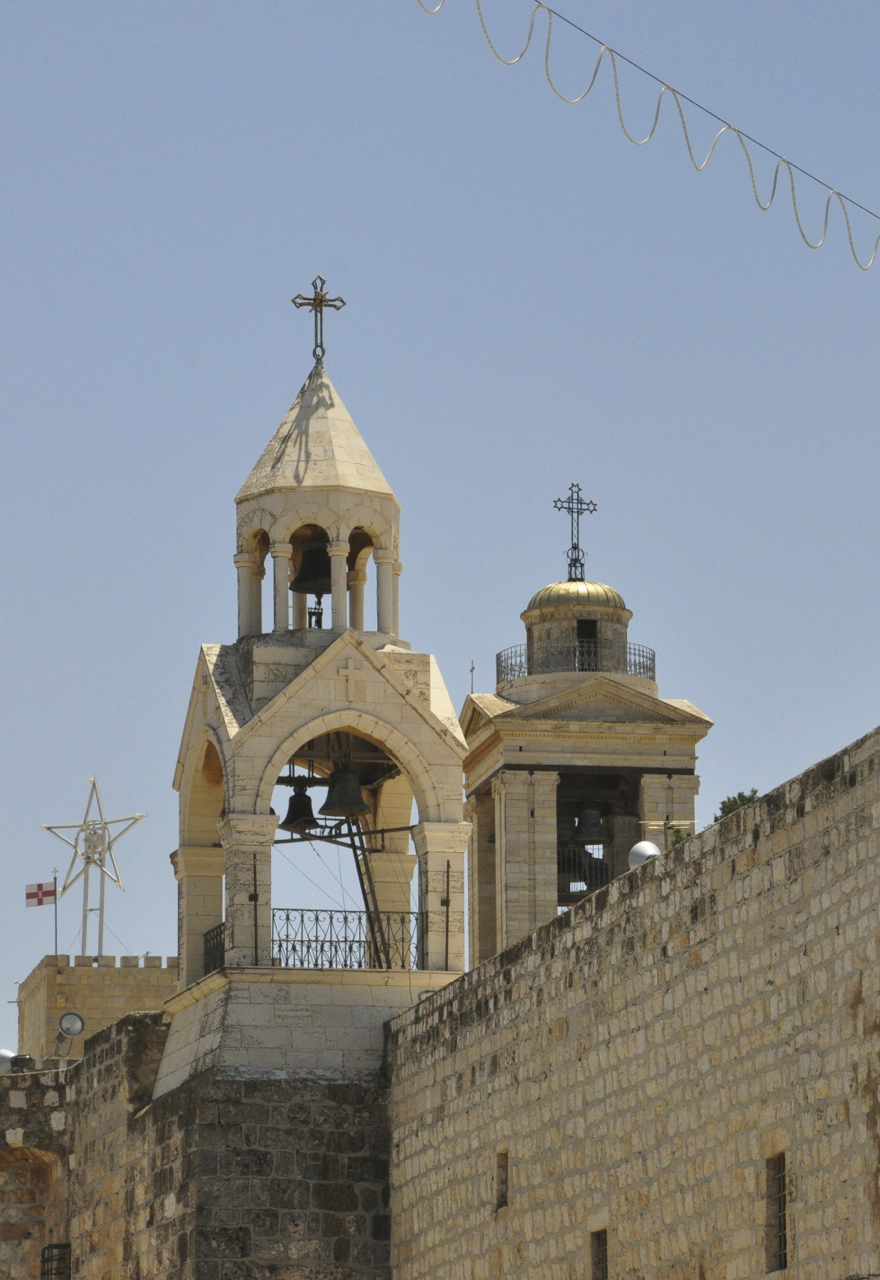
Nativity bell towersBethlehem is a city in the Palestinian Authority with a population of 21,947 and another about 25,000 in the neighboring towns of Beit Sahour and Beit Jalla. The majority (72%) in the district are Muslim today. Christians in Bethlehem constitute less than 15% of the population (Fifty years ago, Christians made up more than 70% of the population). In the Hebrew Bible, the city is described as the birthplace of King David, in the New Testament, as the birthplace of Jesus, and hence is a center of Christian pilgrimage. Although Israelis are not allowed by Israeli law to enter areas of the Palestinian Authority, I have authorization as an Israeli tour guide to take foreign tourists to Bethlehem and Jericho.

The main attraction in Bethlehem is the Church of the Nativity which stands at one end of Manger Square facing the Mosque of Omar. On the sides of the square are restaurants, souvenir shops, and a modern building that houses the Tourist Information Center, a bookstore, a restaurant and an exhibition hall which currently has a display of creches, the models of Jesus’ birth in the manger from Christian communities around the world, each in their own native style.
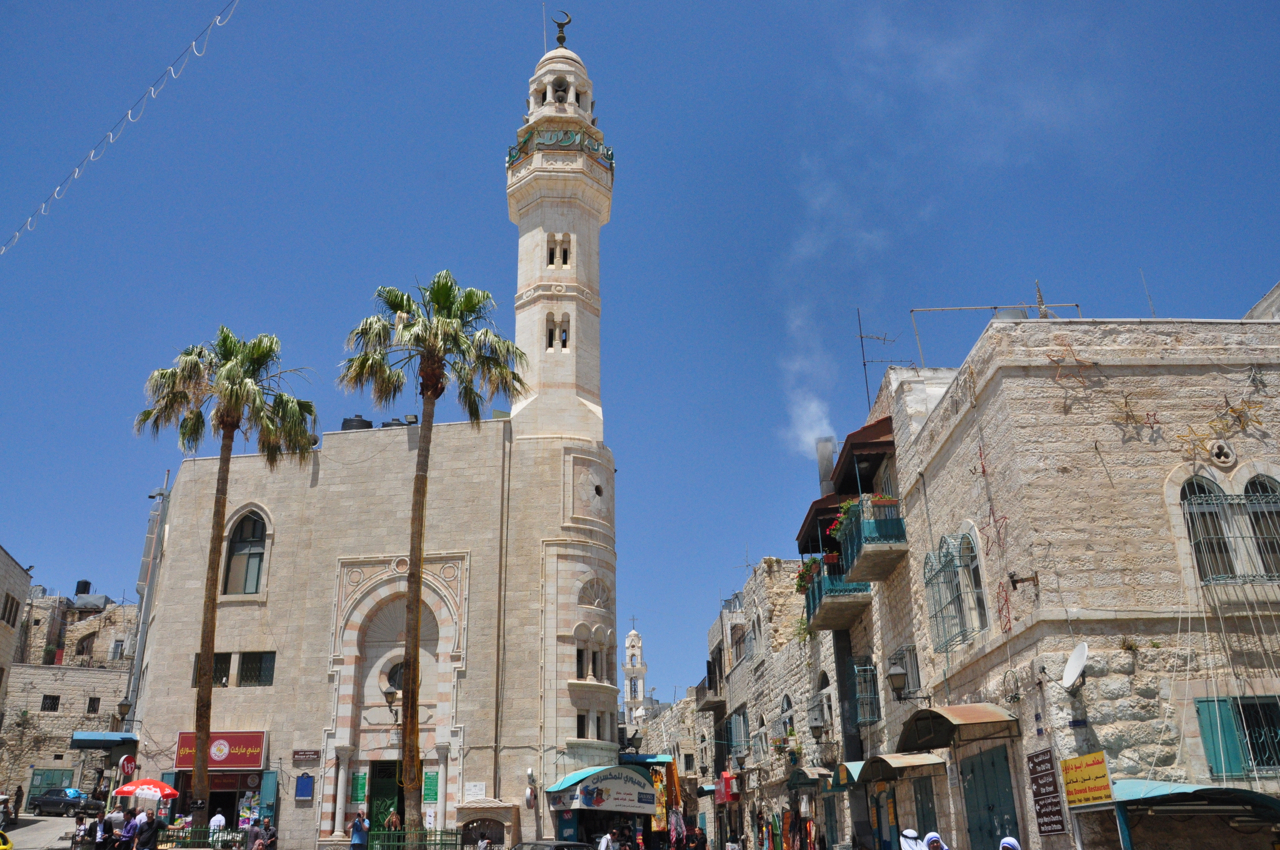
Mosque Omar, Manger Sq

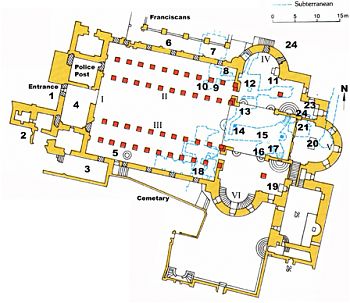
The Church of the Nativity was begun in 327 CE by Emperor Constantine and his mother Helena over the cave that marks the birthplace of Jesus as told in the Gospels of Mathew and Luke; the sanctuary had an octagonal floor plan centered directly above the cave and was completed in 339 CE.
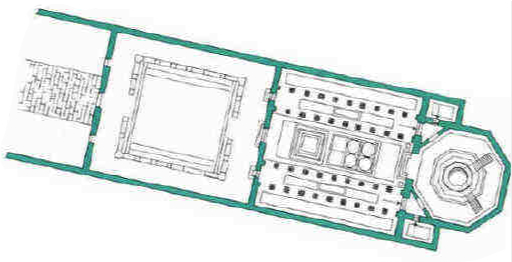
Nativity pre529

Nativity todayThis church was destroyed by fire during the Samaritan Revolts in 529 CE. Justinian rebuilt a new basilica in 565 CE similar to the original, making it one of the oldest surviving churches.  In this plan, the octagonal sanctuary was replaced, being enlarged to three apses. Since then the church has had numerous additions, including its prominent bell towers. The Church of the Nativity is a UNESCO World Heritage Site, the first to be submitted by the Palestine Authority.

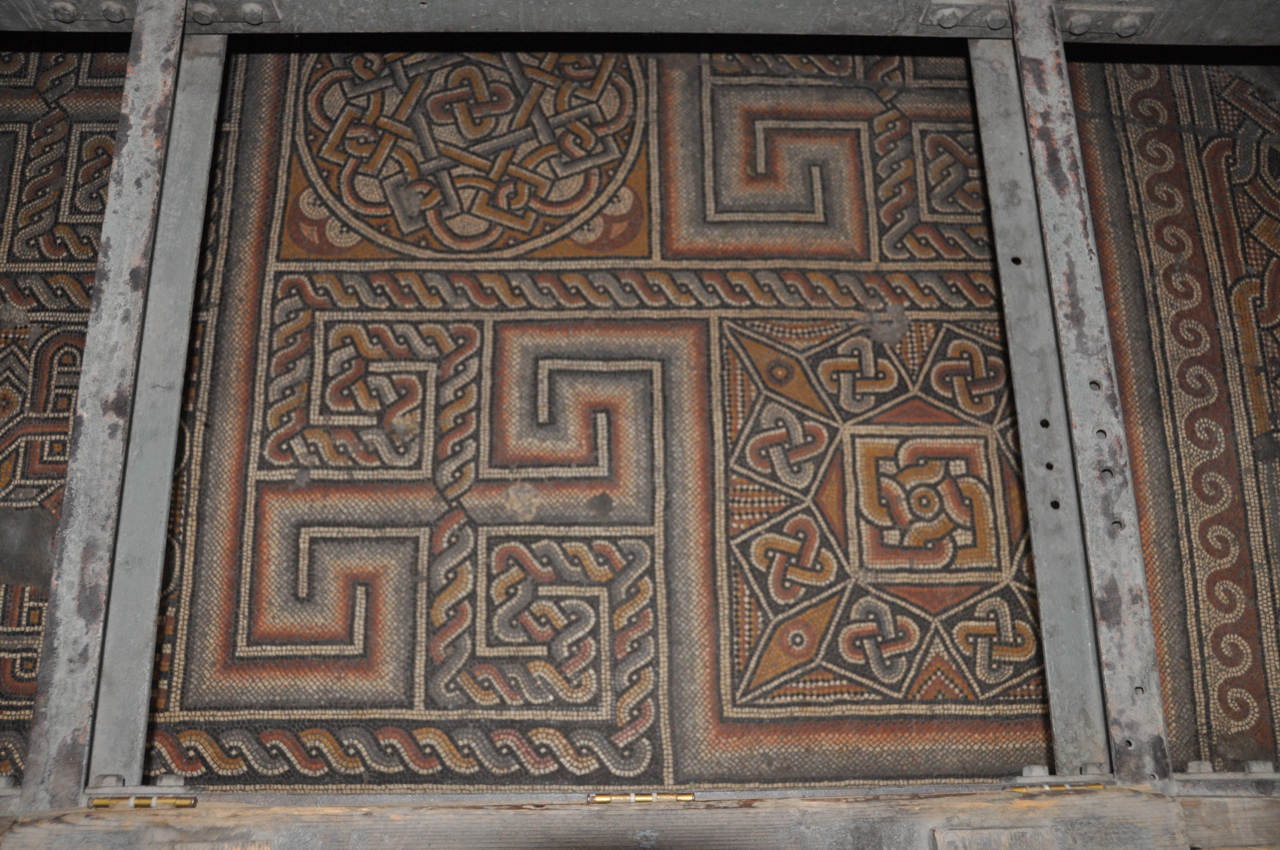
Wooden trap doors give access to portions of the original geometric floor mosaics that survive from Constantine’s church.
C Nativity mosaic

Twice the church was spared, by the Persians during their invasion in 614 CE because, according to legend, they were impressed by a representation of the Magi — fellow Persians — that decorated the building. In 1009 the Muslims prevented the application of el Hakim’s decree ordering the destruction of Christian monuments because, since the time of Omar, they had been permitted to use the south transept for worship.
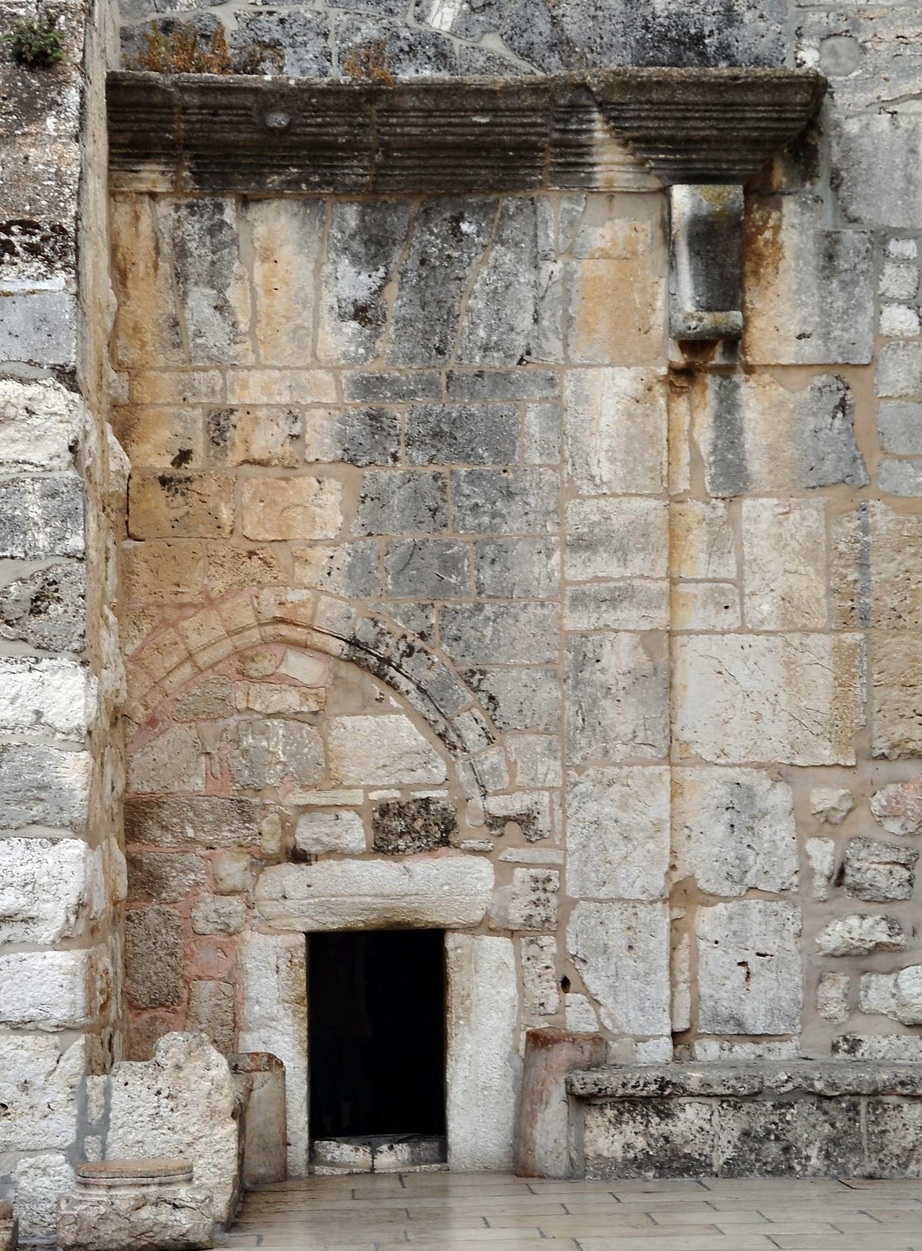
Entrances Church of NativityJustinian’s building had three imposing doorways of which only the central one is now in use (the left entrance is blocked by a buttress, the right by an Armenian hall for pilgrims). The one remaining doorway has been severely constricted – in the Crusader period, it was lowered with a Gothic arch; after 1515, the entrance was further reduced to prevent looters entering with horses and wagons – today it’s called the Door of Humility. Under Crusader rule the church was comprehensively redecorated, the interior walls  covered with gold mosaics. and a unique assembly of Crusader art was painted on the red limestone columns. Access to the grotto is via a pair of Crusader Gothic doorways on either side of the raised sanctuary, the bronze metal doors and baptismal font are from Justinian.

Beside the church is an elegant medieval cloister which was restored in 1948 by Barluzzi. The adjoining Church of St. Catherine is built in a more modern Gothic revival style. Beneath the church is a series of caves where St. Jerome lived and worked on the Vulgate, his translation of the Bible from Hebrew into Latin (having previously translated portions from the Greek Septuagint which came from Alexandria) from 384 CE.

From Bethlehem you can drive east through Beit Sahour to Shepherd’s Field, the site where the shepherds saw the Star of Nativity. There are two rival locations, one Greek Orthodox and the other Franciscan. Both sites have been excavated, and there have been churches and monasteries on both sites since the 4th century. This area is also believed to be where Ruth the Moabite gleaned in the fields of Boaz behind the harvesters. Ruth married Boaz and had a son Oved, the father of Jesse who was the father of King David.

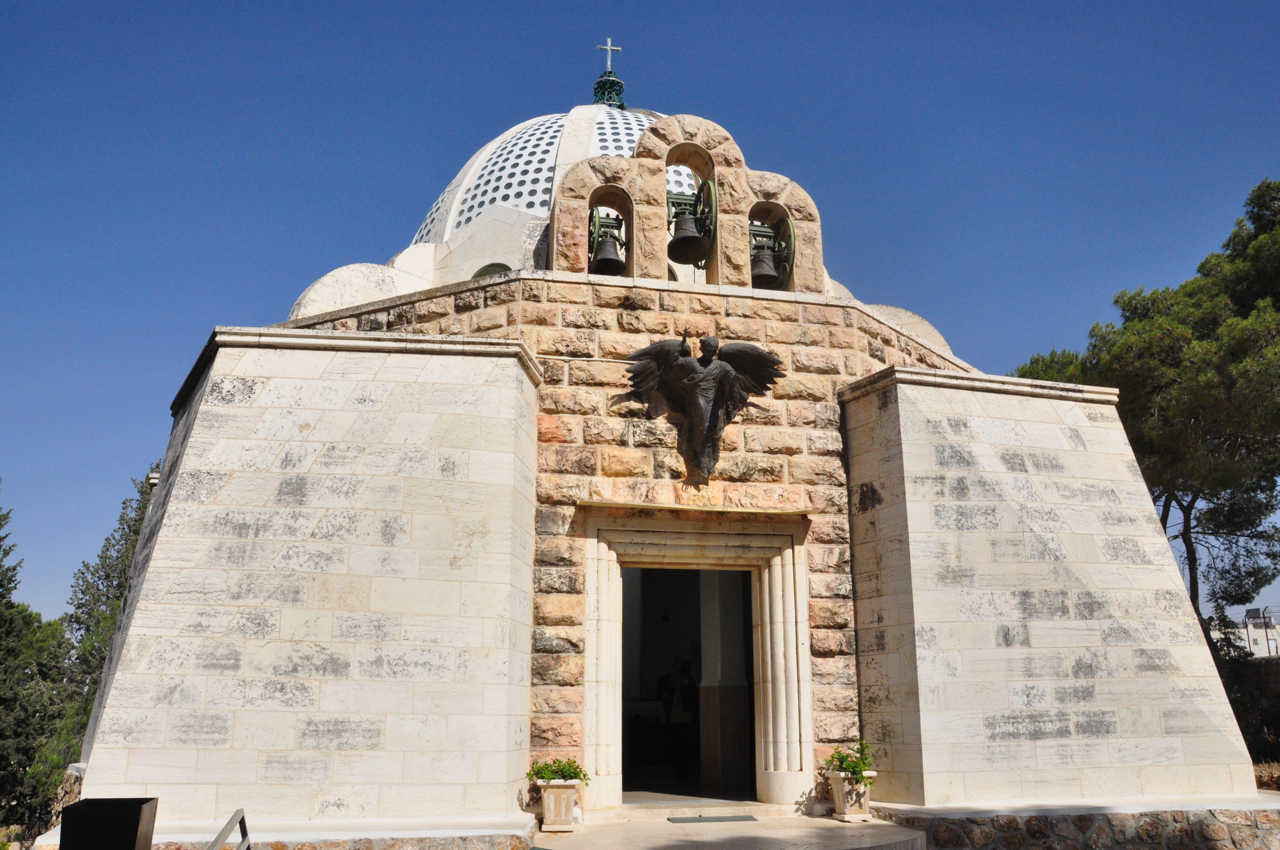
The Greek Orthodox site is at Kanisat al-Ruwat and includes a cave used as a church from the 4th century, of which the barrel-vaulted roof (5th century) still survives; today, a new large church has been built on top. About 600m to the north is the Franciscan site with a low natural cave or rock shelter that is used as a modern chapel. Above is a modern church built by Barluzzi in 1954, shaped like a tent and decorated with a beautiful bronze angel by Duilio Cambellotti.
Shepherd Field Church

If you continue east, perched on the cliff above the Kidron valley is the Monastery of Mar Saba dating back to 483 CE.
Solomons Pool

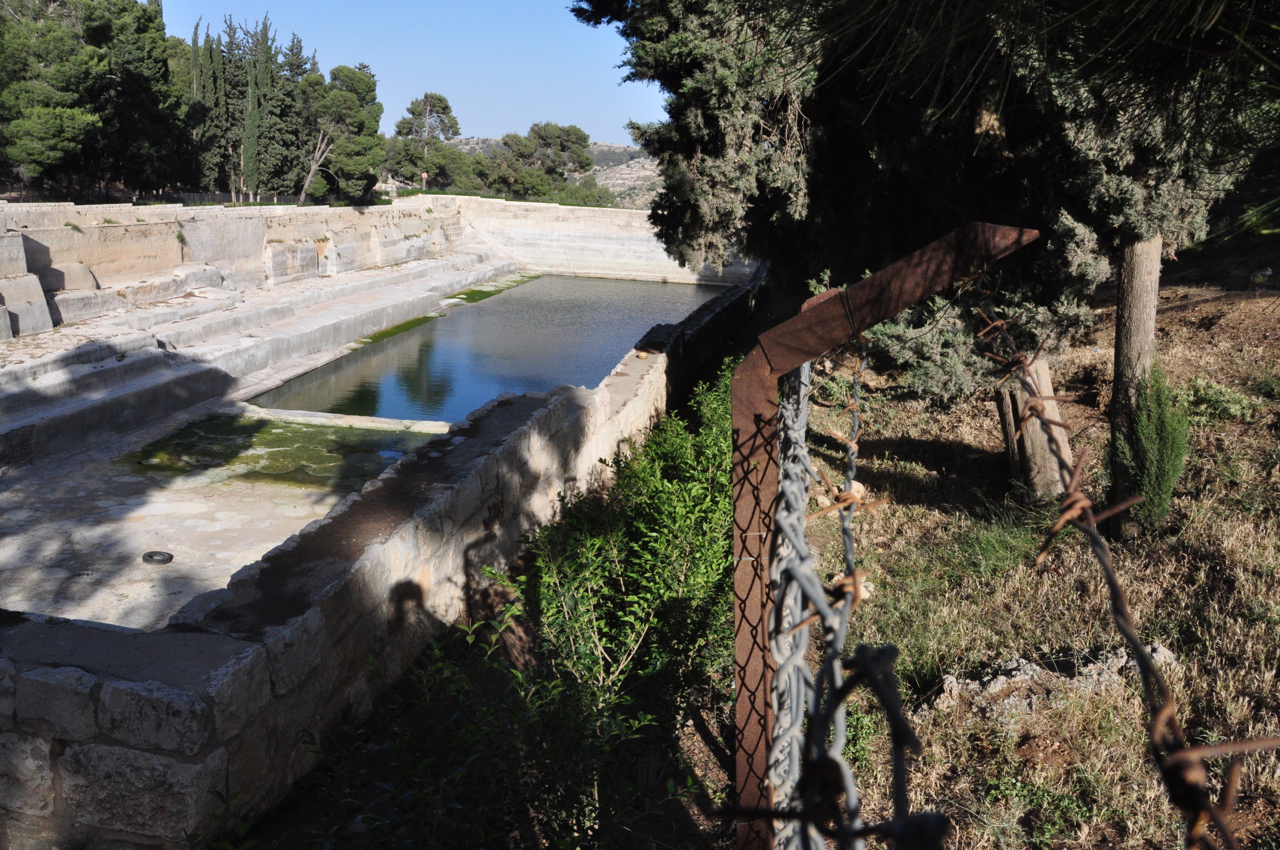
West of Bethlehem are three large reservoirs from the Hasmonean period, called Solomon’s Pools, that stored the water from two aqueducts from springs in the Hebron Hills. From these pools the Upper and Lower aqueducts continued via Bethlehem, Armon HaNatziv, Abu Tor to the Old City (remains of the aqueduct can still be seen along the route); another aqueduct was built by King Herod to bring water to Herodium. The Palestinian Authority have built a large conference center with a restaurant and small archaeological museum overlooking the pools.

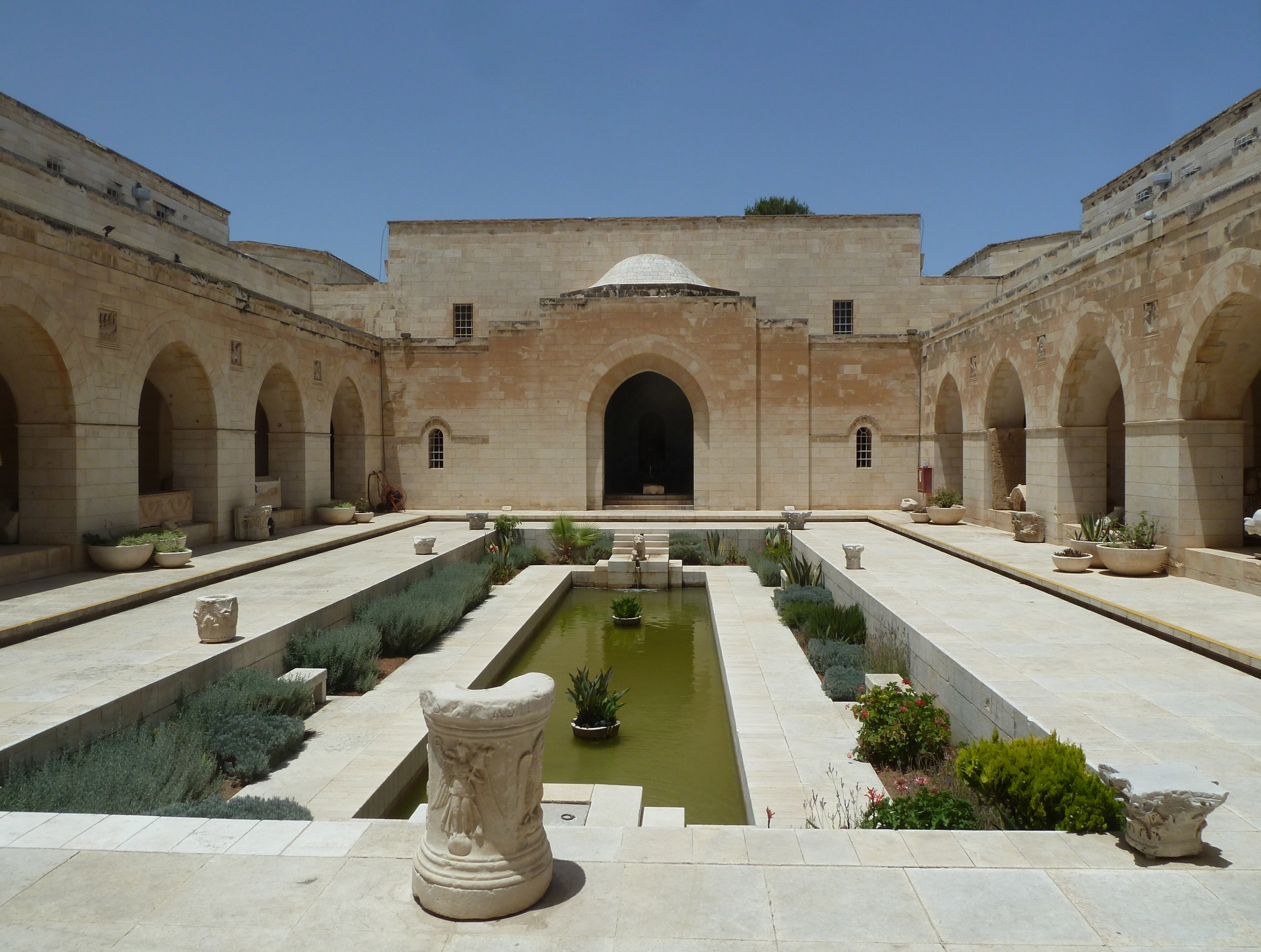
Photo of the Week – Nitzana

Nitzana is an ancient Nabataean city in the southwest Negev desert in Israel close to the Egyptian border. It may have been a camel caravansary on the eastern branch of the ancient Spice Route, serving pilgrims and merchants travelling to Sinai. This week’s photo shows the remains of the German-Turkish hospital (1906-1917) built on ruins of a Byzantine fort at Nitzana.

NitzanaThe technical details – the photo was taken in December 8 years ago with a Nikon point and shoot camera (ISO 100, 8mm, F7.6 at 1/263 sec).

Please share this post with your friends by clicking on the icons at the end of this message.

Photographs on this website are © Shmuel Browns (unless marked otherwise) – if you are interested in purchasing one of my photos or using one of my photos for your own project please contact me.

Related articles

Israel Roundup

Rockefeller Museum

Although few visit, the historic Rockefeller museum in Jerusalem is definitely worth a visit. A blend of western and local eastern architecture, combining historic architecture with modern innovations, the museum was built in 1938, during the Mandate period by the British architect St. Barbe Harrison.

Rockefeller courtyard

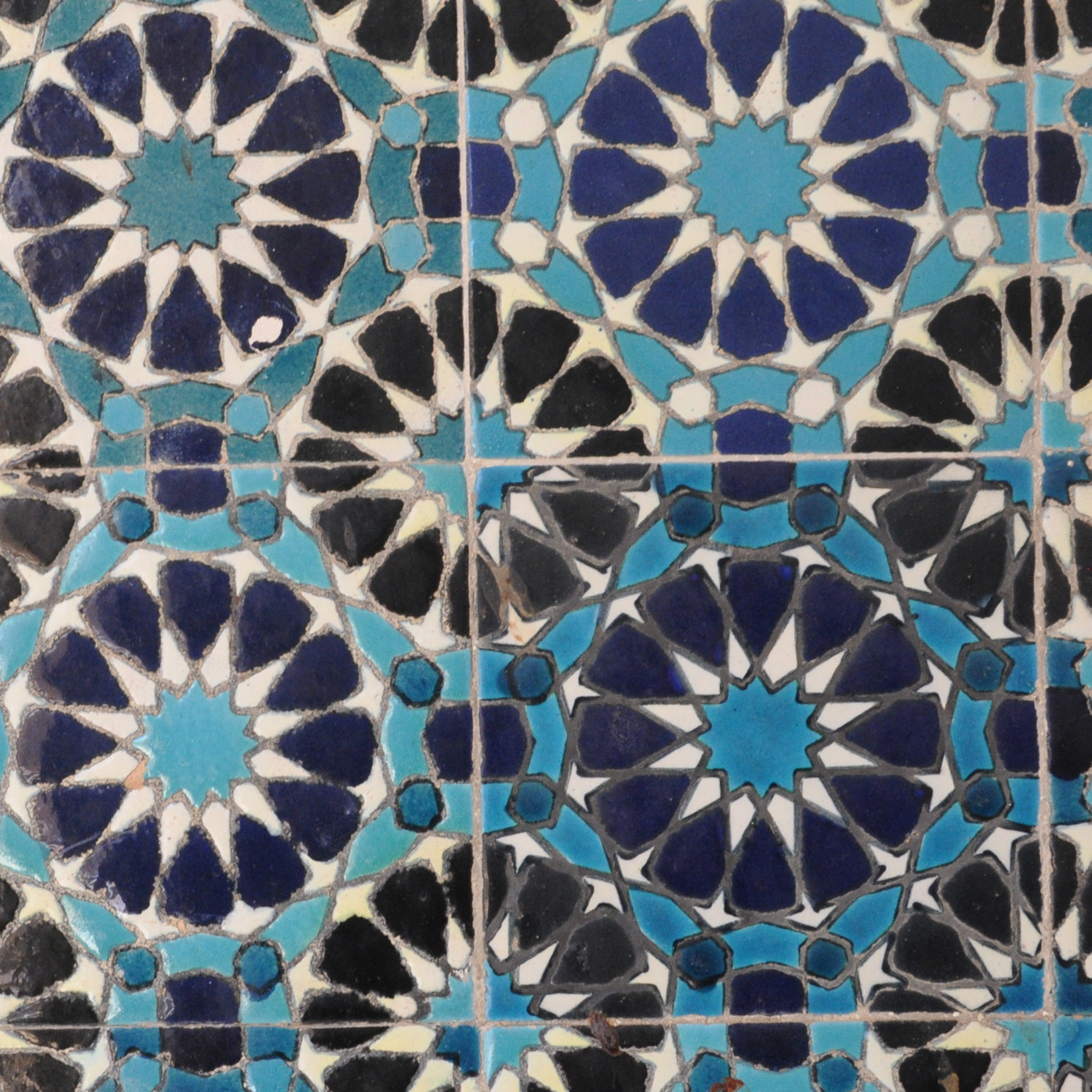
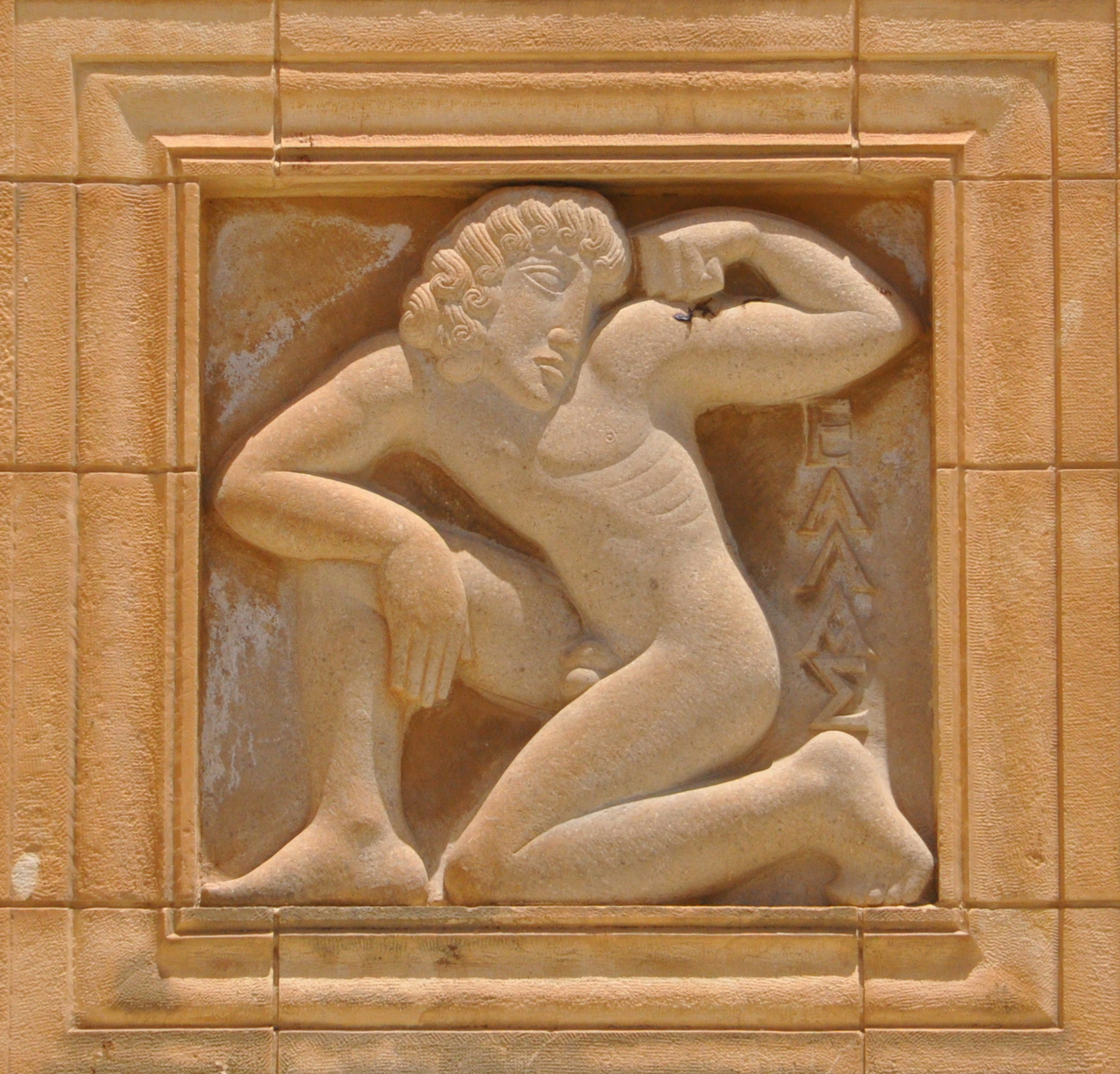
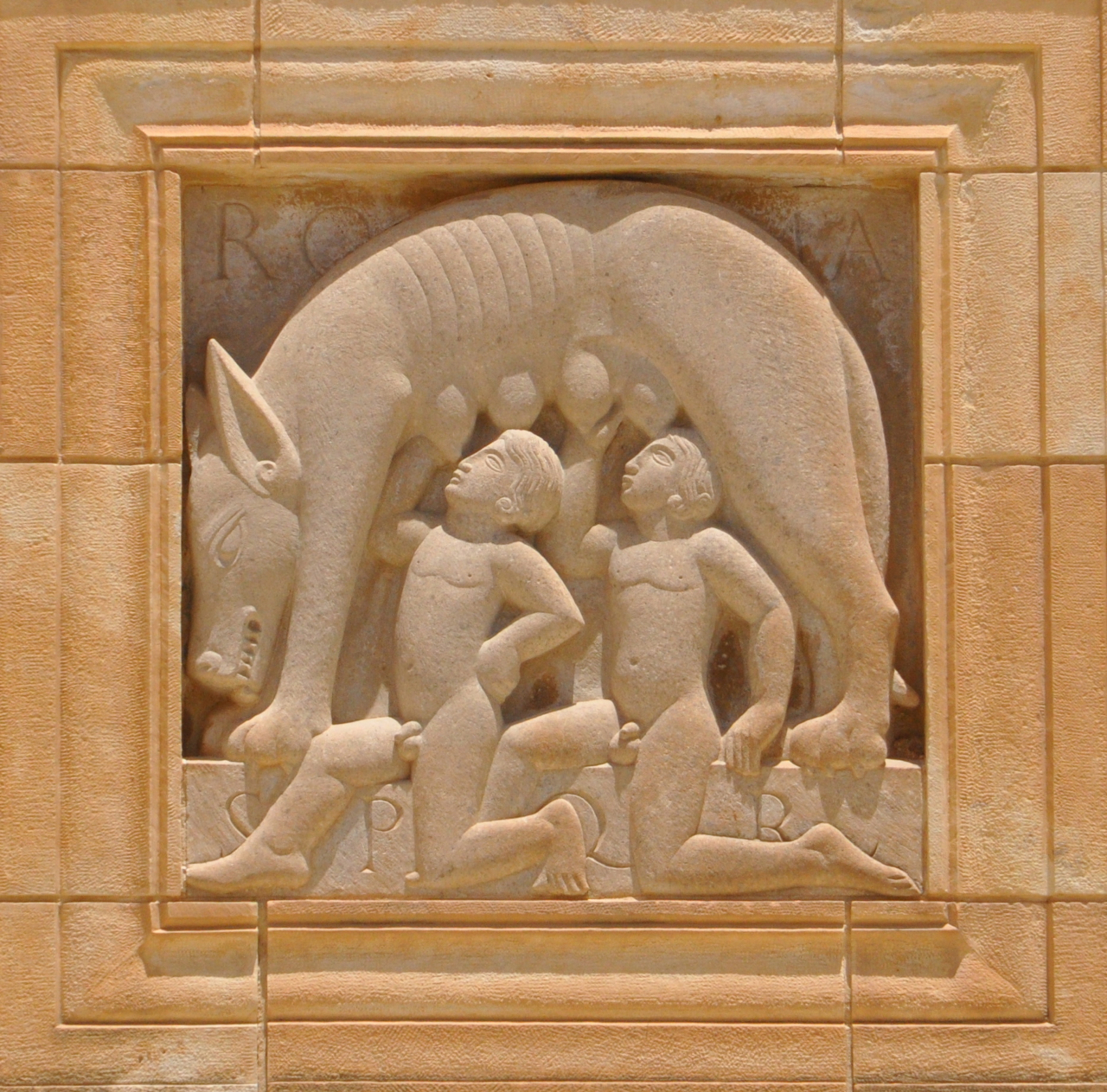
Ohanessian tile workIn the main hall is a model of the museum – exit to the courtyard to see the pool, the Armenian mosaics by Ohanessian and the 10 iconic stone reliefs sculpted by Eric Gill representing the major civilizations that left an imprint on this region. Many of the exhibits in the museum are a little dated, walnut wood framed glass cases with dozen of artifacts each, labelling is just a number which you have to cross-reference with a mimeographed book that you can ask for at security. But they have some important pieces: Greekthe Crusader marble sculpted panels from the lintels of the entranceway to the Church of the Holy Sepulcher, Roman sarcophagi, Umayyad architectural details with their original paint, Crusader capital with goblin from Church of Annunciation, mosaic from an early synagogue, like the one in Jericho also called Peace unto Israel, found in the Druze village of Usifiya.

Having visited the actual site of Hisham’s palace in Jericho and been Romandisappointed at how few of the mosaics and artifacts are on display it was heartening to see the impressive exhibit of sculpture and stucco from Hisham’s palace safe at the museum.

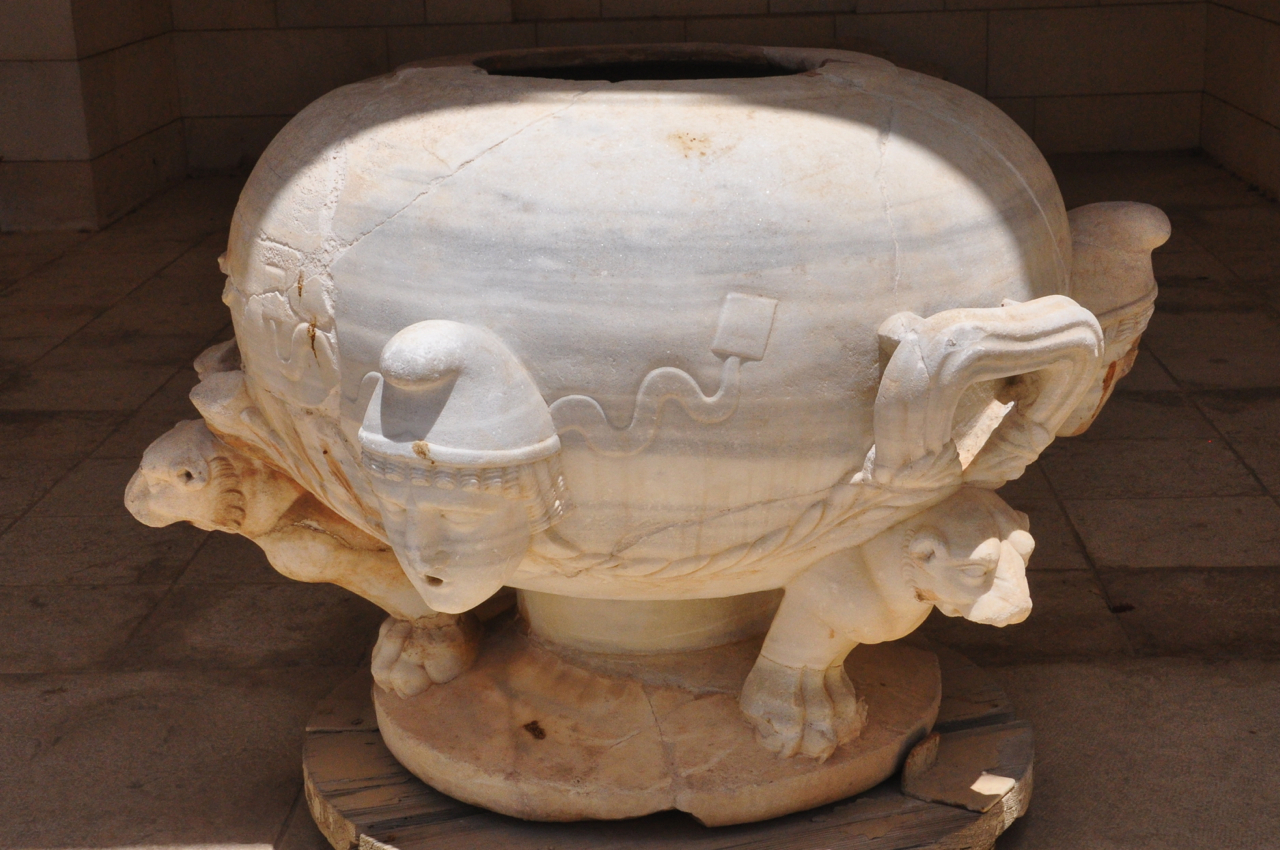
An incredible piece in the courtyard is a Roman wash basin from the 1st century that was found in the Crusader fortress at Montfort – striking how similar it is to the basin that Emperor Augustus sent with Marcus Agrippa as a present for King Herod on display at the Israel museum exhibit on Herod (viewable at https://israel-tourguide.info/2013/02/14/herod-design-realpolitik/).

Wash basin Montfort

There is a very interesting article about architects St. Barbe Harrison and Erich Mendelssohn and their contributions to beautifying Jerusalem. http://www.jpost.com/Opinion/Op-Ed-Contributors/Jerusalem-the-beautiful-312517

BBC has an article about the Hula painted frog at http://www.bbc.co.uk/news/science-environment-22770959

A species of frog that was recently rediscovered after being declared extinct in 1966 has been reclassified as a “living fossil”.

Israel’s Hula painted frog had not been seen for nearly 60 years, but in 2011 one was found lurking in a patch of swampy undergrowth. Tests have revealed that the frog belongs to a group of amphibians that died out 15,000 years ago.


BBC interviewed me for their series, In the Prince’s Footsteps and asked me to take them to the Mar Saba monastery in the Judean desert. We talked about photographer Francis Bedford’s 1862 photograph of the monastery on his travels with Edward, Prince of Wales to the Holy Land. You can read my blog post at Mar Saba and Judean Desert Revisited.

You can hear the interview by clicking on the red button.

I am Gabriel A unique 87 line Hebrew inscription, ink on stone, from the beginning of the Roman period, I am Gabriel, is on display at the Israel museum. Its content is prophetic-apocalyptic, its style literary-religious, and its language reminiscent of the later books of the Prophets. Accompanying it are rare ancient manuscripts, the Hebrew Bible, the New Testament and the Qur’an. The exhibition traces the changing roles of the angel Gabriel in the three monotheistic religions.

While thinking about the Israel museum plan to spend a day with Herod the Great, legendary builder and King of Judea. Combines an in-depth guided tour of Herodium, Herod’s palace complex in the desert and the site of his tomb with the monumental exhibit “Herod the Great: The King’s Final Journey”.  https://israel-tourguide.info/herod-the-great-tour/

Jerusalem Botanic Garden is open for free on Fridays & Saturdays in the month of June 2013 for residents of Jerusalem with presentation of your teudat zehut. This is a great opportunity to wander around the garden and discover the lovely, shaded areas of green that are one of the best kept secrets of the City.  http://en.botanic.co.il/Pages/Show/7

Church of the Annunciation, Nazareth

The Church of the Annunciation has a long history. In the middle of the 4th century, a shrine with altar was built in the cave in which Mary had lived. Emperor Constantine commissioned a larger structure when his mother, Helena, visited the Holy Land to discover the locations of and commemorate important events in Jesus’ life. The Church of the Annunciation was founded around the same time as the Church of the Nativity in Bethlehem and the Church of the Holy Sepulcher in Jerusalem [interesting that Barluzzi worked on all three of these important churches]. It was known to still exist around 570 CE, but was destroyed in the 7th century after the Muslim conquest.

The second church was built over the ruins of the Byzantine era church during the Crusades, after the conquest of Nazareth by Tancred in 1102 but was never completed. Saladin’s victory over the Crusaders at the Battle of Hittin in 1187 ended construction of the church. Five Crusader Romanesque capitals carved by stonemasons from northern France were discovered during excavations along with artifacts from the Middle Bronze Age, Israelite period, Herodian-Roman  and Byzantine periods are in the small museum in the Franciscan convent. In 1260, Baybars and his Mamluk army destroyed the church during their attack on Nazareth.

The Franciscans received permission to return to Nazareth in 1620 and constructed a small structure to enclose the holy grotto that is venerated as the house of Mary. In 1730, they received permission to construct a new church, which was enlarged in 1877.

Church of Annunciation, Nazareth, 1945

Church of Annunciation, Nazareth, 1945

This church stood until 1954 when it was demolished to enable the construction of a new basilica.

In 1924 Ferdinando Diotallevi, the custos, or head of the Franciscan Custody, with the approval of Pope Pius XI began to plan a new basilica to commemorate the Annunciation in Nazareth. Diotallevi intended to entrust the building of the church to Antonio Barluzzi, a young architect who had already proved his abilities and qualifications by building the Church of the Agony (Gethsemane, 1922-24) in Jerusalem and the Church of the Transfiguration on top of Mount Tabor (1919–24) for the Franciscan Custody. Barluzzi was asked to submit his plans for the Church of the Annunciation, but the project was aborted, due to political tensions inside and outside the Custody.

The idea of rebuilding the church emerged again fifteen years later in 1939 when the new custos, Alberto Gori, reappointed Barluzzi to the project. During World War II Barluzzi resided in Italy returning to the Holy Land in 1947. During that time he designed two churches. The first was the incredibly ambitious project of rebuilding the Church of the Holy Sepulcher. The new plan was prepared by Barluzzi and Luigi Marangoni but was never built [sometimes an architect’s best plans are never actualized, check out Louis Kahn and the Hurva synagogue].

Model Church of Holy Sepulcher, Barluzzi

The second was the design for the Church of the Annunciation in Nazareth which Barluzzi thought would be his final work in the Holy Land.

Barluzzi designed a church in eclectic style, using contemporary construction technique, reinforced concrete covered mostly by local limestone. The church was a concentric building dominated by a large dome reminiscent of St. Peters in Rome and surrounded by four towers dedicated to the four evangelists. The towers symbolized the voices announcing to the four corners of the world the event of the Incarnation – critics said the building looked too much like a mosque. In the plan, the length of the church was 90 meters, and the height from the ground to the cross on top of the dome was 72 meters, a very large building. Inside, Barluzzi designed a rotunda over the holy grotto and four wings for the requirements of the liturgy. Like his other projects Barluzzi was involved in the smallest details of the inner decoration far beyond the usual level of architectural planning. For each statue he designated a location, character, symbolic meaning, and connection to the main theme of the church. By 1941, Barluzzi had prepared many sketches of the church and a model on scale of 1:100, and his plans were approved by Father Leonardo Bello, the minister general of the Franciscan order.

Barluzzi drawing Annunciation

Model Church of Annunciation, Barluzzi

All the necessary permits were obtained from the State of Israel, and in December 1954, the year designated by the Vatican as the Year of Mary, the cornerstone of the church that corresponded to Barluzzi’s plan was laid in a well-attended ceremony. However, four years later, in 1958, the new Franciscan custos, Alfredo Polidori took the project from Barluzzi.

Barluzzi wrote in his diary: On 3rd February 1958 the Custos of the Holy Land replaced me by the architect Muzio of Milan to build the Nazareth sanctuary. This gave me heart trouble all night long.. I am going back to Rome and I will seek refuge at the Delegation of the Holy Land…

Barluzzi died on December 14, 1960 in a small room at the Delegation of the Holy Land.

The new basilica was designed by the Italian architect Giovanni Muzio of Milan, one of the leading architects of the Novecento style who came to Israel for the first time in 1958. Muzio planned the church as a fortress, to contrast the new church with the remains of the earlier  churches – he meant to convey that its fate, unlike that of its predecessors, would be different. The fortified nature of the church is evident in its size and strength, its seclusion from the urban surroundings, and the details of the building, like narrow windows, almost slits. The church dimensions are 44.6 meters long and 27 meters wide, and the dome height is 55 meters, still a large church. The outer walls are covered in light-colored combinations of local stone with modern reliefs and engravings that decorate the southern and western façades. It seems that the church was based on an earlier St. Antonio church that was built by Muzio in Varese, Italy.

Church of Annunciation, Muzio

Muzio actually erected two churches, one on top of the other. The lower church protects the valuable archaeological remains of the Byzantine-era church which are displayed next to the holy grotto, the perimeter of the modern church follows the outer limits of the walls of the Crusader-era church. The upper church is designated for the celebration of the liturgy. The upper church is connected to the monastery by a suspended courtyard that protects the underlying remains of the ancient village of Nazareth from the time of Jesus that was discovered during excavation work in 1955.

Annunciation Church grotto

Inside, the modern style of Muzio’s work manifests itself in the extensive use of exposed reinforced concrete and sharp angles. The stained glass windows are striking.

Annunciation church stained glass

The church is decorated by works of art dedicated to Mary and to the Annunciation that were donated by every nation of the Catholic world. Muzio was not involved in choosing the art. The church was built by the Israeli building firm Solel Boneh during the years 1960-69 and cost 2 million dollars.

Annunciation church dome

Chuch of Annunciation, Interior

Church of Annunciation, Interior 2


For an excellent in-depth analysis, see Masha Halevi’s article, “The Politics Behind the Construction of the Modern Church of the Annunciation in Nazareth” at http://muse.jhu.edu/journals/catholic_historical_review/v096/96.1.halevi.html

Nazareth

Nazareth is the largest Arab city in Israel with a population of about 75,000 of whom 69% are Muslim and 30.9% are Christian, mostly Orthodox, but including Maronites, Roman Catholic, Melkite Catholics, Anglicans, Baptists, Evangelicals and Copts. In the New Testament, the city is described as the childhood home of Jesus, and hence is a center of Christian pilgrimage, with many shrines commemorating biblical events.

Gabriel chuch, Nazareth

The Church of St. Gabriel is located over an underground spring, which according to Eastern Orthodox belief is where the Virgin Mary was drawing water at the time of the Annunciation.

Mary's well, Nazareth

Water from the spring still runs inside the apse of the church; it also feeds the adjacent site of Mary’s Well, located 140 meters away.

In the old city market is the Synagogue church, a Melkite Greek Catholic church at the traditional site of the synagogue where Jesus studied and prayed. This is where one Sabbath morning Jesus delivered his famous sermon (Matthew 13, Mark 6, Luke 4) based on Isaiah 61, where he declared himself the Messiah.

Mount Precipice, Nazareth

This so infuriated the congregation that they wanted to throw him off a nearby cliff. Just outside Nazareth, Mount Precipice is believed to be the site described in Luke 4:29-30 but “he passed through the midst of them and went away.”

St Joseph church

St Joseph’s Church marks the traditional place of Joseph’s carpentry workshop.

Under the Mary of Nazareth International Center, next to the Church of the Annunciation, an archaeological excavation recently conducted by the Israel Antiquities Authority has uncovered remains of a dwelling that date to the Early Roman period. According to excavation director Yardenna Alexandre, “The discovery is of the utmost importance since it reveals for the very first time a house from the Jewish village of Nazareth and thereby sheds light on the way of life at the time of Jesus”.

Based on solid New Testament scholarship and the most up-to-date archaeology, Nazareth Village brings to life a farm and Galilean village, recreating Nazareth as it was 2,000 years ago, when Jesus lived there.

Church of Annunciation, Muzio

Church of the Annunciation is the largest Catholic church in the Middle East. In Roman Catholic tradition, it marks the site where the Archangel Gabriel announced the future birth of Jesus to the Virgin Mary (Luke 1:26-31). The new modern, fortress-like basilica was designed by the Italian architect Giovanni Muzio and built by the Israeli construction firm Solel Boneh during the years 1960-69.

Photo of the Week – Judean Desert

Solitude in the Judean desert – for visitors today as for monks and prophets. This image reminds me of Genesis chapter 1 where God made the firmament that He called heaven on the second day and then God said “… let the dry land appear and it was so. And God called the dry land Earth… and God saw that it was good.”

Wadi Qelt

The technical details – the photo was taken with a Nikon DSLR camera (ISO 800, 27mm, F11 at 1/500 sec).

Please share this post with your friends by clicking on the icons at the end of this message.

Photographs on this website are © Shmuel Browns (unless marked otherwise) – if you are interested in purchasing one of my photos or using one of my photos for your own project please contact me.

Related articles