I just received the latest newsletter from Ir David (in Hebrew) and they have a riddle which I’ve modified slightly and include here.
This inscription, carved in stone in proto-Hebrew was discovered in 1880 by chance at the southern end of Hezekiah’s tunnel in the City of David by a young boy named Jacob Eliahu who was playing hooky from school. Because Israel was part of the Ottoman Empire at the time, the Turkish authorities took the stone (which broke when it was pried off the wall) to the Istanbul Archaeological museum, Turkey.
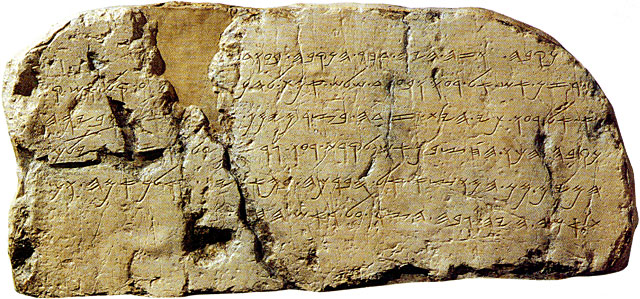
Photo: from the Internet
Subtract the sum of the numbers mentioned in the text of this inscription from the year that it was discovered and then add the units digit of the year that Parker began his excavations in the City of David and you’ll get a year that is important in Jewish history and in relation to the bulla (a seal impression in clay affixed to legal documents) of Gedalya ben Pashur that Eilat Mazar found in her recent excavations below the stepped support wall in Area G. Explain the relationship. Email me your answer. Have fun. 8-)

Photo: Gabri Laron/Hebrew University/Dr. Eilat Mazar
Hints: Who was Gedalya ben Pashur and where in the Bible is he mentioned?
 Israel Tours
Pingback: Archaeological Artifacts with Names « Israel Tour Guide
Pingback: Site Map | Israel Tours | Israel Tour Guide
Pingback: Archaeology in Israel Tour | Israel Tours | Israel Tour Guide
Gedalyah son of Pashhur appears in the Book of Jeremiah where he is described as one of the political opponents of Jeremiah, one of those who appealed to King Zedekiah to have Jeremiah executed because of his prophecies that Jerusalem and the Temple would be destroyed by the Babylonians due to the wickedness of the Jews:
…it was logical to find precisely here the bulla of Gedalyahu ben Pashur—only meters away from the place where we found the bulla of Yehukhal ben Shelemyahu—since these two ministers are mentioned side by side in the Bible as having served together in the kingdom of King Zedekiah,” Mazar said. Jerusalem Post, 2008
[…][ends] the tunnel. And this is the story of the tunnel. While […] the axes were against each other and while three cubits were left to [cut?]… the voice of a man called to his counterpart, for there was zada in the rock, on the right [and on the left] and on the day of the tunnel (being finished) the stonecutters struck each man towards his counterpart, axe against a[xe] and the water [fl]owed from the source to the pool for 1200 cubits. And the height over the head of the stone cutter[s] was [100?] cubits.
Montague Parker began his excavations in the City of David in 1909. He was searching for the Ark of the Covenant and Temple treasures, and conducted his work in secret, bribing officials to allow him to dig. His excavations were eventually discovered in 1911, forcing him to flee the country