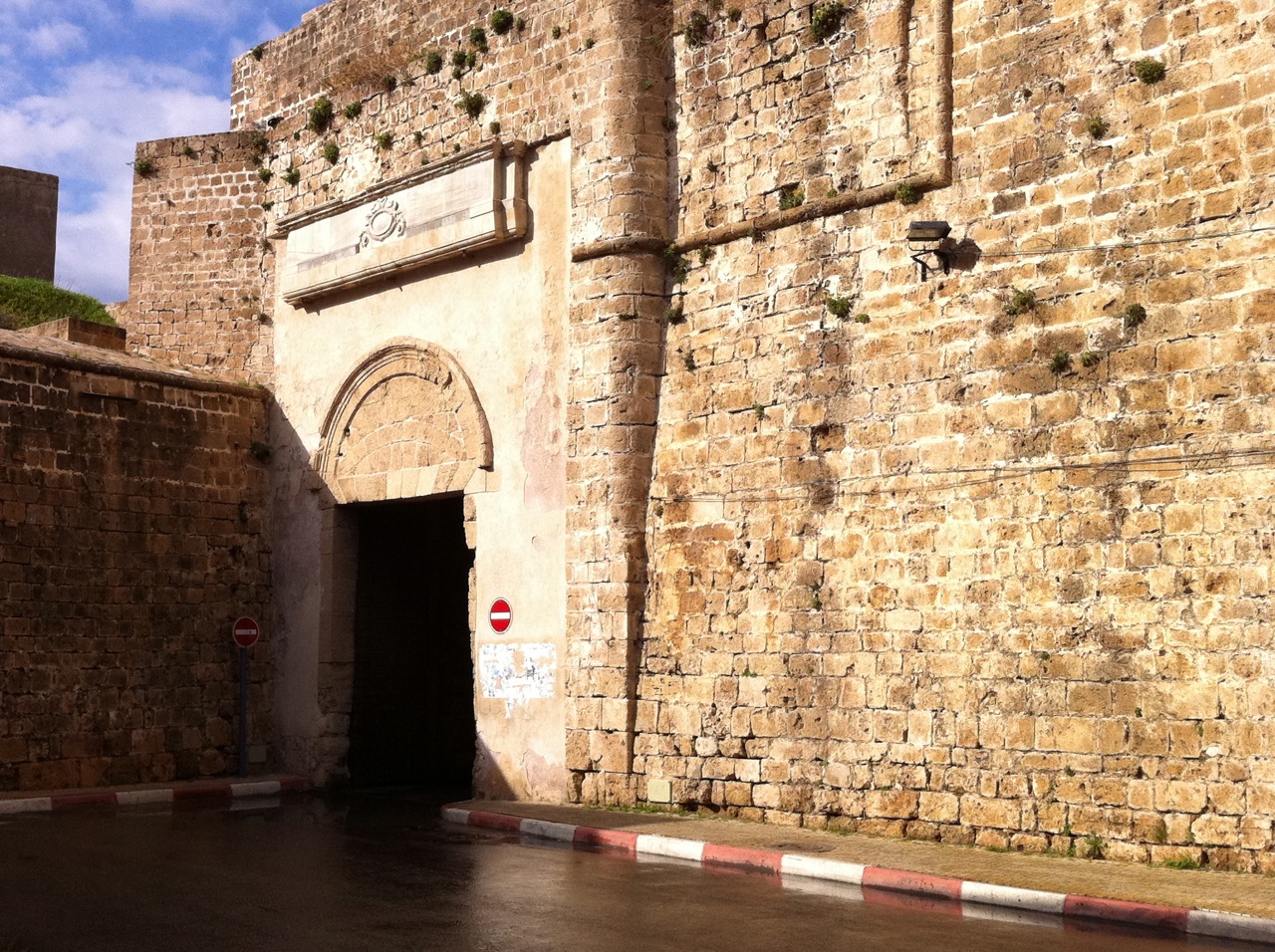
Tag Archives: postaweek2011

Desert Wildflowers

If you are going to be in the south of Israel, there is a nice hike from the Timna valley through Nahal Mangan climbing onto the Milhan ridge; from there you can descend and camp at the Milhan well. This area gets less than 100mm of rain per year but in March we saw a lot of plants in bloom for a desert.

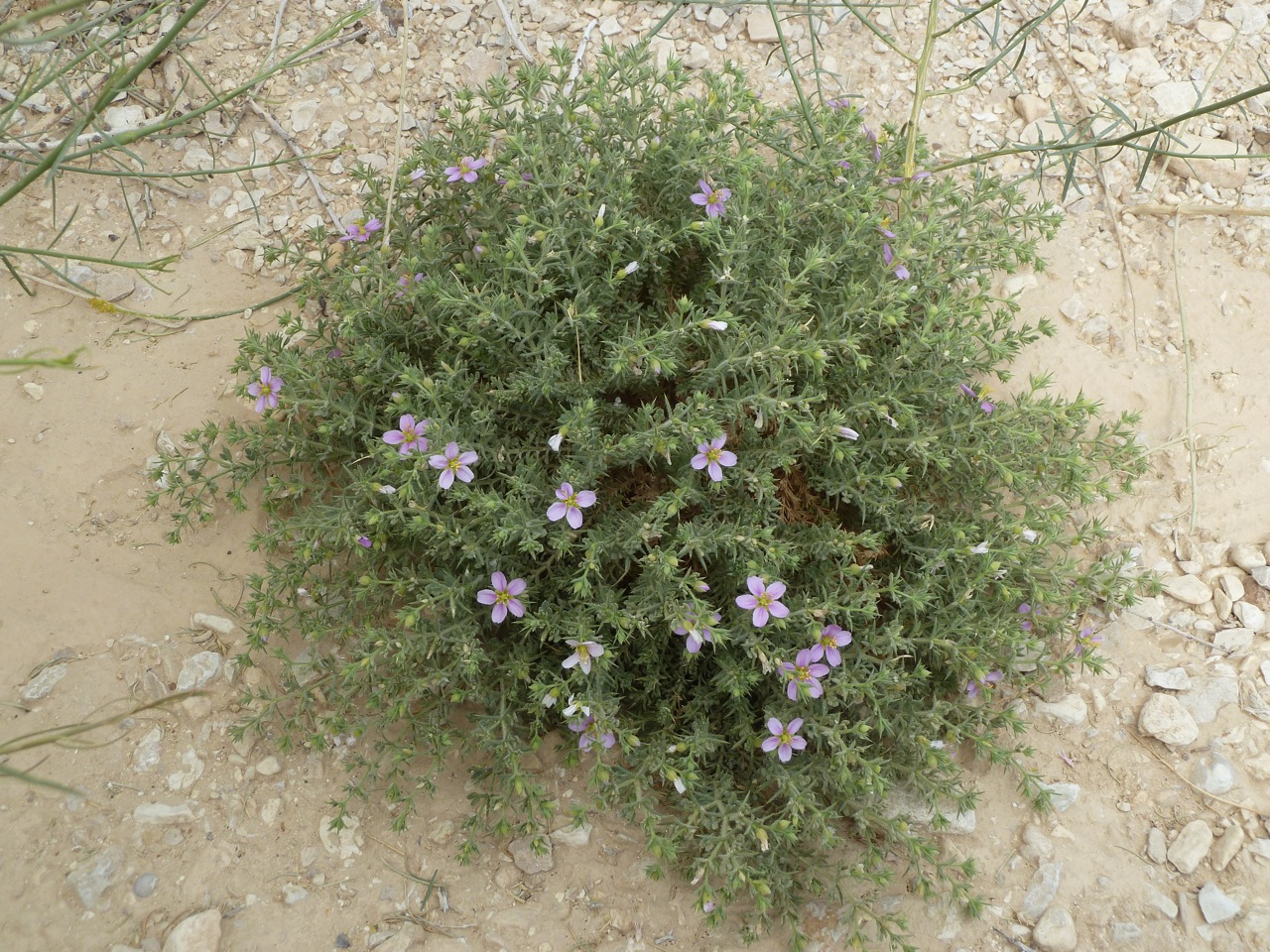
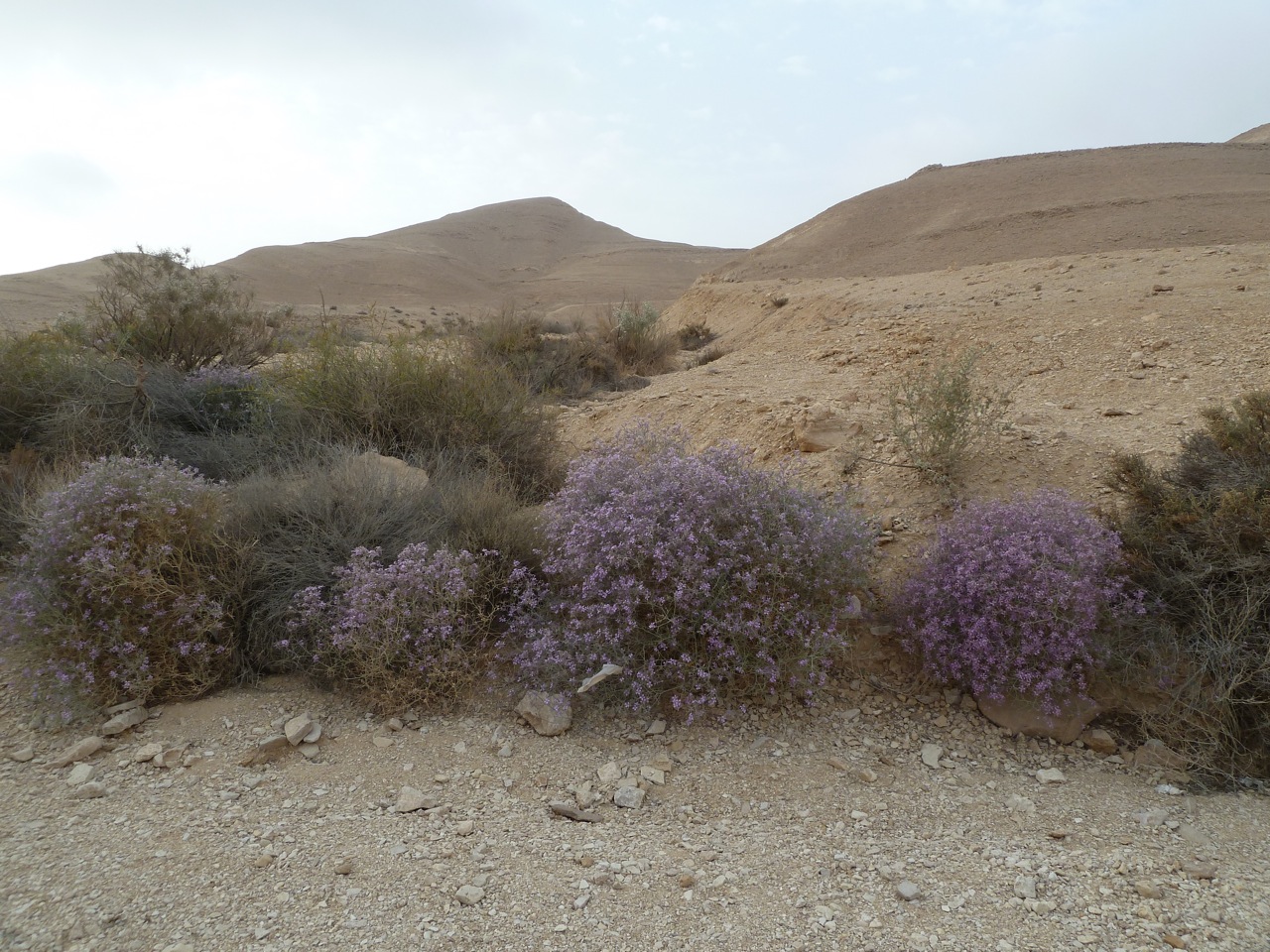
The Silon Kotzani (Zilla spinosa) is a perennial but only lives a couple of years dying from drought or flash floods. The plant grows into a sphere of stems and thorns that is typical of thorny plants in the desert. The peak of its flowering is March, afterwards it dries up. The small purple flowers are edible and have a mild cabbage taste. When dry the stems of the bush can be used as kindling to start your campfire.

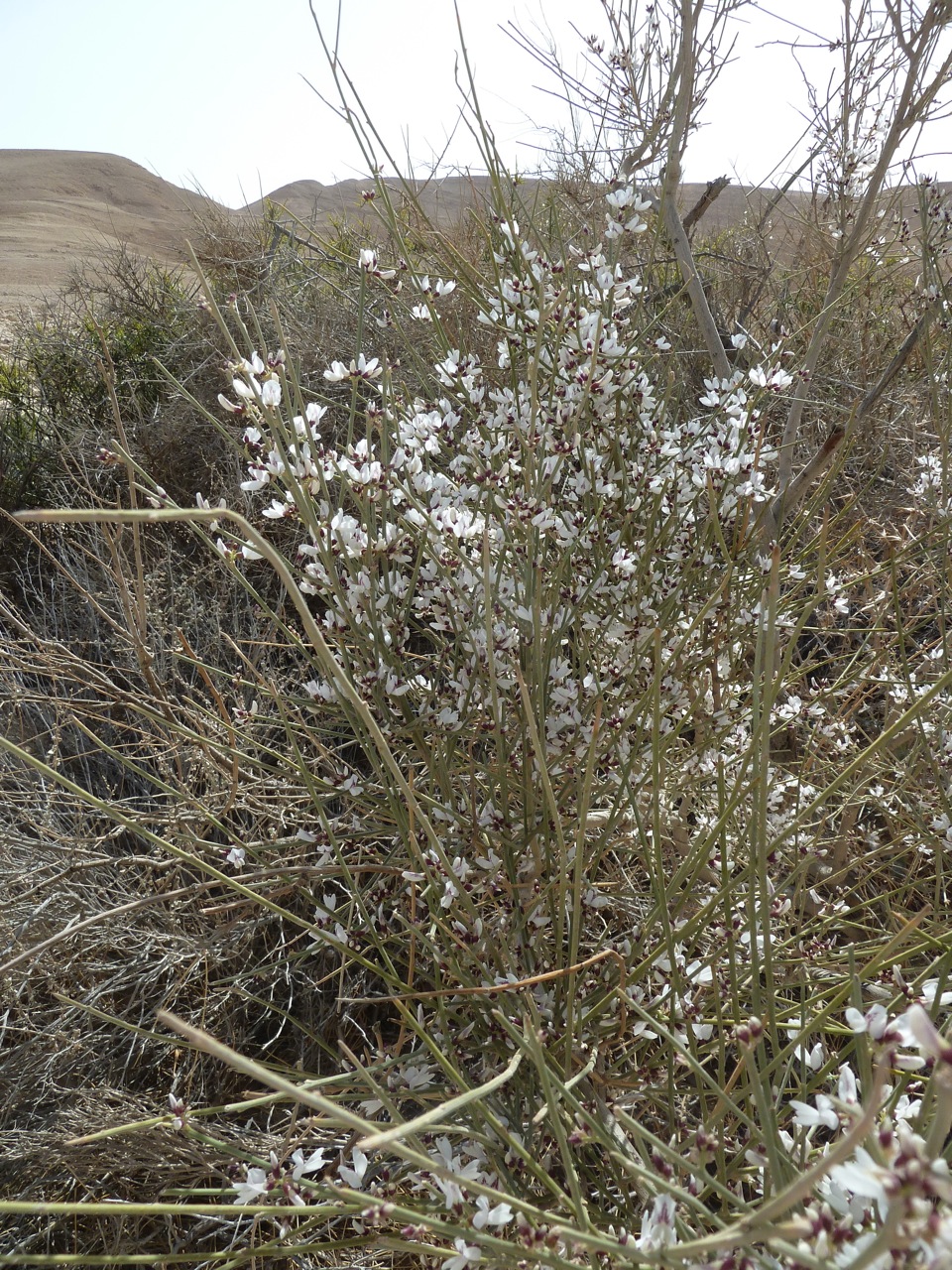
The White Broom, Rotem HaMidbar (Retama raetam) was blossoming, bunches of small, delicate white flowers. This is the bush under which the prophet Elijah sat.

But he went a day’s journey into the wilderness, and came and sat down under a broom-bush. Kings I 19, 4

The Broomrape, Yahnuk HaMidbar (Cistanche tubulosa) is a parasite that grows on and gets its nourishment from the roots of other plants. There are no leaves, just a spike of yellow flowers.

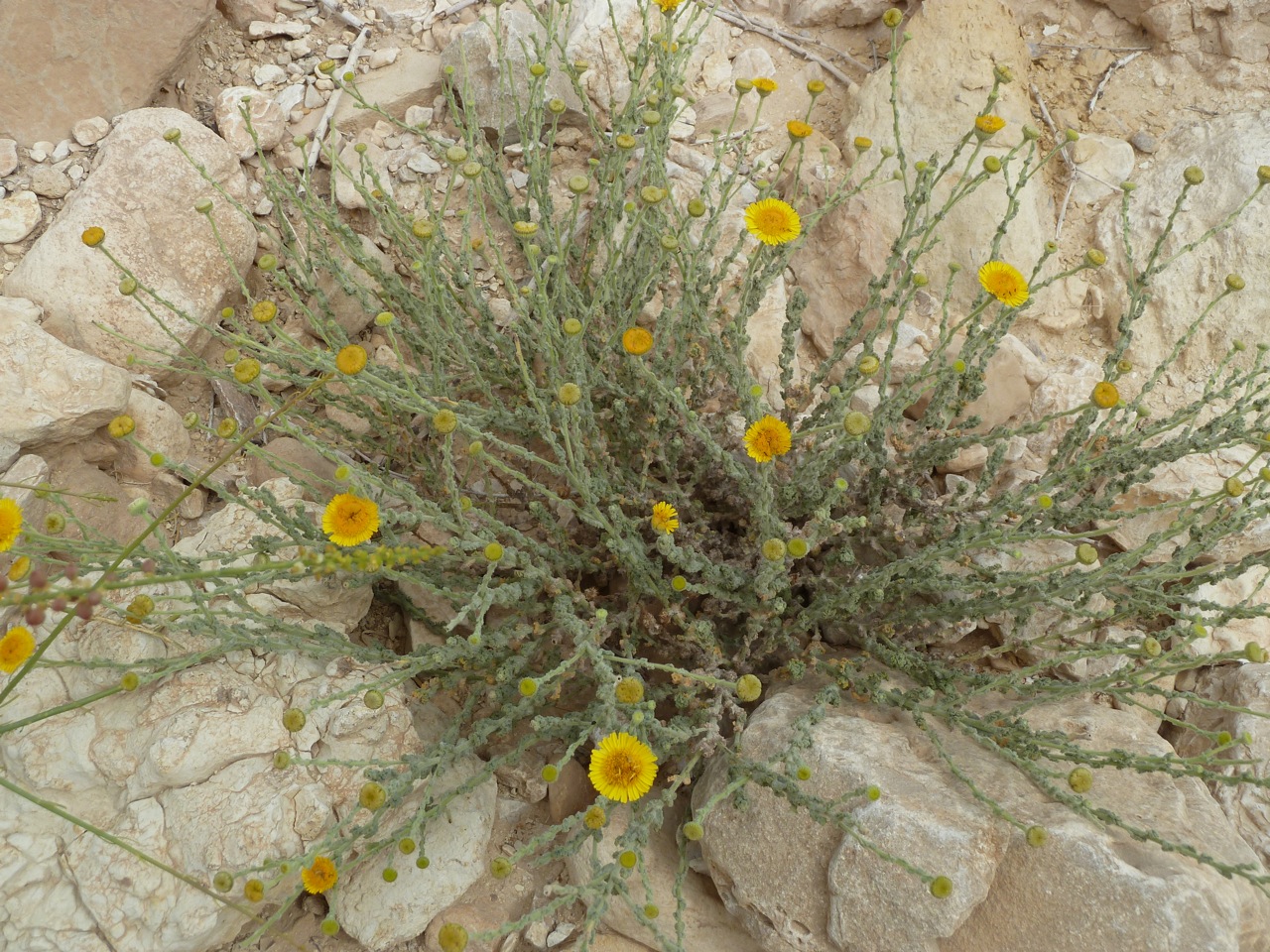
Parosheet Galonit (Pulicaria desertorum) is a low-lying plant with yellow flowers that grows in desert areas. The leaves and flowers can be used to make tea, the plant has a pleasant scent.

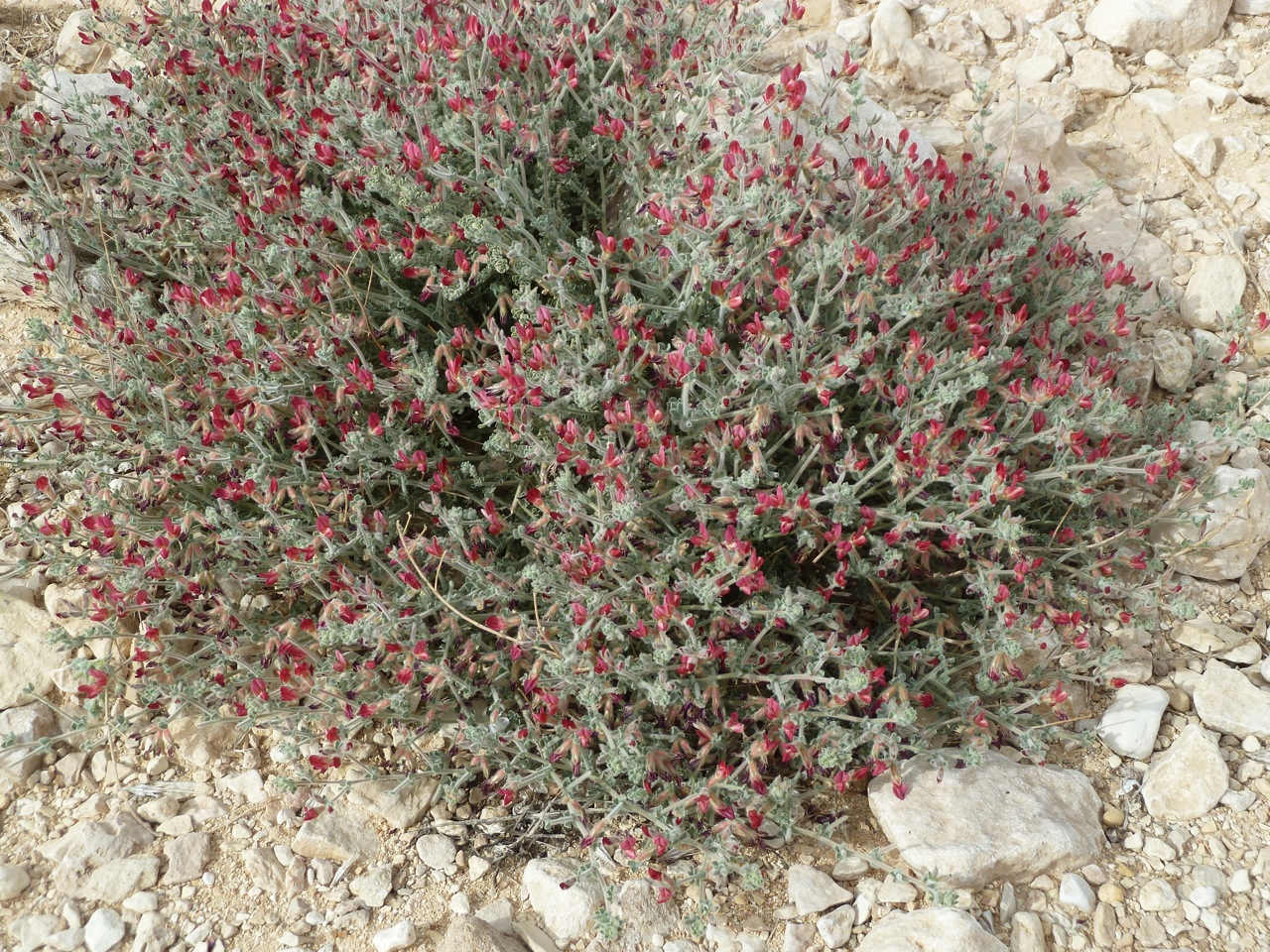
Lotus HaMidbar, Desert Lotus (Lotus lanuginosus) is a low-lying perennial with small red flowers that grows in desert areas.

Fagonia Rakah (Fagonia mollis) is one of the typical and most widespread plants that grows in the desert.

For other posts about wildflowers click on “Wildflowers”  under Categories in the right hand column or https://israeltours.wordpress.com/category/wildflowers/

Israel Trail Encounter

The Israel Trail or Shvil Yisrael is a national hiking trail inaugurated in 1994 that zigzags the entire country from Tel Dan in the north near the Lebanese border to the southernmost tip of Israel at the Red Sea, approximately 940 km. You may have seen sections of the trail on other hikes (the Israel Trail was created by connecting some of the existing, favorite hiking trails), for example, if you’ve visited the Small Makhtesh from the western lookout point the trail descends and crosses to the mouth of the makhtesh and then north via Maale Hatzera. You can recognize the trail by its 3 colored stripes, white (signifying the snow on Mount Hermon, north), blue and orange (like sand or south to Eilat).

I have Zvi Gilat’s excellent guidebook to the Israel Trail in Hebrew; there is one guide book, Israel National Trail by Jacob Saar, including topographical maps in English. The official website is at http://www.israelnationaltrail.com/ which includes a forum that enables you to connect with other hikers to discuss the trail.

I just got back from 8 days hiking on the southern part of the trail from the border crossing with Egypt at Taba to Shaharut in the Negev (incommunicado with the outside world, walking the desert landscape – which is why there was no blog post). Walking for a number of hours through a narrow canyon, climbing a ridge or mountain for a 360 degree view of your surroundings and watching the changing forms of the sandstone cliffs as you hike by is a different experience than driving up to a site by car.

The trail lets you experience nature throughout Israel with the opportunity to relate to the history of the country. I joined the annual Avi B’shvil Yisrael, an incredible project that brings together a third component, encounter with Israelis from throughout the country, young and old, religious and secular. There is a daily group discussion about the significance of kibbutz and an evening guest who talks about his/her experience related to kibbutz (the subject being examined this year). They also handle a lot of the logistics, you can pay 10NIS for fresh fruit, vegetables and bread to have for lunch and 10NIS for a communal dinner, the organizers ensure that there is enough water for the next day, provide a guide and arrange transportation (back to where you left your car, car pooling or a main road where you can get a bus). They are hiking the Israel Trail until Thursday, April 28, 2011 when they reach She’ar Yeshuv so if you can find the time, check out the itinerary at http://www.avi-beshvil-israel.org.il/luz.php and join them. I strongly recommend it.

The project is in memory of Avi Ofner and 72 other soldiers who died on February 4, 1997 when two IDF Sikorsky CH-53 helicopters collided in midair over She’ar Yashuv. The helicopters were hovering waiting for clearance to cross the border into Israel’s “security zone” in Lebanon.

For recommendation on some dozen other hikes, click on “Hiking” under Categories in the right hand column or https://israeltours.wordpress.com/category/hiking/

Chagall Windows

Using the medium of stained glass enables the painter to create intense and fresh colors. “When Matisse dies”, Pablo Picasso remarked in the 1950s, “Chagall will be the only painter left who understands what colour really is.” It was not until 1956, when Chagall was nearly 70 years of age, that he began to design stained-glass windows, first for the church at Assy and then for the Metz Cathedral. One of Chagall’s major contributions to art has been his work with stained glass.

Chagall collaborated with Charles Marq of Atelier Simon in Rheims, France; together they worked on the project, during which time Marq developed a special process for applying color to the glass. This allowed Chagall to use as many as three colors on a single pane, rather than being confined to the traditional technique of separating each colored pane by a lead strip.

French art historian Leymarie writes that in order to illuminate the synagogue at Hebrew University’s Hadassah Medical Center in Jerusalem both spiritually and physically Chagall decided that the twelve windows, representing the twelve tribes of Israel as blessed by Jacob and Moses in the verses which conclude Genesis and Deuteronomy, were to be filled with stained glass. This is very traditional, the Hurva synagogue had 12 windows with stained glass for the twelve tribes around the dome and the ceiling of the Chabad synagogue was decorated with illustrations of the twelve tribes. Chagall envisaged the windows as “jewels of translucent fire”. Each of the twelve windows is approximately 3.35×2.4 meters, much larger than anything he had done before. They are probably Chagall’s greatest work in the field of stained glass.

Leymarie goes on to describe the spiritual and physical significance of the windows:

The essence of the Jerusalem Windows lies in color, in Chagall’s magical ability to animate material and transform it into light. Words do not have the power to describe Chagall’s color, its spirituality, its singing quality, its dazzling luminosity…

At the dedication ceremony in 1962, Chagall described his personal feelings about the windows:

For me a stained glass window is a transparent partition between my heart and the heart of the world. Stained glass has to be serious and passionate. It is something elevating and exhilarating. It has to live through the perception of light. To read the Bible is to perceive a certain light, and the window has to make this obvious through its simplicity and grace… The thoughts have nested in me for many years, since the time when my feet walked on the Holy Land…

You probably notice that there are no photographs of the Chagall Windows accompanying this post. I contacted Hadassah for permission to photograph and was told that I would have to contact an agency in Paris, Société des Auteurs dans les Arts Graphiques et Plastiques, that handles such requests. The ADAGP wants me to pay €7 per image per month, which comes to €84 per year royalties to display one of my photographs on my website. In a quick search for “Chagall Windows” on Google I found 42,700 images that are already online (either ADAGP is bringing in more than €3.5 million per year or these images are not authorized, I’ll let you guess). I suggest that you check some of these images to get some appreciation for Chagall’s stained glass work.

What do Hadassah Ein Karem and Hebrew University Givat Ram have in common? In 1948 the Hadassah medical center and campus of Hebrew University on Mount Scopus built in 1925 were cut off from Israeli held western Jerusalem. For 19 years, a convoy travelled up to Scopus every 2 weeks under Red Cross auspices to exchange people and bring supplies. Consequently, these two institutions are a second hospital and university campus.

Antonio Barluzzi

Antonio Barluzzi is known as an architect but for many years he thought about entering a seminary. It was on the advice of his spiritual mentor and encouragement of his older brother Giulio, already an architect, that he entered the engineering school at university to study to become an architect. After graduation and his army service he worked with his brother on several architectural projects in Rome.

By 1910 Turkey is described as the “sick man on the Bosphorus” and all the European powers were staking their claim to pieces of the Holy Land. Schiaparelli of the Italian Missionaries Association hired Giulio to design and build an Italian hospital in Jerusalem with substantial financial aid from the Italian Ministry of Foreign Affairs. Guilo is overloaded with work and probably prefered Rome to Jerusalem so he sent Antonio.
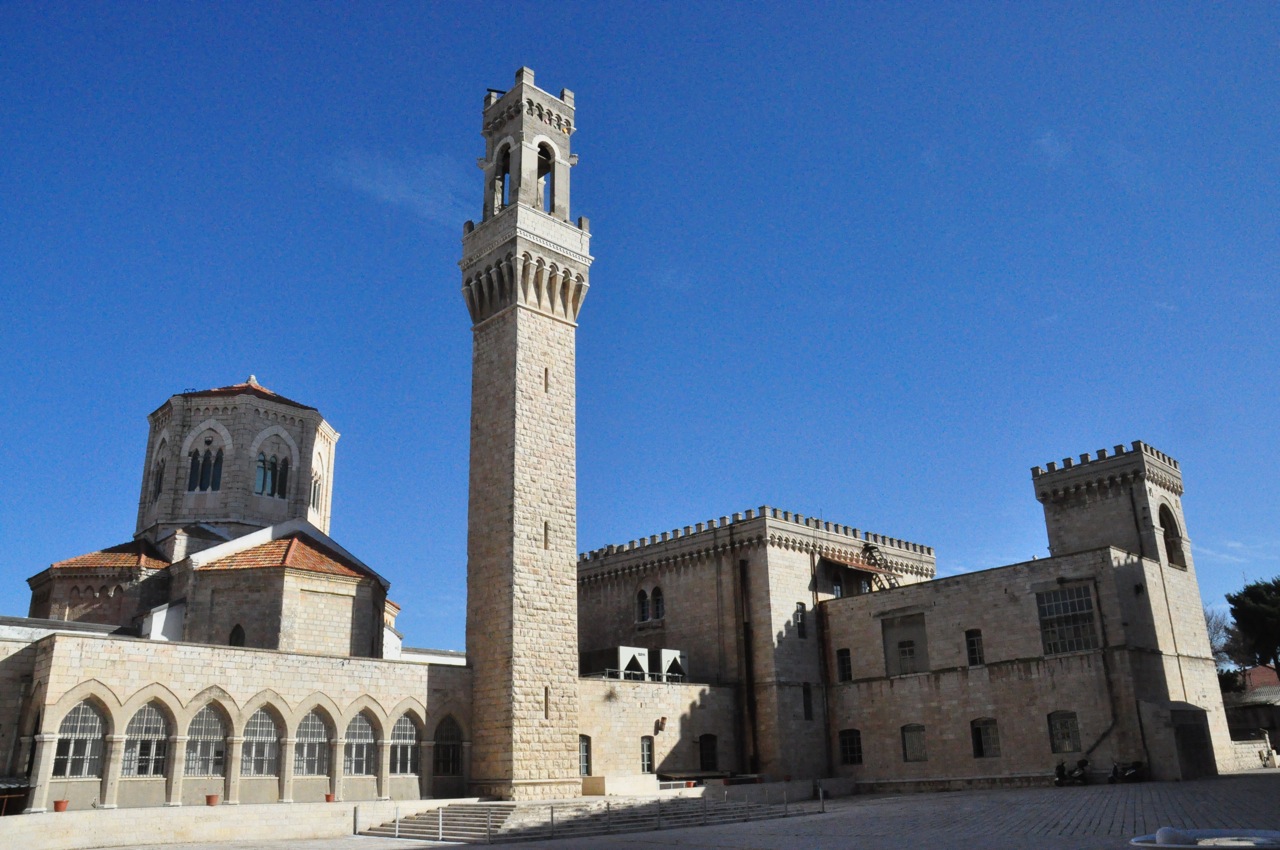
Schiaparelli recommended that “in the new building, a worthy chapel should have a place of honour, which can accommodate, in special circumstances, the Italian colony”. He also suggested that it be named Santa Maria Latina in memory of the old church of the Amalfitans in Jerusalem (today the Crusader part of the German Lutheran Church in the Muristan). So Antonio designed the hospital, definitely Italian looking, a curious mixture of the Palazzo Vecchio on the Piazza Signoria in Florence and the tower of the Mangia in Sienna.

With the outbreak of the First World War Barluzzi left for Italy and entered a seminary and stayed for 40 days, then Italy entered the war and he was called up. Italy allied itself with Britain, Barluzzi was recommended to the Ministry of War as an expert on the Holy Land and so on December 11, 1917, our architect entered Jerusalem on foot through Jaffa gate together with General Allenby.

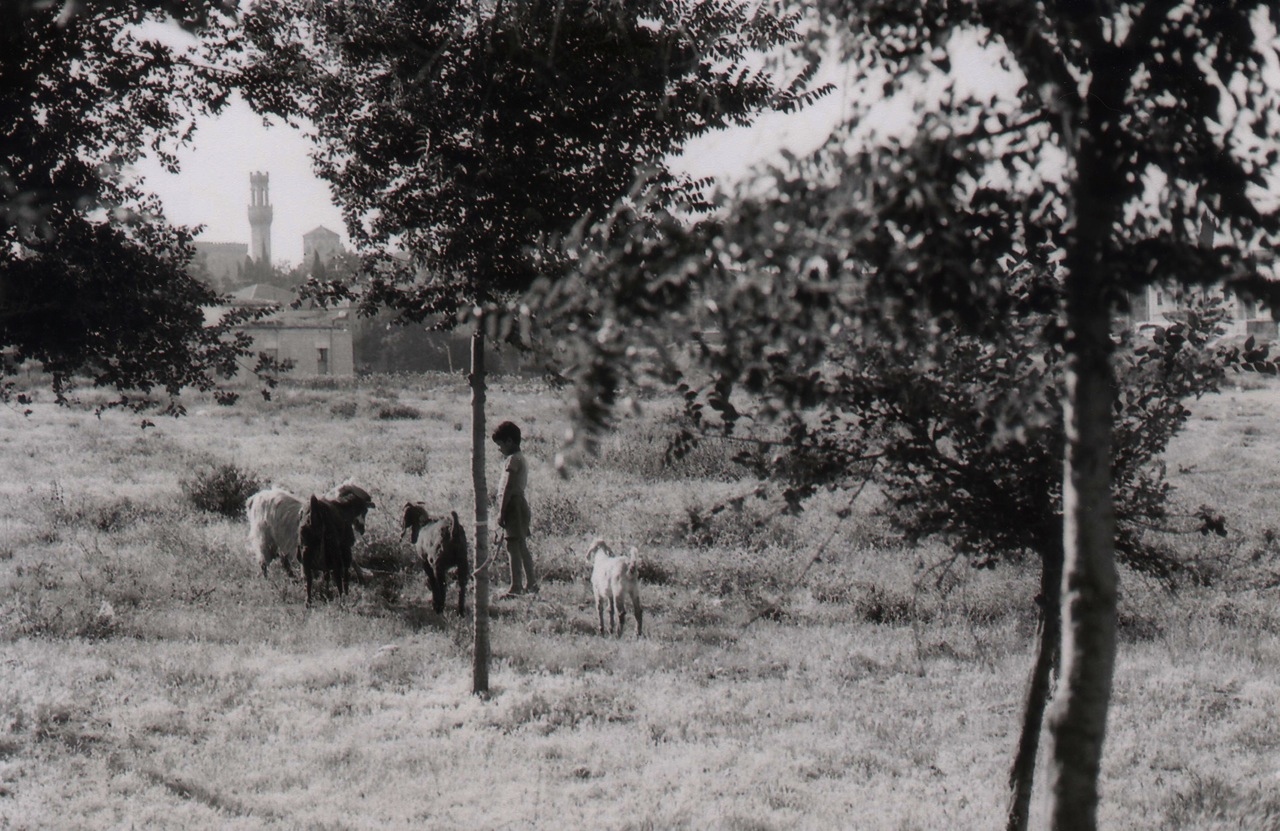
In 1978 while studying in Israel I took some photos of the Old City with a Nikkormat SLR camera using black and white film. One photo in particular I liked quite a lot, a pastoral scene just across from Damascus Gate looking north, of a young Arab boy shepherding four goats in a field. In the distance, framed by two trees is an Italian looking building. Of course, today the field is gone but the building is Barluzzi’s Italian hospital, his first building in Jerusalem.

The question was where would I find that photo from 30 years ago. I started looking through shoeboxes of photos and after about 10 minutes in a box with old letters, lo and behold found the negatives. I took them to be developed and a few hours later had prints of the photos. I shot a similar view the other day from the ramparts at Damascus gate.
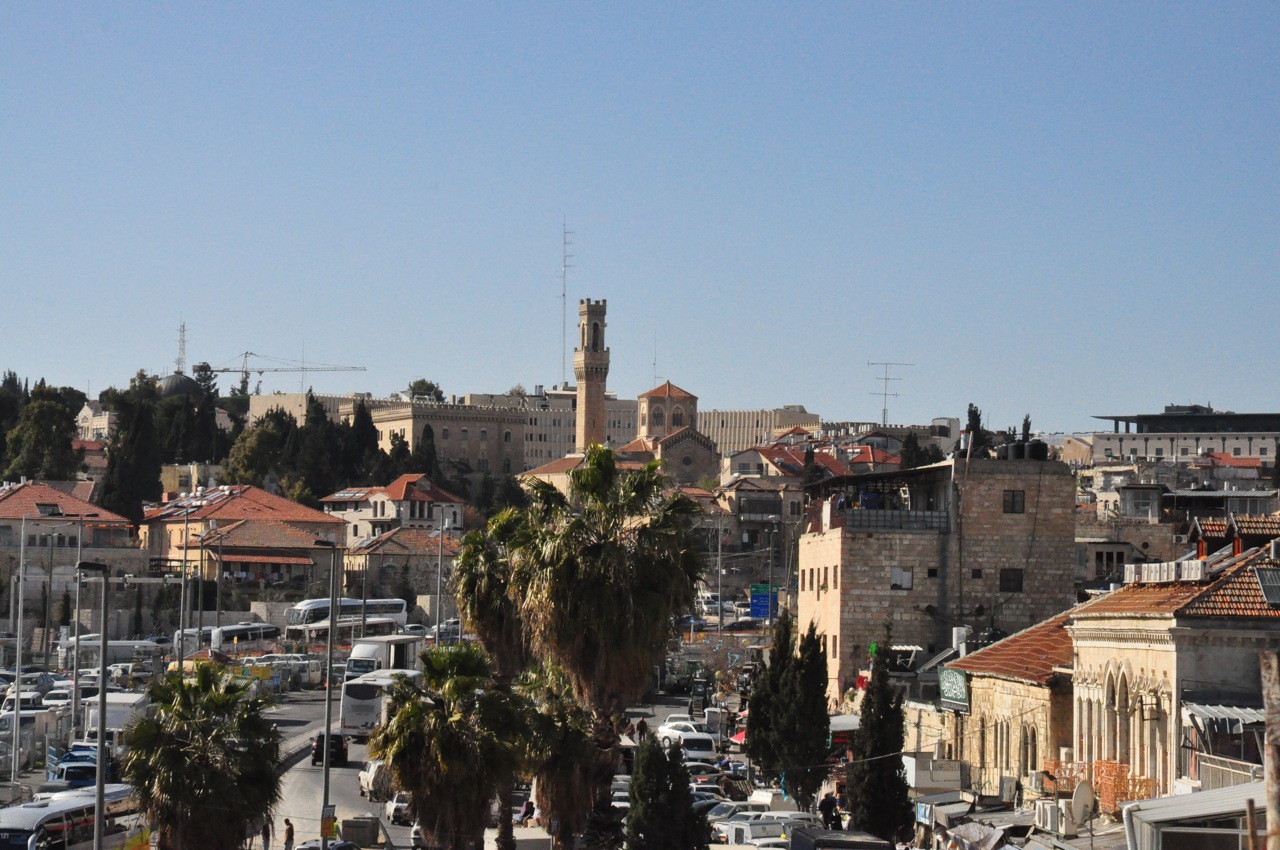
From there I walked over to the chapel – the Italian hospital buildings are being used by the Israeli Ministry of Education. Unfortunately the chapel is not open to the public.
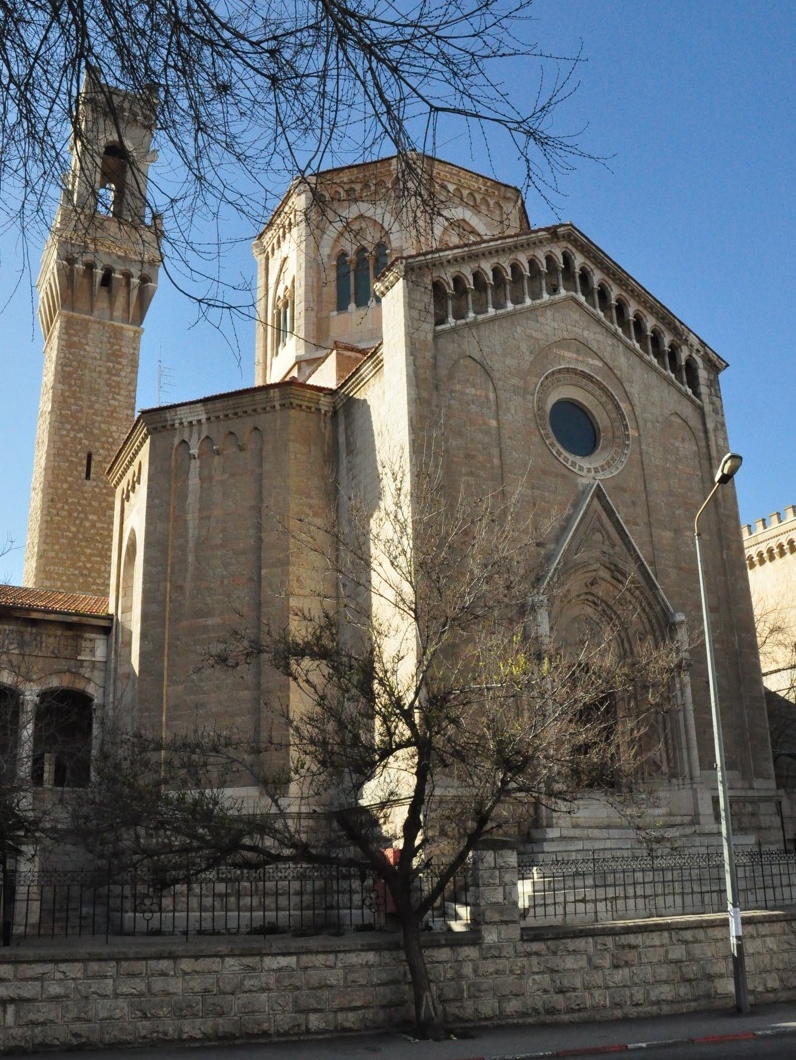
Barluzzi was asked to build two churches by the Franciscans, on Mount Tabor and in the Garden of Gethsemane. He returned to Italy to ponder his future. He wrote in his diary: ‘I go to Father Corrado, the confessor of my youth, I explain my circumstances and ask what I must do. ‘Go and build the Sanctuaries, and then we’ll talk again.’ My heart leaps for joy, and I say: ‘It is Gods will’.

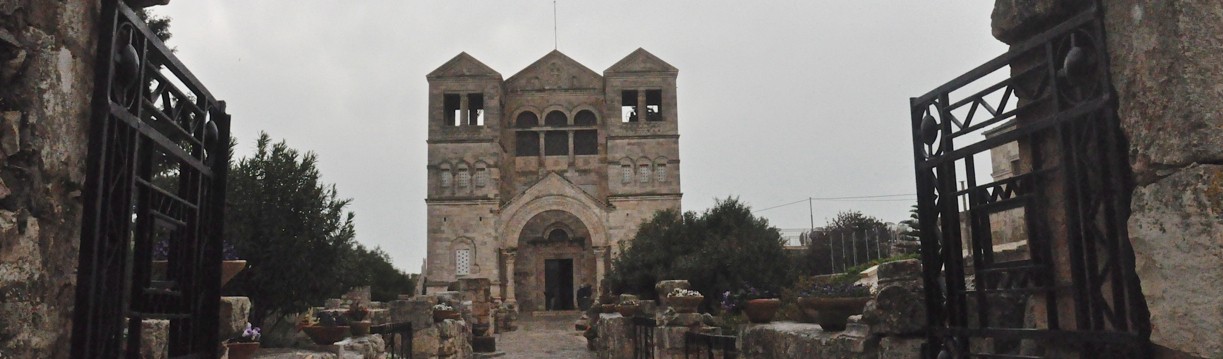
So Barluzzi began to build a basilica on the top of Mount Tabor, one of the traditional sites of the Transfiguration. This was a challenging task in 1919 because there was not even a road or water, which had to be carried by mules; even the stone masons were brought from Italy. Again Barluzzi borrowed from an existing church, St. Simeon the Stylite near Aleppo, for his design because of the importance of the Transfiguration in the Syrian liturgy and the triple division of the facade matched the three figures in the story, Moses, Jesus and Elijah. The roof was originally of alabaster tiles in order to let the light in, unfortunately these had to be covered to prevent the rain coming in but Barluzzi used the element of light to the full.

At the same time he was working on the basilica at Gethsemane, called both the Church of All Nations and the Church of the Agony. Here Barluzzi developed his symbolic architecture, in this case Christus dolens et triumphans. The suffering of Jesus and his pain is represented by a building of Byzantine inspiration which evokes the beginning church, a somber interior of dark mosaics with the light filtered by purple glass, with twelve small domes, like the apostles. The glory is  the triumphal facade of classic Roman inspiration, a triple round arch, supported by four large pilasters surrounded by columns topped with Corinthian capitals (a similar capital was found during the excavations and is on display at the Stadium Biblicum archaeological museum).

Barluzzi went on to build numerous other churches, transforming into stone the deepest sentiments of his heart and dedicated his life to honoring and glorifying the earthly Jerusalem. It is a blessing to be able to experience his work.


Just inside Jaffa gate is the Franciscan Christian Information Center. As of the date of this post, there is an exhibit about Antonio Barluzzi that I highly recommend.
Mary Magdalene

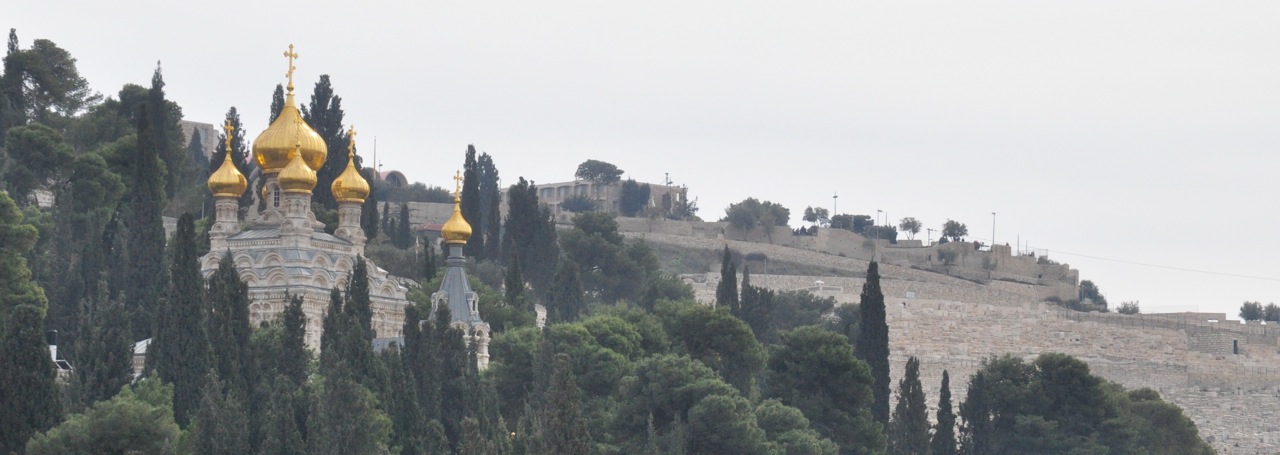
You can’t miss the church on the slope of the Mount of Olives, its seven gilded, onion-shaped domes sparkling in the sunlight. This is the Church of Mary Magdalene built by Czar Alexander III of Russia in 1886. Dedicated to Alexander’s mother Maria Alexandrovna, it was called the Church of Mary Magdalene after her name-saint from the town of Magdala on the western shore of the Sea of Galilee.

Mary Magdalene is mentioned as one of the women who “ministered to him [Christ] of their substance”. The New Testament also tells the story of an exorcism on Mary that cast out seven demons (Luke 8:3). One of the best-known women in the New Testament, Mary accompanied Jesus on his last journey to Jerusalem, was present at the crucifixion and was the first person to see Jesus after the resurrection (Mark 16:9). Though she was very close to Jesus, she was never recognized by Christianity as one of the Apostles.

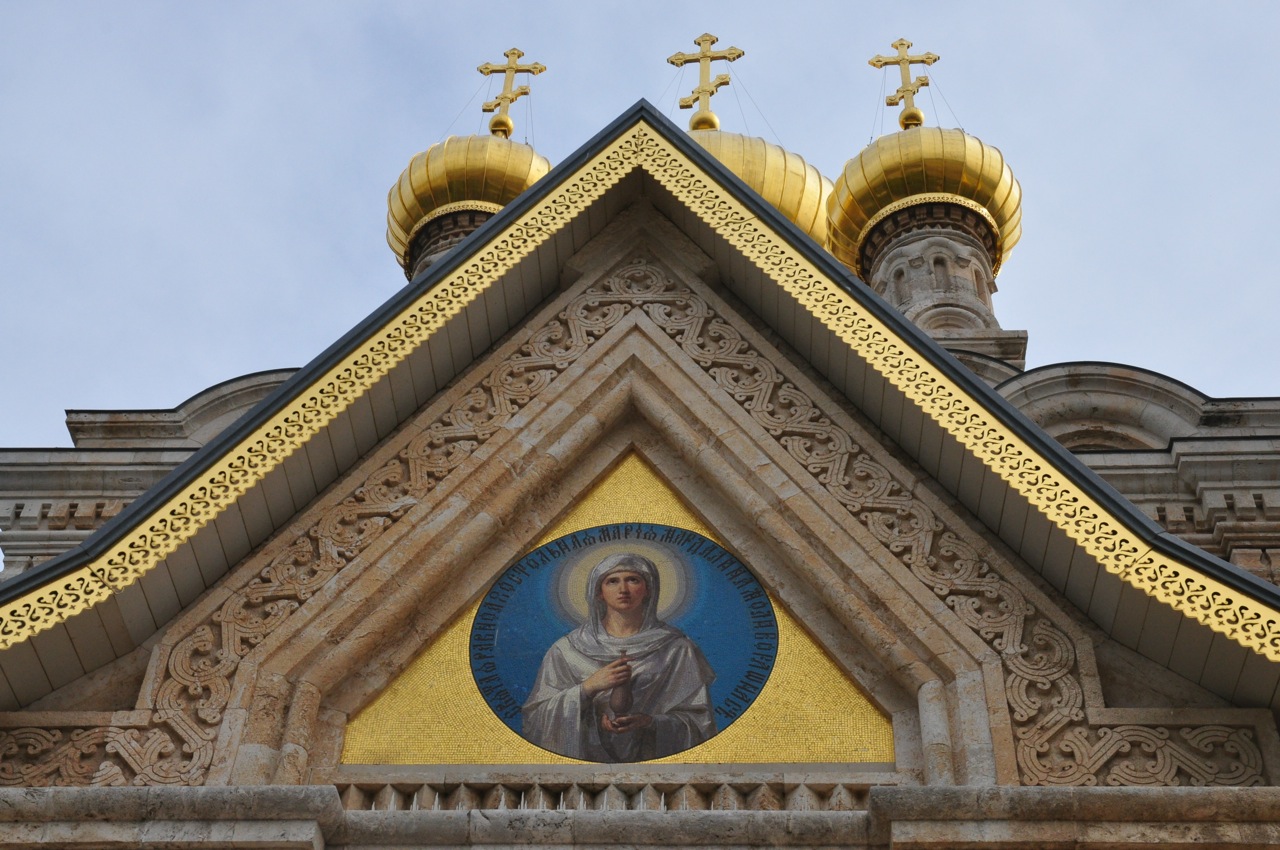
Above the main entrance to the church, located on the second level, is a gabled roof trimmed with a lace pattern in gold. A circular blue mosaic depicting Mary Magdalene piously robed in white is superimposed on a gold triangle in the gable,which is bordered with an intricately carved stone pattern. On the left side of the building is a bell tower ringed with squat squarish pillars topped by a large grey cone with several dormer like windows, a gold onion dome perched on top.

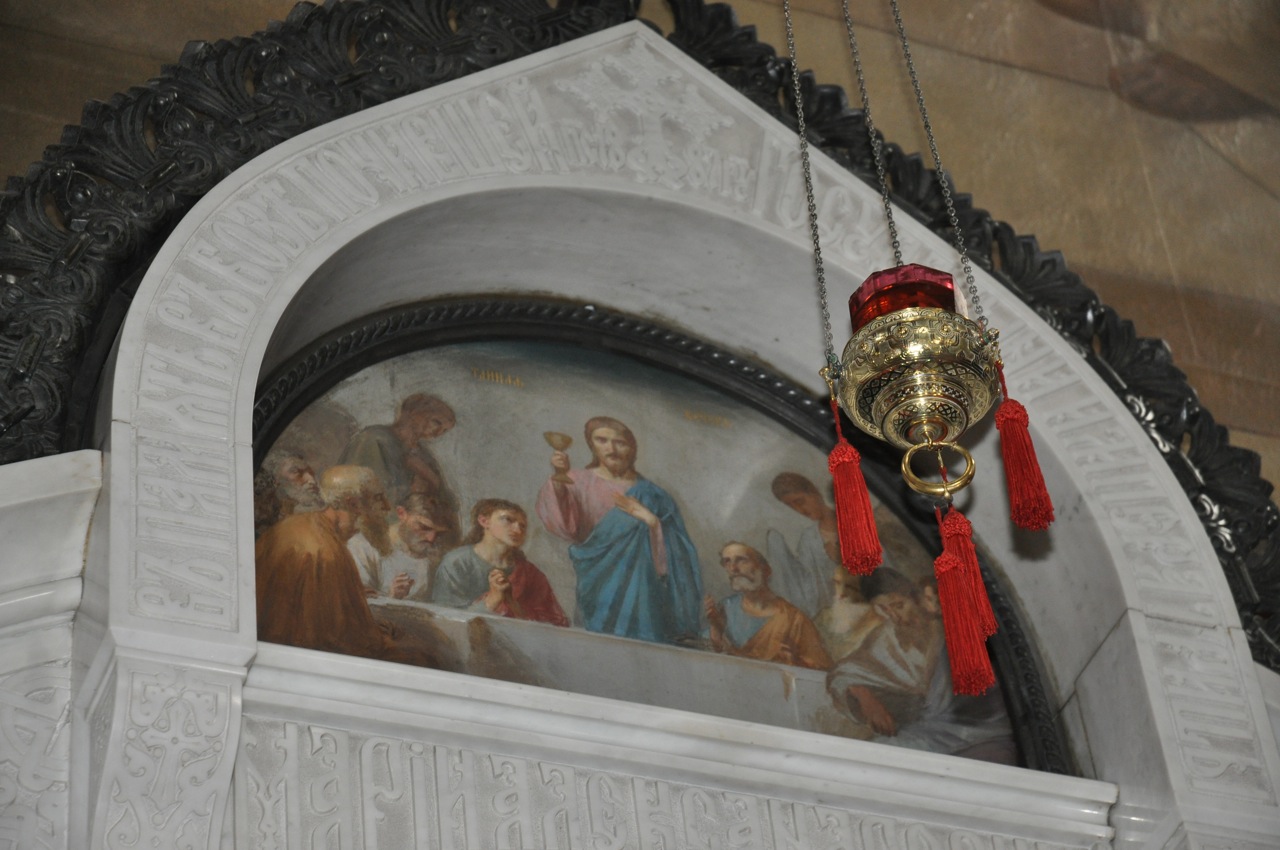
Inside the church decorated in shades of burnt orange in various patterns hangs a large metal chandelier which has small oil lamps for light. The iconostasis, a wall separating the nave from the sanctuary and altar in an Eastern church, consists of a series of arches of beautifully carved white marble, with paintings by Vereshoguine, one of Mary Magdalene. In the middle in an arch above the Holy Doors is the traditional scene of the Last Supper (click on the image to see it larger).

Six tiny paintings on the doors depict the four evangelists, the Virgin Mary, and the angel Gabriel. Over the arches of the iconostasis and high up on the other three walls are scenes with Mary Magdalene painted by Ivanov.

One of Russia’s most extraordinary saints lies in state within the church. She was Russian Grand Duchess Elizabeth Fyodorovna put to death by the Boshevists in 1917, wife of the Czar’s brother Sergei (assasinated in 1905) and sister to the Czar’s wife Alexandra. She was the creative force behind the church and supervised the artwork.

Visiting the church takes planning due to the limited hours it is open (Saturday, Tuesday and Thursday from 10am to noon) so until then check out this virtual tour at http://www.3disrael.com/jerusalem/church_magdalene2.cfm

If you are on the trail of Mary Magdalene search out the church of Saint Etienne, outside of the Old City walls just north of Damascus gate. Named for Saint Stephen, the first Christian martyr, this is a Catholic church of the Dominican order. You can’t help but notice the painting of Mary Magdalene on your right as you enter the church.

For another Russian Orthodox church with gold onions visit the Gorney monastery compound in the village of Ein Kerem southwest of the city where Mary came to visit her sister Elizabeth and where John the Baptist was born (Luke 1:39).

Acre Prison Break

“The first encounter with Acre Prison was terrifying. With your hands and feet shackled, you get off the truck next to a deep moat that reminds you of images of medieval castles that you may have seen in the movies. A fortress wall of seemingly infinite height towers before you. A narrow bridge leads to an opening in the wall. This is the bridge to a place that none has ever escaped from…”

Mendel Malatzky, Irgun prisoner, 1947

The fortress was built by the Bedouin sheikh Daher el Omar in the mid 18th century on the ruins of the Crusader citadel and was further fortified by al Jazzar. Under the British mandate, the fortress served as a jail, where Jewish underground fighters were imprisoned and where 8 Irgun members went to their death on the gallows. Acre was the most secure prison in the country.

Despite this, the Irgun looked for a way to enable their escape. The break came when an Arab inmate mentioned that he had heard women’s voices while working in the oil storeroom (in the south wing of the prison). This was reported to Eitan Livni (father of Tzipi Livni), the most senior Irgun prisoner, who deduced that the south wall of the prison bordered on a street or alley of Old Akko. The information was conveyed to the Irgun general headquarters where they concocted a plan to exploit this weakness for a break-in.

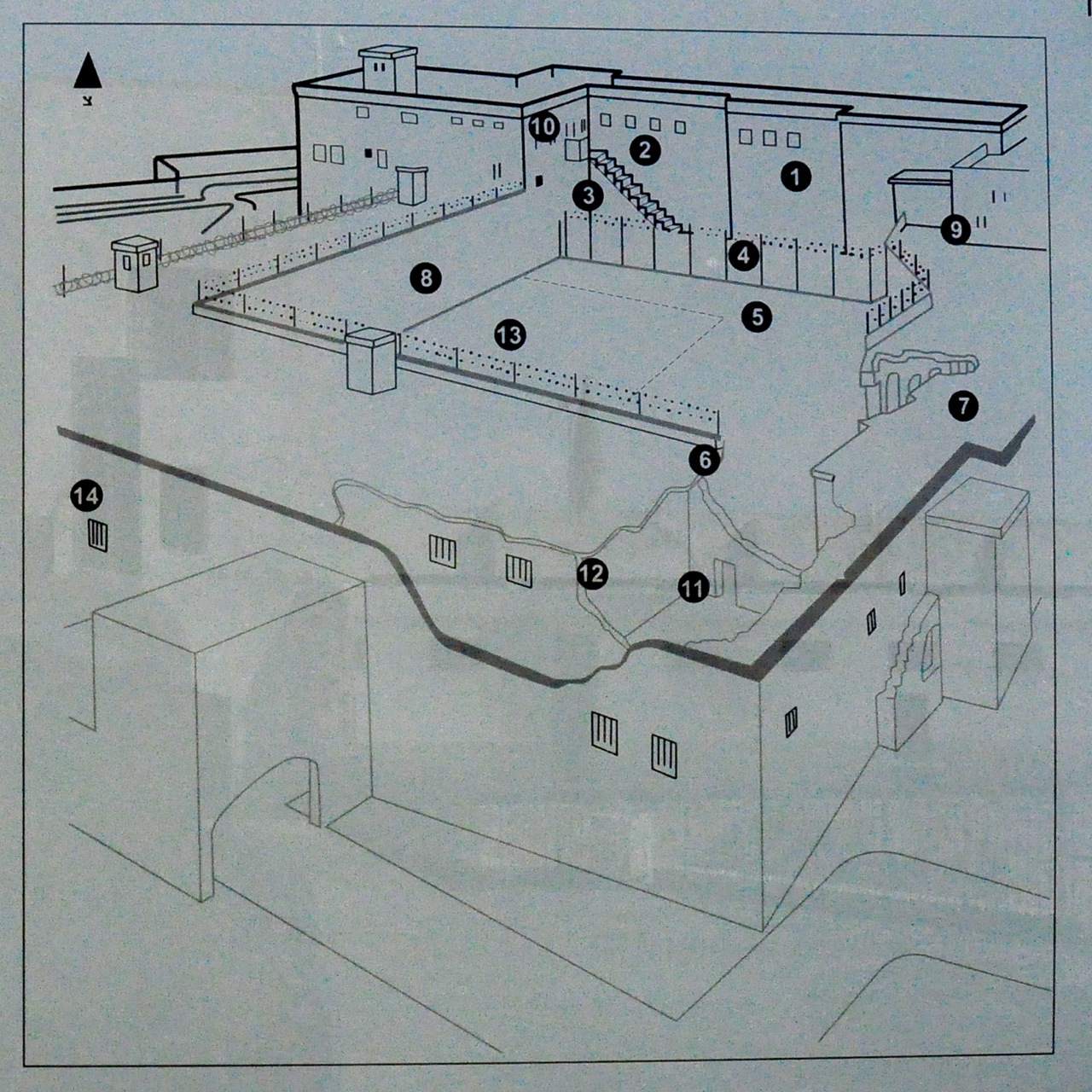
  1. Administration Wing
  2. Hospital
  3. Gallows and Memorial Floor
  4. Visitors’ Wall
  5. Prison Yard
  6. Arab Prisoners’ Wing
  7. Jewish Prisoners’ Wing
  8. Service Wing
  9. Workshops
  10. Jabotinsky Wing
  11. Iron gates that were broken through during the break-in
  12. Archaeological excavations
  13. Prison yard
  14. Break-in point

The logistic preparations were complicated: the Irgun had to purchase a truck, a jeep, two military pickup trucks and make them look like British army vehicles, British army uniforms were acquired and the men were given “English” haircuts. They set out in the convoy of vehicles for Akko to get into position, the two military vans entered the market, while the 3 ton military truck waited at the gate.

The jailbreak was planned for May 4th, 1947 when prisoners would be exercising in the yard to occupy the guards and the cells would be open, the same day the United Nations General Assembly convened to discuss the Palestine issue.

A military engineering unit of the Irgun made its way to the hamam, the Turkish bath house, and pretending to be telephone technicians used ladders to climb onto the roof with the explosives and placed them against the window bars. At 4:22pm there was a loud explosion that blew off the windows and made a hole in the southern wall.

Forty-one prisoners ran from their cells and using explosives that had been smuggled into the prison blew off the iron gates closing the corridors to reach the place of the break-in. From there they went out onto the roof of the hamam and into the alleyways of Old Akko.

Some jumped into the van, others ran through the streets of the market to the Land Gate where the truck was waiting.

Of 41 escapees (30 Irgun, 11 Lehi), 27 inmates succeeded in escaping (20 Irgun,7 Lehi), 6 escapees and 3 fighters were killed and 8, some of them injured were caught and returned to jail; also arrested were five of the attackers. The Arab prisoners took advantage of the commotion and 182 of them escaped.

The action was described by foreign journalists as “the greatest jail break in history.” The New York Herald Tribune wrote that the underground had carried out “an ambitious mission, their most challenging so far, in perfect fashion”, while in the House of Commons, Oliver Stanley asked what action His Majesty’s Government was planning to take “in light of the events at Acre prison which had reduced British prestige to a nadir”.

Three out of the five men captured (Avshalom Haviv, Meir Nakar and Yaakov Weiss) were sentenced to death and died on the gallows in the Acre prison. In retaliation, the Irgun kidnapped two British sergeants, Clifford Martin and Mervyn Paice. When the British did not relent and executed the Irgun men, the Irgun hanged the two sergeants.

Today the Acre Prison is a museum where you can walk through the different cells, offices and workshops of the prison and through a series of dramatic videos experience what it was like. The tour ends at the room with the gallows.

From the prison you can visit the hamam and and learn about the tradition of the Turkish bath and some history of Akko. There is much to see and I’d be happy to take you exploring Akko.