Category Archives: Archaeology

Bar/Bat mitzva in Israel

We celebrated our daughter Tiferet becoming a bat mitzva with family and friends in the archaeological park along the southern wall of the Temple Mount early in the morning – that was back in August 1996 and I still remember how hot it was by mid morning and how our younger son Amitai who was 6 years old at the time foraged for figs that grew on the trees nearby.
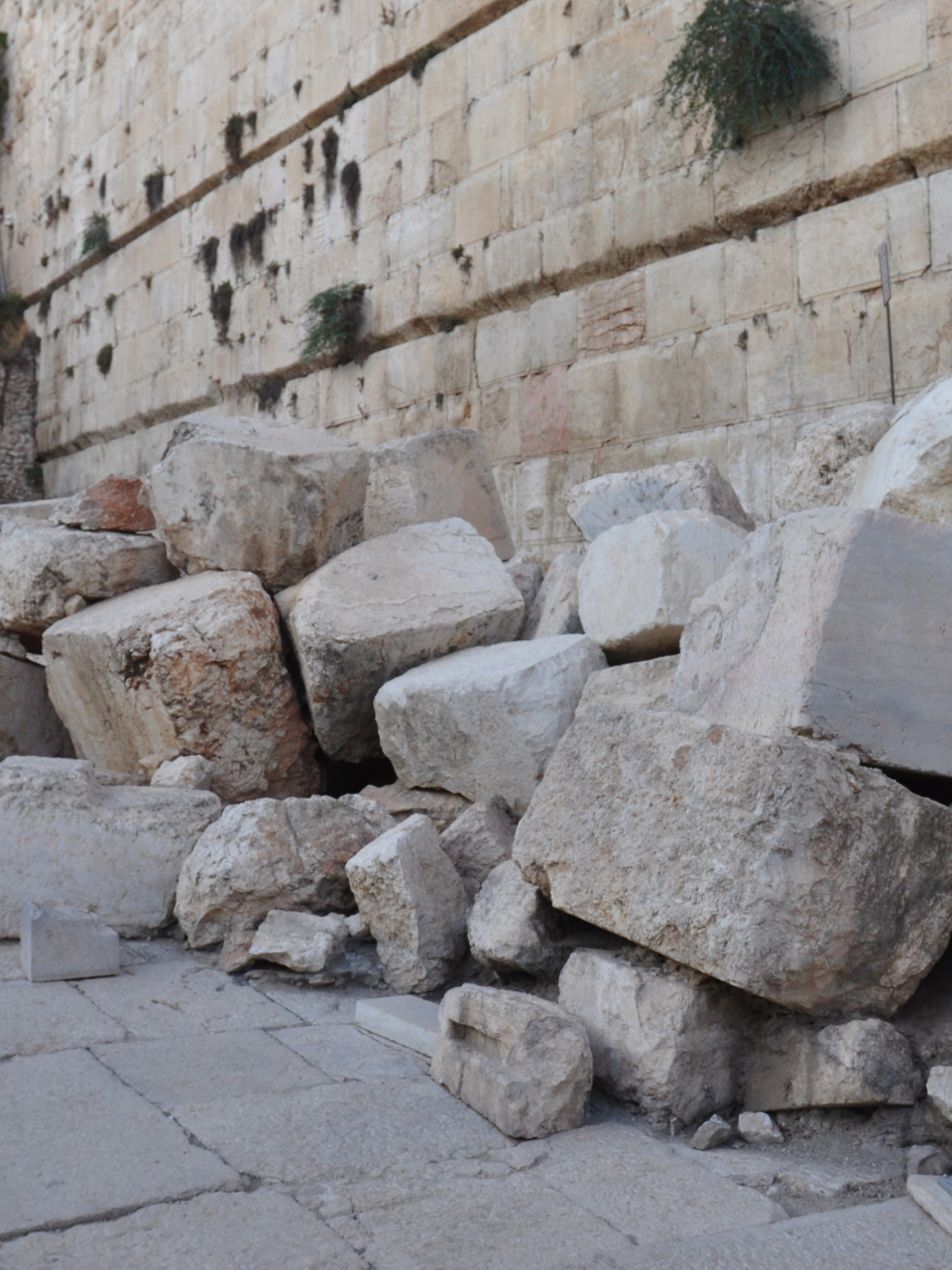
Today the popular place is on the Herodian street that runs along the Western Wall, among the massive stones that were pushed from the wall by the Romans almost 2000 years ago, a silent reminder to the destruction of the Second Temple and the downfall of Jerusalem.

We celebrated our son Uriel becoming a bar mitzva by organizing a trip to Peru with close friends, hiking for 4 days along the Cuzco trail to the sacred Inca site of Machu Pichu. We carried a Sefer Torah with us which we read on Monday and Thursday on the trail, on Rosh Hodesh (the new month) at Machu Pichu and on Shabbat back in Cuzco.

Some families decide to celebrate with family and friends in Israel and have climbed the Snake Path to the top of Masada at sunrise, as a sort of physical rite of passage and celebrated a bat mitzva in the ancient synagogue or one of the rooms in the casement wall used by the Zealots. You might like to celebrate a bar or bat mitzva within the ruins of one of the ancient synagogues, for example at Baram or Korazim in the Galilee or at Herodium.

Besides it being meaningful to experience Israel as part of becoming a bar or bat mitzva, friends and family can explore and enjoy the sites and nature of Israel and feel the connection between the Torah reading and the land. As Reb Shlomo Carlebach used to say, “The Torah is a commentary on the world and the world is a commentary on the Torah“.

Not every guide is able to make all the arrangements necessary for a bar or bat mitzva celebration in Israel – provide a Sefer Torah, take professional photographs, arrange the prayer service, do the guiding that makes Israel part of the experience. I handle the logistics and you get to experience a memorable time. I would be happy to help you arrange your bar or bat mitzva in Israel, just contact me.

Here are some of the photos that I took at Rachel’s bat mitzva in the summer.


Israel with kids

Israel is a great place to visit with kids. The country is small but varied. One day you can be bumping along in a jeep on the Golan Heights with a view into Syria and hear the stories of Israel’s capture of the area during the Six Day War in 1967. The next day you can be riding on a camel across the sands in the Negev, sleeping in a Beduin tent or under the stars. On the Mediterranean coast, in Akko there is a Crusader fortress that was buried in sand by Al Jazar in order to build his citadel that we can explore. At Masada there is a Herodian fortress in the desert later used by Zealots in the Great Revolt against the Romans. There is an opportunity to climb through caves more than two thousand years old, an experience out of “Raiders of the Lost Ark”. In Jerusalem you can walk around the Old City on the ramparts from the time of Suleiman the Magnificent, walk on paving stones that go back to Roman times and even the Second Temple period or walk underground along the length of the Western Wall.

Check out this article by Nancy Better in the May 17th edition of the New York Times, Taking the Kids – In Israel, With a Whiff of Adventure.

All the sites mentioned in the NY Times article can be incorporated into your personalized tour. There are less expensive accommodations for those on a tighter budget.

Heap of the Wild Cat

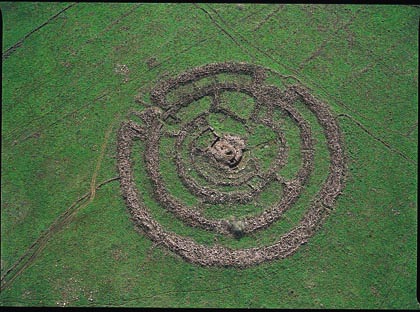
Rogem Hiri (Rujm al-Hiri in Arabic, meaning stone heap of the wild cat) is one of the most intriguing archeological sites in Israel.

The megalithic complex is located in the central Golan, on the Golan trail, near Daliyot reservoir (32.908705°N 35.800705°E). It consists of four concentric circles of local basalt fieldstones (42,000 stones are the estimated number) of varying sizes enclosing a central, round cairn. The outer, largest circle is about 500 meters long and 156 meter in diameter. Several radial walls connect the circular walls, creating a labyrinth-like structure which has only two entryways, one facing northeast, the other southeast. At the center of the circles is a cairn, an irregular mound of stones 20-25 meters in diameter and preserved to a height of 6 meters. A geophysical survey using Ground Penetrating Radar (GPR) revealed the pile of stones to be hollow suggesting that it might be a burial chamber, a monumental commemorative tomb or the mausoleum of an Early Bronze Age ruler in the Golan.

Rogem Hiri, RogemHiri, megalithic complex in Golan (photo from Israel Ministry of Foreign Affairs website)

Rogem Hiri, Heap of the Wild Cat, megalithic complex in Golan (photo: Israel Ministry of Foreign Affairs website)

Archaeologists have proposed a variety of theories concerning the function of this structure, which has no parallel in the Middle East: a religious center; a defensive enclosure; a large burial complex; a center for astronomical observation, a sort of Middle Eastern Stonehenge since the northeastern entryway is roughly oriented towards the solstitial sunrise on 21 June and a calendrical device. The structure was even identified as the tomb of Og, King of the Bashan and last of the giants (see Deuteronomy 3:11).

The structure is not easy to appreciate from the ground so wouldn’t it be great to fly over it in a hot air balloon or glider?

Jerusalem Underground

Jerusalem and the Old City are great places to walk around but there’s also a Jerusalem underground (not to be confused with the light rail :-) ). Remember that in archaeological sites as you go to lower layers you go back in history, for example, under Damascus Gate from the Ottoman period is the Roman gate to the city from the time of Hadrian. Not far is Zedekiah’s Cave, also known as Solomon’s Quarries, a 5-acre (20,000 m2) underground meleke limestone quarry that runs under the Muslim Quarter as far as the Sisters of Zion. According to legend, King Zedekiah escaped from the Chaldeans who had surrounded Jerusalem by fleeing through the cave all the way to the plains of Jericho.

If you like caves, there is also a very fine stalactite cave not far from Jerusalem, Soreq cave in the Avshalom Reserve that you can visit about 2 km from Beit Shemesh. Since you will be nearby this would be a good opportunity to visit Tel Maresha and explore underground, the caves, columbarium and tombs from the Hellenistic period.

Herodium has a series of tunnels dug in the mountain during the Great Revolt and then extended during the Bar Kochba Revolt. Near Herodium in Nahal Tekoa the Haritoun Cave is great for spelunking.

In the Jewish Quarter go underground to the Wohl Archaeological museum to see the remains of mansions from the Second Temple period. You can also take a guided tour of the Western Wall tunnel (you must reserve places in advance) that uncovers the part of the western support wall of the Temple Mount built by Herod that runs under the Muslim Quarter. Afterwards walk down the Via Dolorosa and enter the Sisters of Zion to see the Lithostratus and Struthion pool, from the time of Hadrian.

If you like tunnels, exit Dung gate and walk over to the City of David. There you can walk underground in the passageway from the Canaanite period – then you have 2 options: 1) walk the Canaanite tunnel (dry) and exit in Area E park 2) wade through Hezekiah’s tunnel (wet) and exit at the Byzantine Siloam pool. This site contains a lot of history and archaeology and is worth doing with a knowledgeable guide.

Theses are some ideas for exploring underground Jerusalem. Contact me if you would like me to take you exploring.

City of David: Inscription & bulla

I just received the latest newsletter from Ir David (in Hebrew) and they have a riddle which I’ve modified slightly and include here.

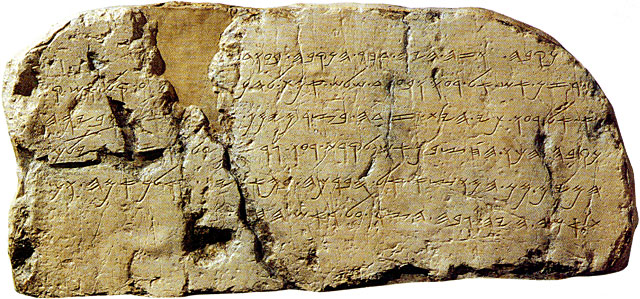
This inscription, carved in stone in proto-Hebrew was discovered in 1880 by chance at the southern end of Hezekiah’s tunnel in the City of David by a young boy named Jacob Eliahu who was playing hooky from school. Because Israel was part of the Ottoman Empire at the time, the Turkish authorities took the stone (which broke when it was pried off the wall) to the Istanbul Archaeological museum, Turkey.

siloam-inscription

Photo: from the Internet

Subtract the sum of the numbers mentioned in the text of this inscription from the year that it was discovered and then add the units digit of the year that Parker began his excavations in the City of David and you’ll get a year that is important in Jewish history and in relation to the bulla (a seal impression in clay affixed to legal documents) of Gedalya ben Pashur that Eilat Mazar found in her recent excavations below the stepped support wall in Area G. Explain the relationship. Email me your answer. Have fun. 8-)

bulla

Photo: Gabri Laron/Hebrew University/Dr. Eilat Mazar

Hints: Who was Gedalya ben Pashur and where in the Bible is he mentioned?

Herod’s Mausoleum and Sarcophagus at Herodium

So they went eight furlongs to Herodium; for there by his own command he was to be buried. And thus did Herod end his life.

Josephus, Antiquities of the Jews

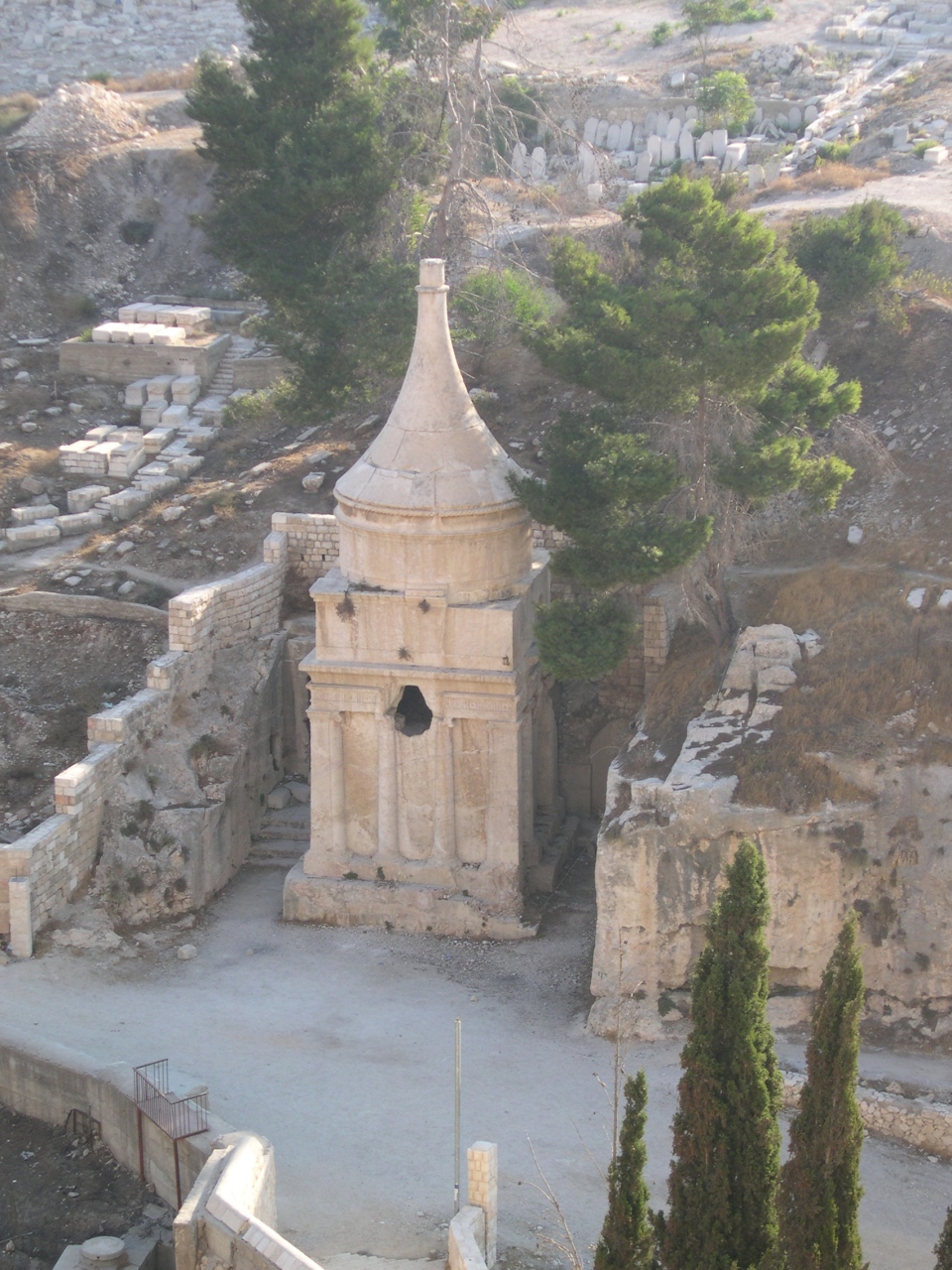
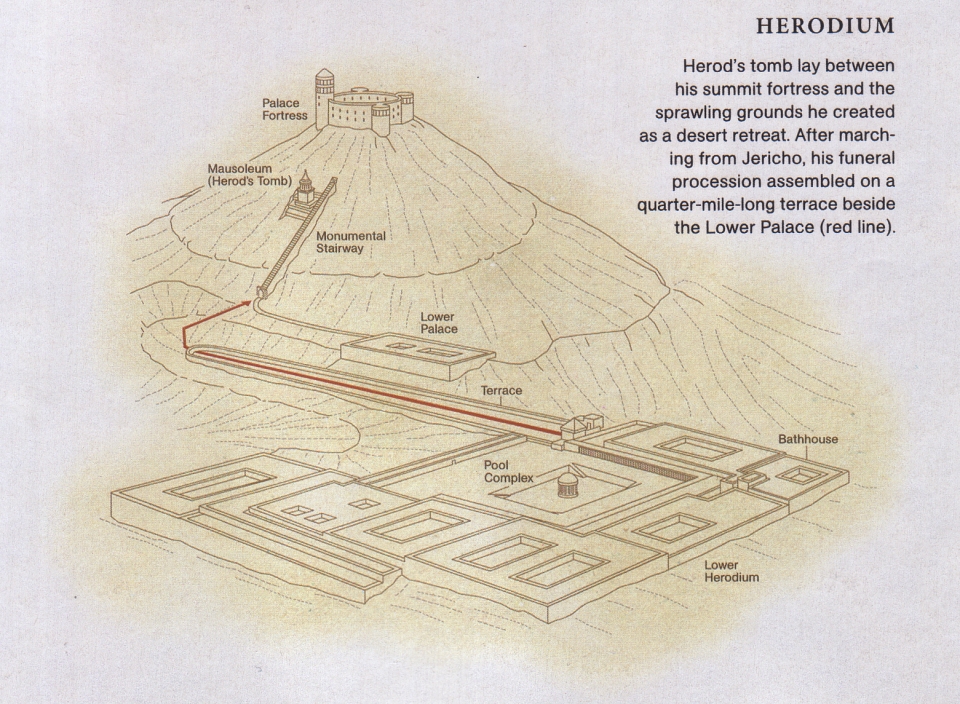
In 1972 Professor Ehud Netzer began his excavations at Lower Herodium. In May 2007 after 35 years of looking for King Herod’s tomb at Herodium, Netzer announced at a press conference that he had uncovered the base of Herod’s mausoleum halfway up the manmade mountain, on the northeast side. Netzer, both an architect and archaeologist and an expert in the Herodian period, has drawn up his reconstruction of the mausoleum, a monument 25 meters high, with a cube-shaped first floor, a cylindrical second floor and a soaring, peaked roof. Note that the photo below is of Yad Avshalom in the Kidron valley – it is an impressive nefesh from the same period so it’s likely that Herod’s monument could have looked similar.

Yad Avshaom, tomb from Second Temple period in the Kidron valley, Jerusalem

Yad Avshalom, tomb from Second Temple period in the Kidron valley, Jerusalem

herodium

National Geographic, December 2008

I’d be delighted to guide you at the site, including the palace complex at the foot of the hill excavated by Netzer in the 1970s and the palace-fortress at the top (in the archaeological park) built by Herod. Although the tomb area is not yet open to the public, they’ve made a temporary path that takes you close, to a lookout of the remains of the mausoleum. Excavations are continuing.

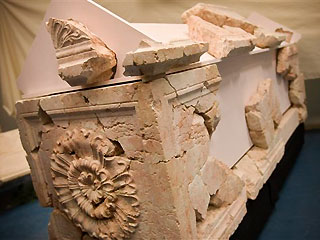
Discovered was an ornate, pink limestone sarcophagus that had been smashed to pieces in antiquity that Netzer claims was King Herod’s.

herods-sarcophagus

Photo: AP (from the Internet)

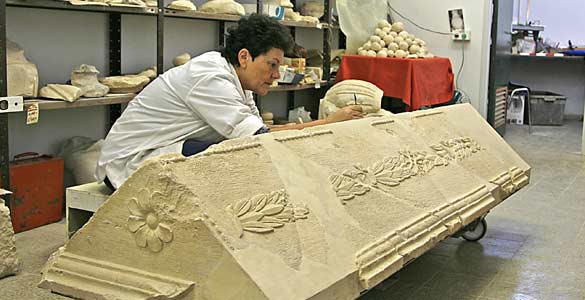
Later two other sarcophagi were discovered that Netzer claims belong to other members of Herod’s family.

herodium-sarcophagus

Photo: Gabi Laron (from Internet)

Herodium is unique among the sites like Masada, Caesarea, Cypros associated with Herod – it was an entire palace complex originally built by Herod in the desert, the only site to bear his name and where he decided to be buried. Herodium gives us a key to understanding Herod and Jewish life during the Second Temple period.

For additional information about Herodium check my blog post at https://israeltours.wordpress.com/2008/06/07/tour-herodium-herod-tomb/

For a sample tour that I do of Herodium check https://israeltours.wordpress.com/tours/herodium/