Category Archives: Archaeology

What to see in Jerusalem

What to see in Jerusalem and Not Hire a Guide

I’m often asked by people who are planning a trip to Israel what they should do if they have a couple of days to see and experience Jerusalem. Of course, there are many answers, it really depends on what you are interested in. Assuming that this is your first visit, you’ll probably want to start in the Old City so here are my recommendations – note some sites charge an entrance fee.

First, drop by the Tourist Information Center at Jaffa Gate, in the Old City and get a free map and a list of sites to see; say hi to Jennifer, she’ll help by marking sites on the map for you and answering your questions. Then walk around, exploring the 4 Quarters, Armenian, Jewish, Muslim and Christian.

Another possibility is to take the Ramparts Walk starting at Jaffa Gate where you actually walk on the walls built in 1537 by the Ottoman Turkish sultan, Suleiman the Magnificent – looking in gives you a birds-eye view of the Old City, looking out gives you a view of the new city.

In terms of churches, I would visit the Church of the Agony/All Nations and the Garden of Gethsemane outside of the city walls, re-enter the Old City at Lions Gate, visit the Church of Santa Anna, a Crusader church with incredible acoustics (try singing Amazing Grace or other liturgical melody). Continue and you will come to Station I of the Via Dolorosa, follow the Via Dolorosa counting 8 stations to the Church of the Holy Sepulcher, the holiest site to Christianity, where Jesus was crucified and buried and according to Christian tradition rose again, stations IX to XIV are at the Church.

Walk through the Arab shuq and take a right at the Cardo to get to the Jewish Quarter. Visit the Wohl archaeological museum to get a feeling for Jerusalem in the Second Temple Period, in the time of Herod and Jesus. If you are interested in more archaeology, then visit the southern wall excavations at the Davidson Center; there is also a movie that describes life at that time.

Visit the Western Wall, the holiest site to Judaism, write your prayer on a paper and tuck it into a crack in the stones of the wall. Try to reserve a Western Wall Tunnel tour in advance, either on their website (if you know some Hebrew) at http://english.thekotel.org/VisitorInfo.asp?id=1 or you can call them at (02) 627-1333 between 8:30-17:00.

It’s worth taking a guided group tour of the City of David – exit the Old City through Dung gate, take a left and then right and the entrance is on your left. If you have “water” shoes and aren’t claustrophobic, you can even walk 45 minutes through Hezekiah’s Tunnel with water up to your knees (you’ll need a flashlight which you can buy at the site or use your cell phone), which is quite an experience.

You might want to walk up onto the Haram el Sharif to see the Dome of the Rock and al Aqsa mosque (the third holiest site to Islam) close up (the Muslim Waqf won’t allowed you to enter them unfortunately) but if so you’ll have to do it in the morning and it takes between 1/2 and 1 hour to pass through security at the entrance to the Western Wall Plaza. Make sure you have no religious articles, prayer books or Bibles and no Swiss Army knife, etc. with you – they will be confiscated.

The new Israel Museum is open after extensive renovations and it is now much easier to find your way (for more information check out my blog entry) – the Archaeology wing has been completely redone, the Ethnography section has been expanded and called Jewish Life and the Art gallery includes a new section on Israeli art. The museum includes the Shrine of the Book, where the Dead Sea Scrolls and other artifacts from Qumran are on display. From the same period, the Holyland model of Jerusalem is now housed on the museum campus. If the weather is cooperative, walk around and enjoy the sculpture garden. If you’re interested in archaeology, you can also visit the Rockefeller museum (on the same admission, there’s even a shuttle bus) which will get you back to the Old City.

For an overview of Jerusalem, there’s a red double-decker bus that takes you for a 2 hour audio tour (explanations in 8 languages) of the whole city:
http://city-tour.co.il/ntext.asp?psn=8375

The Arab shuq/market and the Mahane Yehuda market are great places to get a feel for Jerusalem. There’s the Ben Yehuda Street pedestrian mall, called the Midrahov, and at the bottom Zion Square and the pubs, restaurants and boutique galleries in Nahalat Shiva. There’s live music at the Yellow Submarine in Talpiot.

Explore the German Colony: for a local movie theater from the British Mandate period with restaurant/pub check out the Smadar; for artistic films, check Cinemateque. For music, dance and theater try the Mabada. There are plenty of places to eat in this neighborhood (including my house 8-))

All this without hiring a guide, but to be fair how about reading my post, Why hire a guide?
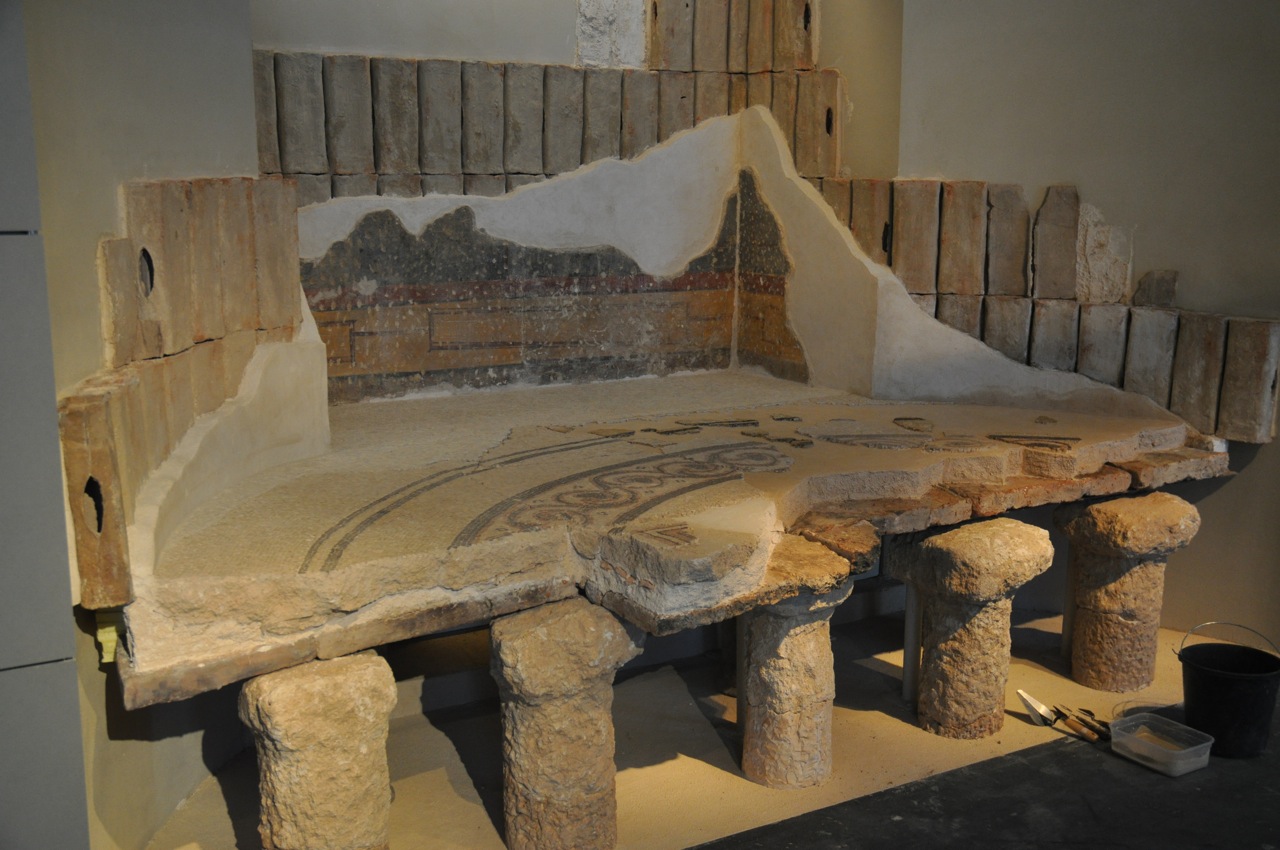
Roman Bath House from Herodium

One of the most exciting new installations that I saw in the Israel Museum’s renovated archaeology galleries was the display of a part of  the laconicum (hot dry room) next to the calderium of the Roman bath house that was found at Lower Herodium. I arrived to see the museum staff putting the final touches to the installation that shows clearly all the components: the hypocaust, the underfloor heating system where the floor is supported by stone pillars (pilae stacks) and the clay tubes in the walls to let the heat pass through; the plasterwork and fresco paintings on the wall; the mosaic floor.

Nearby is another square mosaic floor with a geometric, intertwined circle and pomegranates (one of the 7 species that grows in the land of Israel and characteristic Jewish motif of this period) in each of the corners. You can see this mosaic on site at Lower Herodium in the main tepidarium if you climb onto the roof of the bath house (though I learned that the one in the museum is the original and on site is a copy). If you look to the right, there is another mosaic in the small tepidarium designed as an opus sectile pattern of tiles.

I didn’t see any other artifacts from Herodium being readied for display – I was hoping to see the 3 sarcophagi that were discovered.

New Israel Museum

Today I had the opportunity to visit the Israel Museum before its official opening to the public on July 26th. There have been a lot of changes, to the tune of $100 million and these improve the visitor experience immensely.

James Carpenter Design Associates built new entry pavilions at the entrance to the museum that are connected by a covered “route of passage” to a new gallery entrance pavilion which acts as the central hub giving access to the Museum’s 3 collection gallery wings, Archaeology, Judaica and Art, from a main Cardo. Each of the new buildings is basically a glass cube shaded by cast terracotta louvered shade panels that diffuse the bright Mediterranean light and still allow the visitor a view of and interaction with the exterior. With this design the new pavilions resonate with Alfred Mansfeld and Dora Gad’s original modular and modernist design. I am pleased to offer an architecturally focussed tour of the new Israel Museum, including highlights like the Shrine of the Book, that has been called “a milestone in the history of world architecture”.

In the above photo, the view from the Carter Promenade looking back towards the entrance pavillions; below, looking up the hill to how the new gallery pavillion fits into the plan.

Light and glass comprise the firm’s signature architectural focus. The passageway has a wall of glass and is covered by a swatch of translucent glass panels that were designed and made especially for the project. Outside above the passageway a stream of water cascades down the hill over the glass panels. During the day the water and glass let light into the passage which animates the wall with a moving pattern and at night the light illuminating the passageway lights up the water stream above.

Efrat-Kowalsky Architects redesigned the interior gallery spaces of the existing buildings and the way the museum has organized the art and artifacts suggests some interesting connections among objects and between the particular and the universal. The emphasis is on what cultures have in common and there is an attempt to place Jewish history and practices in a broader context.

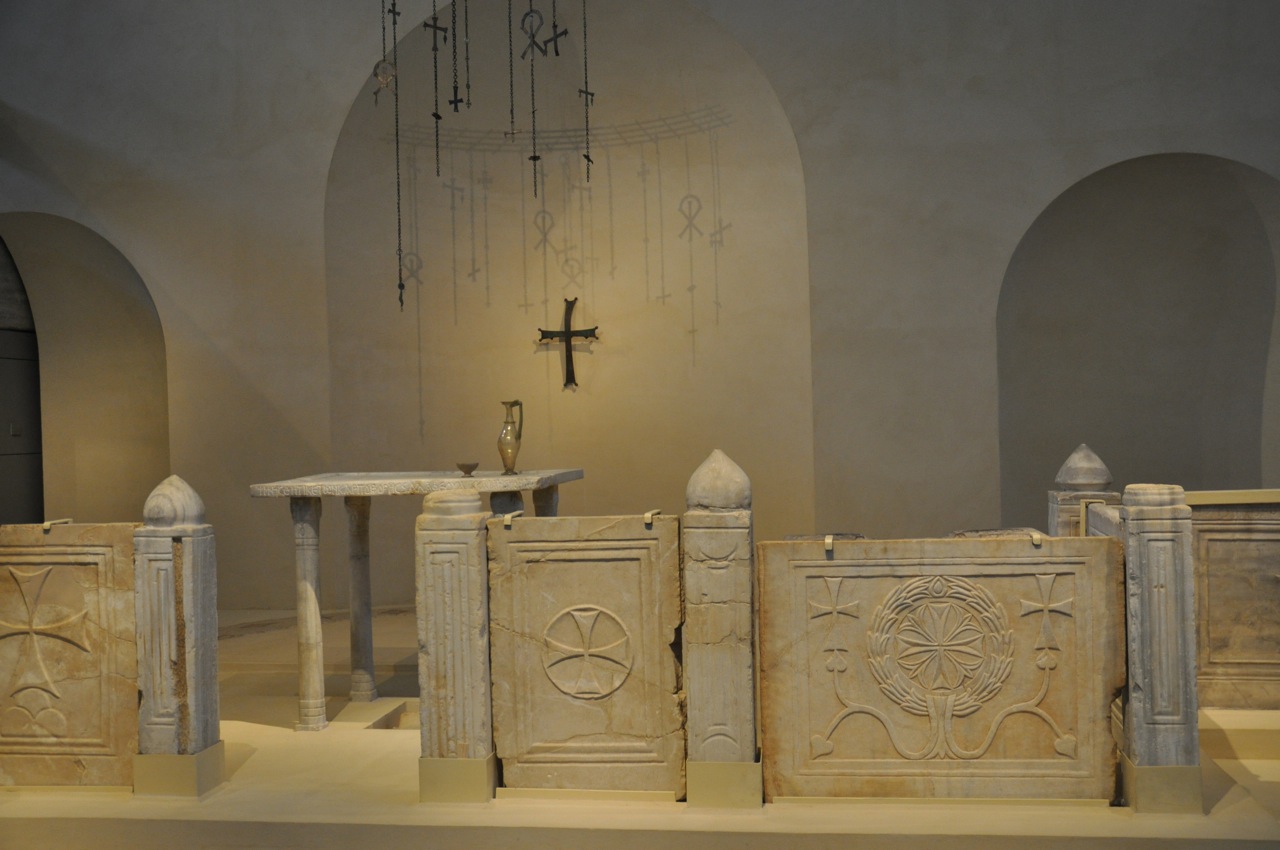
One example is a very impressive new installation in one large room that focuses on the 5th to 7th Century where part of a restored synagogue is displayed, the facade of the interior of the synagogue with its particular decorations and objects and a beautiful mosaic floor. Next to it a Byzantine church and across the room the michrab or prayer niche from a mosque. Roughly contemporary structures, they are placed in a way that highlights both their distinctiveness and their commonality.

The new galleries and displays are stunning. The museum is a wondrous place to explore.

Roman Cardo

When guiding in the Old City I take tourists on the same main roads that were built in antiquity. From Damascus gate we walk along the Cardo, the main north-south route in a Roman city, traverse the Muslim and Jewish quarters until we reach Zion gate. When entering from Jaffa gate we walk along the Decumanus, the main cross street, through the Arab shuq until we reach the Cardo. From there we need to zigzag along the Via Dolorosa to continue to Lions gate on the east of the city to the Kidron valley.

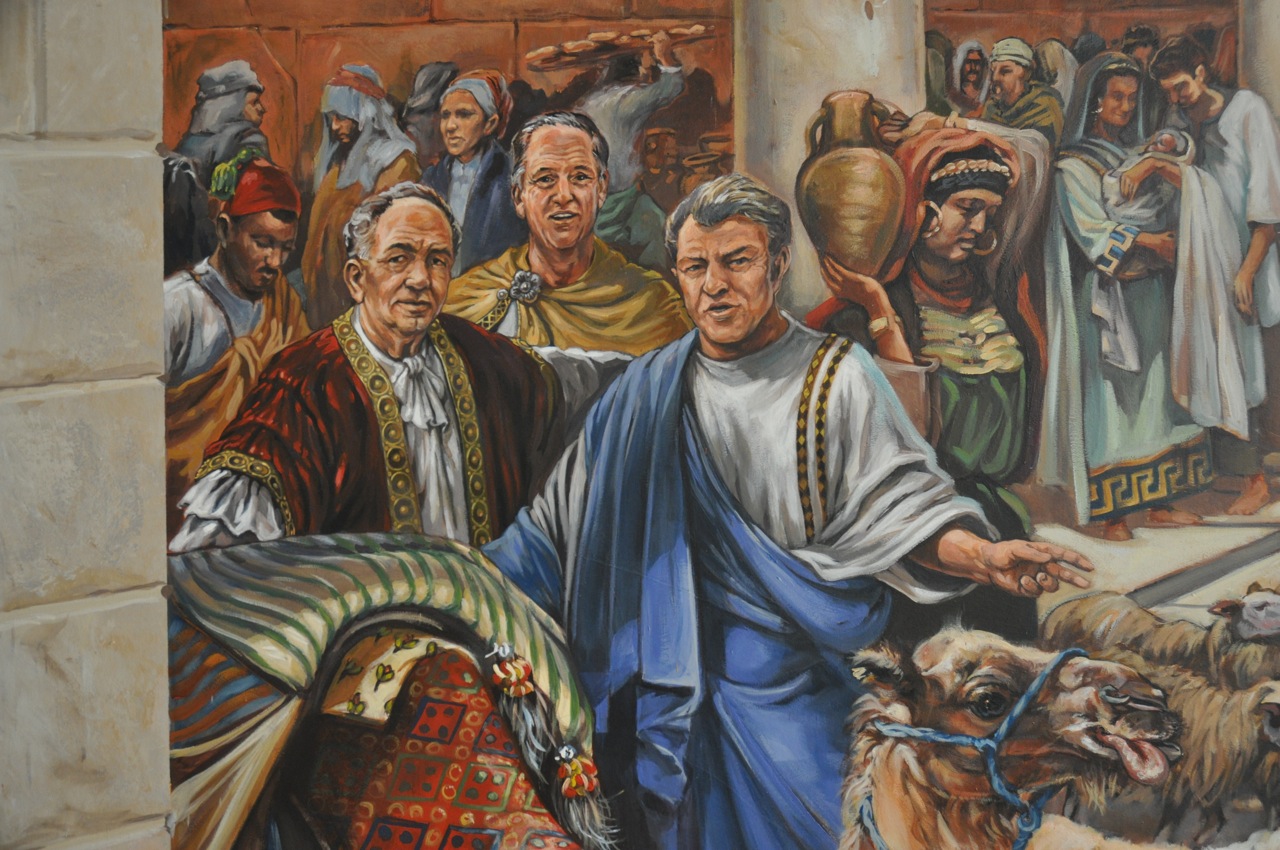
One day while walking along the Cardo I found the French group of artists, Cite Creation (http://www.cite-creation.com/realisations.php), painting a mural of the Cardo on a wall in the Jewish quarter. If you have trouble imagining what the Cardo was like the mural will help you see the main market street, like it was. I like their work – keep your eyes open and you will find other examples as you explore. Note the little boy with baseball cap, backpack and water bottle accepting a pomegranate, one of the 7 species of the land of Israel and the hoopoe bird flying overhead (chosen as Israel’s national bird in a vote on the Internet).

Check out the 3 gentlemen on the left side of the painting. Although they are dressed in traditional garb, there’s something about them that gives them an air of modernity. If you’re familiar with painting, often the artist includes family members or even a portrait of the artist. Not in this case – come on a tour and find out who they are and more.

The Cardo was 22.5 meters wide, flanked with rows of stone columns on either side and five meter-wide covered passageways. A wooden beam construction supported the roofing, probably of ceramic tiles. The columns, five meters high, of hard limestone, were found in fragments, incorporated into later structures, the capitals are Corinthian. You will be able to walk on the original well-hewn paving stones from the Roman period.

The Cardo connected the Church of the Holy Sepulcher, the holiest site to Christianityto the 6th C Nea Church of Justinian. In Byzantine times there were processions along the Cardo between these two churches. Today you can find the remains of the apse of the Nea church along the road and under the elementary school in the Jewish quarter. Along the sidewalk of the Cardo you can see columns (sitting on the earlier city wall from the Hasmonean period) and at the 7th Station of the Cross there is a column in the chapel. Access to the Holy Sepulcher is no longer from the Cardo, now we enter from the parvis (courtyard) on the side of the church.

Hurva Synagogue views

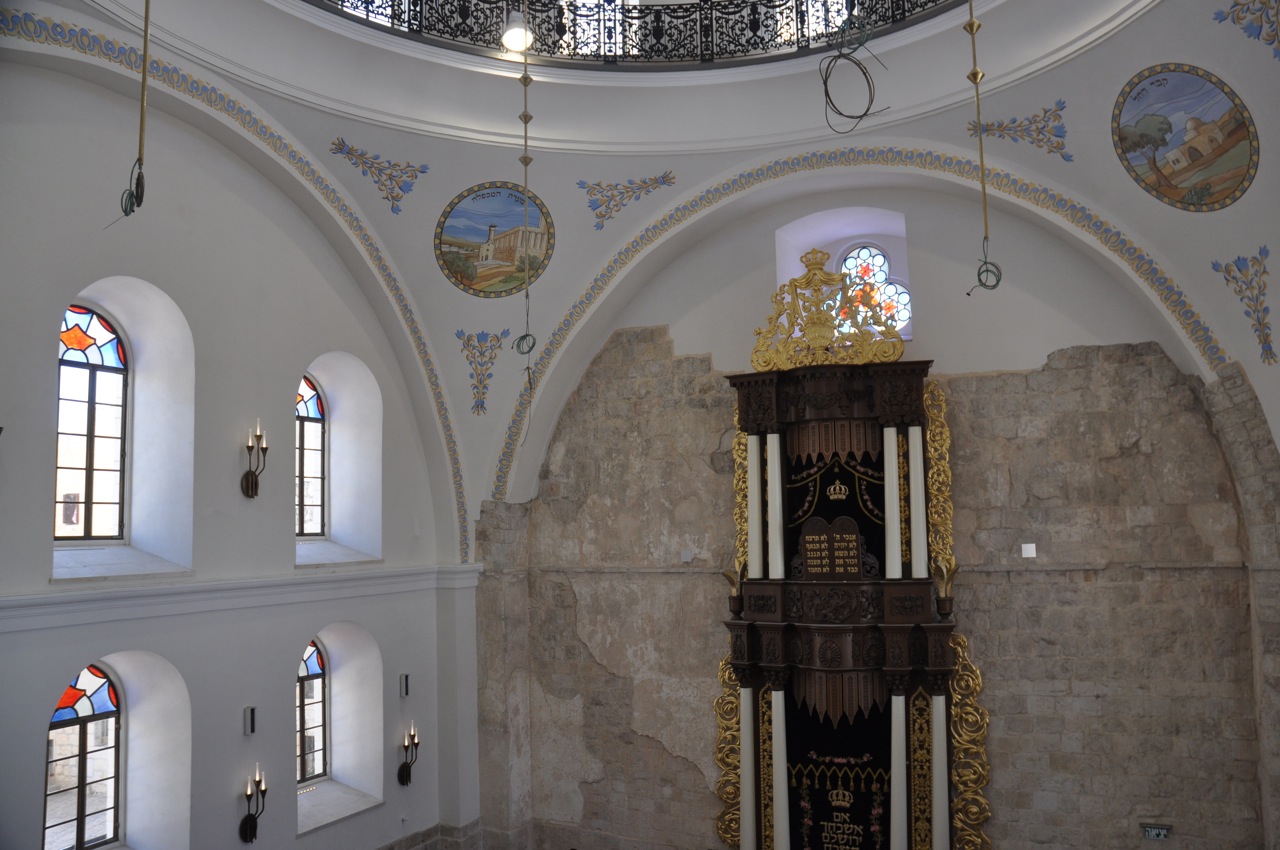
The Hurva was the main Ashkenazi synagogue of the Old City and stood as a landmark for almost 100 years until it was blown up by the Jordanian Legion after they had captured the Jewish quarter on May 27, 1948. It took until 2005 to decide to rebuild the synagogue which was completed in March 2010. I visited it shortly afterwards on a Shabbat morning for services. Make sure to go down into the basement (by the washrooms) to see the discovery of a mikveh (ritual bath) from the Second Temple period and an east-west Byzantine street. The second time I joined a weekday tour of the synagogue but we weren’t allowed into the main sanctuary. The guide was only able to show us the inside of the synagogue from the women’s balcony but we were allowed to go up to the roof. The Hurva synagogue is the only site that I am not permitted to bring people (therefore I skip the Hurva and tell its fascinating story outside) – that privilege goes to local guides that work for the Western Wall Heritage Foundation and you have to reserve a place in advance.

One of the highlights was the view of Jerusalem from the balcony around the dome. Here are 5 photos (shooting clockwise) taken from the height of the dome: 1) looking towards the Christian quarter, domes and bell tower of the Church of the Holy Sepulcher, bell tower of German Church of Redeemer and dome of Alexander Nyevsky Church, 2) view over the Jewish and Muslim quarters with Mount Scopus in the background, 3) Dome of the Rock, Mormon University and Augusta Victoria, 4) dome of Al Aqsa Mosque and Jewish cemetery on Mount of Olives 5) view towards Armon HaNatziv, Mount Zion, Dormition Abbey, Armenian quarter.

This slideshow requires JavaScript.

4–Day Itinerary

I’m happy when people contact me looking for a multi-day itinerary based from Jerusalem. It’s definitely worth a few days if you have the time. I’d like to share one itinerary that I guided for clients a couple of weeks ago. Of course, this itinerary is just to give you the idea – when you hire me as your guide you get a personalized itinerary that matches your interests.

Day 1

  • We started with an overview of Jerusalem from the promenade at Armon HaNatziv, learned about the aquaduct that brought water to the city from Hasmonean times (100 BCE). From there we drove to Herodium for a comprehensive tour: the lower city (pool, Roman bath, monumental building, Byzantine church) outside the park and the palace/fortress on the manmade mountain top built by King Herod including the latest excavation by Netzer of the tomb and Roman theater discovered on the north-east side of the mountain.
  • Visit to Gush Etzion (Etzion Bloc) to learn about the history of the Gush and memorial to the defenders of Kibbutz Kfar Etzion in 1948. Lunch at a lovely restaurant called Gavna in the forest of Kibbutz Massuot Yitzhak with a view all the way to the coastal plain.
  • Visit to Hebron and the Cave of Machpela, that Abraham purchased to bury Sarah in which our forefathers and 3/4 mothers are buried. The building over the cave was built by Herod. Walk around the city to try to understand the current political reality.

Day 2

  • Walking tour of the Old City covering the 4 quarters, the 3 religions and 3000 years of history, including Herodian, Roman, Byzantine, Arab, Crusader periods. Views of the city from above and exploring underground. Tastes of the city for lunch.

Day 3

  • Visit the Israel museum to see the 2nd Temple model of Jerusalem. Tour of the Shrine of the Book, the unique architecture, the exhibits of artifacts from Qumran and the Dead Sea Scrolls.
  • Opportunity to stroll through the Sculpture garden.
  • Visit the City of David, the walled Jebusite city captured by King David in 1004BCE and made the capital of his kingdom. Learn about the extensive archaeology going on there and the politics. Possibility of walking through Hezekiah’s tunnel.

Day 4

  • Drive from Jerusalem to the Dead Sea and Judean desert, the lowest point on earth, only 42 km away but 1170 meters lower. Learn about the African Rift valley, water, shrinking of Dead Sea, sink-holes, flora and fauna.
  • Qumran where the Dead Sea Scrolls were discovered in passing.
  • At Ein Gedi, hike Nahal David to waterfalls and natural pools (it’s delightful to take a dip even in the winter months). Visit the ruins of the Jewish synagogue with mosaic floor.
  • Continue south to Masada, Hasmonean fortress in the desert extensively renovated by Herod, used by the Jewish rebels against the Roman and later by some Byzantine monks. Visit the new museum at Masada.