Food Discoveries at Masada

Yigal Yadin led the archaeological excavations at Masada, an inaccessible fortress situated on the western coast of the Dead Sea between the years 1963-1965. The archaeological evidence from Masada suggests the great richness of King Herod’s stores as described by Josephus, who emphasizes that they are a greater object of admiration than the royal palace itself:

But the stores laid up within would have excited still more amazement, alike for their lavish splendour and their durability. For here had been stored a mass of corn, amply sufficient to last for years, abundance of wine and oil, besides every variety of pulse and piles of dates.

Among the finds archaeologists found some clay shards from Roman amphorae with bilingual Latin-Greek writing, garum BασιλέωϚ ‘of the king’ – referring to Herod. As well, they found shards of wine jars datable by a fragment of inscription bearing the consular name C. Sentius Saturninus to 19BCE. The inscription on the jar indicates that the Philonianum wine from the Italian producer L. Lenius was intended for the King himself.  One should probably add to Herod’s shopping list apples from Kyme, honey and olive oil. The inscriptions not only throw light on Herod’s culinary tastes but show that Herod was able to order such luxurious imports. Herod ordered only the best garum, from Spain which the Roman historian, Pliny the Elder, says was only surpassed in price by perfume and you can assume that it would have had to be kosher.

Garum was a type of fermented fish sauce that was an essential flavour and condiment in ancient Roman cooking (think of worcestershire sauce today). Although it enjoyed its greatest popularity in the Roman world, it originated with the Greeks – its name comes from the Greek words gáron (γάρον) the name of the fish whose intestines were used in the condiment’s production.

Garum was traditionally made in one of two ways. The dry-salting method involved placing layers of small whole fish or the guts of larger fish into a vat on a layer of herbs and spices (dill, coriander, fennel, celery, mint, oregano, and others) and covered with salt “two fingers high”. Repeat until the vat is full and leave for 10 days in the sun after which mix it daily for 20 days (some recipes say allow to ferment for three months). Alternatively, garum makers began with a strong salt solution (brine) into which they placed whole fish or fish intestines. The brine was heated over a fire until the liquid had reduced to an acceptable level.

If you’re interested in making up a batch of garum to taste, you can find various recipes by searching for “garum fish sauce” or check out this great Israeli food blog with a recipe for a modern version:

http://www.baronesstapuzina.com/2010/07/17/garum-roman-ketchup/

Tour of Herodium Palace Complex

In Ehud Netzer’s book on the Palaces of the Hasmoneans and Herod the Great he writes:

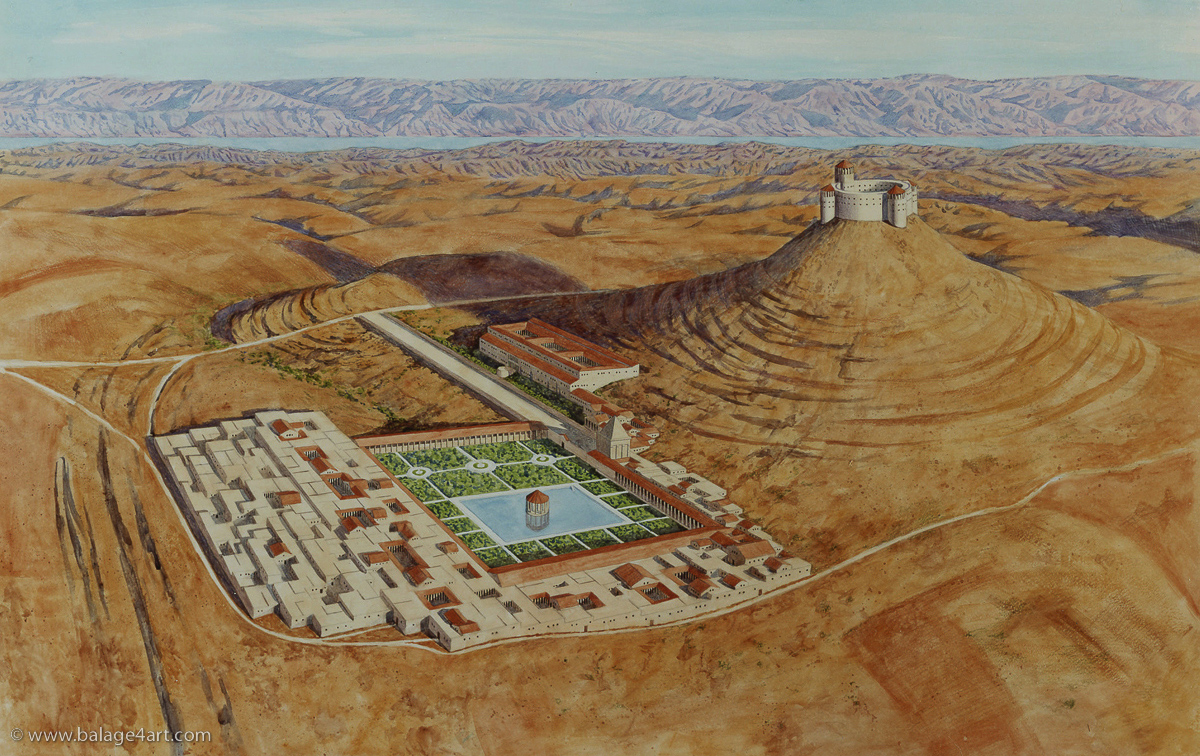
In its day, Herodium was one of the largest palaces in the Greco-Roman world. It is actually the most spacious one of that time that is known to us from archaeological studies.

When I guide Herodium, I include a comprehensive tour of Lower Herodium, outside the archaeological park and the area that Prof. Ehud Netzer excavated in 1972 looking for Herod’s tomb. I point out

  • the overall planning of the site – the relationship between the palace/fortress on a man-made mountain south of the site and the palace complex at its foot
  • the concentration of structures around the pool, more characteristic of present day complexes such as a university campus or large hospital
  • the addition of formal gardens against the background of the barren Judean desert
  • where and how Herod overcame the topography and lack of water to build Herodium
  • Netzer’s discovery of the Monumental building where he thought Herod was buried

In its current state it can be difficult to imagine what Herodium must have looked like. Then I was introduced to the Hungarian-born artist and illustrator, Balage Balogh. Balogh has done paintings where he has recreated (Biblical) settings with a startling degree of accuracy based on a combination of intensive archaeological investigation, scriptural and ancient text research and a measured dose of interpretive insight. He has kindly given me permission to include his illustration of Herodium here. To better picture the ancient world check out his website at
http://www.archaeologyillustrated.com/


(Click on the image to view it in more detail)

Ashdod Cruise Ship Tours

A number of people have contacted me about taking a private tour when their cruise ship docks at the Ashdod port. There are a number of ways of getting from the port to Jerusalem or other destination.

  1. I’m on a cruise ship that will be docking in Ashdod for the day – how can I get from the port and organize my own private tour of Jerusalem?
  2. What is the tour itinerary? Will I see as much as the people who take the cruise ship tour?
  3. Are other tours besides Jerusalem available?
  4. What about shopping?
  5. Is it easy and safe to hail a taxi for the journey from Ashdod port to Jerusalem?
  6. Is the intercity bus relatively easy to catch from Ashdod?
  7. How much (approximately) for each, and is US dollars the preferred currency to use or the NIS (New Israeli Shekel)?
  8. Do you recommend a certain company for a sherut (shared minivan) ?
  9. Is your guide rate fixed, or does it increase based on the number of people attending?

I’m on a cruise ship that will be docking in Ashdod for the day – how can I get from the port and organize my own private tour of Jerusalem?

Rather than joining one of the fixed bus tours (walking tour of Old City and Bethlehem being herded along with 45 other tourists) organized by the cruise company contact me to arrange your own personal tour, see the things you’re interested in, at your own pace and because you are a smaller group it is much easier to explore the city, experience the culture, interact with people, eat at local restaurants, etc.

I can make the arrangements for you to be picked up at the port and driven to Jerusalem; after your tour, the taxi will drive you back to your boat. If you’re more adventurous, you can arrange your own transportation which will work out cheaper (see below).

What is the tour itinerary? Will I see as much as the people who take the cruise ship tour?

The itinerary is similar but you’ll get to do and see a lot more and it’s a completely different experience. After their tour I emailed my clients the itinerary. Here’s what the client said:

Thank you so much for your email with the details of our tour itinerary, it will help no end in labeling my photos. I was expecting Jerusalem to be the highlight of the whole trip and it was. Your personal tour made the day and we will highly recommend you to anyone who needs a guide. We spoke to a person on the ship who had taken the cruise tour and was very dissatisfied due to the large crowds and inability to move about or to see properly, which only emphasized how lucky we were to have you guide us.
Pete and Milli

Are other tour destinations besides Jerusalem available?

Yes. A tour of Masada, Ein Gedi and the Dead Sea is a popular one but you don’t have to hope that the cruise ship will be able to organize an alternate tour. With a private tour you can work out whatever itinerary you are interested in, limited by the time available. Click here for some sample tours.

What about shopping?

It’s completely up to you – if you don’t want to take time out from touring we won’t; if you want time to pick up some gifts or souvenirs, we’ll do that. It’s your tour.

Is it easy and safe to hail a taxi for the journey from Ashdod port to Jerusalem?

There are taxis that will be waiting and happy to take you from the port to Jerusalem and I will meet you. Taxi fare one-way Ashdod-Jerusalem is about 350 NIS (approximately $100 US).

To arrange for a taxi you can call these Ashdod taxi companies at +972 8 852-111 or +972 8 854-0540  (from outside Israel) – take the shuttle bus to the gate to meet the taxi.

Is the intercity bus relatively easy to catch from Ashdod?

You would have to get to the Ashdod central bus station by taxi from the port. Bus 448 at 10:30, 11:30, etc. platform 2. It costs 19.70 NIS one way, slightly cheaper if you get a return ticket. Alternatively, there is also sherut (shared 10 person taxi/minivan) service.

How much (approximately) for each, and is US dollars the preferred currency to use or the NIS (New Israeli Shekel)?

Taxis and sherut will accept US dollars but they won’t necessarily give you the best exchange rate. The best deal is to withdraw cash from your US bank account with your Debit card at an ATM in Israel in NIS. For the current exchange rates click on http://www.bankisrael.gov.il/eng.shearim/index.php

I know the drive to Jerusalem from Ashdod is about an hour away, how long will it take the intercity bus?

The Egged bus company says an hour and 23 minutes (depending on traffic), but remember that is bus station to bus station, you’d still have to get from the port to the bus (by taxi) and from the bus station in Jerusalem to the Old City.

Is your guide rate fixed, or does it increase based on the number of people attending?

My guiding rate does not depend on the number of people (within limits). That is because I break out the costs for a tour and the client pays his/her own entrance fees, transportation, food and accommodation (on a per person basis). In this way the client controls the costs. In fact, if you can organize to share the cost of a tour with a few other people that you have met on the cruise that’s fine with me (just let me know the number of people so that I can help arrange the appropriate vehicle).

Roman Bathing Pool

A 1,800 year old bathing pool that was probably part of a 2nd or 3rd century CE bathhouse used by soldiers of the Tenth Roman Legion was exposed in a salvage excavation by the Israel Antiquities Authority and announced today. The discovery suggests that the scope of Aelia Capitolina, the city built by Hadrian after crushing the Bar Kochba Revolt in 135CE, was much larger than previously estimated. This kind of information about Aelia Capitolina can contribute greatly to research on Jerusalem because it was that city that determined the character and general appearance of ancient Jerusalem and the city that we recognize today. Take a tour of the Roman Gate and plaza, Struthion’s pool, Ecce Homo arch, the Cardo and secondary cardo to understand the Roman city.

Though we know from the writings of Josephus that the Tenth Legion was stationed by Jaffa Gate in what is today the Armenian Quarter from after the destruction of the Second Temple the extensive archaeological excavations failed to discover even one building that had belonged to the Roman legion. One relic that I like to show people is the stone in the wall north of Jaffa Gate, in secondary usage, that has inscribed on it LEGIO X FRETENSIS

During the excavation we uncovered a number of plastered bathtubs in the side of the pool. Incorporated in the side of the pool is a pipe used to fill it with water and on the floor of the pool is a white industrial mosaic pavement. The bathhouse tiles, which are stamped with the symbols of the Tenth Legion “Fretensis” – LEG X FR, were found in situ and it seems that they were used to cover a rock-hewn water channel located at the bottom of the pool. The hundreds of terra cotta roof tiles that were found on the floors of the pool indicate it was a covered structure. The mark of the soldiers of the Tenth Legion, in the form of the stamped impressions on the roof tiles and the in situ mud bricks, bears witness to the fact that they were the builders of the structure.

– Dr. Ofer Sion, excavation director

An additional discovery that caused excitement during the excavation was when one of the roof tiles was found with a paw print of a dog (that probably belonged to one of the soldiers) that obliterated the usual symbol of the legion – it could have happened accidentally or as a joke when the tile was being manufactured.

Photos by Assaf Peretz, courtesy of Israel Antiquities Authority.

墨絵 Jerusalem Sumi-e

My son Amitai and I had the privilege to study 墨絵 sumi painting together with a master, Jan Zaremba, for a couple of years when we were living in Cambridge MA. Amitai was 12 years old when he started sumi, at the time of this post he is 20 and serving in an elite combat unit in the Israeli army. Not being able to study with Jan is one of the few things that I deeply miss since coming back to Israel. The pine tree in this painting is inspired by a traditional sumi painting, the scene of Jerusalem in the background is my creation. I did this painting shortly after returning to Jerusalem, for an artist and friend, Avraham Yakin, on his 80th birthday.

It might seem strange to think about Japanese art and culture while in Israel, you probably are here to explore and experience the history, religions, archeology, etc. of this land. However, if you are going to be in the north, you might want to visit the Tikotin Museum of Japanese Art in Haifa, the only one of its kind in the Middle East. Felix Tikotin, an architect by profession, was an internationally renowned collector and dealer in Japanese works of art. For more than forty years he amassed his valuable and rare collection and organized exhibitions of Japanese art in many museums. During the Second World War, because he was Jewish, Felix Tikotin had to flee for his life from the Nazis; he hid his collection in Holland to prevent it from falling into their hands. After the war, Tikotin decided that his unique collection should be taken to Israel.

Tikotin purchased the “Kisch House” and in accordance with his ideas and plans, a Japanese pavillion to be used as an exhibition hall was added. In 1995 a new wing was added to the existing hall. It was designed by one of the renowned architects of Japan Junzo Yoshimura (1908-1997) of Tokyo, together with the Israeli architect Professor Al Mansfeld (1912-2004) of Haifa. Mansfeld is known as the architect of the Israel Museum in Jerusalem who with architect Ms. Dora Gad in charge of the interior design were awarded the Israel Prize. The Tikotin Museum’s collection comprises some 7,000 items of art and crafts – paintings, prints, drawings, painted screens, textiles, antique illustrated texts, ceramics, miniature carvings (netsuke), lacquer and metal work, antique swords and functional art works, mainly from the 17th to 19th centuries, as well as a collection of modern Japanese art.

Another connection between Japan and Israel is the story of Chiune Sugihara (杉原 千畝) the Japanese Vice Consul to Latvia during World War II. Sugihara single-handedly provided transit visas to more than 6000 Jewish refugees from German-occupied Poland and residents of Latvia who would otherwise have perished in Nazi Europe, risking his career and his family’s life. In 1985, Israel honored him as Righteous Among the Nations for his actions and a tree was planted in his honor at Yad Vashem.

Red Canyon

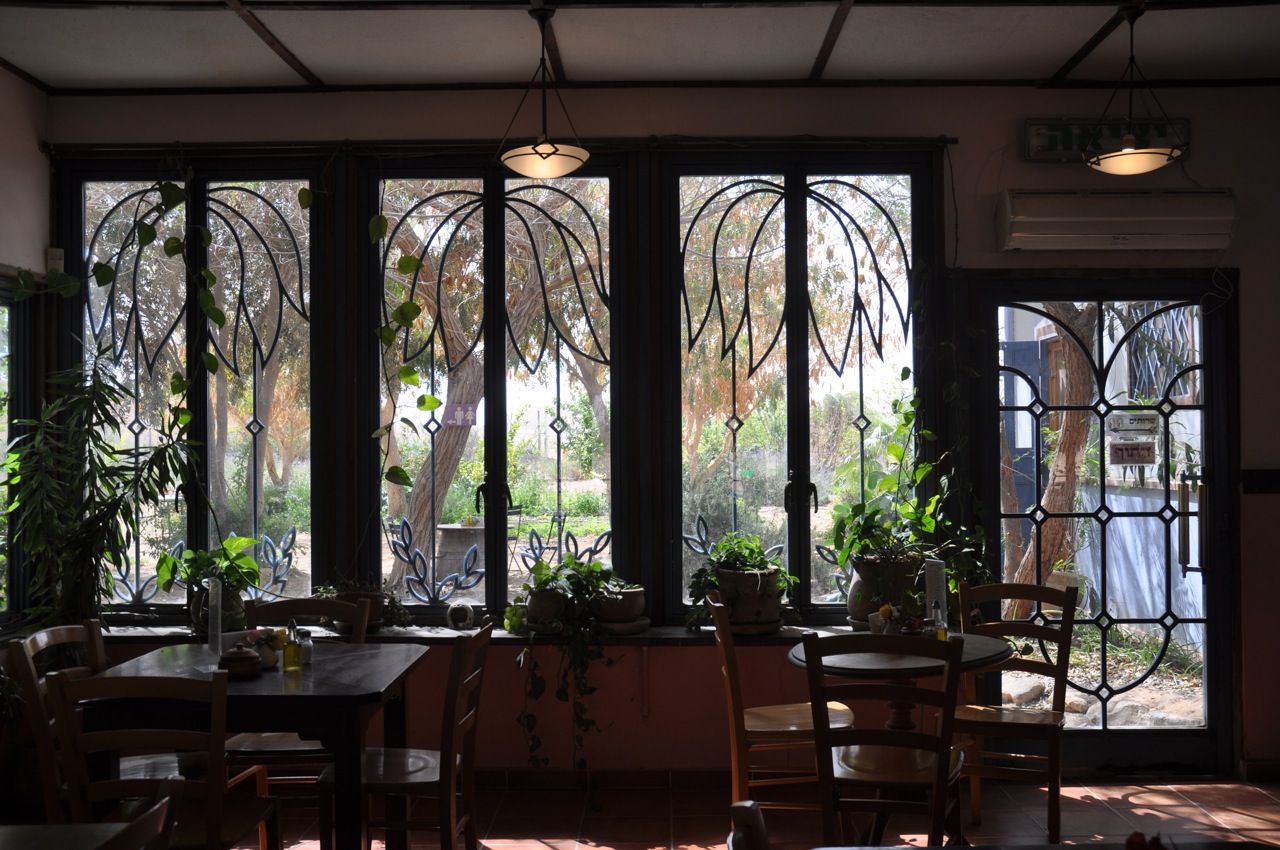
Rather than driving all the way down to Eilat on highway 90 you might want to consider a detour, taking a right onto highway 13 and then a left onto 40 which follows the Israel Trail. After 38 km you’ll come to Shizaphon Junction where you’ll find an organic, vegetarian restaurant run by the folks of Kibbutz Naot Smadar, a lovely place to take a break.

At the Pundak you can also buy products from the kibbutz, artisan goat cheeses, bread, jams, fruit leather, dates and wine – everything you’d need for a picnic. I highly recommend that you try their goats yoghourt ice cream with the homemade apple cake. Mmmm, delicious.

From the junction if you continue on highway 40 you’ll come to the kibbutz itself, like a magical kingdom appearing out of the desert. Many of the kibbutznikim are artists and they’ve built a studio space and gallery that you can visit.

Afterwards retrace your steps and take highway 12. After about 3 km there will be a dirt road to your left that will take you to Shaharut where you can sleepover and go on camel trips. Afterwards retrace your steps and continue on highway 12 south for about 50 km until you see the cutoff for the Red Canyon – Wadi Shani on your left. Follow the dirt road to the parking area.

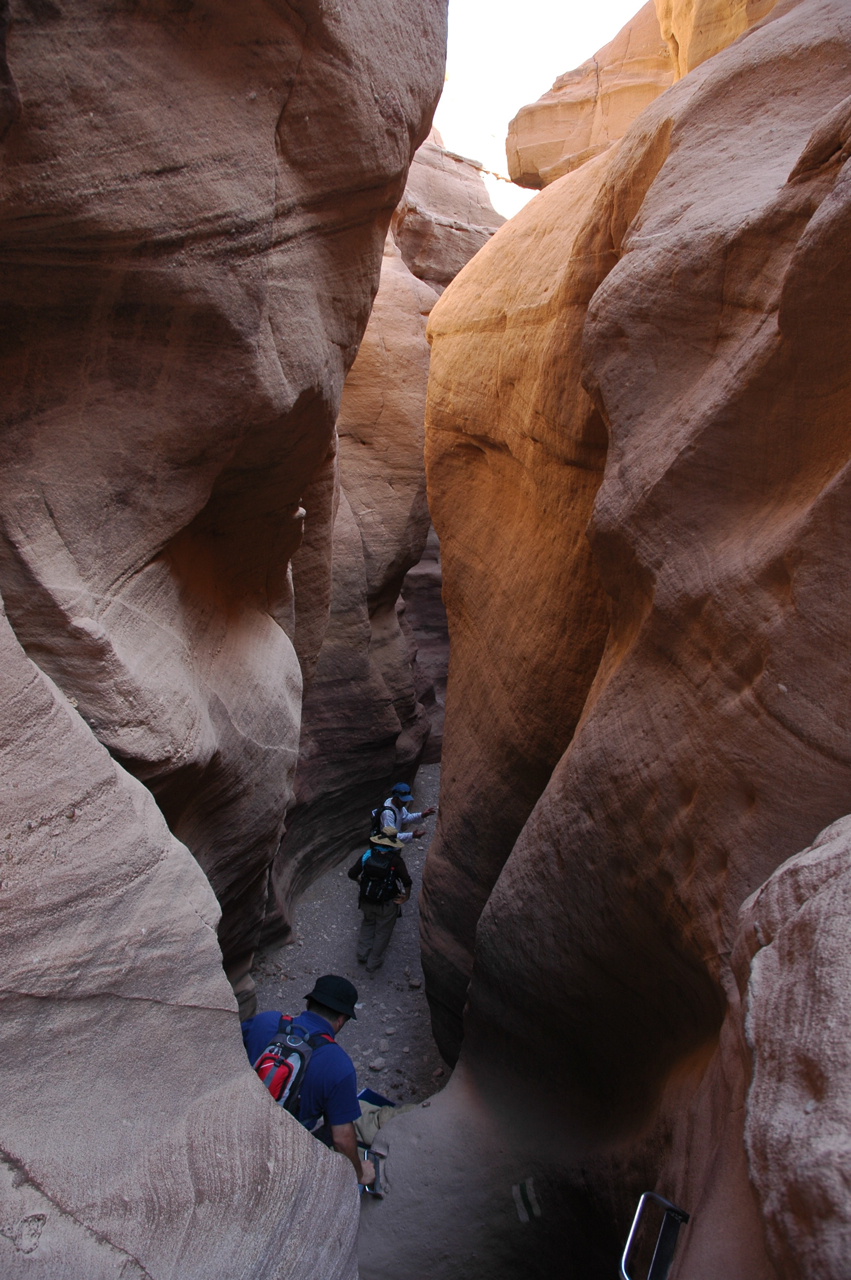
From there you follow the green trail markers and descend into the small canyon, no more than 3 meters in width with a height of up to 30 meters, created over years by water erosion of the sandstone.

Red Canyon

The dominant color of the rock is red with shades of pink and purple. It reminded me of a smaller version of the canyon at Petra. The hike is suitable for families. To return either retrace your steps through the canyon (if there aren’t a lot of people) or climb up out of the canyon where the streambed widens and take the path with a great view of the canyon below. The Red Canyon is one of the places that I recommend to people who are interested in a tour focussed on photography.

If you are continuing to Eilat there are 2 lookout spots that are worth stopping at: Har Hizqiyahu at 838 meters for a view east to the Edom Mountains in Jordan and west to Moon Valley in Egypt and Mount Yoash at 734 meters from which you can see 4 countries on a clear day: Jordan, Egypt, Saudi Arabia and Israel.