Tag Archives: Tomb

Nymphaeum at Herodium?

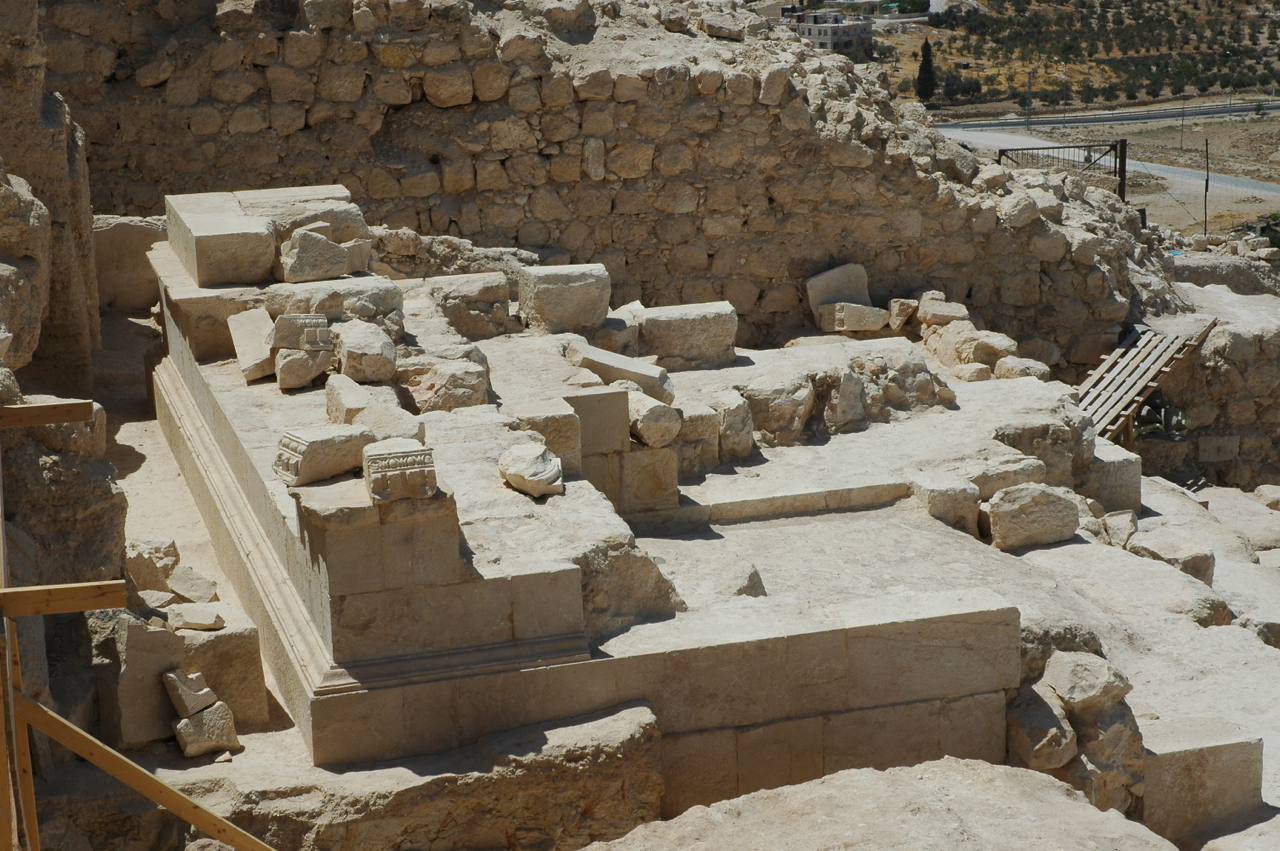
I’m a tour guide who often does tours at Herodium, the palace complex built by King Herod about 15 km south of Jerusalem and where, according to Josephus, Herod was buried. Ehud Netzer, in excavating Lower Herodium, described a building that he called the Monumental building at the end of of an elongated course. He suggested that the building could have been Herod’s burial place. Since then Netzer has discovered the base of a mausoleum with finely carved decorations and 2 sarcophagi on the north-western side of the hill.

On p. 38 of his booklet entitled Herodium (published 1999) Netzer writes

“Present-day visitors are always puzzled by a series of grooves cut into all of the half-columns. These grooves were apparently carved to accommodate a piping system which was probably added later during the period of the Roman pro curators, who may have converted the hall into a nymphaeum.”

Interesting. The nymphaeum that comes to mind in Israel is the one in Bet Shean. So I looked up nymphaeum and came across a very interesting article about Hadrian’s Villa near Tivoli:

http://www.dartmouth.edu/~classics/rome2005/updates/week9_10/nov14.html

There’s a diagram of the Canopus/Serapeum complex, an open air triclinium/nymphaeum and water course. This is very reminiscent of the Monumental building and course that Netzer describes (course at Lower Herodium is ~300m in length and ~25m wide).
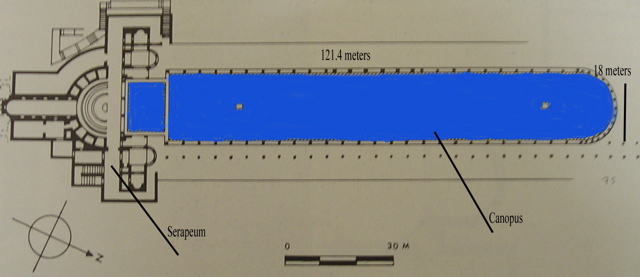
A plan of the Canopus/Serapeum complex (original image from Sear, p. 180.)

There is another nymphaeum in the plan, in the area called the Piazza d’Oro (based on Figure 103 on p. 177 of Sear’s Roman Architecture; the central dark grey area comes from Figure 114 on p. 96 of Macdonald and Pinto’s Hadrian’s Villa and its Legacy).

(A) A large colonaded pool with garden.  (B) The octagonal entrance vestibule.  (C) The eight-sided space on the southeastern side of the courtyard.  (D) The nymphaeum with five niches for fountains of flowing water.

The article includes a photo of the remains of this nymphaeum, made up of 6 niches (which would have held the fountains) separated by pilasters. There is a channel that would have allowed water to run from the nymphaeum to the pool in the courtyard.
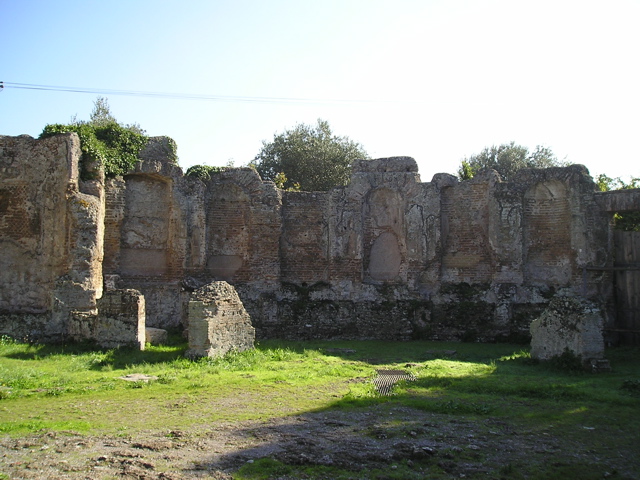
I was struck by how similar this is to the Monumental building, so I have included a photo of it here.

In guiding, I’ve had a number of tourists ask me what the curved cuts in the stone in the lower part of the pilasters (between the niches along the walls, 2 in the end, 3 on each side) were used for. If this was designed as a nymphaeum (either in the time of Herod or by later Roman governors) perhaps the channels were used for water. The course and building are just south of the large pool.
Tour of Herodium and Herod’s Tomb

herodium mountain top palace fortress panorama

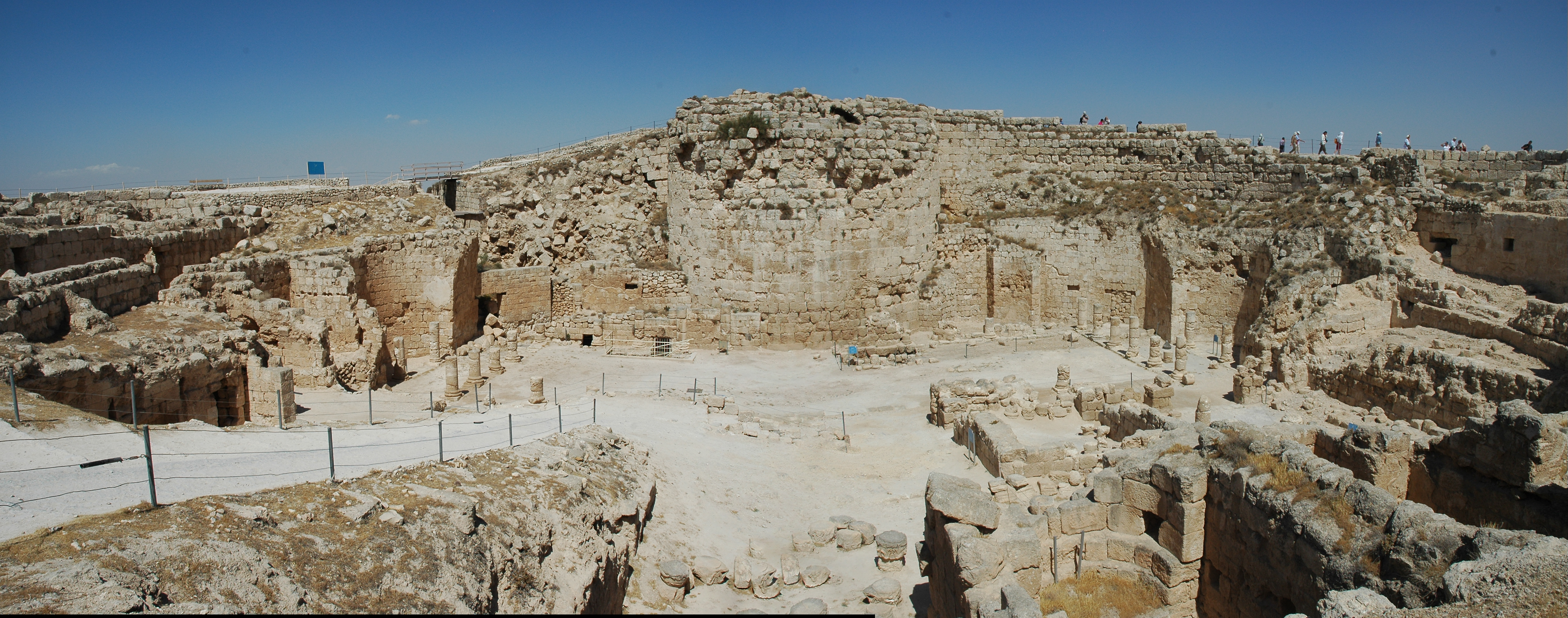
Panoramic view looking down into Herod’s palace-fortress

A guided tour of an archaeological site like Herodium can be a unique birthday present for a friend or family member. It was a hot and sunny day but there was a cool breeze on the mountaintop and you could understand one reason why Herod would have chosen this site.

When I guide Herodium I often start in the Old City to show people the remains of the buildings at the Wohl museum and the stones of the walls and streets from the Herodion period along the western wall below Robinson’s Arch. Also, the Herodion stones forming the base of the tower at the Roman Gate are impressive. Seeing examples of Herod’s architecture help people know what to look for when we get to Herodium.

Last summer, I participated for a few days in the latest excavations that Ehud Netzer is leading on the eastern side of the mountain, excavating the tomb area. We were working on the pool and besides many pottery shards we found some catapult stones (size of snowballs, not to be confused with the larger ones rolled down from the walls by the Jewish rebels) and some coins from the Great Revolt.

Excavations are continuing and they’ve excavated a much larger area now. More of the base of the mausoleum is now exposed. Additional stone architectural details of a very high quality can be seen. These are not of the local soft limestone but a more royal stone, called meleke, that would have been quarried some distance away and brought here. Netzer thinks that the base supported a nefesh or monument, cylindrical in shape, something like Yad Avshalom in the Kidron Valley.

Tomb area at HerodiumThe latest findings are changing our understanding of Herodium. For example, it seems that the earth that was piled up around the mountain palace/fortress is not from the time of Herod but later. Originally, there was a glacis, a sloping wall, that circumvented the mountain.

Glacis at Herodium

Also, the archaeological evidence suggests that the staircase that is described by Josephus “and provided an easy ascent by two hundred steps of the purest white marble” was built later, that originally there was a “snake path” like at Masada. Archaeologists are left with some interesting unanswered questions: When was it done, why and by whom?

I’ve uploaded additional photographs of Herodium to Flickr at http://www.flickr.com/photos/27944012@N06/sets/72157615671440473/

Christian 4-day itinerary

This is a sample multi-day itinerary that I created for a woman who was traveling with her 16 year old son. They have a family tradition that for the child’s 16th birthday s/he can choose a destination that s/he would like to visit. This son choice Israel. I met them at Masada on their way from Eilat to Jerusalem.

“Thank you for helping to make our trip to Israel so memorable!
Without your vast grasp of the beautiful land of Israel and Jerusalem we would have been lost…
Thanks for your great service. Take care and good luck with your guiding.”
Day 1
  • Masada
  • Dead Sea: PEF marker, sink holes
  • Qasr el Yahud baptismal site
  • Saint George’s monastry, Wadi Qelt

Day 2

  • City of David: Hezekiah’s tunnel, Siloam Pool, Herodian street
  • Walking tour of Old City
    • Arab shuq
    • Roman Cardo, Madaba map
    • Mount Zion: Dormition Abbey; King David’s Tomb; Last Supper


Day 3

  • Peace Forest at Ramat Rahel and archaeological excavations
  • Israel Museum: 2nd Temple model; Shrine of Book
  • Mahane Yehuda
  • Back to Old City
    • Bethesda Pools; Church of Santa Anna
    • Tomb of Virgin Mary in Kidron valley
    • Garden of Gethsemane; Church of the Agony
    • Via Dolorosa
    • Church of the Holy Sepulcher

Day 4

  • Emmaus
  • Trappist monastery at Latrun
  • Walking tour of Jaffa
  • To airport