Tag Archives: Jerusalem

What to see in Jerusalem

What to see in Jerusalem and Not Hire a Guide

I’m often asked by people who are planning a trip to Israel what they should do if they have a couple of days to see and experience Jerusalem. Of course, there are many answers, it really depends on what you are interested in. Assuming that this is your first visit, you’ll probably want to start in the Old City so here are my recommendations – note some sites charge an entrance fee.

First, drop by the Tourist Information Center at Jaffa Gate, in the Old City and get a free map and a list of sites to see; say hi to Jennifer, she’ll help by marking sites on the map for you and answering your questions. Then walk around, exploring the 4 Quarters, Armenian, Jewish, Muslim and Christian.

Another possibility is to take the Ramparts Walk starting at Jaffa Gate where you actually walk on the walls built in 1537 by the Ottoman Turkish sultan, Suleiman the Magnificent – looking in gives you a birds-eye view of the Old City, looking out gives you a view of the new city.

In terms of churches, I would visit the Church of the Agony/All Nations and the Garden of Gethsemane outside of the city walls, re-enter the Old City at Lions Gate, visit the Church of Santa Anna, a Crusader church with incredible acoustics (try singing Amazing Grace or other liturgical melody). Continue and you will come to Station I of the Via Dolorosa, follow the Via Dolorosa counting 8 stations to the Church of the Holy Sepulcher, the holiest site to Christianity, where Jesus was crucified and buried and according to Christian tradition rose again, stations IX to XIV are at the Church.

Walk through the Arab shuq and take a right at the Cardo to get to the Jewish Quarter. Visit the Wohl archaeological museum to get a feeling for Jerusalem in the Second Temple Period, in the time of Herod and Jesus. If you are interested in more archaeology, then visit the southern wall excavations at the Davidson Center; there is also a movie that describes life at that time.

Visit the Western Wall, the holiest site to Judaism, write your prayer on a paper and tuck it into a crack in the stones of the wall. Try to reserve a Western Wall Tunnel tour in advance, either on their website (if you know some Hebrew) at http://english.thekotel.org/VisitorInfo.asp?id=1 or you can call them at (02) 627-1333 between 8:30-17:00.

It’s worth taking a guided group tour of the City of David – exit the Old City through Dung gate, take a left and then right and the entrance is on your left. If you have “water” shoes and aren’t claustrophobic, you can even walk 45 minutes through Hezekiah’s Tunnel with water up to your knees (you’ll need a flashlight which you can buy at the site or use your cell phone), which is quite an experience.

You might want to walk up onto the Haram el Sharif to see the Dome of the Rock and al Aqsa mosque (the third holiest site to Islam) close up (the Muslim Waqf won’t allowed you to enter them unfortunately) but if so you’ll have to do it in the morning and it takes between 1/2 and 1 hour to pass through security at the entrance to the Western Wall Plaza. Make sure you have no religious articles, prayer books or Bibles and no Swiss Army knife, etc. with you – they will be confiscated.

The new Israel Museum is open after extensive renovations and it is now much easier to find your way (for more information check out my blog entry) – the Archaeology wing has been completely redone, the Ethnography section has been expanded and called Jewish Life and the Art gallery includes a new section on Israeli art. The museum includes the Shrine of the Book, where the Dead Sea Scrolls and other artifacts from Qumran are on display. From the same period, the Holyland model of Jerusalem is now housed on the museum campus. If the weather is cooperative, walk around and enjoy the sculpture garden. If you’re interested in archaeology, you can also visit the Rockefeller museum (on the same admission, there’s even a shuttle bus) which will get you back to the Old City.

For an overview of Jerusalem, there’s a red double-decker bus that takes you for a 2 hour audio tour (explanations in 8 languages) of the whole city:
http://city-tour.co.il/ntext.asp?psn=8375

The Arab shuq/market and the Mahane Yehuda market are great places to get a feel for Jerusalem. There’s the Ben Yehuda Street pedestrian mall, called the Midrahov, and at the bottom Zion Square and the pubs, restaurants and boutique galleries in Nahalat Shiva. There’s live music at the Yellow Submarine in Talpiot.

Explore the German Colony: for a local movie theater from the British Mandate period with restaurant/pub check out the Smadar; for artistic films, check Cinemateque. For music, dance and theater try the Mabada. There are plenty of places to eat in this neighborhood (including my house 8-))

All this without hiring a guide, but to be fair how about reading my post, Why hire a guide?
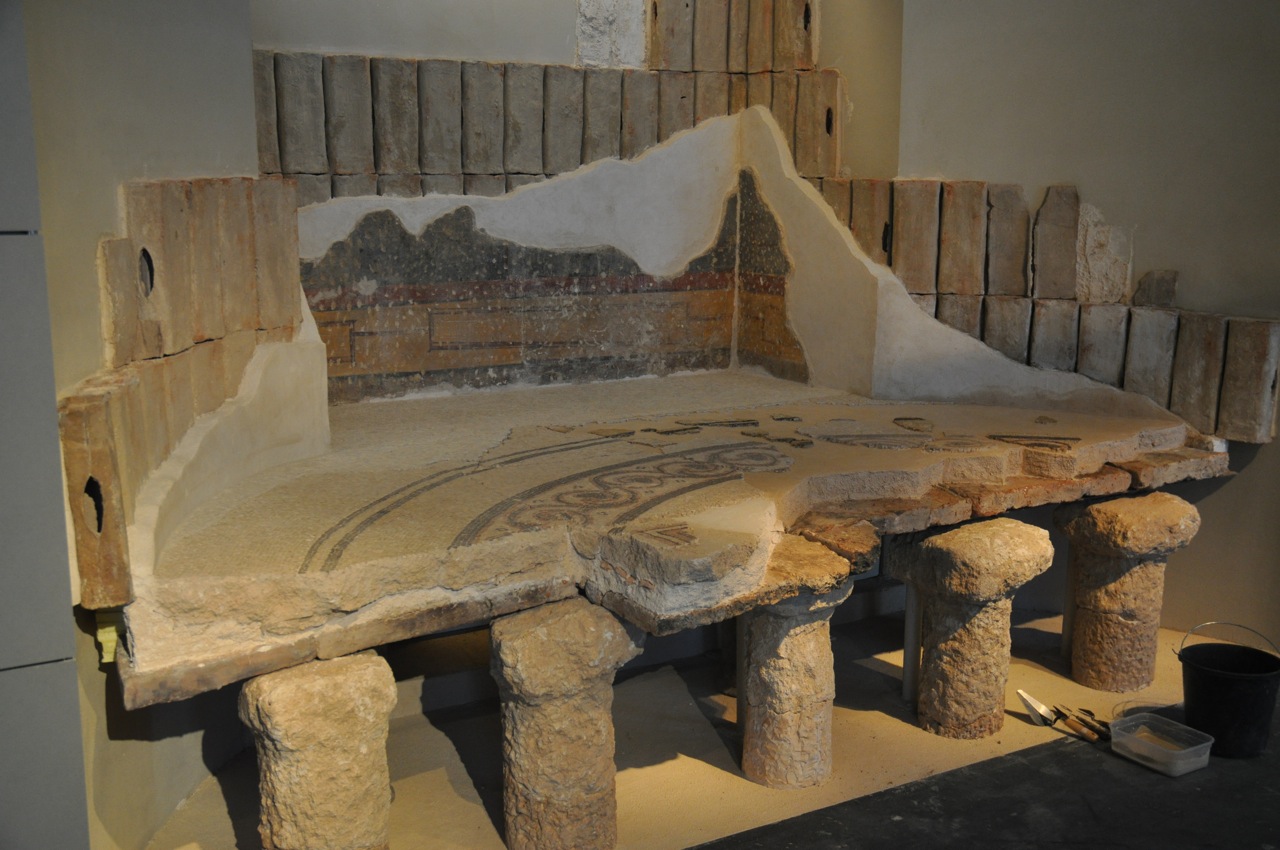
Roman Bath House from Herodium

One of the most exciting new installations that I saw in the Israel Museum’s renovated archaeology galleries was the display of a part of  the laconicum (hot dry room) next to the calderium of the Roman bath house that was found at Lower Herodium. I arrived to see the museum staff putting the final touches to the installation that shows clearly all the components: the hypocaust, the underfloor heating system where the floor is supported by stone pillars (pilae stacks) and the clay tubes in the walls to let the heat pass through; the plasterwork and fresco paintings on the wall; the mosaic floor.

Nearby is another square mosaic floor with a geometric, intertwined circle and pomegranates (one of the 7 species that grows in the land of Israel and characteristic Jewish motif of this period) in each of the corners. You can see this mosaic on site at Lower Herodium in the main tepidarium if you climb onto the roof of the bath house (though I learned that the one in the museum is the original and on site is a copy). If you look to the right, there is another mosaic in the small tepidarium designed as an opus sectile pattern of tiles.

I didn’t see any other artifacts from Herodium being readied for display – I was hoping to see the 3 sarcophagi that were discovered.

Segway Tour

This morning I rode a Segway (Personal Transporter) along the promenade at Armon HaNatziv and I can report that it was really fun (as they say in Hebrew, היה כיף). The Segway is a two-wheeled, self-balancing electric vehicle that was invented by Dean Kamen in 2001. There are 5 gyroscopes that with the aid of computers and motors in the base keep the Segway upright and balanced. Users lean slightly forward to go forward, lean back to stop or go backward and turn using a handlebar that can be tilted left or right.

Currently I often start a tour of the Old City or Herodium with an overview from the promenade so I’m happy to be able to add a Segway tour as part of a day’s guiding. Another example, before visiting the Knesset or Israel museum, you can ride through the Valley of the Cross, past a Crusader fortress-like monastery that was one of the first buildings outside of the Old City walls but in fact, goes all they way back to Queen Helena, the mother of the Emperor Constantine. It’s also possible to arrange a tour along the Jaffa-Tel Aviv promenade along the Mediterranean coast as part of a guided tour of Jaffa and/or Tel Aviv.

A Segway tour adds 180 NIS (which comes to less than $50.) per person (minimum of 2-3 people) for about 2 hours, note that children must be 16 years or older. Helmets and knee and elbow pads are provided.

4–Day Itinerary

I’m happy when people contact me looking for a multi-day itinerary based from Jerusalem. It’s definitely worth a few days if you have the time. I’d like to share one itinerary that I guided for clients a couple of weeks ago. Of course, this itinerary is just to give you the idea – when you hire me as your guide you get a personalized itinerary that matches your interests.

Day 1

  • We started with an overview of Jerusalem from the promenade at Armon HaNatziv, learned about the aquaduct that brought water to the city from Hasmonean times (100 BCE). From there we drove to Herodium for a comprehensive tour: the lower city (pool, Roman bath, monumental building, Byzantine church) outside the park and the palace/fortress on the manmade mountain top built by King Herod including the latest excavation by Netzer of the tomb and Roman theater discovered on the north-east side of the mountain.
  • Visit to Gush Etzion (Etzion Bloc) to learn about the history of the Gush and memorial to the defenders of Kibbutz Kfar Etzion in 1948. Lunch at a lovely restaurant called Gavna in the forest of Kibbutz Massuot Yitzhak with a view all the way to the coastal plain.
  • Visit to Hebron and the Cave of Machpela, that Abraham purchased to bury Sarah in which our forefathers and 3/4 mothers are buried. The building over the cave was built by Herod. Walk around the city to try to understand the current political reality.

Day 2

  • Walking tour of the Old City covering the 4 quarters, the 3 religions and 3000 years of history, including Herodian, Roman, Byzantine, Arab, Crusader periods. Views of the city from above and exploring underground. Tastes of the city for lunch.

Day 3

  • Visit the Israel museum to see the 2nd Temple model of Jerusalem. Tour of the Shrine of the Book, the unique architecture, the exhibits of artifacts from Qumran and the Dead Sea Scrolls.
  • Opportunity to stroll through the Sculpture garden.
  • Visit the City of David, the walled Jebusite city captured by King David in 1004BCE and made the capital of his kingdom. Learn about the extensive archaeology going on there and the politics. Possibility of walking through Hezekiah’s tunnel.

Day 4

  • Drive from Jerusalem to the Dead Sea and Judean desert, the lowest point on earth, only 42 km away but 1170 meters lower. Learn about the African Rift valley, water, shrinking of Dead Sea, sink-holes, flora and fauna.
  • Qumran where the Dead Sea Scrolls were discovered in passing.
  • At Ein Gedi, hike Nahal David to waterfalls and natural pools (it’s delightful to take a dip even in the winter months). Visit the ruins of the Jewish synagogue with mosaic floor.
  • Continue south to Masada, Hasmonean fortress in the desert extensively renovated by Herod, used by the Jewish rebels against the Roman and later by some Byzantine monks. Visit the new museum at Masada.